Quick Verdict: Is the 2018 Camry Hybrid Still Worth It in 2026?
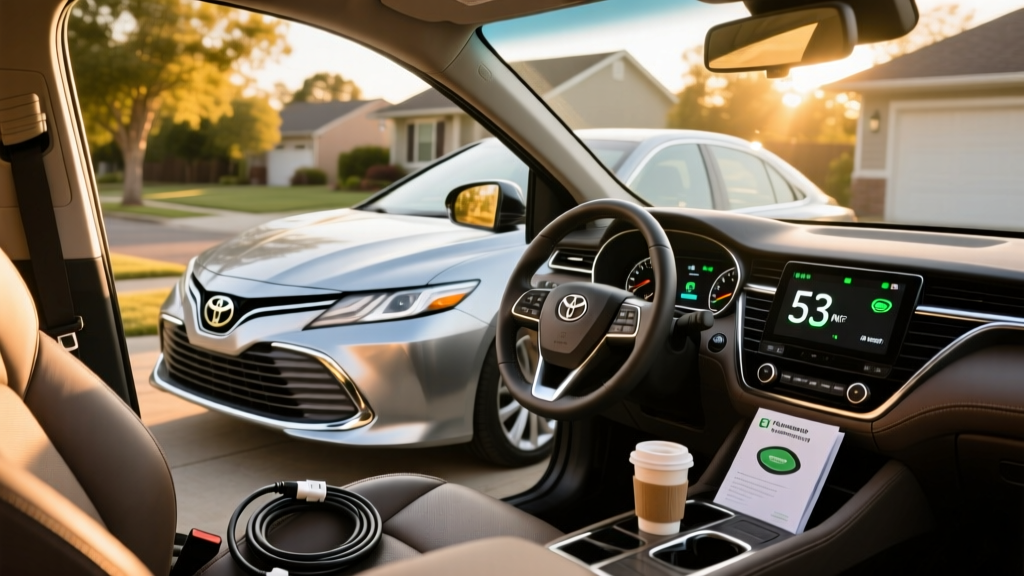
The 2018 Toyota Camry Hybrid remains one of the most efficient midsize sedans you can buy on the used market today. With an EPA-estimated 52 MPG combined on the LE trim and a proven hybrid powertrain, it delivers fuel economy that still rivals or beats many 2026 model-year hybrids. If you're researching 2018 Camry Hybrid gas mileage, this guide gives you exact EPA figures, real-world MPG observations, battery longevity data, and a clear picture of what ownership looks like eight years after this car debuted.
This was the first year of Toyota's eighth-generation Camry, built on the TNGA-K platform with a more powerful and more efficient hybrid system than the previous generation. No plug-in charging required — this is a conventional hybrid electric vehicle (HEV), meaning you simply fill it with gas and drive.
2018 Camry Hybrid MPG: EPA Ratings by Trim
The 2018 Camry Hybrid came in three trims — LE, SE, and XLE — and the gas mileage varies depending on which one you choose. The LE trim, equipped with low-rolling-resistance tires and lighter wheels, achieves the highest EPA ratings.
| Trim | City MPG | Highway MPG | Combined MPG | Fuel Tank (gal) | Est. Total Range (mi) |
|---|---|---|---|---|---|
| LE | 51 | 53 | 52 | 13.2 | ~686 |
| SE | 44 | 47 | 46 | 13.2 | ~607 |
| XLE | 44 | 47 | 46 | 13.2 | ~607 |
Source: EPA Fuel Economy Guide
Powertrain: How the Hybrid System Works
The 2018 Camry Hybrid pairs a 2.5-liter four-cylinder Atkinson-cycle gasoline engine with an electric motor and a compact nickel-metal hydride (NiMH) battery pack. This is Toyota's fourth-generation Hybrid Synergy Drive system, and it was significantly redesigned for this generation.
| Specification | Detail |
|---|---|
| Gas Engine | 2.5L 4-cyl Atkinson-cycle (A25A-FXS) |
| Engine Power | 176 hp / 163 lb-ft torque |
| Electric Motor Power | 118 hp / 149 lb-ft torque |
| Net Combined System Power | 208 hp |
| Transmission | eCVT (planetary gearset, no traditional belts) |
| Hybrid Battery | NiMH, ~1.0 kWh (not plug-in) |
| 0–60 mph | ~7.3 seconds |
| Drivetrain | Front-wheel drive |
Unlike a plug-in hybrid (PHEV), the 2018 Camry Hybrid cannot be plugged in. The small battery pack charges exclusively through regenerative braking and the gasoline engine. You never need to think about charging infrastructure — just refuel at any gas station.
A conventional hybrid (HEV) like the 2018 Camry Hybrid uses a small battery to assist the gas engine and recapture braking energy. You never plug it in. A plug-in hybrid (PHEV) like the Toyota RAV4 Prime or Prius Prime has a larger battery (typically 13–18 kWh) that provides 25–42 miles of electric-only driving before the gas engine kicks in, and it must be plugged in to realize its efficiency advantage. The 2018 Camry was never offered as a PHEV — it is HEV only.
Real-World Fuel Economy: What Owners Actually Report
EPA numbers are a standardized laboratory benchmark, but your daily commute, climate, and driving style will determine what you actually see at the pump. Here's what aggregated owner data and independent testing reveal about 2018 Camry Hybrid gas mileage in practice:
- City/suburban (stop-and-go): 48–55 MPG on LE; 42–49 MPG on SE/XLE. Hybrids excel here because regenerative braking feeds energy back to the battery at every stop.
- Highway (65–75 mph, flat terrain): 44–50 MPG on LE; 40–45 MPG on SE/XLE. The gasoline engine does more work at sustained speed, narrowing the hybrid advantage.
- Cold weather (below 30°F): Expect a 10–18% drop. The engine runs more often to provide cabin heat and maintain battery temperature. Real-world winter combined MPG may fall to 38–44 on the LE.
- Hot climate with A/C: Mild impact — roughly 1–3 MPG reduction vs. spring/fall driving.
According to aggregated driver-reported data on fueleconomy.gov, the 2018 Camry Hybrid LE averages approximately 49.7 MPG combined across hundreds of owner submissions — slightly below the 52 MPG EPA sticker but still exceptional for a midsize sedan.
Battery Longevity, Warranty, and Replacement Cost
Battery lifespan is consistently the top concern for used hybrid buyers. The 2018 Camry Hybrid's NiMH battery pack is proven technology — Toyota has been refining this chemistry since the original 1997 Prius, and these packs are known for durability.
Toyota covers the hybrid battery and related components for 10 years or 150,000 miles (whichever comes first) in states that adopted California's CARB emissions standards (including CA, NY, MA, NJ, CT, RI, VT, ME, MD, OR, WA, and CO). In all other states, the warranty is 8 years or 100,000 miles. Since this is a 2018 model, the federal-emissions-state warranty has expired for most original owners by 2026, but CARB-state coverage may still apply through 2028 for vehicles under 150,000 miles. Always verify coverage with a Toyota dealer using the VIN.
| Option | Estimated Cost (Parts + Labor) | Notes |
|---|---|---|
| New OEM Toyota battery | $3,500 – $4,500 | Full new pack from dealer; best longevity |
| Remanufactured/reconditioned pack | $1,800 – $2,800 | Rebuilt with tested cells; 1–3 year warranty typical |
| Individual cell/module replacement | $500 – $1,200 | Only failed modules replaced; requires skilled hybrid tech |
In practice, many 2018 Camry Hybrids will reach 200,000+ miles on the original battery pack. Toyota's NiMH packs degrade gradually rather than failing catastrophically — you may notice a slight MPG drop (2–4 MPG) over 150,000+ miles as the battery's ability to hold charge diminishes, but the car remains fully drivable. Complete battery failure before 150,000 miles is uncommon based on fleet and owner data.
2018 Camry Hybrid vs. Alternatives: HEV, PHEV, or Full EV?
If you're cross-shopping the 2018 Camry Hybrid, you're likely also considering a plug-in hybrid or a battery-electric vehicle (BEV). Here's how to think about the decision:
| Factor | HEV (2018 Camry Hybrid) | PHEV (e.g., Prius Prime) | BEV (e.g., Tesla Model 3) |
|---|---|---|---|
| Plug-in required? | No | Yes (for EV range) | Yes |
| Electric-only range | None (EV mode ~1 mi at low speed) | 25–44 mi depending on model | 250–360 mi (EPA) |
| Total range | ~600–686 mi | ~550–640 mi (EV + gas) | 250–360 mi (charging required) |
| Fuel/energy cost per mile | ~$0.06–0.08/mi (gas at $3.20/gal) | ~$0.03–0.04/mi (electric) + gas when depleted | ~$0.03–0.05/mi (home charging) |
| Home charging install needed? | No | Recommended (Level 2) | Required (Level 2 strongly recommended) |
| Federal tax credit (§30D, new purchase) | Not eligible | Up to $7,500 (income/MSRP/sourcing rules apply) | Up to $7,500 (income/MSRP/sourcing rules apply) |
| Best for | No plug access; long drives; simplicity | Short commutes + road trips; has plug access | Home charging; lower running cost; zero tailpipe emissions |
Consider a PHEV instead if: You have home or workplace Level 2 charging, your daily commute is under 40 miles round-trip, and you want to drive mostly on electricity while keeping gas for road trips.
Consider a BEV instead if: You can install a Level 2 home charger, you want the lowest per-mile fuel cost, you're eligible for the federal tax credit on a new EV purchase, and you're comfortable planning around DC fast charging on long trips.
Tax Credits and Incentives for the 2018 Camry Hybrid
The 2018 Camry Hybrid is a conventional hybrid (HEV), which means it does not qualify for the federal §30D new clean vehicle tax credit. That credit, which can be worth up to $7,500, applies only to plug-in hybrids (PHEVs) and battery-electric vehicles (BEVs) that meet battery sourcing, MSRP, and buyer income requirements as defined by the IRS.
On the used market, there is no federal tax credit available for purchasing a used conventional hybrid. The federal used clean vehicle credit (up to $4,000) also applies only to used PHEVs and BEVs.
Some states historically offered rebates for conventional hybrids, but most state incentive programs have shifted focus to plug-in vehicles. Check your state's energy or environmental agency website for any remaining hybrid-specific programs, but do not count on state incentives for this purchase.
Pricing and Value in 2026
As of early 2026, the 2018 Camry Hybrid trades on the used market in these approximate ranges depending on mileage, condition, and trim:
| Trim | Mileage Range | Approximate Used Price (2026) |
|---|---|---|
| LE | 60,000 – 90,000 mi | $18,500 – $22,000 |
| SE | 60,000 – 90,000 mi | $19,500 – $23,500 |
| XLE | 60,000 – 90,000 mi | $21,000 – $26,000 |
For comparison, a new 2026 Camry Hybrid LE starts at approximately $30,000 MSRP. The used 2018 model represents strong value — you get 90%+ of the fuel economy benefit at roughly 60–65% of the new-car price, with a proven powertrain that has ample life remaining.
Pros and Cons of the 2018 Camry Hybrid
- Up to 52 MPG combined (LE) — best in class for 2018
- 686-mile total range on one tank
- No plug-in charging required
- Proven NiMH battery durability
- 208 hp — adequate passing power
- Strong resale value
- Comfortable ride, improved handling vs. prior gen
- SE/XLE trims drop to 46 MPG combined
- No PHEV option — cannot drive on electric only
- No federal tax credit eligibility
- Infotainment feels dated (no wireless CarPlay in 2018)
- Rear seat doesn't fold flat (battery placement)
- CVT drone under hard acceleration
- AWD not available (added in 2020 model year)
Frequently Asked Questions
How many MPG does the 2018 Camry Hybrid actually get?
The EPA rates the 2018 Camry Hybrid LE at 51 city / 53 highway / 52 combined MPG. The SE and XLE trims are rated at 44 city / 47 highway / 46 combined. In real-world driving, most LE owners report 48–53 MPG combined, with city driving often exceeding the EPA rating thanks to regenerative braking. Highway-heavy driving at 75+ mph and cold weather will reduce those figures by 5–15%.
Does the 2018 Camry Hybrid need to be plugged in?
No. The 2018 Camry Hybrid is a conventional hybrid (HEV). It charges its small battery pack through regenerative braking and the gasoline engine. You never plug it in — you simply refuel at a gas station like any other car.
Is the 2018 Camry Hybrid reliable, and what does battery replacement cost?
Yes. Toyota's hybrid system is among the most reliable powertrains in the industry, with decades of fleet and consumer data supporting this. The NiMH battery typically lasts 150,000–200,000+ miles with gradual degradation rather than sudden failure. If replacement is needed, expect to pay $3,500–$4,500 for a new OEM pack, $1,800–$2,800 for a remanufactured pack, or $500–$1,200 for individual module replacement at a qualified hybrid shop.
Does the 2018 Camry Hybrid qualify for any tax credit?
No. As a conventional hybrid (HEV), the 2018 Camry Hybrid does not qualify for the federal §30D clean vehicle tax credit, which is reserved for plug-in hybrids and battery-electric vehicles. The used clean vehicle credit (up to $4,000) also does not apply. Some states may have offered hybrid rebates at the time of original purchase, but these are generally no longer available.
How does the 2018 Camry Hybrid compare to the 2018 Prius?
The 2018 Prius achieves slightly higher EPA combined MPG (54–58 depending on trim) but offers less power (121 hp combined vs. 208 hp), a smaller interior, and a hatchback body style. The Camry Hybrid trades a few MPG for significantly more cabin space, trunk room, passing power, and ride comfort. If maximum fuel economy is your only priority, the Prius wins. If you need a midsize sedan with excellent efficiency, the Camry Hybrid is the stronger all-around choice.
Should I buy a 2018 Camry Hybrid or a newer model?
The 2020+ Camry Hybrid added available AWD and slightly updated infotainment, but the core powertrain and EPA ratings remain very similar. If AWD is essential for your climate, look at a 2020 or newer model. Otherwise, the 2018 model offers nearly identical fuel economy and reliability at a meaningfully lower used-car price — making it one of the best value propositions in the hybrid sedan segment.