Quick Verdict: The 2017 RAV4 Hybrid XLE in 2026
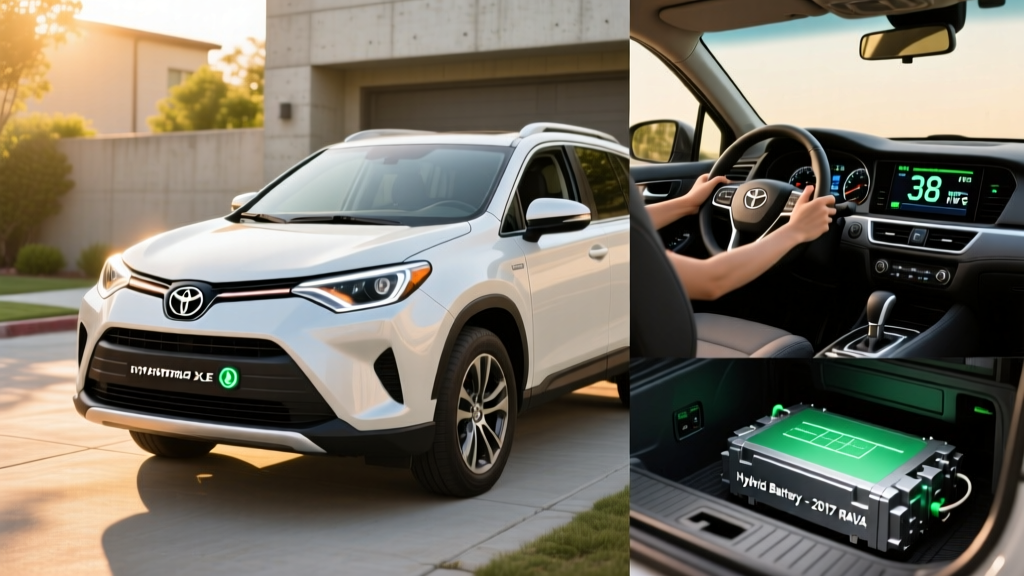
The 2017 Toyota RAV4 Hybrid XLE remains one of the most dependable and fuel-efficient compact SUVs on the used market. With an EPA-rated 32 MPG combined, standard all-wheel drive via Toyota's E-Four system, and a proven hybrid powertrain that rarely needs major intervention, this model continues to punch well above its age. For buyers in 2026 seeking a no-plug-required hybrid that delivers real savings at the pump without the complexity of a plug-in hybrid or full EV, the 2017 RAV4 Hybrid XLE is a compelling choice — typically priced between $16,000 and $21,000 depending on mileage and condition.
| Spec | Value |
|---|---|
| Powertrain | 2.5L 4-cyl Atkinson-cycle + 2 electric motors (AWD) |
| Combined Horsepower | 194 hp (net system) |
| EPA Fuel Economy | 34 city / 30 highway / 32 combined MPG |
| Hybrid Battery | 1.6 kWh nickel-metal hydride (NiMH), sealed |
| Drivetrain | Electronic on-demand AWD (E-Four) |
| 0–60 mph | ~7.8 seconds |
| Cargo Volume | 38.4 cu ft (rear seats up) / 73.4 cu ft (folded) |
| Towing Capacity | 1,750 lbs |
| Original MSRP (2017) | $29,950 (XLE trim, excl. destination) |
| Typical Used Price (2026) | $16,000–$21,000 |
| Hybrid Battery Warranty (orig.) | 8 years / 100,000 miles (10 yr/150k in CARB states) |
HEV vs. PHEV: Where the 2017 RAV4 Hybrid Fits
Before diving into fuel economy, it's critical to understand what the 2017 RAV4 Hybrid is — and isn't. This vehicle is a conventional hybrid electric vehicle (HEV). It does not have a charging port, cannot be plugged in, and has no meaningful electric-only driving range. The small 1.6 kWh NiMH battery recharges exclusively through regenerative braking and the gasoline engine.
| Feature | HEV (e.g., 2017 RAV4 Hybrid) | PHEV (e.g., RAV4 Prime) | BEV (e.g., Tesla Model Y) |
|---|---|---|---|
| Plug-in Charging | No — never plugs in | Yes — Level 1/2 AC | Yes — Level 1/2 + DC fast |
| Electric-Only Range | ~0.5 mi at low speed | 42 mi (RAV4 Prime) | 260–330 mi |
| Battery Capacity | 1.6 kWh (NiMH) | 18.1 kWh (Li-ion) | 60–82 kWh (Li-ion) |
| Fuel Needed | Yes — always | Yes — after EV range depletes | No — electric only |
| Federal Tax Credit (new) | None | Up to $7,500 (§30D, if eligible) | Up to $7,500 (§30D, if eligible) |
| Home Charger Needed | No | Recommended (Level 2) | Essential (Level 2) |
Toyota did not introduce a plug-in RAV4 until the 2021 RAV4 Prime, which offers 42 miles of electric-only range and a much larger 18.1 kWh lithium-ion battery. If you're shopping for a 2017 model year, the only electrified RAV4 available is the conventional HEV described here. There was no PHEV variant in 2017.
Fuel Economy: EPA Ratings and Real-World MPG
The EPA rates the 2017 Toyota RAV4 Hybrid at 34 MPG city, 30 MPG highway, and 32 MPG combined, according to fueleconomy.gov. These figures apply to all trims including the XLE, as the powertrain is identical across the Hybrid lineup.
| Driving Cycle | EPA Rating | Real-World Expectation |
|---|---|---|
| City | 34 MPG | 33–37 MPG (hybrids excel in stop-and-go) |
| Highway | 30 MPG | 28–31 MPG (aerodynamic drag limits regen benefit) |
| Combined | 32 MPG | 30–34 MPG |
Why Real-World City MPG Often Beats the EPA Sticker
Conventional hybrids like the 2017 RAV4 Hybrid tend to exceed EPA city estimates in real-world driving. The Atkinson-cycle 2.5L engine shuts off frequently at stops, and regenerative braking recovers energy that a gas-only vehicle wastes as heat. Owners regularly report 35–37 MPG in urban and suburban driving, particularly in mild weather.
Highway driving tells a different story. At sustained speeds above 65 mph, the electric motors contribute less and the gasoline engine does most of the work. Expect 28–30 MPG on long highway trips, especially with roof cargo boxes or in high headwinds. Cold weather (below 32°F) can reduce combined MPG by 5–10% due to increased engine idling for cabin heat and reduced battery efficiency.
Cost Savings vs. a Gas-Only RAV4
The 2017 gas-only RAV4 with AWD is EPA-rated at 25 MPG combined. At $3.50/gallon and 12,000 miles/year, that's roughly $1,680/year in fuel. The Hybrid at 32 MPG combined costs about $1,313/year — a savings of approximately $367 annually. Over five years, that's $1,835 in fuel savings, which typically covers the used-market price premium the Hybrid commands over the gas model.
Powertrain and Performance
The 2017 RAV4 Hybrid pairs a 2.5-liter 4-cylinder Atkinson-cycle engine (150 hp, 152 lb-ft torque) with a front electric motor (105 kW / 141 hp) and a rear electric motor (50 kW / 67 hp) that provides on-demand all-wheel drive. Net system output is 194 horsepower.
The E-Four AWD system is entirely electronic — there is no mechanical driveshaft connecting the front and rear axles. The rear motor activates only when slip is detected or during hard acceleration, which reduces drivetrain losses and improves efficiency compared to a traditional mechanical AWD system. This setup works well in rain and light snow but is not designed for serious off-road use.
The 0–60 mph time of approximately 7.8 seconds was respectable for a compact SUV in 2017 and still feels adequate in 2026 traffic. Throttle response off the line is brisk thanks to the electric motor's instant torque. The CVT (continuously variable transmission) keeps the engine in its most efficient range, though it can drone under hard acceleration — a common trait of Toyota's hybrid CVTs.
Hybrid Battery: Longevity, Warranty, and Replacement Cost
2017 RAV4 Hybrid Battery Warranty (Original)
Federal emissions states: 8 years / 100,000 miles
CARB states (CA, NY, MA, NJ, CT, RI, VT, ME, MD, OR, WA, CO, and others): 10 years / 150,000 miles
Warranty covers battery capacity below ~60% of original or complete failure. By 2026, most 2017 models are at or beyond the 8-year federal warranty window unless mileage remains under 100,000.
How Long Does the Battery Actually Last?
Toyota's NiMH hybrid batteries have an exceptional track record. The 1.6 kWh pack in the 2017 RAV4 Hybrid uses a conservative charge window — the system never fully charges or fully depletes the battery, which dramatically reduces degradation. Data from fleet operators and long-term owners (including Toyota's warranty records) shows these packs routinely lasting 150,000–200,000+ miles before significant capacity loss.
That said, age is a factor independent of mileage. NiMH cells slowly lose capacity over time, and a 2017 model in 2026 is nine years old. Most packs still function adequately, but you may notice slightly reduced EV-mode engagement and marginally lower MPG compared to when new.
Battery Replacement Cost
If the hybrid battery does fail, replacement options in 2026 include:
- New OEM Toyota battery: $3,000–$4,500 (installed at a dealership)
- Refurbished/remanufactured pack: $1,500–$2,500 (from specialists like Green Bean Battery or Dorman)
- Individual cell/module replacement: $500–$1,200 (independent hybrid shops can replace only the failed modules)
The good news: complete pack failure is rare. More commonly, one or two modules degrade, and a specialist can identify and replace them individually for a fraction of the full-pack cost.
XLE Trim Features and Interior
The XLE was the mid-level Hybrid trim in 2017, sitting above the LE and below the Limited. Key XLE features include:
- Toyota Safety Sense P (TSS-P): pre-collision system, lane departure alert, automatic high beams, dynamic radar cruise control
- 7-inch touchscreen with Entune Audio Plus
- Blind Spot Monitor with Rear Cross-Traffic Alert
- SofTex synthetic leather seats
- Smart Key with push-button start
- Dual-zone automatic climate control
- 17-inch alloy wheels
The cabin is functional rather than luxurious. Hard plastics are prevalent on the lower door panels and dash, but build quality is solid — a hallmark of this RAV4 generation. Cargo space is 38.4 cubic feet behind the rear seats and 73.4 cubic feet with them folded, competitive with the gas-only RAV4 (the hybrid battery sits under the rear seat, not in the cargo floor, so no space is lost).
One 2026 consideration: the infotainment system lacks Apple CarPlay and Android Auto, which Toyota didn't add to the RAV4 until the 2019 refresh. If smartphone integration is essential, budget for an aftermarket head unit ($400–$700 installed).
Tax Credits and Incentives
The 2017 Toyota RAV4 Hybrid does not qualify for the federal §30D new clean vehicle tax credit — it never did, even when new. Conventional hybrids (HEVs) that cannot be plugged in are ineligible under IRS rules. The §30D credit applies only to plug-in electric vehicles (PHEVs and BEVs) with sufficient battery capacity.
If you're buying this vehicle used in 2026, the Used Clean Vehicle Credit (§25E) is also unavailable for the same reason — it's not a plug-in vehicle. This credit covers up to $4,000 (or 30% of the sale price, whichever is lower) for qualifying used PHEVs and BEVs priced under $25,000.
Some states offer registration discounts or HOV lane access for hybrids regardless of plug-in capability, but these programs vary widely. Check your state's DMV or energy office for current incentives. The IRS clean vehicle credits page has the definitive federal rules.
Who Should Choose the 2017 RAV4 Hybrid XLE?
Reasons to Buy
- Proven reliability — Toyota's hybrid system is one of the most durable in the industry
- 32 MPG combined saves ~$370/year vs. gas RAV4 AWD
- Standard AWD with no fuel-economy penalty vs. FWD
- No charging infrastructure needed — just fill up with gas
- TSS-P safety suite standard (forward collision warning, lane assist, adaptive cruise)
- Strong resale value and low cost of ownership
Reasons to Look Elsewhere
- No electric-only driving — if you want EV miles, you need a PHEV or BEV
- No Apple CarPlay / Android Auto (pre-2019 infotainment)
- CVT drone under hard acceleration
- Towing limited to 1,750 lbs
- Original hybrid battery warranty likely expired or expiring soon
- Dated interior design and materials by 2026 standards
Choose the 2017 RAV4 Hybrid XLE If:
- You want maximum MPG without ever plugging in
- You live in an apartment or lack home charging access
- Your budget is $16,000–$21,000 for a reliable AWD SUV
- You drive mostly city/suburban miles where the hybrid system shines
Consider a PHEV or Full EV Instead If:
- You have home Level 2 charging and want electric-only commuting (look at the 2021+ RAV4 Prime or a used Chevy Bolt EUV)
- You want federal tax credits — only plug-in vehicles qualify
- You need modern infotainment with CarPlay/Android Auto
- You drive more than 15,000 miles/year and want to eliminate most fuel costs
Frequently Asked Questions
How many MPG does the 2017 Toyota RAV4 Hybrid XLE get?
The EPA rates it at 34 city / 30 highway / 32 combined MPG. In real-world driving, owners typically see 30–34 MPG combined, with city driving sometimes reaching 35–37 MPG thanks to regenerative braking.
Does the 2017 RAV4 Hybrid need to be plugged in?
No. This is a conventional hybrid (HEV), not a plug-in hybrid (PHEV). The battery charges through regenerative braking and the gasoline engine. There is no charging port on the vehicle.
How far can the 2017 RAV4 Hybrid drive on electric only?
Effectively zero miles in any practical sense. The hybrid system can propel the vehicle at very low speeds (under 25 mph) for roughly half a mile on battery alone in ideal conditions, but the engine engages almost immediately under normal driving. For meaningful electric-only range, you'd need the 2021+ RAV4 Prime PHEV (42 miles).
Is the 2017 RAV4 Hybrid reliable?
Yes. Toyota's hybrid powertrain is among the most reliable in the automotive industry. The 2017 RAV4 Hybrid consistently earns high reliability scores from Consumer Reports and J.D. Power. The NiMH battery pack commonly lasts 150,000–200,000 miles. The conventional 2.5L engine and eCVT transmission have minimal wear components compared to a traditional gas powertrain with a multi-speed automatic.
What does a replacement hybrid battery cost?
A new OEM Toyota battery costs $3,000–$4,500 installed at a dealer. Refurbished packs run $1,500–$2,500, and individual module replacement at a hybrid specialist can cost as little as $500–$1,200.
Does the 2017 RAV4 Hybrid qualify for any tax credit?
No. The federal §30D credit applies only to plug-in vehicles (PHEVs and BEVs). As a conventional hybrid, the RAV4 Hybrid does not qualify for federal EV tax credits, either when purchased new or used. Check your state for any hybrid-specific incentives, which vary by jurisdiction.
How does the 2017 RAV4 Hybrid compare to a full EV?
A full EV (like a used Tesla Model Y or Chevy Bolt) offers zero tailpipe emissions, lower per-mile fueling costs, and access to federal tax credits on used purchases. However, EVs require home charging access, have higher upfront costs, and may present range challenges on long road trips. The 2017 RAV4 Hybrid is the pragmatic choice for buyers who want better fuel economy without changing their refueling habits or investing in charging infrastructure.
What should I check when buying a used 2017 RAV4 Hybrid?
Prioritize: (1) hybrid battery health — ask for a Toyota Health Check report showing battery state of health, (2) maintenance records — especially engine oil changes and inverter coolant service, (3) brake condition — regenerative braking reduces pad wear, so rotors can corrode if the vehicle sat unused, and (4) recall status — verify all open recalls (including fuel pump and airbag campaigns) have been addressed at a Toyota dealer.