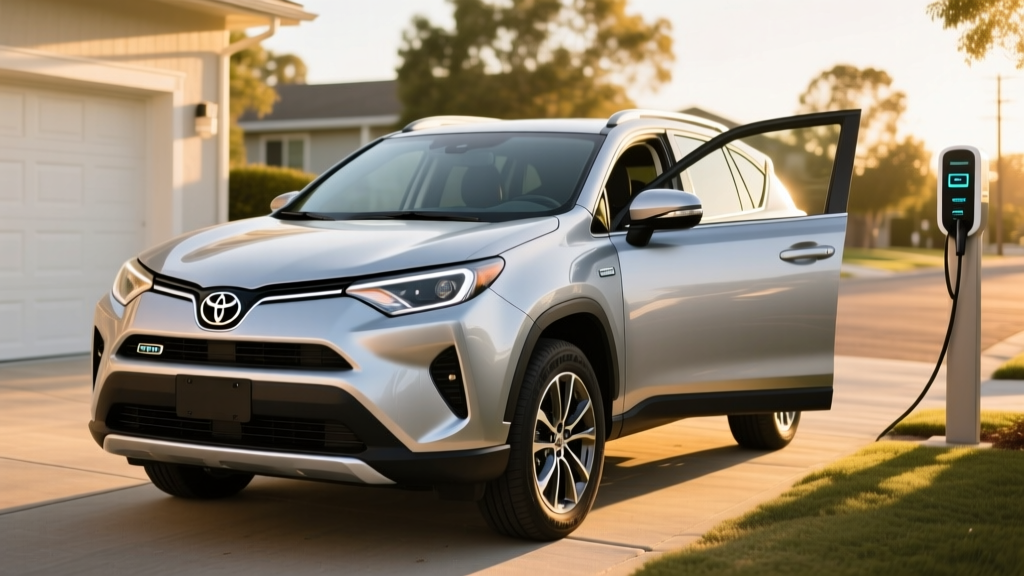
The 2017 Toyota RAV4 Hybrid SUV occupies a specific niche in the used electrified-vehicle market: it's a conventional hybrid (HEV), not a plug-in, and it doesn't pretend to be an EV. What it does offer is a proven 194-horsepower powertrain, standard all-wheel drive, and EPA-rated fuel economy that still holds up nearly a decade after its release. For buyers in 2026 weighing a used hybrid crossover against newer EVs or gas-only alternatives, the RAV4 Hybrid demands an honest look at its numbers, limitations, and long-term ownership costs.
2017 Toyota RAV4 Hybrid Key Specifications
| Spec | Value |
|---|---|
| Powertrain | 2.5L 4-cyl Atkinson-cycle + 2 electric motors (AWD-i) |
| Combined Horsepower | 194 HP (net system) |
| EPA Fuel Economy | 34 city / 30 hwy / 32 combined MPG |
| Hybrid Battery | 1.6 kWh NiMH (sealed, not plug-in) |
| Drivetrain | Electronic on-demand AWD (AWD-i) |
| 0-60 mph | ~7.8 seconds |
| Cargo Volume | 35.6 cu ft (behind rear seats) |
| Towing Capacity | 1,750 lbs |
| Original MSRP (XLE) | ~$29,270 |
| Used Price Range (2026) | ~$14,000 – $20,500 |
Fuel Economy: EPA Ratings vs. Real-World MPG
The EPA rates the 2017 RAV4 Hybrid at 34 MPG city, 30 MPG highway, and 32 MPG combined per fueleconomy.gov. The city-highway split is the hallmark of a conventional hybrid: regenerative braking and low-speed electric assist shine in stop-and-go traffic, while highway cruising relies more heavily on the gasoline engine.
In real-world ownership, many drivers report exceeding the EPA city figure. Short commutes with frequent stops allow the hybrid system to keep the engine off for extended stretches, pushing observed city MPG into the 35–38 range. Highway driving at 75+ mph, however, typically drops to 27–29 MPG as aerodynamic drag overwhelms the modest electric assist. Cold-weather operation (below 35°F) can shave 2–4 MPG off combined figures because the engine runs more frequently to maintain cabin heat and battery temperature.
MPG Breakdown: EPA vs. Observed
| Condition | City | Highway | Combined |
|---|---|---|---|
| EPA Rating | 34 | 30 | 32 |
| Real-World (mild weather, mixed) | 35–38 | 27–29 | 31–33 |
| Cold Weather (<35°F) | 30–33 | 26–28 | 28–30 |
HEV vs. PHEV: Understanding What the 2017 RAV4 Hybrid Is (and Isn't)
This is where buyer confusion frequently surfaces. The 2017 RAV4 Hybrid is a conventional hybrid (HEV). It has no plug, no electric-only driving range to speak of, and no ability to charge from an external source. The 1.6 kWh nickel-metal hydride (NiMH) battery charges exclusively through regenerative braking and engine-driven generation. It can propel the vehicle at very low speeds (parking lots, creeping traffic) for brief distances — typically under one mile — but this is assistive, not a primary drive mode.
HEV vs. PHEV vs. BEV at a Glance
| Feature | 2017 RAV4 Hybrid (HEV) | RAV4 Prime (PHEV, 2021+) | bZ4X (BEV) |
|---|---|---|---|
| Plug-in Charging | No | Yes (Level 1/2) | Yes (Level 1/2/DC) |
| Electric-Only Range | Negligible | 42 miles (EPA) | 222–252 miles (EPA) |
| Battery Size | 1.6 kWh NiMH | 18.1 kWh Li-ion | 71.4 kWh Li-ion |
| Combined MPG / MPGe | 32 MPG | 38 MPG / 94 MPGe | 104–114 MPGe |
| Needs Home Charger | No | Recommended | Essential |
| Federal Tax Credit (new) | None | $7,500 (when eligible) | $7,500 (when eligible) |
Toyota did not offer a RAV4 plug-in hybrid until the 2021 RAV4 Prime. If plug-in electric driving is a priority, the 2017 model year won't deliver it. The HEV's advantage is simplicity: no charging infrastructure needed, no range anxiety, and a lower purchase price — especially on the used market in 2026.
Powertrain and Driving Performance
The 2017 RAV4 Hybrid pairs a 2.5-liter Atkinson-cycle four-cylinder engine (150 HP, 152 lb-ft torque) with a front electric motor (105 kW / 141 HP) and a rear electric motor (50 kW / 67 HP) that provides electronic on-demand all-wheel drive. The net system output is 194 HP, routed through Toyota's e-CVT (electronically controlled continuously variable transmission).
The e-CVT is not a belt-driven CVT like those in some competitors; it's a planetary gearset that blends engine and motor power seamlessly. Acceleration to 60 mph takes approximately 7.8 seconds — adequate for merging and passing, though not brisk by modern turbocharged crossover standards. The AWD-i system activates the rear motor only when slip is detected or during hard acceleration, so there's no mechanical driveshaft to the rear wheels. This keeps weight down but means the system isn't designed for serious off-road use or heavy towing (1,750-lb max).
Driving refinement is mixed. The engine can drone under hard acceleration due to the e-CVT holding high RPM, a common hybrid trait. At cruising speeds, the cabin is reasonably quiet, and the transition between electric and gas power is nearly imperceptible in normal driving.
Hybrid Battery Longevity, Warranty, and Replacement Cost
Battery Warranty and Expected Lifespan
Original warranty: 8 years / 100,000 miles (10 years / 150,000 miles in CARB states including CA, NY, MA, and others).
Expected lifespan: 150,000–200,000+ miles based on fleet data and owner reports for Toyota's NiMH hybrid packs.
2026 reality: A 2017 model is now 9 years old. Most vehicles are at or past the federal 8-year warranty window, though CARB-state vehicles with under 150,000 miles may still have coverage through 2027.
The 1.6 kWh NiMH battery in the 2017 RAV4 Hybrid is one of the most proven hybrid packs Toyota has produced. Unlike lithium-ion batteries in EVs and PHEVs, NiMH chemistry degrades more gradually and tolerates a wider temperature range without active thermal management. That said, capacity loss does occur: expect roughly 10–15% degradation over 150,000 miles, which manifests as slightly reduced low-speed electric assist and marginally lower MPG — not a sudden failure.
Replacement cost in 2026: A new OEM hybrid battery pack from Toyota runs approximately $2,500–$3,500 including labor at a dealership. Independent hybrid specialists and refurbished/reconditioned packs are available for $1,200–$2,000 installed. Individual cell module replacement (only the degraded cells) can cost as little as $400–$800 at a specialist shop. This is significantly cheaper than EV traction battery replacement, which can exceed $10,000.
Used Pricing, Tax Credits, and Ownership Economics
As of early 2026, a used 2017 Toyota RAV4 Hybrid typically lists between $14,000 and $20,500, depending on mileage, condition, trim (XLE or Limited), and region. Well-maintained examples under 80,000 miles command the upper end of that range.
Tax credit reality: The 2017 RAV4 Hybrid does not qualify for the federal §30D clean vehicle tax credit, which applies only to plug-in electric vehicles (BEVs and PHEVs) meeting battery sourcing and MSRP requirements per IRS guidelines. Conventional hybrids like this one have not been eligible for federal purchase incentives since the early-2010s Alternative Motor Vehicle Credit expired for Toyota. Some states offered hybrid rebates historically, but most have shifted incentives exclusively to plug-in vehicles.
Where the economics work is at the fuel pump. At 32 MPG combined and $3.40/gallon gas (2026 national average), annual fuel cost for 12,000 miles is approximately $1,275. A comparable gas-only 2017 RAV4 AWD (25 MPG combined) costs roughly $1,632 annually — a savings of about $357 per year, or $1,785 over five years, in the hybrid's favor. That gap widens in city-heavy driving and as fuel prices rise.
Pros
- Proven hybrid system with 200K+ mile track record
- Standard AWD without fuel-economy penalty vs. FWD gas models
- No charging infrastructure required
- Strong cargo space (35.6 cu ft) and practicality
- Low battery replacement cost vs. EV/PHEV packs
- Toyota Safety Sense P included (pre-collision, lane departure, auto high beams, dynamic radar cruise)
Cons
- No electric-only driving; not a plug-in vehicle
- Highway MPG drops below EPA rating at 75+ mph
- Modest towing capacity (1,750 lbs)
- e-CVT drone under hard acceleration
- Infotainment feels dated (no Apple CarPlay/Android Auto on 2017)
- Most examples now outside factory hybrid battery warranty
Reliability and What to Check Before Buying Used
Toyota's hybrid Synergy Drive system has accumulated billions of real-world miles across the Prius, Camry Hybrid, and RAV4 Hybrid lineages. The 2017 RAV4 Hybrid benefits from this maturity. Major failure points are rare, but used buyers should verify:
- Hybrid battery health: A dealership or hybrid specialist can run a State of Health (SoH) diagnostic. Look for packs reporting above 85% capacity.
- Brake actuator recalls: Some 2016–2017 RAV4 Hybrids were included in recalls related to the brake booster assembly. Verify recall completion via NHTSA's VIN lookup.
- Inverter coolant: The hybrid inverter has its own coolant loop. Check maintenance records for coolant replacement intervals.
- Rear motor function: The AWD-i rear motor is sealed and generally trouble-free, but confirm AWD engagement on a low-traction surface during a test drive.
- 12V auxiliary battery: Like all hybrids, the RAV4 has a conventional 12V battery that can fail independently of the hybrid pack. A weak 12V battery can cause bizarre electronic gremlins even when the hybrid system is healthy.
Who Should Choose the 2017 RAV4 Hybrid vs. an EV or Gas Car?
Decision Framework
Choose the 2017 RAV4 Hybrid if: You want a used AWD crossover under $20K, drive 10,000–15,000 miles/year with significant city/stop-and-go segments, have no access to home or workplace charging, and want minimal maintenance risk. It's the pragmatic choice for apartment dwellers and those in areas with sparse public charging.
Choose a used PHEV (e.g., RAV4 Prime, 2021+) if: You can install a Level 2 home charger, your daily commute is under 40 miles round-trip, and you want electric-only daily driving with gas-engine backup for road trips. Expect to pay $30K+ for a used Prime in 2026.
Choose a used BEV (e.g., Tesla Model Y, Hyundai Ioniq 5) if: You have reliable home charging, your budget allows $22K+, you want zero tailpipe emissions, and you drive under 250 miles between charges or are comfortable with DC fast charging on road trips.
Choose a gas-only RAV4 if: Your budget is under $14K, you drive mostly highway miles (where the hybrid's advantage shrinks), or you need maximum towing capacity (gas RAV4 can tow up to 3,500 lbs in some configurations).
Frequently Asked Questions
How many MPG does the 2017 Toyota RAV4 Hybrid get?
The EPA rates it at 34 city / 30 highway / 32 combined MPG. Real-world driving typically yields 31–33 MPG combined in mild weather, with city MPG often exceeding the EPA figure and highway MPG falling short, especially above 75 mph or in cold conditions.
Can the 2017 RAV4 Hybrid be plugged in to charge?
No. This is a conventional hybrid (HEV), not a plug-in hybrid (PHEV). The battery charges solely through regenerative braking and the gasoline engine. There is no charging port and no electric-only driving range beyond brief low-speed assist.
How long does the hybrid battery last and what does replacement cost?
Toyota's NiMH hybrid packs commonly last 150,000–200,000+ miles. OEM replacement costs $2,500–$3,500 at a dealer; refurbished packs or cell-level repairs run $1,200–$2,000 at independent hybrid specialists. The original warranty was 8 years/100,000 miles (10 years/150,000 miles in CARB states), meaning most 2017 examples are at or near the warranty boundary in 2026.
Does the 2017 RAV4 Hybrid qualify for any tax credit?
No federal tax credit applies. The §30D Clean Vehicle Credit covers only plug-in vehicles (BEVs and PHEVs) meeting battery-sourcing and MSRP requirements. Conventional hybrids are not eligible. Check your state's environmental agency for any local incentives, though most states have shifted rebate programs to plug-in vehicles.
Is the 2017 RAV4 Hybrid reliable?
Yes. Toyota's hybrid Synergy Drive is among the most thoroughly validated electrified powertrains in production. The NiMH battery, e-CVT planetary gearset, and AWD-i rear motor have demonstrated long service life with minimal unplanned failures. Regular maintenance (engine oil, inverter coolant, brake fluid) keeps the system healthy. Verify recall completion and hybrid battery SoH before purchasing a used example.
How does the 2017 RAV4 Hybrid compare to the current RAV4 Hybrid?
The 2025 RAV4 Hybrid (5th generation) rates at 41 MPG combined — a 28% improvement — and offers Apple CarPlay/Android Auto, a more refined interior, and the option of the RAV4 Prime PHEV with 42 miles of electric range. However, a new 2025 RAV4 Hybrid starts above $33,000. The 2017 model delivers its core value proposition — AWD, hybrid efficiency, and Toyota reliability — at less than two-thirds the price of a new equivalent.