Why the 2017 Toyota Prius Still Matters in 2026
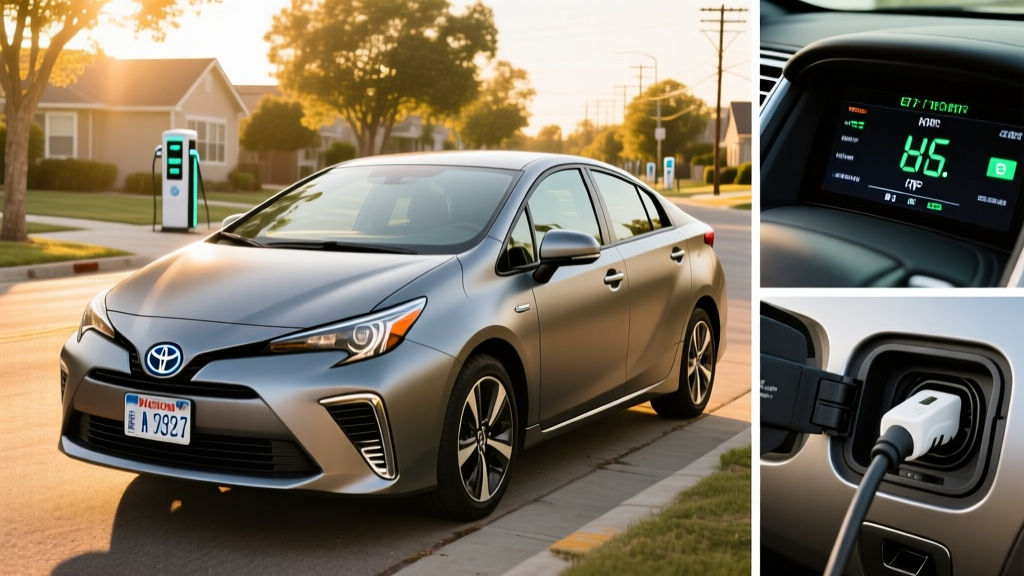
Nine years after it debuted, the fourth-generation 2017 Toyota Prius remains one of the most fuel-efficient non-plug-in vehicles you can buy on the used market. With EPA ratings up to 58 MPG city and a reputation for outlasting 200,000 miles with basic maintenance, the 2017 Prius hybrid draws buyers who want maximum efficiency without plugging in, worrying about charging infrastructure, or paying new-car EV premiums.
This guide covers the 2017 Prius as a conventional hybrid electric vehicle (HEV) — meaning it generates all its electricity internally through regenerative braking and its gasoline engine. It does not plug in. If you're looking for a plug-in variant, the 2017 Prius Prime is the PHEV version covered separately below.
- 2017 Toyota Prius (HEV): Conventional hybrid. No plug. 1.8L engine + electric motor. Up to 58 MPG city / 53 MPG highway / 56 MPG combined (Eco trim).
- 2017 Toyota Prius Prime (PHEV): Plug-in hybrid. 8.8 kWh battery, ~25 miles electric-only range, then operates as a hybrid at 54 MPG combined.
This article focuses on the standard Prius HEV. Prius Prime PHEV details are included in the comparison section below.
2017 Toyota Prius Fuel Economy: EPA Ratings vs Real-World MPG
Fuel economy is the Prius's defining feature, and the fourth-generation model (introduced for 2016, carried into 2017) achieved class-leading numbers. The EPA publishes two distinct ratings for the 2017 Prius depending on trim, because the Eco trim uses lighter wheels and low-rolling-resistance tires.
| Trim | City MPG | Highway MPG | Combined MPG |
|---|---|---|---|
| One, Two, Three, Four, Four Touring | 54 | 50 | 52 |
| One Eco, Two Eco, Three Eco, Four Touring Eco | 58 | 53 | 56 |
Source: fueleconomy.gov
Real-World MPG: What Owners Actually See
Conventional hybrids like the Prius often exceed their EPA city ratings in stop-and-go driving because regenerative braking recaptures energy that gas-only cars waste as heat. In city-heavy commutes, many 2017 Prius owners report 55–62 MPG on the Eco trim. Highway driving at 75+ MPH tends to drop efficiency to 44–48 MPG, as aerodynamic drag dominates and the electric motor assists less.
Cold weather reduces MPG by roughly 5–10% due to longer engine warm-up cycles and increased cabin heating demand. Expect 47–52 MPG combined in freezing conditions versus 52–58 MPG in mild weather.
Powertrain and Performance Specs
The 2017 Prius uses Toyota's Hybrid Synergy Drive system, pairing a 1.8-liter Atkinson-cycle four-cylinder engine with two motor-generators and a nickel-metal hydride (NiMH) traction battery (on most trims; some Eco trims use a lighter lithium-ion pack).
| Specification | Value |
|---|---|
| Engine | 1.8L Atkinson-cycle 4-cylinder |
| Engine horsepower | 95 HP @ 5,200 RPM |
| Electric motor output | 71 HP (53 kW) |
| Net combined system horsepower | 121 HP |
| Traction battery | 0.75 kWh NiMH (standard) / 0.56 kWh Li-ion (Eco trims) |
| Transmission | eCVT (planetary gearset, no traditional belt/pulleys) |
| 0–60 MPH | ~9.8 seconds |
| Drivetrain | Front-wheel drive |
| Curb weight | 3,042–3,130 lbs |
The 9.8-second 0–60 time is leisurely. The Prius prioritizes efficiency over acceleration, and merging onto fast-moving highways requires planning. That said, around-town responsiveness is adequate thanks to instant electric motor torque at low speeds.
Battery Lifespan, Warranty, and Replacement Cost
Hybrid battery longevity is the single biggest concern for used Prius buyers. Here's what the data shows nearly a decade into the 2017 model's life cycle.
- Hybrid battery: 8 years / 100,000 miles (10 years / 150,000 miles in California and states adopting CARB emissions standards)
- Hybrid system components: 8 years / 100,000 miles
- Powertrain: 5 years / 60,000 miles
As of 2026, most 2017 Prius vehicles have exceeded the standard 8-year/100k federal hybrid battery warranty. However, vehicles originally sold in CARB states (CA, CT, ME, MD, MA, NJ, NY, OR, RI, VT, WA) may still carry the 10-year/150,000-mile coverage through model year 2027.
How Long Do 2017 Prius Batteries Actually Last?
The NiMH and Li-ion traction batteries in the 2017 Prius are proven technology. Toyota's hybrid system never fully charges or fully depletes the battery — it operates in a narrow state-of-charge window (roughly 40–80%) to minimize degradation. Real-world data from fleet operators and owner surveys indicates:
- Typical lifespan: 150,000–200,000 miles before significant capacity loss
- Failure rate before 150k miles: Under 5% based on aggregated repair data
- Capacity loss at 100k miles: Typically 5–10%, largely imperceptible to the driver
Because the battery is small (0.75 kWh), even moderate degradation has minimal impact on MPG — the engine simply runs slightly more often. You won't see a dramatic range cliff like you might with a degraded EV battery.
Hybrid Battery Replacement Cost in 2026
If the battery does fail outside warranty, replacement options include:
- New OEM Toyota battery: $2,000–$2,500 installed at a dealership
- Remanufactured battery: $1,000–$1,600 installed at an independent hybrid specialist
- Individual module replacement: $200–$500 if only one or two cells have failed (a common repair for NiMH packs)
Compared to EV battery replacements ($8,000–$20,000+), the Prius's small hybrid battery is relatively affordable to replace — and far less likely to need it.
2017 Prius HEV vs Prius Prime PHEV vs Full EV: Which Is Right for You?
The 2017 model year offered two Prius flavors. Here's how the conventional hybrid stacks up against the plug-in Prime and a comparable used battery-electric vehicle.
| Attribute | Prius HEV | Prius Prime PHEV | Bolt EV (BEV) |
|---|---|---|---|
| Plug-in required? | No | Yes (optional) | Yes (required) |
| Electric-only range | N/A | 25 miles | 238 miles |
| Combined MPG / MPGe | 52–56 MPG | 54 MPG / 133 MPGe | 119 MPGe |
| Total range | ~600 miles | ~640 miles | 238 miles |
| Battery size | 0.75 kWh | 8.8 kWh | 60 kWh |
| DC fast charging | N/A | No | Yes (55 kW CCS) |
| Level 2 charge time | N/A | ~5.5 hours | ~9 hours |
| Federal tax credit (original) | None | $4,502 (expired) | $7,500 (expired) |
| Approx. used price (2026) | $14,000–$20,000 | $16,000–$22,000 | $12,000–$17,000 |
Does the 2017 Prius Qualify for Any Tax Credit in 2026?
The 2017 Prius HEV never qualified for a federal tax credit — conventional hybrids are ineligible under IRS §30D, which applies only to plug-in electric vehicles (PHEVs and BEVs). The 2017 Prius Prime PHEV originally qualified for a $4,502 federal credit, but that credit was claimed by the original purchaser and does not transfer to used buyers.
Under current 2026 IRS rules, the used clean vehicle credit (§25E) offers up to $4,000 (30% of sale price, capped) for qualifying used plug-in vehicles purchased from a dealer for $25,000 or less. The used Prius Prime may qualify; the standard Prius HEV does not. Verify eligibility with a tax professional and check the IRS's current qualified vehicle list before purchasing.
Pricing and What to Expect Buying a Used 2017 Prius
Original MSRP for the 2017 Prius ranged from $24,685 (One base) to $30,735 (Four Touring with Advanced Technology Package). In the 2026 used market:
- 80,000–120,000 miles: $14,000–$17,000
- 50,000–80,000 miles: $17,000–$20,000
- Under 50,000 miles: $19,000–$22,000
The Prius holds value well due to strong demand from rideshare drivers, commuters, and reliability-focused buyers. Low-mileage examples command a premium.
Pre-Purchase Inspection Checklist
When evaluating a used 2017 Prius, pay specific attention to:
- Hybrid battery health: Ask for a hybrid battery diagnostic report from a Toyota dealer or use an OBD-II scanner with the Dr. Prius or Hybrid Assistant app to check battery block voltage delta. A delta under 0.20V at rest indicates a healthy pack.
- Inverter coolant pump: Listen for the inverter coolant pump running when the car is in READY mode. No fluid movement visible in the reservoir can indicate pump failure.
- EGR system: The 2017 Prius is susceptible to EGR cooler and valve clogging, which can cause head gasket failure if neglected. Ask for EGR cleaning records.
- Brake actuator: Some fourth-gen Prius models had brake actuator recalls. Verify recall status at nhtsa.gov/recalls using the VIN.
Who Should Buy the 2017 Prius Hybrid — And Who Shouldn't
- You drive 15,000+ miles/year and want the lowest cost per mile without plugging in
- You lack access to home or workplace charging
- You want proven reliability with massive aftermarket support
- Your commute is city-heavy (where hybrids beat their EPA ratings)
- You need 600+ miles of range for long road trips without stopping
- You want electric-only driving for short commutes (consider the Prius Prime PHEV or a used BEV)
- You need strong acceleration for mountain passes or frequent highway merging (121 HP is modest)
- You want the latest driver-assistance tech (the 2017's Toyota Safety Sense P is basic by 2026 standards)
- You want to eliminate gasoline entirely
- You qualify for the used-EV tax credit and want to maximize savings with a used PHEV/BEV
2017 Toyota Prius Hybrid FAQ
How many MPG does the 2017 Toyota Prius get?
The EPA rates the 2017 Prius at 54 city / 50 highway / 52 combined MPG on standard trims, and 58 city / 53 highway / 56 combined on Eco trims. In real-world city driving, many owners see 55–62 MPG on Eco trims. Highway driving at 75+ MPH typically yields 44–48 MPG.
Does the 2017 Prius need to be plugged in?
No. The standard 2017 Prius is a conventional hybrid (HEV) that charges its small battery entirely through regenerative braking and the gasoline engine. You never plug it in — you only refuel with gasoline. The 2017 Prius Prime is the plug-in variant that can charge from a wall outlet.
How far can the 2017 Prius Prime go on electric only?
The 2017 Prius Prime PHEV has an EPA-rated 25 miles of electric-only range in EV Mode. After the battery depletes, it operates as a conventional hybrid at 54 MPG combined. Total range (electric + gasoline) is approximately 640 miles.
Is the 2017 Prius reliable, and what does a battery replacement cost?
The 2017 Prius has excellent long-term reliability. The hybrid battery typically lasts 150,000–200,000 miles with under a 5% failure rate before 150k miles. If replacement is needed, expect $2,000–$2,500 for a new OEM battery at a dealer, or $1,000–$1,600 for a remanufactured unit at an independent shop. Individual cell module repairs can cost as little as $200–$500.
Does the 2017 Prius qualify for any tax credit?
The standard 2017 Prius HEV does not qualify for any federal tax credit — conventional hybrids are ineligible under IRS §30D. The 2017 Prius Prime PHEV originally qualified for a $4,502 credit, but this was claimed by the original buyer and does not transfer. Under the 2026 used clean vehicle credit (§25E), a used Prius Prime purchased from a dealer for $25,000 or less may qualify for up to $4,000 if the buyer meets income requirements. Consult a tax professional for your specific situation.
What's the difference between the 2017 Prius Eco trim and the standard trim?
The Eco trim uses lighter aluminum wheels, low-rolling-resistance tires, and a lighter lithium-ion hybrid battery (0.56 kWh vs 0.75 kWh NiMH) to achieve 58/53/56 MPG vs 54/50/52 MPG. The Eco trim also deletes the spare tire in favor of a tire repair kit to save weight.
How does the 2017 Prius compare to a modern 2026 hybrid?
The 2017 Prius's 52–56 MPG combined remains competitive with the latest 2026 Prius (rated at 57 MPG combined on LE trim). The newer model offers more power (196 HP vs 121 HP), a modern infotainment system, and updated Toyota Safety Sense 3.0. However, a well-maintained 2017 Prius delivers nearly the same fuel economy for roughly half the price of a new 2026 Prius.