Quick Verdict: A Proven Three-Row Hybrid for the Used Market
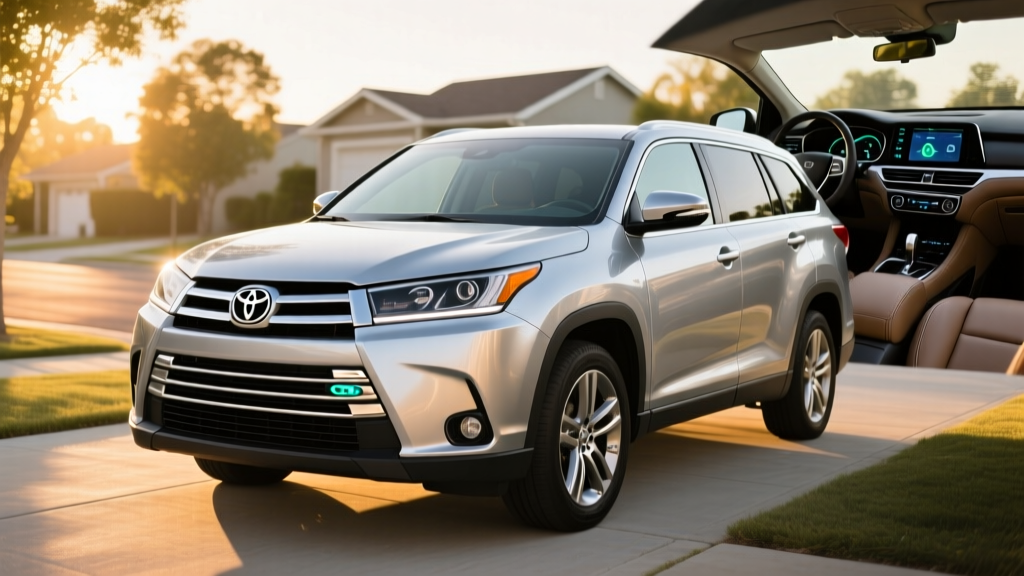
The 2017 Toyota Highlander Hybrid remains one of the most practical three-row SUVs on the used market for families who want lower fuel bills without plugging in. As a conventional hybrid (HEV) — not a plug-in hybrid — it requires zero lifestyle changes: no chargers, no range planning, no app wrangling. You just fill it with gas and drive. Nearly a decade after its launch, the 2017 Highlander Hybrid's 306-horsepower V6/electric-motor powertrain and 29 MPG combined rating still hold up against newer, pricier rivals.
This guide breaks down everything a used-car buyer in 2026 needs to know: real-world fuel economy, hybrid battery health and replacement cost, what tax incentives (if any) still apply, and how the Highlander Hybrid stacks up against PHEVs and full EVs for your next family hauler.
| Specification | 2017 Toyota Highlander Hybrid |
|---|---|
| Powertrain | 3.5L V6 + 2 electric motors (AWD-i) |
| Combined Horsepower | 306 HP |
| Drivetrain | Electronic on-demand AWD (eFour) |
| EPA Fuel Economy | 29 city / 27 highway / 29 combined MPG |
| Battery Type | Nickel-Metal Hydride (NiMH) |
| Plug-In Capable? | No — conventional HEV, self-charging |
| Towing Capacity | 3,500 lbs |
| Cargo Volume (behind 3rd/2nd/1st row) | 13.8 / 42.3 / 83.2 cu ft |
| 0–60 MPH | ~7.6 seconds |
| Original MSRP Range | $47,030 – $51,590 (Limited/Platinum) |
| Used Price Range (2026 est.) | $18,000 – $26,000 depending on mileage/condition |
Fuel Economy: EPA Numbers vs. Real-World MPG
The EPA rates the 2017 Highlander Hybrid at 29 MPG city, 27 MPG highway, and 29 MPG combined. That's a significant improvement over the gas-only 2017 Highlander V6 AWD, which returns 20 city / 26 highway / 22 combined — a 32% fuel-economy gain in combined driving.
| Driving Scenario | EPA Estimate | Real-World Expectation |
|---|---|---|
| City (stop-and-go) | 29 MPG | 28–31 MPG (hybrids excel here) |
| Highway (70+ mph) | 27 MPG | 25–27 MPG (aero drag hurts at speed) |
| Combined | 29 MPG | 26–29 MPG |
| Cold weather (below 32°F) | N/A | 24–27 MPG (engine runs more for heat) |
Like all Toyota hybrids, the Highlander Hybrid tends to meet or slightly exceed its EPA city rating in real-world driving. That's because stop-and-go traffic gives the regenerative braking system more energy to recapture and lets the electric motors handle more low-speed propulsion. Highway driving is where hybrids lose their advantage — at sustained 70–80 mph speeds, the V6 engine does most of the work.
Source: fueleconomy.gov — 2017 Highlander Hybrid vs. gas V6 comparison
HEV vs. PHEV vs. EV: Which Powertrain Fits You?
The 2017 Highlander Hybrid is a conventional hybrid (HEV). It does not plug in. Its 1.5 kWh NiMH battery pack is charged entirely by the gasoline engine and regenerative braking. This is fundamentally different from a plug-in hybrid (PHEV) or a battery-electric vehicle (BEV).
| Factor | HEV (Highlander Hybrid) | PHEV (e.g., Toyota RAV4 Prime) | BEV (e.g., Tesla Model X) |
|---|---|---|---|
| Plug in to charge? | No | Yes | Yes |
| Electric-only range | ~1 mile at low speed | 42 miles (RAV4 Prime) | 300+ miles |
| Fuel / energy cost per mile | ~$0.12 (at $3.50/gal) | ~$0.04 electric / $0.12 gas | ~$0.04–$0.06 electric |
| Home charging needed? | No | Recommended (Level 2) | Essential |
| Used price (2026) | $18K–$26K | $28K–$38K | $35K–$60K+ |
| Best for | No plug access, want simplicity | Short commutes + road trips | Home charging + low running cost |
Choose the Highlander Hybrid (HEV) if: You don't have access to home or workplace charging, you want a three-row SUV with low running costs, and you don't want to change any driving habits. It's the lowest-friction path to better fuel economy.
Consider a PHEV instead if: You can install a Level 2 charger at home and your daily commute is under 40 miles. A PHEV like the RAV4 Prime or the newer Highlander Hybrid's spiritual successor (the 2026 Highlander PHEV, available in some markets) lets you drive most weekdays on electricity alone, then use gas for road trips.
Go full EV if: You have reliable home charging, want the lowest per-mile energy cost, and are ready for a 300+ mile range vehicle. The trade-off is higher upfront cost and the need to plan longer road trips around DC fast-charging stops.
Powertrain Deep Dive: 306 HP Without the Guilt
The 2017 Highlander Hybrid pairs a 3.5-liter V6 engine (295 HP on its own) with a two-motor hybrid system Toyota calls Hybrid Synergy Drive. The front electric motor contributes additional torque through a planetary gearset that acts as a continuously variable transmission (eCVT). A rear-mounted electric motor provides on-demand all-wheel drive — Toyota calls this eFour or AWD-i.
Key powertrain specs:
- V6 engine: 3.5L, 295 HP, 263 lb-ft torque
- Front electric motor: Integrated into transaxle
- Rear electric motor: 67 HP (independent, no mechanical link to front)
- Net system output: 306 HP
- Transmission: eCVT (planetary gearset, no belt or traditional CVT)
- AWD system: Electronic on-demand — rear motor engages only when traction is needed
The eCVT is worth noting: unlike the rubber-belt CVTs found in some competitors, Toyota's planetary gearset design has no wearable belt or chain. This is a major factor in the Highlander Hybrid's long-term reliability. The system seamlessly blends gas and electric power, and most drivers won't notice the transitions.
Hybrid Battery Health, Warranty, and Replacement Cost
The 2017 Highlander Hybrid uses a 1.5 kWh nickel-metal hydride (NiMH) battery pack mounted under the second-row seats. Unlike the lithium-ion packs in full EVs, this NiMH pack is small, simple, and proven. Toyota's hybrid batteries have an excellent longevity track record.
Battery Warranty (Original)
- Federal emissions states: 8 years / 100,000 miles (hybrid battery + related components)
- CARB states (CA, NY, MA, and others): 10 years / 150,000 miles
- Warranty covers: Battery pack, hybrid control module, inverter — defects and capacity loss below functional threshold
For a 2017 model in 2026, the original factory battery warranty is expiring or already expired depending on mileage. If the original battery has survived this long, data from Toyota hybrid owners suggests it will likely last well beyond 150,000–200,000 miles. Many first-generation Prius packs have exceeded 250,000 miles.
Battery replacement cost (2026 estimates):
- Remanufactured NiMH pack: $2,000 – $3,000 installed
- New OEM Toyota pack: $3,500 – $5,000 installed
- Individual module replacement: Some independent shops can replace failed modules for $500 – $1,200, extending pack life at lower cost
Before buying a used 2017 Highlander Hybrid, ask for a hybrid battery health check. A Toyota dealer can pull the battery's State of Health (SoH) data through Techstream diagnostics. You want to see balanced module voltages (all within 0.2V of each other) and no history of hybrid system warning codes. An independent hybrid specialist can perform this check for $50–$100.
Pricing, Trims, and Tax Credit Eligibility in 2026
The 2017 Highlander Hybrid was offered in two trims:
- Limited: ~$47,030 original MSRP — leather, navigation, JBL audio, blind-spot monitoring
- Limited Platinum: ~$51,590 original MSRP — adds panoramic sunroof, ventilated front seats, rear entertainment
On the used market in 2026, expect to pay $18,000 to $26,000 depending on mileage, condition, and region. Lower-mileage examples (under 80,000 miles) in the Platinum trim command the highest prices.
Tax credit eligibility: The 2017 Highlander Hybrid does not qualify for the federal §30D new clean vehicle credit — that credit applies only to new vehicle purchases with specific battery-sourcing and MSRP requirements (see IRS §30D guidelines). The now-expired used EV credit under §25E applied only to plug-in electric vehicles (PHEVs and BEVs), not conventional hybrids. As of 2026, there are no federal tax credits available for purchasing a used conventional hybrid.
Some states may offer minimal incentives for used hybrids, but these are rare and vary by jurisdiction. Check your state's energy office or DMV website for current programs. The financial case for the Highlander Hybrid rests entirely on its fuel savings, not tax incentives.
Who Should Buy the 2017 Highlander Hybrid?
Pros
- 29 MPG combined — 32% better than gas V6 Highlander
- 306 HP provides confident merging and passing
- Proven hybrid system with 200K+ mile longevity track record
- No plug-in charging required — zero lifestyle change
- Standard AWD (eFour) without fuel-economy penalty
- 3,500-lb towing capacity (adequate for small trailers/boats)
- Three-row seating for up to 7 passengers
- eCVT planetary gearset — no belt to fail
Cons
- Highway MPG drops to 25–27 at sustained 75+ mph
- Only 13.8 cu ft cargo behind third row (tight for a 3-row SUV)
- No plug-in option — can't drive on electric alone for commutes
- Original battery warranty expiring on 2017 models
- Dated infotainment vs. 2024+ competitors
- No federal tax credit available for used HEV purchase
- Third-row seat is best suited for children on longer trips
Buy the 2017 Highlander Hybrid if:
- You need three rows but don't want the size/cost of a minivan or large SUV
- You lack home charging access and can't use a PHEV or EV effectively
- Your driving is a mix of city and highway (where the hybrid system shines)
- You value reliability and low maintenance over cutting-edge tech
- You want AWD capability without a fuel-economy tradeoff
Look elsewhere if:
- You have a short commute and home charging — a PHEV will save more on fuel
- You need maximum cargo space — consider a Sienna Hybrid or a used Tesla Model X
- You want the latest safety tech and infotainment — newer models offer more
Reliability and Long-Term Ownership Costs
Toyota's hybrid powertrain is among the most reliable in the industry. The Highlander Hybrid's eCVT has no wearable clutch packs or belts, the regenerative braking system reduces wear on the friction brakes (expect 80,000–120,000 miles from original brake pads), and the V6 engine is under less stress because the electric motors handle low-speed load.
Common maintenance items for a 2017 Highlander Hybrid at 100,000+ miles:
- Hybrid battery cooling fan filter: Clean or replace every 30,000 miles — a clogged filter causes battery overheating and premature degradation
- Brake fluid flush: Every 3 years — regenerative braking means the friction brakes see less use, but the fluid still absorbs moisture
- Transmission fluid (eCVT): Toyota calls it "lifetime" but many mechanics recommend a drain-and-fill at 100,000 miles (~$150–$250)
- 12V auxiliary battery: Replace every 4–6 years — a weak 12V battery can prevent the hybrid system from starting
According to NHTSA records, the 2017 Highlander Hybrid has no major recurring safety recalls specific to the hybrid system. Check the NHTSA VIN lookup tool for any open recalls on a specific vehicle before purchasing.
Insurance costs for a used 2017 Highlander Hybrid are moderate — typically $1,200–$1,800 annually depending on your profile and coverage level. The hybrid system doesn't significantly increase insurance premiums the way EV battery replacement risk can.
Frequently Asked Questions
How many MPG does the 2017 Toyota Highlander Hybrid get?
The EPA rates it at 29 city / 27 highway / 29 combined MPG. In real-world driving, expect 26–29 combined depending on your mix of city and highway driving. City-heavy commutes will return the best results, often matching or exceeding the 29 MPG city estimate.
Does the 2017 Highlander Hybrid need to be plugged in?
No. It is a conventional hybrid (HEV), not a plug-in hybrid (PHEV). The battery charges through the gasoline engine and regenerative braking. You never plug it in — just fill it with regular unleaded gasoline.
How long does the hybrid battery last?
Toyota's NiMH hybrid batteries commonly last 150,000–250,000 miles with proper maintenance (keeping the cooling fan filter clean). Many first-generation Prius packs exceeded 250,000 miles. For a 2017 model, the original battery is likely near the end of its warranty coverage but may have significant remaining life.
What does a replacement hybrid battery cost?
A remanufactured NiMH pack costs $2,000–$3,000 installed; a new OEM Toyota pack runs $3,500–$5,000 installed. Some independent shops can replace individual failed modules for $500–$1,200, which is a cost-effective option if only one or two modules have degraded.
Does the 2017 Highlander Hybrid qualify for any tax credit?
No. As a conventional hybrid (not a plug-in), it does not qualify for the federal §30D new vehicle credit or the §25E used EV credit. There are no federal tax incentives for purchasing a used HEV. Some states may offer minor incentives — check your state energy office.
Is the Highlander Hybrid good for towing?
It's rated for 3,500 lbs of towing capacity, which handles a small utility trailer, a pair of jet skis, or a lightweight camping trailer. For heavier loads (large boat, horse trailer), you'd need a body-on-frame SUV or truck. Note that towing will reduce fuel economy to roughly 18–22 MPG depending on trailer weight and terrain.
How does it compare to the 2026 Toyota Highlander Hybrid?
The current-generation Highlander Hybrid uses a 2.5L four-cylinder hybrid system (243 HP) and achieves 35–36 MPG combined — a meaningful efficiency improvement. However, the 2017 model offers more horsepower (306 vs. 243), a smoother V6 engine note, and a significantly lower used price. If maximum fuel economy is your priority, the newer model wins. If power and value matter more, the 2017 remains compelling.
Is AWD standard on the 2017 Highlander Hybrid?
Yes. All 2017 Highlander Hybrids come with Toyota's eFour electronic AWD system as standard equipment. Unlike mechanical AWD systems, eFour uses an independent rear electric motor that engages only when the system detects front-wheel slip. This means there's no fuel-economy penalty for having AWD, unlike gas-only AWD systems that add weight and drivetrain loss.
Sources: EPA fueleconomy.gov, NHTSA vehicle records, IRS §30D clean vehicle credits.