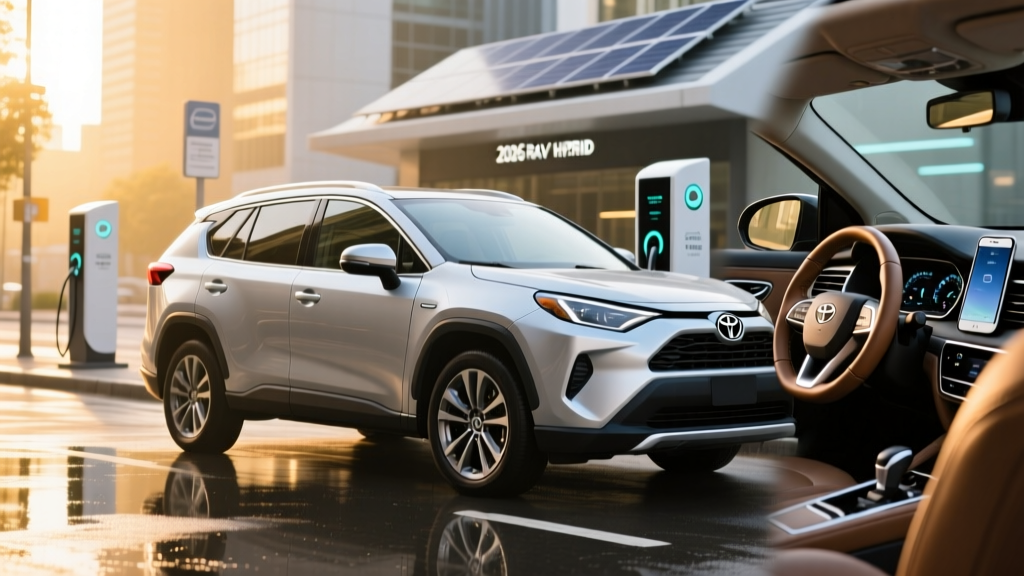
If you're searching the used market for a fuel-efficient compact SUV that won't break the bank, the 2017 Toyota RAV4 Hybrid consistently surfaces as a top contender. Nearly a decade after its release, this fourth-generation hybrid crossover remains one of the most dependable and cost-effective ways to cut fuel consumption without plugging in. But with newer PHEVs, long-range EVs, and updated RAV4 Prime models now available, does the 2017 RAV4 Hybrid still make sense in 2026?
This guide covers everything a used-car buyer needs: real-world MPG versus EPA estimates, hybrid battery longevity and replacement costs, powertrain specs, and how it stacks up against plug-in hybrids and full electric alternatives.
2017 RAV4 Hybrid Powertrain and Key Specs
The 2017 RAV4 Hybrid pairs a 2.5-liter Atkinson-cycle four-cylinder gasoline engine with two electric motor-generators and a nickel-metal hydride (NiMH) traction battery. Unlike a plug-in hybrid, this is a conventional hybrid electric vehicle (HEV) — it charges its battery entirely through regenerative braking and engine operation. There is no plug, no charging port, and no electric-only driving mode beyond very low-speed maneuvering.
| Specification | Value |
|---|---|
| Powertrain Type | Conventional Hybrid (HEV) |
| Gas Engine | 2.5L Atkinson-cycle I4 |
| Combined System Horsepower | 194 hp |
| Electric Motors | Front: 105 kW / Rear: 50 kW (independent rear motor for AWD-i) |
| Traction Battery | NiMH, ~1.6 kWh (gross) |
| Drivetrain | AWD-i (electronic all-wheel drive, no mechanical driveshaft) |
| Transmission | eCVT (planetary gearset, not a belt-driven CVT) |
| 0–60 mph | ~7.8 seconds |
| EPA Fuel Economy (Combined) | 32 MPG |
| EPA City / Highway | 34 city / 30 highway |
| Fuel Tank Capacity | 14.8 gallons |
| Total Driving Range | ~474 miles (EPA estimate) |
| Cargo Volume | 35.6 cu ft (rear seats up) / 70.2 cu ft (folded) |
| Towing Capacity | 1,750 lbs |
The AWD-i system is worth noting: instead of a traditional driveshaft connecting front and rear axles, the rear wheels are powered by a dedicated 50 kW electric motor. This means the rear axle engages only when needed — during acceleration, low-traction starts, or detected wheel slip — which saves weight and reduces parasitic drivetrain losses compared to mechanical AWD.
Fuel Economy: EPA Ratings vs. Real-World MPG
The EPA rates the 2017 RAV4 Hybrid at 34 MPG city / 30 MPG highway / 32 MPG combined. That city-highway inversion — where the city number is higher — is a hallmark of Toyota's hybrid synergy drive system. In stop-and-go traffic, regenerative braking recaptures kinetic energy and the engine shuts off frequently, letting the electric motors handle low-speed propulsion. On the highway, the gasoline engine runs more continuously, and aerodynamic drag works against efficiency.
| Driving Scenario | EPA Rating | Real-World Expectation |
|---|---|---|
| City | 34 MPG | 33–36 MPG (hybrids often beat EPA city) |
| Highway (70–80 mph) | 30 MPG | 27–30 MPG (speed and wind are big factors) |
| Combined | 32 MPG | 30–34 MPG depending on driving mix |
| Cold Weather (below 32°F) | — | 26–29 MPG (engine runs more for cabin heat) |
Based on aggregated owner data from fueleconomy.gov, many 2017 RAV4 Hybrid owners report averaging 31–34 MPG in mixed driving. The real-world advantage of this hybrid shows up most in urban commutes with frequent stops, where owners regularly achieve 35+ MPG. Highway-heavy drivers should expect numbers closer to the EPA highway rating or slightly below, especially at speeds above 75 mph or in hilly terrain.
HEV vs. PHEV vs. EV: Where Does the 2017 RAV4 Hybrid Fit?
Understanding the difference between hybrid types is essential before committing to a used purchase. The 2017 RAV4 Hybrid is a conventional HEV — it never plugs in. If you're looking for electric-only range or home charging, you need either a PHEV or a full BEV.
| Feature | HEV (2017 RAV4 Hybrid) | PHEV (e.g., RAV4 Prime) | BEV (e.g., Tesla Model Y) |
|---|---|---|---|
| Plugs In? | No | Yes | Yes |
| Electric-Only Range | ~0.5 mi at low speed | 42 mi (RAV4 Prime EPA) | 260–330 mi |
| Total Range | ~474 mi | ~600 mi (electric + gas) | 260–330 mi |
| Home Charging Needed? | No | Recommended (Level 2) | Essential |
| Federal Tax Credit (New) | None | Up to $7,500 (§30D) | Up to $7,500 (§30D) |
| Used EV Credit (§25E) | Not eligible | Up to $4,000 | Up to $4,000 |
| Maintenance Complexity | Low (proven system) | Moderate (two full powertrains) | Low (few moving parts) |
Who should choose the 2017 RAV4 Hybrid (HEV)? Drivers who want better fuel economy without changing their refueling habits. If you don't have access to home charging — apartment dwellers, street parkers, or those without a garage — an HEV delivers meaningful fuel savings with zero lifestyle adjustment.
Who should look at a PHEV instead? Drivers with home charging access who want 30–45 miles of daily electric-only commuting but also need gas-engine range for road trips. The RAV4 Prime (introduced in 2021) offers 42 miles of electric range and 94 MPGe, but used prices remain significantly higher than a 2017 RAV4 Hybrid.
Who should go full BEV? Drivers with reliable home or workplace Level 2 charging, commutes under 200 miles round-trip, and a desire to eliminate gasoline entirely. The used EV market in 2026 offers models like the Chevrolet Bolt EUV and Hyundai Ioniq 5 at competitive prices — but they require charging infrastructure.
Hybrid Battery Longevity and Replacement Cost
The biggest concern for any used hybrid buyer is the traction battery. The 2017 RAV4 Hybrid uses a nickel-metal hydride (NiMH) battery pack, a chemistry Toyota has refined over two decades of hybrid production. NiMH is less energy-dense than the lithium-ion packs in modern PHEVs and EVs, but it has a well-documented track record for longevity.
How long do these batteries actually last? Real-world data from owner forums, fleet operators, and repair shops suggests the NiMH pack in the 2017 RAV4 Hybrid typically lasts 150,000 to 200,000+ miles before significant degradation. Unlike EV batteries that lose range visibly over time, hybrid batteries operate within a narrow state-of-charge window (roughly 40–80% SoC), which dramatically reduces stress on the cells. The most common failure mode is individual module imbalance rather than total pack failure.
Battery replacement cost in 2026:
- New OEM Toyota pack: $3,500–$5,000 (parts + labor at a dealership)
- Refurbished/remanufactured pack: $1,500–$2,800 (from third-party specialists like Green Bean Battery or similar)
- Individual module replacement: $300–$800 if only a few cells have failed (requires a hybrid-specialist shop)
For context, a 2017 RAV4 Hybrid with 120,000 miles on the odometer is statistically unlikely to need a battery replacement within the next several years of typical use. The eCVT transmission, which uses a simple planetary gearset with no belts or clutches, is similarly robust and rarely requires service beyond fluid changes.
Reliability, Safety, and Long-Term Ownership Costs
Toyota's hybrid powertrain is one of the most thoroughly validated in the automotive industry. The 2017 RAV4 Hybrid carries forward the same fundamental system architecture that debuted in the original Prius, with incremental improvements in efficiency and integration. According to owner-reported data tracked by sources like IIHS, the 2017 RAV4 earned Top Safety Pick+ honors when equipped with the optional front crash prevention system — a strong result for its model year.
The standard Toyota Safety Sense P (TSS-P) suite on all 2017 RAV4 Hybrid trims includes:
- Pre-Collision System with Pedestrian Detection
- Lane Departure Alert with Steering Assist
- Automatic High Beams
- Full-Speed Range Dynamic Radar Cruise Control
These are SAE Level 1 driver-assist features — they provide warnings and limited interventions but do not automate steering, acceleration, and braking simultaneously. The driver remains fully responsible at all times.
Common maintenance items at 100,000+ miles:
- Inverter coolant flush (every 100,000 mi): $150–$250
- Hybrid battery cooling fan filter cleaning: $0 (DIY) or $50–$80 at a shop
- Brake pad replacement: Less frequent than gas cars due to regenerative braking — many owners report original pads lasting 80,000–100,000+ miles
- Standard items: engine oil, cabin air filter, tire rotation (same as any vehicle)
One underappreciated ownership advantage: regenerative braking significantly reduces wear on the friction brake pads and rotors. It's common for RAV4 Hybrid owners to reach 100,000 miles on original brake pads, which offsets some of the higher upfront cost versus a non-hybrid model.
Used Pricing and Tax Credit Eligibility in 2026
The 2017 RAV4 Hybrid was sold in two trims: XLE and Limited. Original MSRP ranged from approximately $29,270 (XLE) to $34,510 (Limited), including destination. In the 2026 used market, pricing varies significantly based on mileage, condition, and region:
| Trim | Mileage Range | Typical Used Price |
|---|---|---|
| XLE | 60,000–90,000 mi | $17,000–$21,000 |
| XLE | 90,000–130,000 mi | $13,500–$17,000 |
| Limited | 60,000–90,000 mi | $19,500–$23,500 |
| Limited | 90,000–130,000 mi | $15,500–$19,500 |
Despite the lack of tax incentives, the 2017 RAV4 Hybrid's total cost of ownership remains compelling. Its combination of strong reliability, low maintenance costs, and 32 MPG combined means lower operating expenses than most non-hybrid compact SUVs in the same price range. Insurance rates are typically in line with the non-hybrid RAV4, as insurers have long since adjusted to the hybrid variant's claims history.
Pros, Cons, and the Final Verdict
Pros
- Proven, reliable hybrid powertrain with 20+ years of Toyota refinement
- 32 MPG combined — significantly better than the non-hybrid RAV4 AWD (25 MPG)
- No charging infrastructure needed — just fill up with gas
- Standard AWD-i (electronic all-wheel drive) on every trim
- Standard Toyota Safety Sense P (adaptive cruise, lane assist, AEB)
- Strong cargo space (35.6 cu ft) with no battery intrusion
- Regenerative braking extends brake pad life significantly
- Low used pricing: $13,500–$23,500 depending on trim and mileage
Cons
- No electric-only driving range — this is not a plug-in vehicle
- No federal or state tax credits available for conventional hybrids
- NiMH battery is older tech; replacement costs $1,500–$5,000 if needed
- Highway MPG (30) trails city MPG (34) — less efficient on long road trips
- Infotainment system is dated by 2026 standards (no wireless CarPlay/Android Auto)
- Towing capacity limited to 1,750 lbs
- Most examples are now out of the original 8-year hybrid battery warranty
The verdict: The 2017 Toyota RAV4 Hybrid is one of the smartest used-vehicle buys in the compact SUV segment for drivers who want fuel savings without lifestyle changes. It requires no plug, no charging app, no route planning around DC fast chargers — just gasoline and routine maintenance. At $13,500–$23,500 on the used market, it undercuts nearly every PHEV and EV alternative while delivering proven reliability and 32 MPG combined.
It's not the right choice if you want electric-only commuting (look at a used RAV4 Prime or a PHEV from Hyundai/Kia) or if you want to eliminate gasoline entirely (consider a used Model Y or Ioniq 5). But for the driver who simply wants a dependable, efficient AWD crossover that works exactly like a gas car but sips fuel like a compact sedan, the 2017 RAV4 Hybrid remains hard to beat.
Frequently Asked Questions
How many MPG does the 2017 RAV4 Hybrid actually get?
The EPA rates it at 34 city / 30 highway / 32 combined MPG. In real-world driving, most owners report 30–34 MPG combined, with city-heavy drivers often achieving 35+ MPG thanks to regenerative braking. Highway-only driving at 75+ mph may drop to 27–29 MPG. Cold weather (below freezing) typically reduces efficiency by 10–15% because the engine runs more frequently to provide cabin heat.
Does the 2017 RAV4 Hybrid need to be plugged in?
No. This is a conventional hybrid (HEV), not a plug-in hybrid (PHEV). The battery charges exclusively through regenerative braking and the gasoline engine. There is no charging port on the vehicle. You refuel it exactly like a standard gas car.
How long will the hybrid battery last, and what does replacement cost?
Toyota's NiMH hybrid batteries in this generation typically last 150,000–200,000+ miles. The original warranty was 8 years/100,000 miles (10 years/150,000 miles in CARB states). If replacement is needed, expect $1,500–$2,800 for a refurbished pack or $3,500–$5,000 for a new OEM pack from a Toyota dealer. Individual module repairs can cost as little as $300–$800 at a hybrid specialist.
Does the 2017 RAV4 Hybrid qualify for any tax credit?
No. Federal tax credits under IRS §30D (new vehicles) and §25E (used vehicles) apply only to plug-in electric vehicles — PHEVs and BEVs with sufficient battery capacity. The 2017 RAV4 Hybrid is a conventional HEV and does not qualify for any federal purchase incentive. Check your state's energy office for any local hybrid incentives, though these are uncommon.
Is the 2017 RAV4 Hybrid better than buying a newer used RAV4 Prime?
It depends on your budget and charging situation. The RAV4 Prime (2021+) offers 42 miles of electric-only range, 94 MPGe, and 302 combined horsepower — but used prices typically start around $30,000–$38,000 in 2026, roughly double the cost of a 2017 RAV4 Hybrid. If you have home charging and can afford the premium, the Prime delivers dramatically lower fuel costs on daily commutes. If you lack charging access or want to spend under $20,000, the 2017 HEV is the pragmatic choice.
Should I buy a 2017 RAV4 Hybrid or a full EV like a used Bolt or Model 3?
Choose the RAV4 Hybrid if you lack reliable home charging, frequently drive more than 250 miles in a day, live in an area with sparse public charging infrastructure, or want to minimize upfront cost. Choose a full EV if you have Level 2 home charging, your daily driving is under 200 miles round-trip, and you want to eliminate gasoline costs and tailpipe emissions entirely. A used Bolt EUV or Model 3 can offer lower per-mile energy costs, but requires charging access and acceptance of range planning on longer trips.