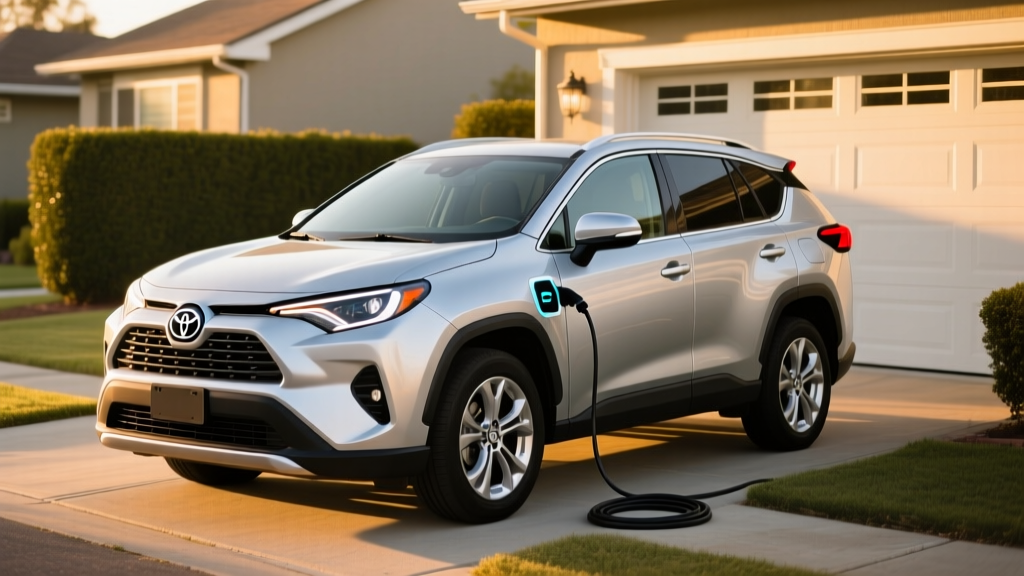
The 2017 Toyota RAV4 Hybrid occupies a specific and increasingly valuable niche in the used-car market: a compact hybrid SUV from Toyota's most dependable generation, now available at a fraction of its original MSRP. For buyers who want hybrid efficiency without plug-in complexity or range-anxiety calculations, this model remains one of the most pragmatic choices on the road in 2026.
This guide breaks down the 2017 RAV4 Hybrid's real-world fuel economy, powertrain specs, hybrid battery longevity, replacement costs, and how it stacks up against modern PHEVs and full EVs. Whether you're shopping the used market or evaluating your current RAV4 Hybrid's long-term ownership outlook, here's what the data actually shows.
2017 RAV4 Hybrid Fuel Economy: EPA vs. Real-World MPG
The 2017 RAV4 Hybrid carries EPA ratings that remain competitive even against newer hybrid SUVs nearly a decade later. Toyota's Hybrid Synergy Drive system pairs a 2.5-liter Atkinson-cycle four-cylinder engine with electric motors to deliver efficiency that punches above its weight in city driving — exactly where conventional hybrids shine.
| Metric | AWD-i (XLE/SE) |
|---|---|
| City MPG | 34 MPG |
| Highway MPG | 30 MPG |
| Combined MPG | 32 MPG |
| Annual Fuel Cost (est.) | ~$1,550 |
| Gallons per 100 Miles | 3.1 |
Powertrain Specs: How the Hybrid System Works
The 2017 RAV4 Hybrid uses Toyota's proven eCVT-based Hybrid Synergy Drive — not a traditional continuously variable transmission with belts and pulleys, but a planetary gearset that seamlessly blends engine and motor power. This architecture has fewer moving parts than a conventional automatic, contributing to Toyota's reputation for long-term drivetrain reliability.
| Specification | Detail |
|---|---|
| Engine | 2.5L 4-cyl Atkinson-cycle (150 HP / 152 lb-ft) |
| Front Electric Motor | Permanent magnet synchronous (141 HP / 247 lb-ft) |
| Rear Electric Motor (AWD-i) | 67 HP / 105 lb-ft (activates under acceleration/slip) |
| Net System Horsepower | 194 HP |
| 0–60 MPH | ~7.8 seconds |
| Transmission | eCVT (planetary gearset) |
| Drivetrain | Electronic AWD (AWD-i) |
| Hybrid Battery | 1.6 kWh Nickel-Metal Hydride (NiMH) |
| Towing Capacity | 1,750 lbs |
The AWD-i system deserves specific attention: unlike mechanical all-wheel drive with a driveshaft and rear differential, the RAV4 Hybrid uses an independent rear electric motor that engages only when needed — during hard acceleration, slippery conditions, or cornering. This eliminates drivetrain parasitic loss, which is why the hybrid AWD achieves nearly identical MPG to what a front-wheel-drive equivalent would deliver.
HEV vs. PHEV vs. EV: Where the 2017 RAV4 Hybrid Fits
The 2017 RAV4 Hybrid is a conventional hybrid (HEV). It cannot be plugged in. It has no meaningful electric-only range (the small 1.6 kWh NiMH battery assists the engine at low speeds and during acceleration but cannot propel the vehicle alone beyond roughly one mile at parking-lot speeds). All energy comes from gasoline; the hybrid system simply uses that gasoline more efficiently.
HEV vs. PHEV vs. BEV — Quick Comparison
| Factor | HEV (2017 RAV4 Hybrid) | PHEV (e.g., RAV4 Prime) | BEV (e.g., Tesla Model Y) |
|---|---|---|---|
| Plug-in Required? | No | Yes (optional — runs as hybrid without) | Yes (mandatory) |
| Electric-Only Range | ~0 miles | 42 miles (RAV4 Prime) | 260–330 miles |
| Home Charging Needed? | No | Recommended (120V/240V) | Essential (240V Level 2) |
| Federal Tax Credit (§30D) | Not eligible | Up to $7,500 (if eligible) | Up to $7,500 (if eligible) |
| Best For | No home charging access; simplicity | Home charging + short commutes | Home charging + low operating cost |
The 2017 RAV4 Hybrid is the right choice for buyers who lack reliable access to home or workplace charging. If you can install a Level 2 charger and have a commute under 40 miles, a PHEV like the RAV4 Prime (introduced for 2021) or a full BEV will deliver dramatically lower per-mile energy costs. But if you park on the street, live in an apartment without charging infrastructure, or simply want zero behavioral change from your gas car, the conventional hybrid remains the lowest-friction path to better fuel economy.
Hybrid Battery Longevity and Replacement Cost
Hybrid battery anxiety is the single most common concern among used hybrid buyers. The data is reassuring: Toyota's NiMH hybrid batteries in the RAV4 Hybrid have proven exceptionally durable, routinely lasting well beyond 150,000 miles with minimal capacity loss.
• Original warranty: 8 years / 100,000 miles (10 years / 150,000 miles in California and states adopting CARB emissions standards)
• Typical real-world lifespan: 150,000–200,000+ miles before significant degradation
• Replacement cost (OEM new): $3,000–$4,500 installed at a Toyota dealer
• Replacement cost (refurbished/remanufactured): $1,500–$2,500 installed
• Individual cell module replacement: $300–$800 (only failed modules replaced — viable repair at independent hybrid specialists)
The NiMH chemistry used in the 2017 RAV4 Hybrid degrades more gracefully than early lithium-ion packs. Rather than sudden capacity cliff failure, NiMH batteries slowly lose capacity over hundreds of thousands of miles. Many 2017 RAV4 Hybrids now approaching 100,000–130,000 miles still show minimal fuel economy degradation — typically 1–2 MPG loss from original.
Maximizing battery life: Toyota's hybrid system never fully charges or fully depletes the battery, operating in a narrow 40–80% state-of-charge window. This built-in buffer dramatically extends cycle life. The most damaging behavior is leaving the vehicle sitting unused for months — NiMH batteries self-discharge, and prolonged deep discharge can cause cell imbalance. If you buy a used RAV4 Hybrid that sat for extended periods, have the battery health checked with a scan tool that reads individual module voltages.
Used Pricing in 2026 and Tax Credit Eligibility
The 2017 RAV4 Hybrid was offered in XLE and SE trims, with original MSRPs ranging from approximately $29,270 (XLE) to $33,610 (SE) including destination. In the 2026 used market, well-maintained examples with 80,000–120,000 miles typically trade between $14,000 and $19,500 depending on condition, mileage, and regional demand.
From a total-cost-of-ownership perspective, the math still works compellingly. At 32 combined MPG and current fuel prices (~$3.10/gallon national average in early 2026), the RAV4 Hybrid costs approximately $0.10 per mile in fuel. A comparable gas-only 2017 RAV4 (26 combined MPG) costs roughly $0.12 per mile. Over 15,000 annual miles, that's a ~$300/year fuel savings — modest individually, but the hybrid also commands a resale premium and avoids the charging-infrastructure dependency of a PHEV or BEV.
Reliability, Safety, and Long-Term Ownership Costs
The 2017 RAV4 Hybrid benefits from Toyota's industry-leading reliability record and a powertrain architecture with fewer wear components than conventional vehicles. The eCVT has no clutch packs, bands, or torque converters to fail. Regenerative braking significantly extends brake pad life — many owners report original brake pads at 80,000+ miles.
The IIHS rated the 2017 RAV4 as a Top Safety Pick when equipped with Toyota Safety Sense-P (standard on all Hybrid trims), which includes pre-collision braking, lane departure alert, automatic high beams, and full-speed-range adaptive cruise control. The NHTSA awarded it a 5-star overall safety rating.
Pros & Cons at a Glance
- 34 MPG city — exceptional for an AWD SUV
- No plug-in required — zero infrastructure dependency
- Proven NiMH battery longevity (150K–200K+ miles)
- Toyota Safety Sense-P standard on all trims
- Strong resale value and low depreciation curve
- eCVT reliability — no traditional transmission failures
- No electric-only driving capability
- No federal tax credit eligibility
- Dated infotainment (no Apple CarPlay/Android Auto)
- Cabin noise under hard acceleration (CVT drone)
- 1,750-lb towing limit (lower than gas RAV4)
- Rear cargo space slightly reduced vs. gas model
Who Should Buy the 2017 RAV4 Hybrid — and Who Shouldn't
The 2017 RAV4 Hybrid is a purpose-built vehicle for a specific buyer profile. It excels when your situation matches its strengths and frustrates when you need capabilities it doesn't offer.
Choose the 2017 RAV4 Hybrid if: You lack home charging access but want hybrid efficiency. You drive primarily in city or suburban conditions where regenerative braking maximizes fuel savings. You want a used AWD SUV under $20,000 with minimal maintenance risk. You plan to own the vehicle 5+ years and value long-term reliability over cutting-edge technology.
Look elsewhere if: You have home charging and a short commute — a used PHEV (RAV4 Prime, Outlander PHEV, or Prius Prime) will deliver far lower per-mile costs on electric-only driving. You want modern infotainment with smartphone integration — the 2017 RAV4's Entune system is dated, and aftermarket CarPlay head units are the typical solution. You need serious towing capacity — the 1,750-lb limit rules out most boat or utility trailers.
Frequently Asked Questions
How many MPG does the 2017 RAV4 Hybrid actually get in real driving?
The EPA rates it at 34 city / 30 highway / 32 combined. Real-world reports cluster around 33–36 MPG in mixed driving. City-heavy routes with frequent stops often exceed the EPA city estimate, while sustained highway driving at 75+ MPH typically yields 28–30 MPG. Cold weather reduces efficiency by roughly 5–10%.
Does the 2017 RAV4 Hybrid need to be plugged in?
No. This is a conventional hybrid (HEV), not a plug-in hybrid (PHEV). The battery recharges through regenerative braking and the gasoline engine. You fuel it exactly like a gas car — there is no charging port, no plug, and no electric-only range to manage.
What does it cost to replace the hybrid battery?
A new OEM battery from Toyota costs approximately $3,000–$4,500 installed. Refurbished or remanufactured batteries run $1,500–$2,500 installed. Many independent hybrid specialists offer individual cell-module replacement for $300–$800 if only specific modules have degraded. Most 2017 RAV4 Hybrid batteries last 150,000–200,000+ miles before needing service.
Is the 2017 RAV4 Hybrid eligible for any federal tax credit?
No. Federal clean vehicle credits (§30D for new, §25E for used) require plug-in capability — either a PHEV or a battery-electric vehicle. The conventional RAV4 Hybrid does not qualify. Some states offer separate used-hybrid incentives; check your state energy office for current programs.
How does the 2017 RAV4 Hybrid compare to newer hybrid SUVs?
The current-generation RAV4 Hybrid (2023–2026) achieves 41 city / 38 highway / 40 combined — a meaningful improvement driven by Toyota's newer TNGA platform and updated hybrid system. However, a well-maintained 2017 model at $15,000–$19,000 delivers 80% of the efficiency at roughly half the price of a new hybrid SUV, making it a strong value proposition for budget-conscious buyers.
What should I check when buying a used 2017 RAV4 Hybrid?
Prioritize a pre-purchase inspection that includes hybrid battery health (individual module voltage delta — a spread greater than 0.3V between modules signals imbalance). Verify the hybrid system coolant has been serviced per Toyota's schedule (every 100,000 miles). Check for any open recalls on the hybrid inverter or brake actuator. Confirm Toyota Safety Sense-P calibration if the windshield has been replaced.