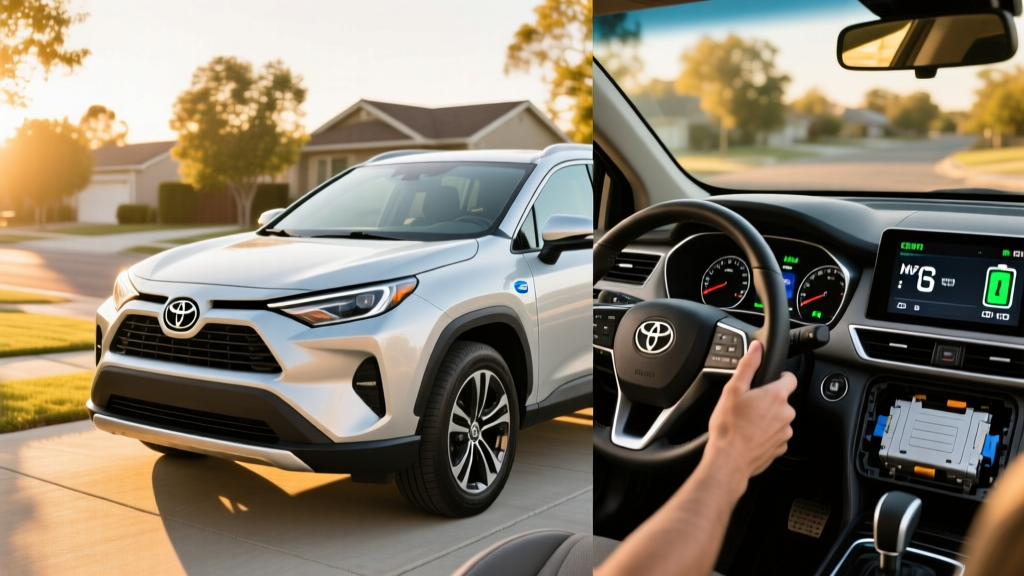
The 2017 Toyota RAV4 Hybrid AWD remains one of the most searched used hybrid SUVs in 2026 — and for good reason. It delivers all-wheel drive, a spacious cabin, and Toyota's proven hybrid system without ever needing a plug. If you're evaluating one on the used market today, this guide covers every number that matters: real-world MPG, battery longevity, replacement costs, and how it stacks up against the plug-in RAV4 Prime and full-electric alternatives now available.
HEV vs PHEV: Where the 2017 RAV4 Hybrid Fits
Before diving into specs, it's critical to distinguish what this vehicle is — and what it isn't.
| Feature | 2017 RAV4 Hybrid (HEV) | RAV4 Prime (PHEV, 2021+) | bZ4X (BEV, 2023+) |
|---|---|---|---|
| Powertrain type | Conventional hybrid (self-charging) | Plug-in hybrid | Battery electric |
| Plug-in required? | No | Yes (Level 1/2) | Yes (Level 1/2/DC) |
| Electric-only range | ~0.5 mi at low speed | 42 mi (EPA) | 222–252 mi (EPA) |
| Battery capacity | 1.6 kWh (NiMH) | 18.1 kWh (Li-ion) | 71.4 kWh (Li-ion) |
| Federal tax credit (new) | None | Up to $7,500 (§30D, if eligible) | Up to $7,500 (§30D, if eligible) |
| Used EV credit (§25E) | Not eligible | Up to $4,000 | Up to $4,000 |
The 2017 RAV4 Hybrid is a conventional hybrid electric vehicle (HEV). It charges its own small battery through regenerative braking and the gasoline engine. You never plug it in. This is fundamentally different from the RAV4 Prime (a plug-in hybrid introduced in 2021) and the fully electric bZ4X. If you see the word "hybrid" without "plug-in," the vehicle does not charge from a wall outlet.
Powertrain and Performance Specs
| Specification | 2017 RAV4 Hybrid AWD |
|---|---|
| Engine | 2.5L 4-cylinder Atkinson cycle |
| Engine output | 150 HP / 152 lb-ft torque |
| Front electric motor | 141 HP / 295 lb-ft |
| Rear electric motor (AWD) | 67 HP / 149 lb-ft |
| Combined net system horsepower | 194 HP |
| Transmission | eCVT (electronically controlled) |
| 0–60 mph | 7.8 seconds |
| Drivetrain | Electronic on-demand AWD (rear motor) |
| Hybrid battery | 1.6 kWh, Nickel-Metal Hydride (NiMH) |
| Curb weight | ~3,950 lbs |
| Towing capacity | 1,750 lbs |
The AWD system in the 2017 RAV4 Hybrid is worth explaining. Unlike mechanical AWD with a driveshaft, Toyota uses a dedicated rear-axle electric motor that engages automatically when the front wheels slip or during hard acceleration. This means there's no parasitic drivetrain loss during normal cruising — the rear motor simply freewheels. The trade-off is that the rear motor provides limited torque at higher speeds, so this is a traction-aid AWD system, not a performance-oriented one. For snow, rain, and light off-road conditions, it's effective.
Fuel Economy: EPA Ratings vs Real-World MPG
This is where the 2017 RAV4 Hybrid earns its reputation. According to fueleconomy.gov, the EPA rates it as follows:
| Driving Cycle | EPA Rating | Real-World Expectation |
|---|---|---|
| City | 34 MPG | 32–36 MPG (often exceeds EPA) |
| Highway | 30 MPG | 27–31 MPG (varies with speed/terrain) |
| Combined | 32 MPG | 30–34 MPG |
Why hybrids often beat EPA city estimates: The EPA city cycle includes frequent stops and low-speed driving — exactly where regenerative braking recovers the most energy and the electric motor does the most work. Many owners report 34–36 MPG in suburban stop-and-go driving. Highway efficiency drops because aerodynamic drag dominates at 70+ mph and the gasoline engine carries the full load.
Cold-weather impact: Expect a 5–10% MPG reduction in sub-freezing temperatures. The engine runs more often to provide cabin heat (no electric heat pump in this generation), and the battery operates less efficiently when cold. Owners in northern climates typically see 28–30 MPG combined in winter versus 33–35 MPG in summer.
Hybrid Battery Warranty (Original)
Toyota's original hybrid battery warranty for the 2017 RAV4 Hybrid was 8 years / 100,000 miles (10 years / 150,000 miles in California and states adopting CARB emissions standards). As of 2026, most 2017 models are beyond the 8-year mark but may still fall within mileage coverage depending on odometer reading. Toyota extended hybrid battery coverage to 10 years / 150,000 miles for all 2020+ model years, but this does not retroactively apply to 2017 vehicles unless registered in a CARB state.
Hybrid Battery Longevity and Replacement Cost
The 1.6 kWh NiMH battery pack in the 2017 RAV4 Hybrid is small by EV standards, but it's engineered for longevity rather than capacity. Toyota's hybrid batteries rarely operate at full charge or full discharge — the system maintains a state-of-charge window between roughly 40% and 80%, which dramatically reduces cell stress.
Real-world lifespan data: Based on owner reports and fleet data through 2026, the majority of 2017 RAV4 Hybrid batteries are still on their original pack at 100,000–150,000 miles. Failures before 120,000 miles are uncommon. The NiMH chemistry in this generation is less energy-dense than modern lithium-ion but is known for exceptional cycle stability.
Replacement cost breakdown (2026 estimates):
- New OEM Toyota battery: $3,000–$4,500 (parts + dealer labor)
- Refurbished/remanufactured battery: $1,500–$2,500 (independent hybrid specialist)
- Individual module replacement: $300–$800 (if only 1–2 of 34 modules are degraded — requires diagnostic testing)
Before assuming a full replacement is needed, have a hybrid specialist run a module-level balance test. Often, a single weak module triggers the hybrid system warning, and replacing just that module restores full function. Shops like Green Tech Automotive and local hybrid specialists routinely perform this service.
Reliability and Safety Ratings
The 2017 RAV4 Hybrid benefits from Toyota's decades-long hybrid refinement. The eCVT transmission has no traditional gears, clutches, or belts — it uses a planetary gearset that's among the most durable drivetrain components in any vehicle. There are no timing belts to replace (the 2AR-FXE engine uses a timing chain), and brake pad life is extended significantly by regenerative braking — many owners report 60,000–80,000 miles on original pads.
According to NHTSA, the 2017 RAV4 (including Hybrid AWD) received a 5-Star Overall Safety Rating. The IIHS named it a Top Safety Pick when equipped with the optional front crash prevention package (Toyota Safety Sense P was standard on the Hybrid trim).
Common issues to check on a used 2017 RAV4 Hybrid:
- Hybrid battery cooling fan: Located behind the rear seat; ensure it's not blocked by cargo and listen for unusual noise. A clogged filter can cause battery overheating and reduced efficiency.
- Brake actuator recall: Toyota issued a recall for certain 2017 RAV4 Hybrid vehicles related to the brake actuator assembly. Verify recall status via the VIN at nhtsa.gov/recalls.
- 12V auxiliary battery: Like all hybrids, the RAV4 Hybrid has a standard 12V battery that powers electronics. These typically last 4–6 years and are a common cause of "no-start" complaints that owners mistakenly attribute to the hybrid system.
Used Market Pricing and Tax Credit Eligibility
As of early 2026, the 2017 RAV4 Hybrid AWD trades on the used market in the following ranges:
- XLE trim (80,000–100,000 mi): $17,000–$20,000
- XLE trim (50,000–80,000 mi): $20,000–$23,500
- Limited trim (60,000–90,000 mi): $21,000–$25,000
Tax credit situation: The 2017 RAV4 Hybrid is a conventional HEV and does not qualify for the federal §30D Clean Vehicle Credit (which applies only to plug-in vehicles — BEVs and PHEVs meeting battery-sourcing and MSRP requirements). It also does not qualify for the §25E Used Clean Vehicle Credit, which similarly requires a plug-in powertrain. No federal tax incentive is available for purchasing a used conventional hybrid.
Some states offer modest incentives for used hybrid purchases, but these vary widely by jurisdiction. Check your state's energy or environmental agency website for current programs. A tax professional can confirm any applicable local credits.
Who Should Buy the 2017 RAV4 Hybrid AWD?
Choose the 2017 RAV4 Hybrid AWD if:
- You want AWD and strong MPG without changing your fueling habits (no plugs, no charging apps)
- Your daily driving is mostly city/suburban where the hybrid system maximizes regenerative braking
- You want proven long-term reliability with a simple, well-understood powertrain
- Your budget is $17,000–$25,000 and you want a compact SUV with cargo versatility
- You live in an area with limited public charging infrastructure
Consider a PHEV (RAV4 Prime) or BEV instead if:
- You have home charging access and want electric-only commuting (the RAV4 Prime offers 42 mi electric range)
- You want federal tax credit eligibility — the used RAV4 Prime can qualify for up to $4,000 under §25E
- Your commute is under 30 miles round-trip and you want to minimize gasoline use
- You're buying new and want the latest safety tech and infotainment
Pros and Cons at a Glance
Pros
- 32 MPG combined EPA; often 34+ in real-world city driving
- Standard electronic AWD with no fuel-economy penalty vs FWD hybrid
- Toyota Safety Sense P standard (pre-collision, lane departure, auto high beams, adaptive cruise)
- Proven eCVT durability — no traditional transmission maintenance
- Extended brake pad life from regen braking
- Spacious 70.7 cu ft cargo volume with rear seats folded
- No plug-in requirement — fuel anywhere, no range anxiety
Cons
- No EV-only mode for meaningful zero-emission driving
- 1.6 kWh NiMH battery is aging technology; less efficient than modern Li-ion hybrids
- Hybrid battery replacement cost ($1,500–$4,500) is a real ownership risk past 150k miles
- Infotainment is dated by 2026 standards (no Apple CarPlay/Android Auto on 2017 model)
- No federal tax credit eligibility (HEV, not PHEV/BEV)
- Rear motor AWD provides limited high-speed traction intervention
- Cabin noise under hard acceleration (eCVT drone)
Frequently Asked Questions
How many MPG does the 2017 RAV4 Hybrid AWD actually get?
The EPA rates it at 34 city / 30 highway / 32 combined MPG. In real-world driving, most owners report 30–34 MPG combined, with city driving often exceeding the EPA estimate thanks to regenerative braking. Highway driving at 75+ mph and cold-weather operation reduce efficiency by 5–10%.
Does the 2017 RAV4 Hybrid need to be plugged in?
No. This is a conventional hybrid (HEV), not a plug-in hybrid (PHEV). The battery charges itself through regenerative braking and the gasoline engine. You fuel it exactly like any other gas vehicle.
How long does the hybrid battery last, and what does replacement cost?
Most 2017 RAV4 Hybrid batteries last 120,000–180,000+ miles based on current data. A new OEM replacement costs $3,000–$4,500 installed at a dealer. Refurbished batteries from hybrid specialists run $1,500–$2,500. Individual module replacement (when only one cell is degraded) can cost as little as $300–$800.
Does the 2017 RAV4 Hybrid qualify for any tax credit?
No. Federal tax credits under §30D (new vehicles) and §25E (used vehicles) apply only to plug-in vehicles — battery electric vehicles (BEVs) and plug-in hybrids (PHEVs). The 2017 RAV4 Hybrid is a conventional HEV and is not eligible for any federal purchase incentive.
Is the 2017 RAV4 Hybrid AWD system good in snow?
Yes, for typical winter conditions. The rear electric motor engages automatically when front-wheel slip is detected, providing additional traction without driver input. It's not a substitute for winter tires on ice, but combined with proper tires, owners report confident performance in moderate snow. The system adds only ~100 lbs over the FWD hybrid variant.
How does the 2017 RAV4 Hybrid compare to the RAV4 Prime PHEV?
The RAV4 Prime (introduced for 2021) offers 302 combined HP, 42 miles of electric-only range, an 18.1 kWh lithium-ion battery, and eligibility for up to $4,000 in used EV tax credits under §25E. It also starts at a significantly higher used price ($35,000–$45,000). If you can charge at home and want electric commuting, the Prime is the stronger choice. If you want simplicity and a lower entry price, the 2017 Hybrid remains excellent.
What maintenance does the hybrid system require?
Minimal. The hybrid battery cooling fan filter (behind the rear seat) should be cleaned every 15,000–30,000 miles. The inverter coolant should be inspected per Toyota's schedule (typically every 100,000 miles). The eCVT requires no fluid changes under normal use. Standard maintenance (oil changes every 10,000 miles, tire rotation, cabin filter) applies as with any vehicle.