Why the 2017 RAV4 AWD Hybrid Still Matters in 2026
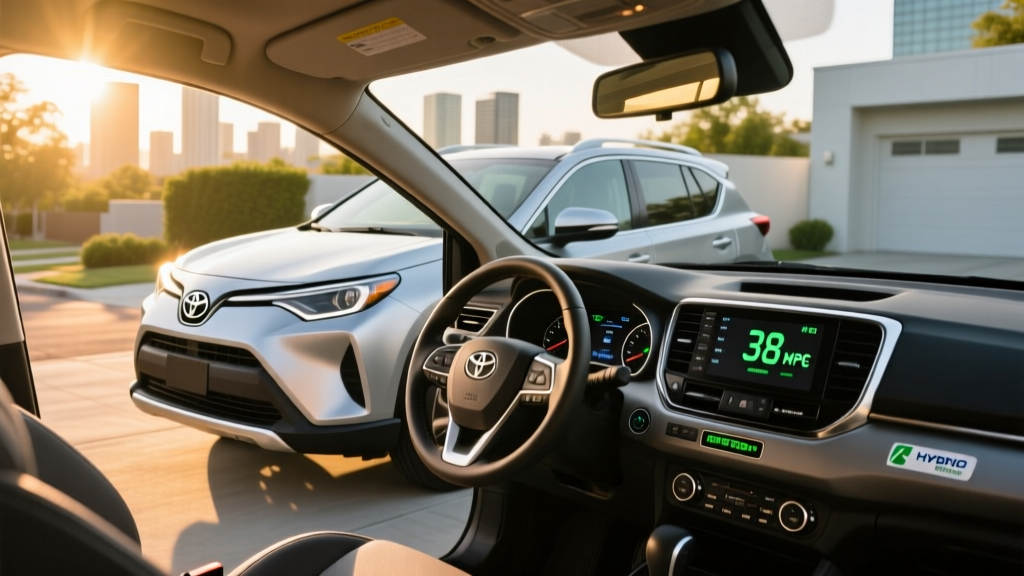
Nine years after it rolled off the lot, the 2017 Toyota RAV4 AWD Hybrid remains one of the most searched used hybrid SUVs on the market — and for good reason. With EPA-rated fuel economy that still rivals brand-new compact crossovers, a proven all-wheel-drive system, and Toyota's reputation for hybrid longevity, this model represents a compelling entry point for buyers who want hybrid efficiency without the new-car premium or the charging logistics of a plug-in vehicle.
But buying a nearly decade-old hybrid comes with specific questions that don't apply to gas-only used cars: How has the hybrid battery held up? What does replacement cost? And does the real-world MPG match the EPA sticker? This guide answers every question a 2026 used-car shopper needs to ask before signing on a 2017 RAV4 Hybrid.
HEV vs PHEV: What the 2017 RAV4 Hybrid Actually Is
The 2017 RAV4 Hybrid is a conventional hybrid electric vehicle (HEV). It pairs a gasoline engine with electric motors and a small battery pack that recharges through regenerative braking and engine power. You never plug it in. There is no electric-only driving range to manage, no charging cable to deal with, and no home charger to install.
| Feature | 2017 RAV4 Hybrid (HEV) | RAV4 Prime (PHEV, 2021+) |
|---|---|---|
| Plug-in charging | Not required | Required for EV range |
| Electric-only range | None (EV mode limited to ~1 mi at low speed) | 42 miles EPA |
| Battery capacity | ~1.6 kWh (NiMH) | 18.1 kWh (lithium-ion) |
| Federal tax credit (new) | None | $7,500 (when eligible) |
| Combined HP | 194 HP | 302 HP |
Toyota did not introduce the plug-in RAV4 Prime until the 2021 model year. If you see "RAV4 Hybrid" on a 2017 listing, it is the self-charging HEV — no plug, no EV mode beyond brief low-speed maneuvering.
Fuel Economy: EPA Ratings vs Real-World MPG
The EPA rates the 2017 RAV4 AWD Hybrid at 34 MPG city / 30 MPG highway / 32 MPG combined, according to fueleconomy.gov. Those figures held up well for a compact AWD SUV in 2017, and they remain competitive against many 2026 gas-only crossovers.
| Driving Scenario | EPA Estimate | Real-World Expectation |
|---|---|---|
| City | 34 MPG | 33–37 MPG (hybrids excel in stop-and-go) |
| Highway (70 mph) | 30 MPG | 27–30 MPG (less regen benefit at steady speed) |
| Combined | 32 MPG | 30–34 MPG depending on driving mix |
| Cold weather (below 30°F) | — | 27–30 MPG (engine runs more for cabin heat) |
Real-world note: Hybrids typically exceed their EPA city rating because regenerative braking recovers energy in stop-and-go traffic. Highway driving is where the advantage narrows — the electric motor contributes less at sustained high speeds, and the 2.5-liter Atkinson-cycle engine does most of the work. Owners who commute in urban traffic often report 35–37 MPG. Those doing mostly interstate driving should expect closer to 28 MPG.
Compared to the gas-only 2017 RAV4 AWD (EPA 25 MPG combined), the hybrid saves roughly 3–4 gallons per 100 miles driven. At $3.25/gallon and 12,000 annual miles, that translates to approximately $470–$520 in annual fuel savings.
Powertrain and Performance Specs
| Specification | 2017 RAV4 AWD Hybrid |
|---|---|
| Engine | 2.5L 4-cylinder Atkinson cycle |
| Combined system horsepower | 194 HP |
| Front motor | 105 kW (141 HP) |
| Rear motor (AWD) | 50 kW (67 HP) |
| Transmission | eCVT (planetary gearset, no belt) |
| 0–60 mph | ~7.8 seconds |
| Drivetrain | Electronic AWD (eAWD, no mechanical driveshaft) |
| Towing capacity | 1,750 lbs |
| Hybrid battery | ~1.6 kWh, nickel-metal hydride (NiMH) |
The AWD system in the 2017 RAV4 Hybrid is worth explaining: there is no mechanical connection between the front and rear axles. Instead, a dedicated rear electric motor powers the rear wheels when the system detects slip or during hard acceleration. This "eAWD" approach means fewer moving parts than a traditional AWD system, which contributes to reliability — but it also means the rear motor only engages in specific conditions, not continuously. In heavy snow or off-pavement situations, it provides adequate traction for most drivers but is not a substitute for a dedicated off-road vehicle.
Hybrid Battery Lifespan, Warranty, and Replacement Cost
Toyota Hybrid Battery Warranty
When new, the 2017 RAV4 Hybrid's battery was covered for 8 years / 100,000 miles (10 years / 150,000 miles in California and states that adopted CARB emissions standards). As of 2026, most original warranties have expired by time but may still apply by mileage for low-use vehicles. Check the in-service date on the vehicle's Carfax.
The NiMH battery pack in the 2017 RAV4 Hybrid is one of the most proven hybrid batteries Toyota has built. Data from fleet operators and long-term owners shows these packs routinely last 150,000–200,000 miles before significant capacity loss. Unlike lithium-ion packs in full EVs, NiMH degrades gradually rather than experiencing sudden capacity cliffs.
Battery replacement cost (2026):
- New OEM Toyota pack: $3,500–$4,500 (parts) plus ~$500–$800 labor
- Refurbished/remanufactured pack: $1,500–$2,500 installed
- Individual module replacement: $500–$1,200 (if only 1–2 of the 34 modules have failed — a common repair at hybrid specialty shops)
Before purchasing a used 2017 RAV4 Hybrid, request a hybrid battery health check. Many Toyota dealers can pull the battery's internal resistance readings and state-of-health data through the OBD-II port. A healthy pack should show balanced module voltages (within 0.2V of each other). Independent hybrid shops often perform this test for $50–$100.
Reliability, Safety, and Long-Term Ownership Costs
The 2017 RAV4 Hybrid benefits from Toyota's Hybrid Synergy Drive, a system with over two decades of refinement by that model year. The eCVT transmission contains no belts, clutches, or traditional friction components — it is a planetary gearset that is essentially wear-free under normal use. Brake pad life is extended significantly by regenerative braking; many owners report original brake pads lasting 80,000+ miles.
The NHTSA gave the 2017 RAV4 a 5-star overall safety rating. The IIHS rated it a Top Safety Pick when equipped with the optional front crash prevention system.
Common issues to watch for at high mileage:
- Hybrid battery cooling fan clogging (dust/pet hair) — clean the intake filter behind the rear seat annually
- 12V auxiliary battery failure (standard lead-acid, $180–$250 replacement every 4–5 years)
- Water pump (electric, $400–$600 replacement around 120,000–150,000 miles)
- Inverter coolant pump inspection at high mileage
Overall maintenance costs remain lower than the gas-only RAV4 because the hybrid system eliminates the alternator, starter motor, and traditional transmission — all common failure points in conventional vehicles.
Pricing and Tax Credit Eligibility in 2026
The 2017 RAV4 AWD Hybrid originally started at approximately $29,030 MSRP (XLE trim) and $34,030 (Limited trim). In the 2026 used market, expect to pay:
- $14,000–$18,000 for an XLE with 80,000–120,000 miles
- $18,000–$22,000 for a Limited or Platinum with under 80,000 miles
- $10,000–$14,000 for high-mileage examples (130,000+ miles) or vehicles needing battery service
Federal tax credit: The 2017 RAV4 Hybrid does not qualify for the IRS §30D federal tax credit. That credit applies only to plug-in electric vehicles (BEVs and PHEVs) meeting battery sourcing, MSRP, and buyer income requirements. Conventional HEVs like this RAV4 are excluded. Some states offer modest rebates for used hybrid purchases, but these vary widely — check your state's energy office or AFDC for current local incentives.
Who Should Buy This Hybrid vs a PHEV or Full EV?
Choose the 2017 RAV4 AWD Hybrid if:
- You cannot charge at home (apartment, street parking, no garage)
- Your budget is under $20,000
- You want AWD for snow/rain without the complexity of plug-in charging
- You drive 12,000+ miles/year and want reliable, low-maintenance efficiency
- You want a proven vehicle with widely available parts and hybrid-savvy mechanics
Consider a PHEV (like the RAV4 Prime) if:
- You can charge at home (Level 2) and commute under 40 miles round-trip
- You want electric-only daily driving with gas flexibility for road trips
- Your budget allows $28,000+ for a used 2021+ RAV4 Prime
Consider a full EV if:
- You have reliable home or workplace charging
- You want zero tailpipe emissions and minimal drivetrain maintenance
- You qualify for the federal used-EV credit (up to $4,000 under §25E for qualifying pre-owned BEVs)
Pros and Cons at a Glance
Pros
- 32 MPG combined EPA — still competitive in 2026
- Proven NiMH battery with 150K–200K mile typical lifespan
- No plug-in charging required — works anywhere gas is sold
- eAWD system with fewer mechanical parts than traditional AWD
- Strong resale value and parts availability
- Lower brake wear due to regenerative braking
Cons
- No electric-only driving range
- Modest 194 HP — adequate but not quick for highway merging
- Cargo space slightly reduced vs gas RAV4 (battery under rear seat)
- Infotainment system feels dated by 2026 standards (no Apple CarPlay/Android Auto in 2017)
- Hybrid battery replacement is a real cost at high mileage ($2K–$5K)
- No federal tax credit eligibility
Frequently Asked Questions
How many MPG does the 2017 RAV4 AWD Hybrid get?
The EPA rates it at 34 city / 30 highway / 32 combined MPG. Real-world owners typically see 30–37 MPG depending on driving conditions. City commuters often exceed the EPA estimate thanks to regenerative braking, while sustained highway driving yields closer to 27–30 MPG.
Does the 2017 RAV4 Hybrid need to be plugged in?
No. This is a conventional hybrid (HEV), not a plug-in hybrid (PHEV). The battery charges through regenerative braking and the gasoline engine. You fuel it like any other car at a gas station.
How long does the hybrid battery last, and what does replacement cost?
The NiMH battery typically lasts 150,000–200,000 miles. A new OEM replacement runs $3,500–$4,500 for parts plus labor. Refurbished packs cost $1,500–$2,500 installed. Individual module repairs can be as low as $500–$1,200.
Is the 2017 RAV4 Hybrid reliable at high mileage?
Yes. The Hybrid Synergy Drive system is one of Toyota's most durable powertrains. The eCVT has no belts or clutches to wear out. Main concerns at high mileage are the hybrid battery, electric water pump, and keeping the battery cooling fan clean.
Does the 2017 RAV4 Hybrid qualify for any tax credit?
No federal tax credit applies to conventional hybrids. The IRS §30D credit is reserved for plug-in vehicles (BEVs and PHEVs). Check your state's energy office for any local used-hybrid incentives.
How does the AWD system work?
The 2017 RAV4 Hybrid uses electronic AWD (eAWD). A separate rear electric motor powers the rear wheels when slippage is detected or during hard acceleration. There is no mechanical driveshaft connecting the front and rear axles, reducing weight and maintenance.
What should I check before buying a used 2017 RAV4 Hybrid?
Request a hybrid battery health check (module voltage balance and internal resistance), verify the 12V battery age, inspect the hybrid battery cooling fan intake for blockage, and confirm the vehicle's maintenance history — especially inverter coolant service intervals.