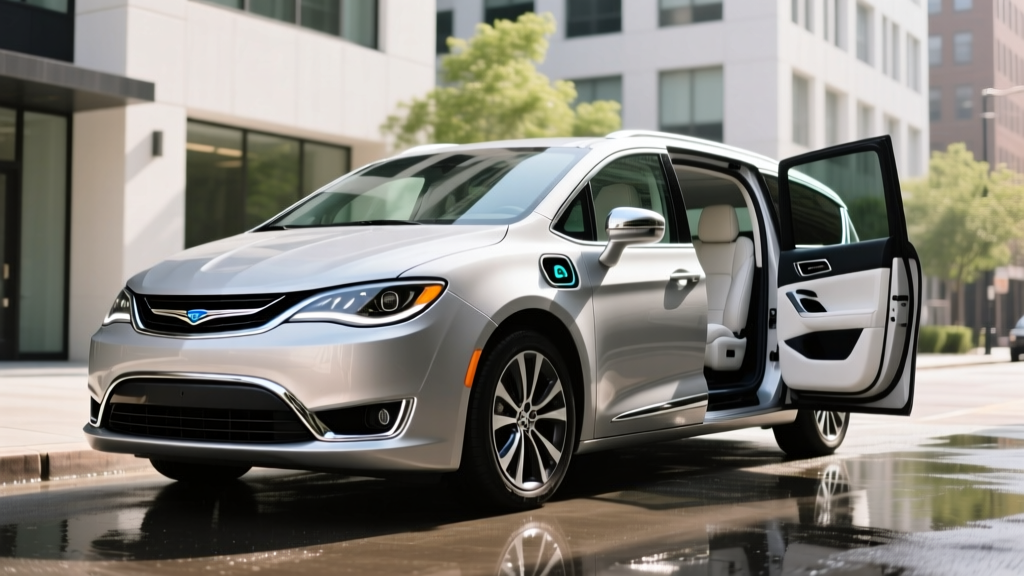
The 2017 Chrysler Pacifica Hybrid was the first plug-in hybrid minivan to reach the U.S. market, offering families the ability to complete school runs and errands on electricity before the gas engine ever fired up. Nearly a decade later, it remains one of the most practical used PHEV purchases available — but buying a nearly 10-year-old plug-in hybrid requires careful evaluation of battery health, warranty transferability, and real-world efficiency. This guide breaks down every number you need to make an informed decision.
HEV vs PHEV: Understanding What the Pacifica Hybrid Actually Is
The 2017 Pacifica Hybrid is a plug-in hybrid electric vehicle (PHEV), not a conventional hybrid (HEV). The distinction matters enormously for ownership:
- PHEV (this vehicle): Has a larger 16 kWh battery you can plug in to charge. Delivers 33 miles of electric-only driving before the gas engine engages. Requires access to a Level 1 (120V) or Level 2 (240V) outlet to realize its full value.
- HEV (conventional hybrid): Has a small battery charged only by regenerative braking and the engine. Cannot plug in. Offers no meaningful electric-only range but still improves fuel economy — especially in stop-and-go city driving.
If you cannot charge at home or work, the Pacifica Hybrid still functions as a conventional hybrid once the battery is depleted — but you'll miss the efficiency gains that justify its higher original price.
Electric-Only Range and Total Range
When new, the 2017 Pacifica Hybrid earned an EPA-rated 33 miles of electric-only range. In real-world use, expect that figure to vary significantly:
- Ideal conditions (55-65°F, city driving, gentle acceleration): 30-35 miles electric
- Highway driving at 70+ mph: 22-27 miles electric (higher speeds drain the battery faster)
- Cold weather (below 30°F): 18-24 miles electric (cabin heating and battery chemistry reduce usable capacity)
EPA Electric Range: 33 miles | Real-World Expectation: 22-30 miles depending on temperature and driving style | Total Combined Range (electric + gas): approximately 566 miles with a full tank and full battery
The 16-gallon fuel tank combined with the battery gives this minivan serious road-trip legs. Once the battery is depleted, the vehicle operates as a conventional hybrid with an EPA-rated 32 MPG combined — competitive with many non-plug-in minivans of the era.
Fuel Economy: EPA Numbers vs Real-World Results
| Metric | EPA Rating | Real-World Expectation |
|---|---|---|
| MPGe (electric + gas combined) | 84 MPGe | 70-90 MPGe (depends on plug-in frequency) |
| Gas-only combined MPG | 32 MPG | 28-34 MPG |
| Gas-only city MPG | 32 MPG | 30-35 MPG (regen braking helps in traffic) |
| Gas-only highway MPG | 31 MPG | 27-31 MPG |
| Electric-only efficiency | 2.0 kWh/mile (32 kWh/100mi) | 2.0-2.5 kWh/mile |
The Pacifica Hybrid's real-world MPG depends almost entirely on how often you plug it in. Owners who charge nightly and drive under 30 miles per day may use almost no gasoline for weeks. Those who never charge will see roughly 30-32 MPG combined — still respectable for a 5,000-pound minivan, but not dramatically better than the gas-only Pacifica's 22 MPG combined.
Powertrain and Battery Specifications
| Specification | Detail |
|---|---|
| Engine | 3.6L Atkinson-cycle V6 |
| Electric Motors | Two integrated motors (one drives wheels, one starts engine/generates) |
| Combined System Output | 260 horsepower |
| Transmission | Si-EVT (single-speed electrically variable transmission) |
| Battery Capacity (Total) | 16 kWh |
| Battery Usable Capacity | ~13 kWh (system buffer protects longevity) |
| Battery Chemistry | Lithium-ion (NMC) |
| 0-60 mph | ~7.1 seconds |
| Drivetrain | Front-wheel drive |
| Curb Weight | 5,032 lbs |
The dual-motor e-CVT system is smooth and unobtrusive. Unlike some PHEVs that feel underpowered once the battery depletes, the 3.6L V6 provides adequate passing power on the highway even in hybrid mode. The transition between electric and gas operation is among the seamless in the PHEV segment — most passengers won't notice when the engine fires up.
Charging Times and Capabilities
The 2017 Pacifica Hybrid cannot DC fast charge. It is limited to AC charging only:
- Level 1 (120V household outlet): ~14 hours for a full charge (using the included cord). Plugging in overnight recovers roughly 18-22 miles of range in 10-12 hours.
- Level 2 (240V, 32A): ~2 hours for a full charge. A home Level 2 station is strongly recommended for daily PHEV ownership.
The charge port uses a standard J1772 connector, compatible with virtually every public Level 2 station in the U.S. The onboard charger maxes out at approximately 6.6 kW on Level 2.
What to Expect from a Used 2017 Pacifica Hybrid Battery
Battery Warranty: 8 years / 100,000 miles (10 years / 150,000 miles in CARB states including California, New York, Massachusetts, and others adopting California emissions standards). Warranty covers defects and capacity loss below 70% of original capacity.
2026 Status: Original 8-year warranties have expired for most 2017 models. However, vehicles first sold in CARB states may retain coverage through 2027 if under 150,000 miles. Always verify warranty status with a Chrysler dealer using the VIN.
Lithium-ion battery degradation in the Pacifica Hybrid has been moderate based on owner reports. At 8-9 years old with average mileage, expect the battery to retain roughly 75-85% of its original capacity, translating to approximately 25-28 miles of electric range instead of the original 33. Some high-mileage examples have dropped below 70%, which would have qualified for warranty replacement if caught within the coverage window.
Battery replacement cost: A new OEM battery pack currently runs between $7,500 and $9,500 including labor. Refurbished packs are occasionally available for $4,000-$6,000 through independent EV shops. Given this cost, obtaining a battery State of Health (SoH) report from a dealer before purchase is essential — request a diagnostic scan showing current capacity percentage.
Pricing and Tax Credit Eligibility
The 2017 Pacifica Hybrid originally started at approximately $41,995 (Premium trim) and reached over $47,000 for the Platinum trim. In 2026, used examples typically trade between $14,000 and $24,000 depending on mileage, condition, and battery health.
Federal Tax Credits for Used PHEV Purchases
The original $7,500 federal tax credit that applied to new 2017 Pacifica Hybrid purchases is long gone. However, under the current IRS Used Clean Vehicle Credit (§25E), you may qualify for up to $4,000 or 30% of the sale price (whichever is lower) when buying from a licensed dealer. Key requirements:
- Sale price must be $25,000 or less (many 2017 Pacifica Hybrids qualify)
- Buyer adjusted gross income: $75,000 single / $112,500 head of household / $150,000 joint
- Vehicle must be at least 2 model years old (2017 qualifies)
- Must purchase from a licensed dealer (private-party sales do not qualify)
- Credit is non-refundable — you must have tax liability to claim it
- The same vehicle can only generate this credit once in its lifetime — verify the previous owner did not claim it
State incentives vary by jurisdiction. Check your state's energy office or the Alternative Fuels Data Center for local rebates that may stack with the federal credit.
Reliability, Common Issues, and Ownership Costs
The 2017 Pacifica Hybrid's first model year brought predictable teething issues. According to NHTSA complaint data and owner forums, watch for these specific concerns:
- High-voltage battery coolant leak: Some early models developed coolant seepage near the battery enclosure. Verify recall T56 (high-voltage battery shutdown risk) was completed — Chrysler issued a software update and inspection for affected vehicles.
- Power sliding door and liftgate malfunctions: Shared with the gas Pacifica; electrical gremlins in the door modules are common across 2017-2019 model years.
- Infotainment Uconnect reboots: The 8.4-inch Uconnect system can freeze or reboot; usually resolved with a software flash at the dealer.
- Regenerative braking feel: Some owners report a slight lurch during the transition from regen to friction braking at low speeds — this is a characteristic of the system, not necessarily a defect, but a test drive should feel acceptable to you.
Insurance costs for a used 2017 Pacifica Hybrid average $1,400-$1,900 annually depending on your location and driving record — modestly higher than the gas-only Pacifica due to the high-voltage system repair costs in a collision.
Maintenance advantages: The PHEV system actually reduces wear on some components. Brake pads last significantly longer thanks to regenerative braking (60,000-80,000+ miles is common). The engine runs less frequently, potentially extending oil change intervals — though following the manufacturer's schedule is still recommended.
Pros
- 33 miles of electric range covers most daily family driving
- Minivan practicality — seating for 7, sliding doors, flat-load floor
- Smooth, seamless electric-to-gas transitions
- 32 MPG gas-only when battery is depleted
- Level 2 charging in ~2 hours is quick for a PHEV
- Used pricing now within budget territory for many families
- Potential $4,000 used-EV tax credit lowers effective cost
Cons
- No DC fast charging — road trips rely entirely on the gas engine
- Battery degradation reduces electric range to 25-28 miles at this age
- $7,500-$9,500 battery replacement cost is a serious liability
- Original 8-year battery warranty has expired for most examples
- First model year — more reliability concerns than 2019+ refresh
- Only FWD — no all-wheel-drive option
- Stow 'n Go second-row seats removed to make room for battery (no fold-flat second row)
Who Should Buy the 2017 Pacifica Hybrid — and Who Shouldn't
Choose the 2017 Pacifica Hybrid if:
- You can charge at home (Level 1 overnight is sufficient, Level 2 is ideal)
- Your daily driving is under 30-35 miles with occasional longer trips
- You need minivan space but want to reduce fuel costs
- You find a well-maintained example with a battery SoH above 80%
- You want to avoid full EV range anxiety while still driving on electricity daily
Consider a full EV (like a used Tesla Model X or upcoming electric minivans) if:
- Your daily driving regularly exceeds 40 miles and you want zero gas use
- You have reliable DC fast-charging access for road trips
- You want minimal maintenance with no engine, oil changes, or exhaust system
Consider the gas-only Pacifica or a conventional HEV (like the Toyota Sienna hybrid) if:
- You cannot charge at home or work
- You need Stow 'n Go fold-flat second-row seating (the battery eliminates this in the PHEV)
- You want a simpler ownership experience with no high-voltage battery liability
Frequently Asked Questions
How many MPG does the 2017 Pacifica Hybrid get?
The EPA rates the 2017 Pacifica Hybrid at 84 MPGe when combining electric and gas operation, and 32 MPG combined (32 city / 31 highway) when running on gasoline alone after the battery is depleted. Real-world results vary from 28-35 MPG in gas-only mode depending on driving conditions and temperature.
How far can the 2017 Pacifica Hybrid go on electric only?
The EPA rated it for 33 miles of electric-only range when new. A 2017 model in 2026 will likely deliver 25-30 miles of real-world electric range depending on battery degradation, temperature, and driving style. Highway speeds and cold weather reduce this further to approximately 18-24 miles.
Does the 2017 Pacifica Hybrid qualify for any tax credit in 2026?
It does not qualify for the new-vehicle §30D credit. However, under the IRS §25E Used Clean Vehicle Credit, you may receive up to $4,000 (or 30% of the sale price, whichever is lower) if you buy from a licensed dealer for $25,000 or less and meet income requirements ($75K single / $150K joint). The vehicle must not have previously been used to claim this credit. Consult a tax professional for your specific eligibility.
Is the 2017 Pacifica Hybrid reliable?
As a first-year PHEV, the 2017 model has more reported issues than the refreshed 2019+ versions. Key concerns include high-voltage battery coolant leaks (recall T56), power door module glitches, and Uconnect infotainment freezes. The powertrain itself is generally robust. A pre-purchase inspection with battery SoH readout is strongly recommended. The IIHS gave the 2017 Pacifica acceptable ratings in most crash tests, though headlight ratings were poor.
What does it cost to replace the Pacifica Hybrid battery?
A new OEM 16 kWh battery pack costs approximately $7,500-$9,500 installed at a Chrysler dealer. Refurbished packs from independent EV shops run $4,000-$6,000. Before purchasing any used Pacifica Hybrid, budget for the possibility of a battery replacement within your ownership period — especially if the current SoH is below 80%.
Can the 2017 Pacifica Hybrid fast charge?
No. The Pacifica Hybrid is limited to AC charging only — Level 1 (120V, ~14 hours full charge) or Level 2 (240V, ~2 hours full charge at 6.6 kW). There is no DC fast-charging capability. For a PHEV with 33 miles of range, this is acceptable for overnight home charging but means road trips rely entirely on the gasoline engine.
Hybrid vs PHEV vs EV — which minivan is right for me?
If you can charge at home and drive under 35 miles daily, the PHEV (this Pacifica Hybrid) gives you electric commuting with gas-engine road-trip flexibility. If you cannot charge at home, a conventional hybrid like the Toyota Sienna (36 MPG combined, no plug needed) is the better choice. If you want zero emissions and can charge at home plus use DC fast chargers on road trips, a full EV minivan is worth considering — though used options remain limited in 2026.