Quick Verdict: A Discontinued Hybrid Worth Considering on the Used Market
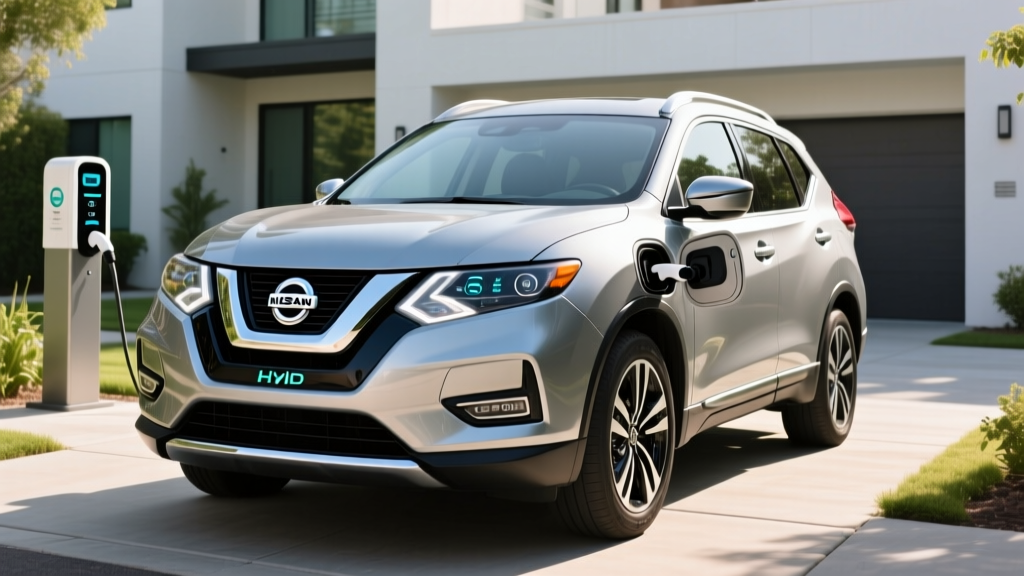
The 2017 Nissan Rogue Hybrid was a one-generation experiment — Nissan paired a 2.0-liter four-cylinder with a small electric motor and a compact lithium-ion battery to create a conventional hybrid (HEV) version of its best-selling crossover. It was sold only for the 2017 and 2018 model years before Nissan quietly dropped the hybrid variant. Today, as a used purchase, the Rogue Hybrid offers legitimate fuel savings over the gas-only Rogue without requiring any change in driving habits: no plugging in, no range anxiety, just better MPG.
But buying a nearly decade-old hybrid raises specific questions. How much does the battery degrade? What does replacement cost? And does the real-world fuel economy actually deliver on the EPA promise? This guide answers those questions with hard numbers.
The 2017 Nissan Rogue Hybrid is a conventional hybrid (HEV), not a plug-in hybrid (PHEV). It cannot be plugged in and has no electric-only driving range. The battery recharges through regenerative braking and the gasoline engine. If you're looking for electric-only commuting, you'd need a PHEV like the Toyota RAV4 Prime or a full BEV. The Rogue Hybrid simply uses its electric motor to assist the gas engine and enable brief engine-off coasting, reducing fuel consumption.
Fuel Economy: EPA Ratings and Real-World MPG
The 2017 Rogue Hybrid was offered in front-wheel drive (FWD) and all-wheel drive (AWD) configurations, with a slight MPG penalty for AWD. Here are the official EPA fuel economy figures:
| Drivetrain | City | Highway | Combined |
|---|---|---|---|
| FWD | 33 | 35 | 34 |
| AWD | 31 | 34 | 33 |
For comparison, the 2017 gas-only Rogue FWD rated 26 city / 33 highway / 29 combined — so the hybrid delivers roughly a 5 MPG combined improvement, or about 17% better fuel economy.
Real-World MPG: What Owners Actually Report
Conventional hybrids tend to perform close to or even slightly above EPA city estimates because stop-and-go driving maximizes regenerative braking and electric-motor assist. Highway driving is where hybrids lose their advantage — the gas engine does most of the work at sustained speeds.
Owner-reported data from fuel-tracking platforms suggests the 2017 Rogue Hybrid averages 30–33 MPG combined in mixed driving. City-heavy commutes with frequent stops can push toward 34–35 MPG, while sustained highway trips at 75+ mph typically drop to 28–30 MPG. Cold weather (below 30°F) reduces efficiency by roughly 5–8% as the engine runs more frequently to provide cabin heat and maintain battery temperature.
Powertrain Specs: Engine, Motor, and Combined Output
| Specification | Value |
|---|---|
| Gas Engine | 2.0L inline-4 (QR20DE) |
| Engine Horsepower | 135 hp @ 6,000 rpm |
| Electric Motor | 30 kW (40 hp) |
| Net System Horsepower | 176 hp |
| Hybrid Battery | 0.6 kWh lithium-ion (not plug-in) |
| Transmission | Xtronic CVT (continuously variable) |
| Drivetrain | FWD or AWD (AWD uses rear motor assist) |
| 0–60 mph | ~8.5 seconds (estimated) |
| Fuel Tank | 14.5 gallons |
| Total Driving Range | ~478 miles (FWD, combined EPA) |
The 0.6 kWh battery pack is tiny by modern standards — it's not designed for electric-only driving. Instead, it buffers energy captured from regenerative braking and deploys it for torque-fill during acceleration and brief engine-off coasting at low speeds. This is the same fundamental architecture Toyota pioneered with the Prius, just applied to a compact crossover.
Battery Health, Warranty, and Replacement Cost
Nissan covered the 2017 Rogue Hybrid's lithium-ion battery for 8 years / 100,000 miles (96 months / 100,000 miles), whichever comes first. In California Air Resources Board (CARB) states, the warranty extended to 10 years / 150,000 miles. This warranty covers battery capacity loss below a defined threshold and defects — not normal gradual degradation.
For a 2017 model, the standard 8-year/100,000-mile factory hybrid battery warranty has now expired as of 2025 (or 2027 for CARB-state vehicles). This is the single most important factor when evaluating a used Rogue Hybrid today.
Battery Degradation: What to Expect
Nissan's hybrid battery in the Rogue is small and operates in a narrow state-of-charge window (roughly 40–80%), which is gentler on lithium-ion cells than the deep cycles a full EV battery experiences. Based on owner reports and general hybrid battery longevity data:
- Typical degradation at 8–10 years: 10–20% capacity loss
- Impact on MPG: Minimal — a degraded hybrid battery may reduce fuel economy by 1–2 MPG as the system relies more on the gas engine
- Catastrophic failure rate: Low but not zero; most hybrid batteries last 150,000–200,000 miles before needing replacement
Battery Replacement Cost
If the hybrid battery fails out of warranty, replacement costs typically fall in the $2,000–$4,000 range including parts and labor. Refurbished or aftermarket battery packs can reduce this to $1,500–$2,500. Nissan dealerships charge a premium for new OEM units. Given the used market value of a 2017 Rogue Hybrid (roughly $12,000–$18,000 depending on mileage and condition in early 2026), a battery replacement represents a significant percentage of the vehicle's value — factor this into your purchase decision.
Pre-purchase tip: Ask for a hybrid battery health check. Some Nissan dealers can read the battery's state-of-health (SoH) via the onboard diagnostic system. Independent hybrid specialists can also perform this test. If SoH is below 80%, negotiate the price down to account for eventual replacement.
Pricing and Tax Credit Eligibility
The 2017 Rogue Hybrid was offered in two trims:
- SV Hybrid: Original MSRP ~$29,560 (FWD) / ~$30,910 (AWD)
- SL Hybrid: Original MSRP ~$32,990 (FWD) / ~$34,340 (AWD)
On the used market in 2026, expect to pay roughly $12,000–$18,000 depending on mileage, condition, trim, and region. Lower-mileage SL AWD examples command the top of that range.
Does the 2017 Rogue Hybrid Qualify for Any Tax Credit?
No. The 2017 Nissan Rogue Hybrid does not qualify for the federal §30D New Clean Vehicle Credit. That credit applies only to new plug-in electric vehicles (BEVs and PHEVs) meeting specific battery capacity, critical-mineral sourcing, MSRP caps, and buyer income limits. Conventional hybrids (HEVs) like the Rogue Hybrid have never been eligible for the federal EV tax credit.
Some states historically offered small rebates for conventional hybrids, but most of these programs have ended or shifted exclusively to plug-in vehicles. Check your state's current incentive programs, but do not expect any tax credit or rebate for purchasing a used 2017 Rogue Hybrid.
Reliability and Common Issues
The 2017 Rogue Hybrid shares most of its platform with the conventional Rogue, which has an average reliability record. The hybrid-specific components (electric motor, inverter, battery pack) have generally proven durable, but a few issues are worth watching:
- CVT transmission: Nissan's Xtronic CVTs from this era have a mixed reliability history. While the hybrid's CVT is different from the gas-only Rogue's unit, some owners report shuddering or hesitation at low speeds. A pre-purchase inspection should include a CVT fluid check and a test drive focusing on low-speed behavior.
- Regenerative braking feel: The brake pedal can feel grabby or inconsistent as the system transitions between regenerative and friction braking. This is normal for the design but worth experiencing on a test drive.
- Reduced cargo space: The hybrid battery pack sits under the cargo floor, eliminating the spare tire and slightly reducing cargo volume compared to the gas Rogue. You get a tire inflator kit instead of a spare.
- AWD system (if equipped): The AWD Rogue Hybrid uses a rear-mounted electric motor rather than a mechanical driveshaft. This is efficient but provides less aggressive torque distribution than a traditional AWD system — it's adequate for rain and light snow, not serious off-road use.
The NHTSA gave the 2017 Rogue (including hybrid variants) a 4-star overall safety rating. The IIHS did not separately test the hybrid, but the conventional 2017 Rogue earned Good ratings in most crash tests.
Who Should Buy the 2017 Rogue Hybrid — And Who Shouldn't
✓ Buy It If
- You want better MPG without changing habits (no plugging in)
- Your commute is city-heavy with frequent stops
- You want a compact crossover with AWD availability
- You're budget-conscious and buying used saves you $15,000+ vs. a new hybrid
- You drive 12,000–15,000 miles/year and want to reduce fuel costs by ~$400–$600 annually vs. the gas Rogue
✗ Skip It If
- You want electric-only driving or a plug-in experience
- You need maximum cargo space or a spare tire
- You're concerned about out-of-warranty hybrid battery replacement cost
- You want the latest ADAS features (this generation lacks modern driver-assist suites)
- You do mostly highway driving, where the hybrid advantage shrinks
Hybrid vs PHEV vs Full EV — Which Fits You?
| Factor | HEV (Rogue Hybrid) | PHEV (e.g., RAV4 Prime) | BEV (e.g., Ioniq 5) |
|---|---|---|---|
| Plug-in required? | No | Optional (best with home charging) | Yes — mandatory |
| Electric-only range | 0 miles | 25–42 miles | 200–350+ miles |
| Federal tax credit | None | Up to $7,500 (new, if eligible) | Up to $7,500 (new, if eligible) |
| Fuel cost (per mile) | ~$0.10–$0.12 | ~$0.04 (electric) / $0.10 (gas) | ~$0.03–$0.05 |
| Best for | No home charging access | Short commute + road trips | Home charging + low operating cost |
Frequently Asked Questions
How many MPG does the 2017 Nissan Rogue Hybrid get?
The EPA rates the FWD model at 33 city / 35 highway / 34 combined MPG, and the AWD model at 31 city / 34 highway / 33 combined MPG. Real-world owners report 30–33 MPG combined, with city-heavy driving pushing toward the higher end and sustained highway driving dropping to 28–30 MPG.
Does the 2017 Rogue Hybrid need to be plugged in?
No. This is a conventional hybrid (HEV). The battery charges through regenerative braking and the gasoline engine. There is no plug, no charging cable, and no electric-only driving mode. You fuel it exactly like a gas car.
Is the hybrid battery reliable, and what does replacement cost?
Nissan's hybrid batteries in this generation are generally reliable, with most lasting 150,000–200,000 miles. The original 8-year/100,000-mile warranty has now expired for most 2017 models. Out-of-warranty replacement costs $2,000–$4,000. Request a battery state-of-health check before purchasing.
Does the 2017 Rogue Hybrid qualify for any tax credit?
No. Conventional hybrids are not eligible for the federal §30D Clean Vehicle Credit. That credit applies only to new plug-in vehicles (BEVs and PHEVs) meeting battery sourcing, MSRP, and income requirements. No state-level hybrid incentives are widely available for used purchases in 2026.
How does the Rogue Hybrid compare to a Toyota RAV4 Hybrid?
The 2017 Toyota RAV4 Hybrid (32 city / 28 highway / 30 combined EPA for AWD) is slightly less efficient on paper but benefits from Toyota's stronger hybrid-system reliability reputation and better cargo space. The Rogue Hybrid edges out the RAV4 Hybrid on highway MPG. Both are solid used purchases, but the RAV4 Hybrid typically commands a higher resale price and has broader dealer support for hybrid-specific service.
What's the difference between the Rogue Hybrid and the gas-only Rogue?
Beyond the powertrain, the Rogue Hybrid sacrifices the spare tire (replaced by an inflator kit) and a small amount of under-floor cargo space due to the battery pack. It also came only in SV and SL trims — no base S trim was offered. The driving experience is nearly identical, with the hybrid providing slightly smoother low-speed acceleration thanks to electric motor torque-fill.