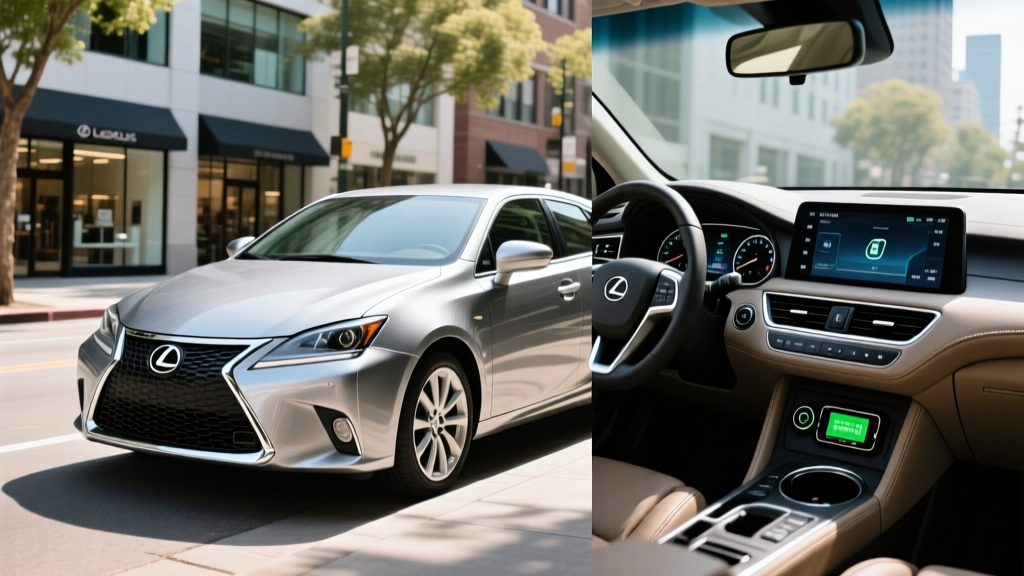
The 2017 Lexus CT 200h occupies a specific niche in the used electrified-car market: a premium compact hatchback hybrid that prioritizes fuel efficiency and low running costs over performance. Lexus discontinued the CT in the U.S. after the 2017 model year, which means every example on the road today is a used vehicle. For buyers in 2026 weighing a budget-friendly hybrid against a newer plug-in hybrid (PHEV) or full battery-electric vehicle (BEV), the CT 200h remains a data point worth examining — especially given its Toyota-sourced powertrain and strong reliability record.
This guide covers the 2017 Lexus CT 200h's real-world and EPA fuel economy, powertrain specifications, hybrid battery longevity and replacement cost, tax credit eligibility, and how it stacks up against modern PHEVs and EVs for today's buyers.
HEV vs PHEV: What the 2017 Lexus CT 200h Actually Is
Before diving into specs, it's critical to establish what the CT 200h is — and what it isn't. The 2017 Lexus CT 200h is a conventional hybrid electric vehicle (HEV), not a plug-in hybrid (PHEV). This distinction matters for charging expectations, electric-only capability, and tax credit eligibility.
| Feature | HEV (2017 CT 200h) | PHEV (e.g., Toyota Prius Prime) |
|---|---|---|
| Plug-in charging | No — charges via regenerative braking and engine | Yes — Level 1/Level 2 AC charging |
| Electric-only range | ~1 mile at very low speed | 25–44 miles (model-dependent) |
| Battery capacity | 1.3 kWh (NiMH) | 13.6–18.1 kWh (lithium-ion) |
| Federal tax credit (§30D) | Not eligible | Up to $7,500 (if eligible, new only) |
| Primary fuel | Gasoline (electric assist only) | Electricity + gasoline |
The CT 200h's hybrid system recovers energy during braking and deceleration, storing it in a small nickel-metal hydride (NiMH) battery. The electric motor assists the gasoline engine during acceleration and enables brief electric-only movement at very low speeds (typically under 25 mph, for roughly a mile or less). You never plug it in. The gas engine is always the primary power source.
Fuel Economy: EPA Ratings and Real-World MPG
The 2017 Lexus CT 200h carries EPA fuel economy ratings that remain competitive even by 2026 hybrid standards. According to fueleconomy.gov, the official ratings are:
| Driving Condition | MPG |
|---|---|
| City | 43 MPG |
| Highway | 40 MPG |
| Combined | 42 MPG |
Real-World MPG: What Owners Actually Report
Conventional hybrids like the CT 200h frequently match or exceed their EPA city rating in stop-and-go driving because regenerative braking recovers energy that a gas-only car wastes as heat. Owner-reported data on Fuelly and similar platforms clusters between 39 and 45 MPG combined, with city-heavy commuters sometimes seeing 46–48 MPG in warm weather.
Highway driving at sustained speeds above 70 mph tends to drop efficiency to 37–39 MPG because the electric motor provides minimal assist at cruising speed and the 1.8L engine operates under continuous load. Cold weather (below 35°F) reduces MPG by roughly 5–10% as the engine runs longer to maintain cabin heat and the NiMH battery operates less efficiently.
Total range: With a 10.6-gallon fuel tank and 42 MPG combined, the CT 200h delivers approximately 445 miles per tank. Real-world range with mixed driving: 400–470 miles depending on conditions.
Powertrain Specs: Engine, Motor, and Combined Output
The CT 200h shares its powertrain with the Toyota Prius of the same era — a proven, widely serviced system with abundant parts availability.
| Engine | 1.8L inline-4 Atkinson cycle |
| Engine horsepower | 98 hp @ 5,200 rpm |
| Electric motor output | 80 hp (60 kW) |
| Combined net horsepower | 134 hp |
| Transmission | ECVT (planetary gearset, not a belt-driven CVT) |
| 0–60 mph | ~9.8 seconds |
| Drivetrain | Front-wheel drive |
| Hybrid battery | 1.3 kWh NiMH (nickel-metal hydride) |
| Curb weight | ~3,130 lbs |
The 9.8-second 0–60 time is the CT 200h's most common criticism. This is not a quick car, and merging onto fast-moving highways requires planning. The ECVT, however, is a Toyota-patented planetary gearset — not a traditional belt-and-pulley CVT — and is widely regarded as one of the most durable transmissions in production. There is no belt to wear, no fluid to flush on a short interval.
Hybrid Battery Longevity, Warranty, and Replacement Cost
Battery lifespan is the top concern for any used-hybrid buyer. The 2017 CT 200h uses a 1.3 kWh NiMH battery pack — a chemistry that Toyota/Lexus has deployed across millions of vehicles since the 2001 Prius. NiMH packs are less energy-dense than modern lithium-ion but are exceptionally tolerant of heat and deep cycling.
Original warranty: Lexus covered the hybrid battery for 8 years / 100,000 miles (10 years / 150,000 miles in California-emissions states: CA, CT, ME, MA, NJ, NY, OR, RI, VT, WA). For a 2017 model, the 8-year/100k federal warranty has expired as of 2025. The 10-year/150k CARB-state warranty may still apply through 2027 for low-mileage examples.
Real-World Battery Degradation Data
NiMH hybrid batteries in Toyota/Lexus vehicles commonly last 150,000–200,000+ miles before capacity loss becomes noticeable. "Failure" in a conventional hybrid doesn't mean the car stops running — it means the battery holds less charge, the engine kicks in more frequently, and MPG drops by 3–8 MPG. The vehicle remains drivable.
Taxi and rideshare fleets running Toyota/Lexus hybrids regularly report original batteries surviving past 250,000 miles with moderate degradation. Heat is the primary enemy: vehicles in Arizona, Texas, and Southern California tend to see earlier degradation than those in cooler climates.
Battery Replacement Cost (2026 Estimates)
| Option | Cost Range | Warranty |
|---|---|---|
| New OEM Lexus battery (dealer) | $3,000–$4,200 (parts + labor) | 1 year / unlimited miles |
| Remanufactured battery (e.g., Dorman, Green Bean) | $1,500–$2,400 (parts + labor) | Typically 3–5 years |
| Individual module replacement (specialty shop) | $400–$900 | Varies; typically 1 year |
The remanufactured route is the most popular among used-CT owners. Companies like Green Bean Battery and Dorman offer reconditioned NiMH packs with multi-year warranties at roughly half the OEM cost. Individual module replacement — swapping only the degraded cells within the pack — is viable at specialty hybrid shops and can extend battery life for under $1,000.
Used Pricing in 2026 and Tax Credit Eligibility
The 2017 Lexus CT 200h was originally priced from approximately $31,250 MSRP (base) to around $38,000 (fully loaded with F Sport package and navigation). In the 2026 used market, expect the following price ranges depending on mileage and condition:
| Mileage Range | Typical Asking Price |
|---|---|
| Under 50,000 miles | $18,000–$22,000 |
| 50,000–90,000 miles | $14,000–$18,000 |
| 90,000–130,000 miles | $10,000–$14,000 |
| 130,000+ miles | $7,000–$10,000 |
Does the 2017 CT 200h Qualify for Any Tax Credit?
No. The federal §30D Clean Vehicle Credit applies only to new plug-in vehicles (PHEVs and BEVs) meeting battery sourcing, MSRP, and buyer income requirements. The CT 200h is a conventional hybrid (HEV) with no plug-in capability, so it has never qualified for §30D — not when new, and not on the used market.
The Used Clean Vehicle Credit (§25E) offers up to $4,000 (30% of sale price, capped) for qualifying used PHEVs and BEVs purchased from a dealer for under $25,000. Because the CT 200h is an HEV, it is not eligible for this credit either. Buyers should not expect any federal incentive for this purchase.
Some states offer rebates or HOV-lane access for hybrids, but these vary by jurisdiction and frequently exclude non-plug-in vehicles. Check your state's energy or DMV website for current rules.
Reliability, Safety, and Ownership Costs
The CT 200h benefits from one of the most extensively validated hybrid drivetrains ever produced. The 1.8L 2ZR-FXE engine and Toyota hybrid synergy drive system are shared with the Prius, which has accumulated billions of real-world miles globally. Common failure points are minimal: the water pump (electric, ~$300–$500 replacement) and the 12V auxiliary battery (standard replacement, ~$200) are the most frequently cited maintenance items beyond normal wear.
According to NHTSA, the 2017 CT 200h received a 5-star overall safety rating. The IIHS rated it Good in most crashworthiness categories, though its headlight rating and front crash prevention (not available) reflect its pre-2018 design era.
Annual Ownership Cost Estimate
At 42 MPG combined and $3.25/gallon gasoline (2026 national average), the CT 200h costs approximately $890/year in fuel for a 12,000-mile annual commute. Compare this to a comparable non-hybrid compact (28 MPG combined): approximately $1,390/year. Annual fuel savings: roughly $500.
Insurance rates for the CT 200h are moderate — typically $1,200–$1,600/year depending on state and driver profile. There is no EV-specific insurance surcharge, and repair costs are kept low by Toyota parts commonality.
Pros
- 42 MPG combined EPA; 43–48 MPG achievable in city driving
- Proven Toyota hybrid powertrain with 200,000+ mile battery lifespan
- Premium interior materials, quiet cabin, Lexus dealer service network
- Hatchback cargo versatility (14.3 cu ft rear seats up, 37.4 cu ft folded)
- Low annual fuel cost (~$890/year at 12,000 miles)
- No charging infrastructure needed — works for apartment dwellers
Cons
- Slow: 9.8-second 0–60; underpowered highway merging
- Discontinued in U.S. — limited used inventory, aging infotainment
- No plug-in capability; zero meaningful electric-only range
- No federal tax credit eligibility (HEV)
- Firm ride on F Sport trim with 17-inch wheels
- Pre-2018 safety tech: no standard automatic emergency braking or lane-keeping
CT 200h vs PHEV vs EV: Which Should You Choose?
Choose the 2017 Lexus CT 200h (HEV) if:
- You cannot charge at home (apartment, street parking, no garage)
- Your budget is $10,000–$18,000 and you want a premium-badge hybrid
- You drive 10,000–15,000 miles/year and want simple, proven efficiency
- You want zero charging hassle — fill up at any gas station
Choose a used PHEV (e.g., 2019+ Prius Prime, 2020+ RAV4 Prime) if:
- You can install a Level 2 home charger and have a short commute (under 30 miles)
- You want 25–42 miles of electric-only driving for daily errands
- You want lower per-mile fuel costs on short trips with gas-engine backup for road trips
Choose a used BEV (e.g., 2020+ Chevy Bolt EV, 2021+ Tesla Model 3) if:
- You have reliable home Level 2 charging
- Your daily driving is under 200 miles and you rarely road-trip beyond charger-network coverage
- You want the lowest per-mile energy cost (electricity at ~$0.04–$0.06/mile vs gasoline at ~$0.08–$0.10/mile)
Pre-Purchase Checklist for a Used 2017 CT 200h
If you're evaluating a specific 2017 CT 200h, here's what to verify before purchase:
- Hybrid battery health check: Ask a Lexus dealer or hybrid specialist to run a battery diagnostic (State of Health / SoH report). This takes 15–30 minutes and reveals individual module voltage balance.
- Hybrid system warranty status: Check if the vehicle was originally sold in a CARB state (10-year/150,000-mile battery coverage may still apply through 2027).
- Maintenance records: Confirm engine oil changes (0W-20 synthetic, every 10,000 miles), inverter coolant service, and brake fluid flushes.
- Brake pad life: Regenerative braking extends pad life significantly (original pads often last 80,000+ miles), but at 100,000+ miles, replacement may be due (~$300–$500 per axle).
- 12V battery age: The auxiliary 12V battery (located in the rear cargo area) typically needs replacement every 4–6 years. A weak 12V battery can prevent the hybrid system from starting.
- Tire condition: The CT 200h uses low-rolling-resistance tires; replacements should match the OEM size and LRR spec for optimal MPG.
Frequently Asked Questions
How many MPG does the 2017 Lexus CT 200h hybrid get?
The EPA rates the 2017 CT 200h at 43 MPG city, 40 MPG highway, and 42 MPG combined. Real-world owner reports cluster between 39 and 45 MPG combined, with city-heavy drivers often exceeding the EPA city rating due to regenerative braking efficiency.
Can the 2017 Lexus CT 200h drive on electric power only?
Only marginally. The CT 200h can travel roughly 1 mile at speeds under 25 mph in EV mode, but the 1.3 kWh NiMH battery is too small for meaningful electric-only commuting. The gasoline engine is always the primary power source. This is a conventional hybrid, not a plug-in.
Is the 2017 Lexus CT 200h reliable?
Yes. The CT 200h uses the Toyota Prius-derived hybrid powertrain, which has one of the strongest long-term reliability records in the automotive industry. The ECVT transmission, electric motor, and NiMH battery are all proven components with extensive fleet and taxi validation exceeding 250,000 miles.
How much does it cost to replace the hybrid battery?
A new OEM battery from a Lexus dealer costs approximately $3,000–$4,200 installed. Remanufactured batteries from reputable suppliers cost $1,500–$2,400 installed with a 3–5 year warranty. Individual module replacement at a hybrid specialty shop can cost as little as $400–$900.
Does the 2017 Lexus CT 200h qualify for any federal tax credit?
No. The CT 200h is a conventional hybrid (HEV), not a plug-in vehicle. The federal §30D credit (new vehicles) and §25E credit (used vehicles) both require plug-in capability (PHEV or BEV). The CT 200h is ineligible for any federal EV tax incentive.
What's the difference between the CT 200h and a Prius?
Both share the same 1.8L hybrid powertrain, but the CT 200h features a Lexus-tuned suspension, premium interior materials, more sound insulation, and a hatchback design. The trade-off is added weight (~300 lbs more than a Prius), which slightly reduces MPG (Prius: 52 MPG combined vs CT 200h: 42 MPG combined). The CT 200h prioritizes refinement; the Prius prioritizes maximum efficiency.
Is the 2017 CT 200h a good buy in 2026?
For buyers who cannot charge at home and want a reliable, fuel-efficient premium compact under $18,000, the CT 200h is a strong choice. Its limitations — slow acceleration, dated infotainment, no modern ADAS — are trade-offs for its low running costs and proven durability. Buyers with home charging access and a higher budget may find a used PHEV or BEV more cost-effective over five years.