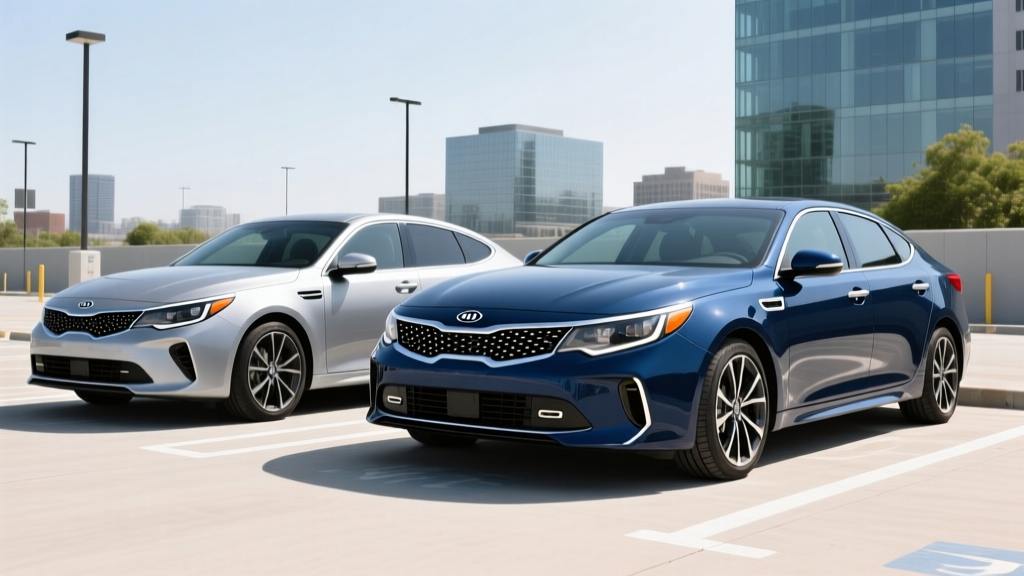
The 2017 Kia Optima arrived at a turning point for midsize hybrid sedans. Kia offered two electrified variants: a conventional Hybrid (HEV) that never needs to be plugged in, and a Plug-in Hybrid (PHEV) with meaningful electric-only range. Nearly a decade later, both remain compelling options on the used market — especially for buyers who want hybrid efficiency without the upfront cost of a new electrified vehicle. This guide breaks down exactly what each version delivers in MPG, electric range, battery longevity, and real-world ownership costs.
HEV vs PHEV: What's the Difference?
Before diving into specs, it's critical to understand that the 2017 Optima Hybrid and the 2017 Optima Plug-in Hybrid are fundamentally different vehicles under the skin. The HEV generates all its electricity from the gasoline engine and regenerative braking — you never plug it in. The PHEV has a much larger battery that you charge from a wall outlet or Level 2 station, enabling genuine electric-only commuting before the gas engine takes over.
| Attribute | 2017 Optima Hybrid (HEV) | 2017 Optima Plug-In Hybrid (PHEV) |
|---|---|---|
| Needs to be plugged in? | No | Yes (Level 1 or Level 2) |
| Battery capacity | 1.62 kWh | 9.8 kWh |
| Electric-only range | ~1 mile at low speed | 27 miles (EPA) |
| Total combined range | ~630 miles | ~460 miles |
| EPA combined MPG/MPGe | 40 MPG | 95 MPGe (electric) / 38 MPG (gas) |
| Combined horsepower | 192 hp | 202 hp |
| DC fast charging | N/A | No — AC only |
2017 Optima Hybrid: EPA MPG and Real-World Fuel Economy
The conventional 2017 Optima Hybrid uses a 2.0-liter four-cylinder engine paired with a 38 kW electric motor and a 6-speed automatic transmission (not a CVT, which is notable for driving feel). The combined system output is 192 horsepower.
| Trim / Configuration | City MPG | Highway MPG | Combined MPG |
|---|---|---|---|
| 2017 Optima Hybrid (HEV) | 39 | 43 | 40 |
| 2017 Optima PHEV (charge-sustaining) | 38 | 39 | 38 |
| 2017 Optima PHEV (blended) | 95 MPGe combined | 27 mi EV range | |
Source: EPA Fuel Economy
Real-World MPG vs. EPA Sticker
The 2017 Optima Hybrid's 40 MPG combined rating is achievable in mixed driving, but real-world results depend heavily on your commute pattern. Like most hybrids, this car excels in stop-and-go city traffic where regenerative braking recaptures energy constantly. Drivers who do predominantly city driving often report 41–44 MPG. Highway cruising at 70–75 mph, however, typically drops to 36–39 MPG because the electric motor provides less assist at sustained high speeds and the 2.0L engine carries more of the load.
Cold weather reduces MPG by roughly 5–10% due to longer engine warm-up cycles, increased battery internal resistance, and heater usage. In sub-freezing conditions, expect 35–37 MPG combined until the powertrain reaches operating temperature.
2017 Optima Plug-In Hybrid: Electric Range and Charging
The PHEV variant is where the Optima gets genuinely interesting for commuters. Its 9.8 kWh lithium-polymer battery delivers an EPA-rated 27 miles of electric-only range — enough to cover most daily commutes without burning a drop of gasoline.
Charging Specs and Times
The 2017 Optima PHEV uses a standard J1772 connector for AC charging. It does not support DC fast charging — a common limitation for PHEVs of this era, since their smaller batteries don't justify the added cost and weight of DC hardware.
| Charging Level | Power (kW) | 0–100% Time | Where |
|---|---|---|---|
| Level 1 (120V household) | ~1.4 kW | ~9 hours | Standard outlet |
| Level 2 (240V) | ~3.3 kW (onboard charger limit) | ~3 hours | Home wallbox or public station |
| DC Fast Charge | N/A | N/A | Not supported |
For PHEV owners, Level 1 charging from a standard 120V outlet is often sufficient. If you drive 27 miles or less per day, plugging in overnight on a regular outlet will fully replenish the battery by morning. A Level 2 home station is a convenience upgrade, not a necessity, for most PHEV use cases.
Total Combined Range
Once the battery is depleted, the PHEV operates as a conventional hybrid, achieving 38 MPG combined. With its 16.4-gallon fuel tank, that yields roughly 460 miles of total range (27 electric + ~430 on gas). That's less than the HEV's ~630-mile total, due to the PHEV's slightly smaller fuel tank and marginally lower gas-mode MPG.
Powertrain and Driving Impressions
Both variants share Kia's 2.0-liter GDI four-cylinder engine, but the electric motor outputs differ:
| Specification | HEV | PHEV |
|---|---|---|
| Engine | 2.0L GDI 4-cyl | 2.0L GDI 4-cyl |
| Engine HP | 154 hp | 154 hp |
| Electric motor | 38 kW (51 hp) | 50 kW (67 hp) |
| Combined system HP | 192 hp | 202 hp |
| Transmission | 6-speed automatic | 6-speed automatic |
| 0–60 mph (est.) | ~8.3 sec | ~7.8 sec |
| Drivetrain | FWD | FWD |
Kia's choice of a traditional 6-speed automatic instead of a CVT gives both models a more natural acceleration feel. There are no rubber-band rev surges or droning under hard throttle — shifts are perceptible and linear. The PHEV's stronger electric motor gives it a slight edge off the line, and in EV mode the car is whisper-quiet with instant torque up to about 75 mph.
Regenerative braking in both models is progressive and predictable. The HEV offers a "Sport" mode that increases regen aggressiveness, but neither model delivers true one-pedal driving like a full BEV. The transition from regen to friction braking is well-calibrated — a common complaint in competing hybrids of this era (looking at you, 2017 Fusion Hybrid).
Battery Health, Warranty, and Replacement Cost
For used-car buyers, the hybrid battery is the single biggest financial wildcard. Here's what you need to know.
Original Battery Warranty
Kia originally warranted the hybrid battery in the 2017 Optima for 10 years / 100,000 miles for the first owner. This warranty is not transferable to subsequent owners in most states — second owners receive the powertrain warranty of 5 years / 60,000 miles instead. However, in states that follow California Air Resources Board (CARB) emissions rules (CA, CT, ME, MA, NJ, NY, OR, RI, VT, WA, and others adopting CARB), the hybrid battery may be covered for 10 years / 150,000 miles regardless of ownership transfer. Verify with a Kia dealer using the VIN.
Battery Degradation in Practice
The 2017 Optima's lithium-polymer battery chemistry has proven durable. Hyundai-Kia's hybrid battery management systems are conservative — they maintain a generous buffer at the top and bottom of the state-of-charge window, which reduces stress on the cells. Based on long-term owner reports and fleet data, most 2017 Optima Hybrids show 5–10% capacity loss after 100,000 miles. For the HEV (with its tiny 1.62 kWh pack), this degradation is barely perceptible since the battery is used in short bursts. For the PHEV, a 10% loss means electric range drops from 27 miles to roughly 24 miles — still useful.
Battery Replacement Cost
If the battery does fail outside warranty, here's what to budget:
- HEV battery replacement: $2,000–$3,500 (parts + labor at a dealer; independent hybrid shops may do it for $1,500–$2,500 with a refurbished pack)
- PHEV battery replacement: $4,000–$6,500 (larger pack, higher parts cost)
These figures are based on dealer and independent hybrid shop pricing as of 2025–2026. Refurbished and aftermarket packs are becoming more available, which is pushing prices down. A full battery failure on a 2017 Optima is still uncommon — most high-mileage examples are running on their original packs.
Used Pricing and Tax Credit Eligibility
As of early 2026, the 2017 Kia Optima Hybrid trades on the used market for approximately:
| Model | Mileage Range | Typical Used Price |
|---|---|---|
| Optima Hybrid (HEV) | 60,000–90,000 mi | $12,000–$16,000 |
| Optima Hybrid (HEV) | 90,000–130,000 mi | $9,000–$12,500 |
| Optima PHEV (EX Premium) | 50,000–80,000 mi | $14,000–$18,500 |
| Optima PHEV (EX Premium) | 80,000–120,000 mi | $11,000–$15,000 |
Does the 2017 Optima Qualify for a Tax Credit?
Under the current IRS §25E Used Clean Vehicle Credit, buyers of qualifying pre-owned plug-in vehicles can claim up to $4,000 or 30% of the sale price (whichever is less). The 2017 Optima PHEV may qualify, provided:
- The sale price is $25,000 or less (virtually all used 2017 Optima PHEVs meet this)
- The buyer's adjusted gross income is ≤ $75,000 (single), $112,500 (head of household), or $150,000 (joint)
- The vehicle is purchased from a licensed dealer (private-party sales do not qualify)
- The vehicle has not been previously claimed for the used-vehicle credit after August 16, 2022 (check with the dealer)
- The buyer has not claimed another used clean vehicle credit in the prior 3 years
The conventional HEV does not qualify for any federal tax credit — it is not a plug-in vehicle. Some states and utilities offer rebates for conventional hybrids, but these vary by jurisdiction. Check your state energy office or utility provider for local programs.
Who Should Buy the 2017 Optima Hybrid vs. a Full EV or Gas Car?
Optima HEV Pros
- 40 MPG combined without ever plugging in
- 630+ mile total range — excellent road-trip car
- Natural 6-speed automatic (no CVT drone)
- Comfortable, quiet midsize sedan with strong safety ratings (IIHS Top Safety Pick)
- Low used-market entry price ($9K–$16K)
Optima HEV Cons
- No electric-only commuting capability
- Trunk space reduced by battery (~13.4 cu ft vs. 15.9 in gas Optima)
- Hybrid battery warranty may not transfer to second owner (state-dependent)
- No federal tax credit for conventional HEV
Optima PHEV Pros
- 27 miles electric-only covers most commutes gas-free
- Up to $4,000 used EV tax credit (§25E) for eligible buyers
- 202 combined hp — strongest Optima in the lineup
- Level 1 overnight charging is sufficient for daily use
Optima PHEV Cons
- Only 27 miles EV range — short for long commutes
- No DC fast charging
- Higher used price than HEV variant
- Smaller fuel tank = less total range than HEV
Decision Framework
Choose the Optima HEV if: You don't have access to home or workplace charging, you drive 30+ miles daily on highways, or you want the lowest entry price and longest total range.
Choose the Optima PHEV if: Your daily round-trip commute is under 27 miles, you can charge at home (even on a 120V outlet), you want to minimize gas spending, and you meet the income requirements for the $4,000 used EV credit.
Choose a full EV instead if: You have reliable Level 2 home charging, your daily driving is under 250 miles, you want zero tailpipe emissions, and you're willing to spend $18,000+ on a newer used BEV like a 2019–2021 Hyundai Kona Electric or Chevrolet Bolt.
Stick with a gas car if: You drive very low annual miles (under 5,000/year), where the fuel savings from a hybrid won't offset the higher purchase price within your ownership period.
Frequently Asked Questions
How many MPG does the 2017 Optima Hybrid get?
The EPA rates the 2017 Optima Hybrid at 39 city / 43 highway / 40 combined MPG. Real-world results typically range from 36 MPG (highway-heavy, cold climate) to 44 MPG (city-heavy, warm climate). The PHEV variant achieves 38 MPG combined in charge-sustaining (gas-only) mode, or 95 MPGe when blending electric and gas driving.
How far can the 2017 Optima PHEV go on electric only?
The EPA rates the 2017 Optima PHEV at 27 miles of electric-only range. In warm weather with gentle driving, some owners report 29–31 miles. In cold weather (below 32°F) or at highway speeds, expect 20–23 miles before the gas engine engages.
Is the 2017 Optima Hybrid reliable?
Yes. The 2017 Optima Hybrid has above-average reliability for its class. The powertrain (engine + electric motor + 6-speed automatic) has proven durable past 150,000 miles with standard maintenance. The hybrid battery shows minimal degradation in most examples. Kia's original 10-year/100,000-mile hybrid battery warranty was among the best in the industry, though second-owner coverage varies by state. Common non-powertrain complaints include infotainment lag and some interior trim wear — neither affects drivability.
What does a hybrid battery replacement cost?
For the HEV, expect $2,000–$3,500 at a dealer or $1,500–$2,500 at an independent hybrid specialist using a refurbished pack. For the PHEV, dealer replacement runs $4,000–$6,500. Full battery failures on the 2017 Optima are uncommon; most high-mileage examples still run on original packs.
Does the 2017 Optima Hybrid qualify for any tax credit?
The conventional HEV does not qualify for any federal tax credit. The PHEV may qualify for the IRS §25E Used Clean Vehicle Credit of up to $4,000 (30% of sale price, capped at $4,000), subject to buyer income limits ($75K single / $150K joint), dealer purchase requirement, and the 3-year-per-buyer claim limit. Always verify eligibility with your tax professional and the IRS §25E page before purchase.
Can I charge the Optima PHEV on a regular outlet?
Yes. The PHEV charges on a standard 120V (Level 1) outlet in about 9 hours — sufficient for overnight replenishment if your daily driving is under 27 miles. A 240V Level 2 station reduces charge time to about 3 hours, which is convenient but not essential for most PHEV owners.
Hybrid vs. PHEV vs. EV — which should I choose?
The HEV is the lowest-risk option: no plug, no behavior change, just better MPG. The PHEV bridges the gap — electric commuting with a gas safety net — but only makes financial sense if you can charge regularly. A full EV eliminates gas entirely and has lower per-mile energy costs, but requires reliable charging access and a higher upfront budget. Your charging situation and daily mileage are the two biggest factors in this decision.