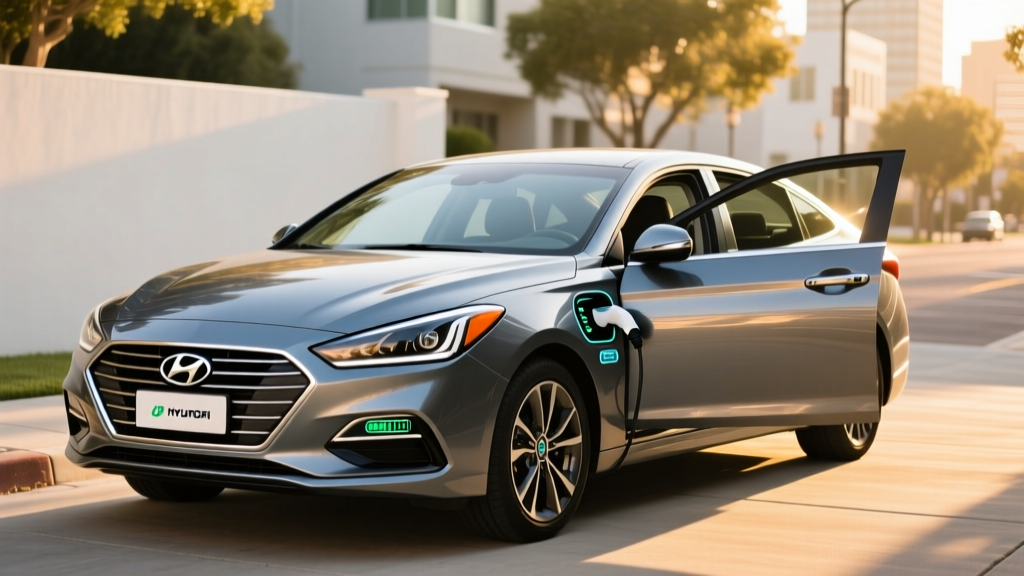
The 2017 Hyundai Sonata Plug-In Hybrid occupies a specific niche in the used-car market: a midsize sedan that bridges daily electric commuting with gas-powered road-trip capability. With 27 miles of EPA-rated electric-only range and a combined 99 MPGe, it was designed for drivers who want EV-like operation on short trips without range anxiety on longer ones. Now available exclusively on the used market, understanding its real-world efficiency, battery health considerations, and ownership costs is essential before signing any paperwork.
HEV vs PHEV: What the Sonata Plug-In Hybrid Actually Is
Hyundai sold the Sonata in two electrified variants for the 2017 model year, and confusing them is a common buyer mistake:
Conventional Hybrid (Sonata Hybrid)
- No plug — charges via regenerative braking and the gasoline engine
- Small battery (~1.6 kWh) assists the engine but cannot drive on electricity alone for meaningful distances
- EPA: 39 city / 43 highway / 41 combined MPG
- Lower upfront cost, simpler ownership — treat it like a gas car
Plug-In Hybrid (Sonata Plug-In Hybrid)
- Has a charge port — plugs into Level 1 (120V) or Level 2 (240V) outlets
- Larger 9.8 kWh battery enables 27 miles of pure electric driving before the gas engine engages
- EPA: 99 MPGe (electric+gas combined) / 39 MPG (gas-only after battery depletes)
- Higher upfront cost, requires home or workplace charging access to realize full value
This article focuses exclusively on the Plug-In Hybrid (PHEV) variant. If you see a listing that simply says "Sonata Hybrid," it is the conventional HEV — no plug, no electric-only range.
Real-World Range and Fuel Economy
The EPA's official numbers provide a baseline, but PHEV efficiency depends heavily on how you use the vehicle. Here is the complete breakdown:
| Metric | EPA Rating | Real-World Expectation |
|---|---|---|
| Electric-only range | 27 miles | 22–25 mi (highway/cold); up to 28 mi (city, mild weather) |
| MPGe (charge-depleting + gas) | 99 MPGe | Varies wildly with charge frequency — 99 MPGe assumes regular plugging in |
| Gas-only MPG (city) | 38 MPG | 36–40 MPG — PHEVs often exceed EPA city estimates in stop-and-go regen-heavy driving |
| Gas-only MPG (highway) | 40 MPG | 36–39 MPG at 70+ mph — aerodynamic drag and battery weight reduce highway efficiency |
| Gas-only MPG (combined) | 39 MPG | 37–40 MPG mixed driving without plugging in |
| Total range (electric + gas) | ~590 miles | ~520–560 miles with a full tank and full charge |
Battery, Charging, and Powertrain Specs
| Specification | 2017 Sonata Plug-In Hybrid |
|---|---|
| Battery capacity | 9.8 kWh (lithium-ion polymer) |
| Usable battery capacity | ~7.6 kWh (buffer protects longevity) |
| Electric-only range (EPA) | 27 miles |
| Electric motor output | 50 kW (67 hp) |
| Gas engine | 2.0L 4-cylinder Atkinson cycle, 154 hp |
| Combined system output | 202 hp |
| Transmission | 6-speed automatic |
| 0–60 mph | ~8.2 seconds |
| Level 1 charging (120V, 12A) | ~9 hours (0–100%) |
| Level 2 charging (240V, 3.3 kW) | ~2.5 hours (0–100%) |
| DC fast charging | Not supported |
| Charge port | SAE J1772 (Level 1/2 only) |
| Fuel tank | 14.0 gallons |
| Cargo volume | 13.3 cu ft (trunk space reduced by battery) |
Charging Reality for Used PHEV Buyers
The Sonata PHEV maxes out at 3.3 kW on Level 2 — modest by 2026 standards but entirely adequate for overnight home charging. A full charge in roughly 2.5 hours on a 240V Level 2 station means you can easily top up between evening commute and morning departure. There is no DC fast charging capability, so this vehicle relies entirely on home, workplace, or destination Level 2 chargers. Public Level 2 stations at grocery stores, libraries, and workplaces are your best bet for opportunistic top-ups.
If you lack access to a Level 2 outlet at home or work, the 9-hour Level 1 charge time on a standard 120V wall outlet still allows overnight replenishment — but you will want to plug in as soon as you arrive home to ensure a full battery by morning.
Battery Longevity, Warranty, and Replacement Costs
What to Expect from an 8-Year-Old PHEV Battery
Lithium-ion battery degradation is a function of time, temperature exposure, and charge cycles. For the 2017 Sonata PHEV's 9.8 kWh pack:
- Typical degradation at 8 years: 10–20% capacity loss, translating to roughly 22–24 miles of electric range instead of the original 27
- Hyundai's warranty threshold: Coverage triggers if the battery drops below 70% of original capacity — a significant failure, not normal wear
- Real-world reports: Sonata PHEV batteries have proven relatively durable; widespread premature failures are not a documented pattern for this generation
Battery Replacement Cost
If the high-voltage battery fails outside warranty, expect a replacement cost of $3,000–$5,500 including parts and labor at a Hyundai dealer. Independent hybrid-battery specialists may offer refurbished packs for $2,000–$3,500. Before purchasing, request a battery state-of-health (SoH) reading via an OBD-II scanner or have a pre-purchase inspection at a Hyundai dealer that can pull the battery management system data.
The standard 12V auxiliary battery (a separate, conventional lead-acid unit) will likely need replacement every 3–5 years at a cost of $150–$250 — standard maintenance unrelated to the hybrid system.
Reliability and Ownership Costs
The 2017 Sonata PHEV benefits from Hyundai's mature hybrid powertrain architecture. The 2.0L Atkinson-cycle engine is under-stressed and proven, and the 6-speed automatic avoids the complexity of a continuously variable transmission (CVT). Key reliability considerations:
- Powertrain: The hybrid system and electric motor have few wear components — no traditional starter, alternator, or accessory belt to replace
- Brakes: Regenerative braking significantly extends pad life; many owners report 60,000+ miles on original brake pads
- Common complaints: Some owners report infotainment glitches and occasional transmission shift hesitation — neither is unique to the PHEV variant
- NHTSA recalls: Check the NHTSA recall database using the specific VIN before purchasing — verify all recall work has been completed
Insurance costs for a used 2017 Sonata PHEV are generally comparable to the gas-only Sonata — PHEVs of this era do not carry the insurance premiums sometimes associated with high-performance EVs.
Used Pricing and Tax Credit Eligibility
As of early 2026, the 2017 Hyundai Sonata Plug-In Hybrid trades on the used market in a range of approximately $12,000–$18,000, depending on mileage, condition, trim (Base or Limited), and regional demand. Limited trims with leather, navigation, and the Infinity audio system command the upper end of that range.
Federal Used EV Tax Credit (§25E)
Good news for budget-conscious buyers: the IRS §25E used clean vehicle credit may apply to this PHEV. Key eligibility requirements:
- Credit amount: 30% of the sale price, up to a maximum of $4,000
- Sale price cap: Vehicle must sell for $25,000 or less (virtually all 2017 Sonata PHEVs qualify)
- Buyer income limits (2026): AGI must not exceed $75,000 (single), $112,500 (head of household), or $150,000 (joint filers)
- Dealer requirement: Must purchase from a licensed dealer (private-party sales do not qualify)
- Vehicle age: Must be at least 2 model years old (2017 easily qualifies)
- One-time use: You can only claim this credit once every 3 years per buyer
- Point-of-sale transfer: Eligible buyers can transfer the credit to the dealer for an immediate price reduction at purchase
At a $15,000 purchase price, the 30% credit equals $4,000 (hitting the cap) — effectively reducing your net cost to $11,000. Consult a tax professional to confirm your eligibility, as rules can change and individual circumstances vary.
Who Should Buy This PHEV (and Who Shouldn't)
Pros
- Daily electric commuting under 25 miles eliminates most gas use
- No range anxiety — 590-mile total range for road trips
- Level 1 overnight charging sufficient for many owners
- Proven, conventional 6-speed automatic (no CVT)
- Potential $4,000 federal used-EV credit lowers effective price
- Spacious midsize sedan cabin with comfortable ride
Cons
- Only 27 miles of electric range — short by 2026 PHEV standards
- No DC fast charging — limited to 3.3 kW Level 2
- Trunk space reduced to 13.3 cu ft by battery placement
- Most examples now outside factory battery warranty
- Outdated infotainment compared to current models
- Modest 202 hp — adequate but not quick
Decision Framework
Choose the 2017 Sonata PHEV if:
- Your round-trip commute is under 25 miles and you can charge at home overnight
- You want a used sedan under $18,000 with minimal gas consumption
- You take occasional road trips and don't want to rely on public charging infrastructure
- You qualify for the §25E used-vehicle tax credit
Choose a full BEV (like a used Chevrolet Bolt or Nissan Leaf) if:
- You have reliable home Level 2 charging and rarely drive over 150 miles between charges
- You want zero gasoline maintenance (no oil changes, no engine)
- Your total range needs can be met by a 200+ mile BEV
Choose a conventional hybrid (HEV) if:
- You cannot charge at home or at work
- You want simplicity — no plugs, no charging routines, no battery range to monitor
- Your driving is mostly highway miles where PHEV electric range offers little benefit
Frequently Asked Questions
How many MPG does the 2017 Hyundai Sonata Plug-In Hybrid get?
When the battery is depleted and the car operates as a conventional hybrid, the EPA rates it at 38 city / 40 highway / 39 combined MPG. Real-world driving typically yields 36–40 MPG combined. The 99 MPGe figure applies only when you factor in electric-only driving from regular plug-in charging — the more you charge and drive electric, the less gas you use.
How far can the 2017 Sonata PHEV go on electric only?
The EPA rates it at 27 miles of electric-only range. In real-world conditions, expect 22–25 miles in mixed driving, dropping to 18–22 miles in cold weather or sustained highway speeds above 70 mph. City driving in mild weather can stretch this to 28 miles thanks to regenerative braking.
Does the 2017 Sonata Plug-In Hybrid qualify for any tax credit?
It is no longer eligible for the new-vehicle §30D credit (which ended for this model years ago). However, it may qualify for the IRS §25E used clean vehicle credit — up to $4,000 (30% of sale price, capped at $4,000) if you meet income limits and purchase from a licensed dealer for under $25,000. Verify current eligibility on irs.gov and consult a tax professional.
Is the 2017 Sonata PHEV reliable, and what does battery replacement cost?
The powertrain is generally reliable, with Hyundai's hybrid system proving durable over time. The high-voltage battery typically degrades 10–20% over 8 years, which is normal. A full battery replacement outside warranty runs $3,000–$5,500 at a dealer, or $2,000–$3,500 from an independent hybrid specialist. Always get a pre-purchase battery health check.
Can I charge the Sonata PHEV at a DC fast charger?
No. The 2017 Sonata Plug-In Hybrid does not support DC fast charging. It uses a J1772 charge port limited to Level 1 (120V, ~9 hours) or Level 2 (240V at 3.3 kW, ~2.5 hours). This is typical for PHEVs of this era — the smaller battery does not require rapid charging.
How does the Sonata PHEV compare to a newer PHEV like the 2025 Toyota Prius Prime?
Modern PHEVs have significantly advanced. The 2025 Prius Prime offers 44 miles of electric range, 50 MPG gas-only, and a more refined powertrain — but at a starting MSRP above $33,000. The 2017 Sonata PHEV at $12,000–$18,000 (potentially $8,000–$14,000 after the used-EV credit) represents a budget-friendly entry into plug-in ownership, accepting shorter electric range and older tech in exchange for a dramatically lower purchase price.
Should I get the Sonata Hybrid or Sonata Plug-In Hybrid?
If you can charge at home and your daily driving is under 25 miles, the PHEV will use dramatically less gasoline. If you cannot charge at home, or if most of your driving is long-distance highway travel, the conventional Sonata Hybrid (41 MPG combined, no plug needed) is simpler and equally efficient on the highway. The PHEV's value proposition depends entirely on your ability to plug in regularly.
For the latest EPA efficiency data, reference the official fueleconomy.gov listing for the 2017 Sonata Plug-In Hybrid. Always verify specific vehicle history through a VIN report and pre-purchase inspection before committing to any used PHEV purchase.