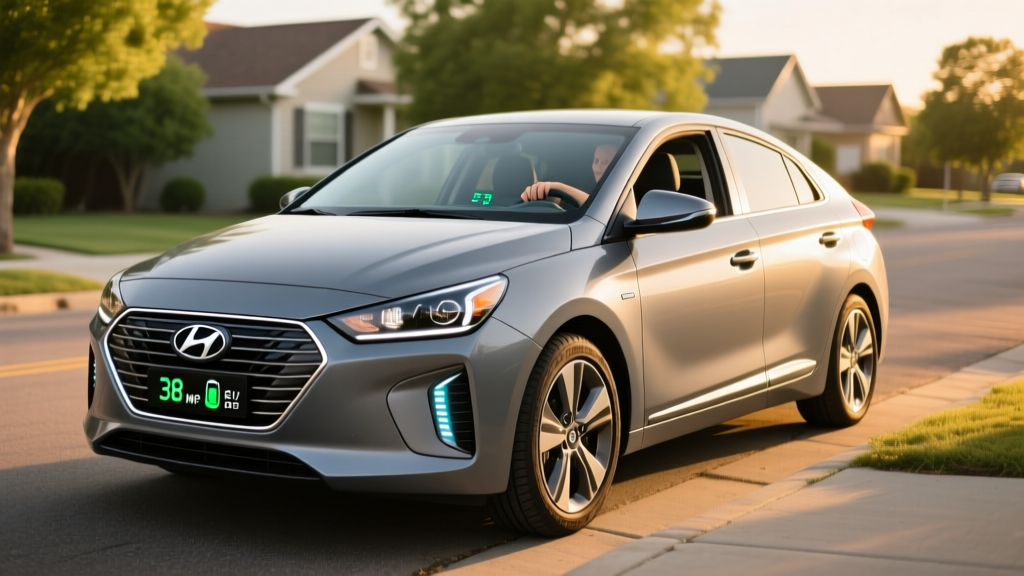
If you're shopping the used hybrid market for maximum fuel efficiency on a tight budget, the 2017 Hyundai Ioniq Hybrid keeps showing up on shortlists — and for good reason. At its launch, it posted the highest combined EPA MPG of any mass-market hybrid, edging past even the Toyota Prius. Nearly a decade later, the question for used buyers is whether that efficiency holds up, what battery replacement actually costs, and how it compares to a modern PHEV or full EV.
This guide covers everything a 2026 used-car buyer needs: real-world MPG data, the HEV vs. PHEV distinction within the Ioniq lineup, battery longevity, and who should still consider this car versus stepping into a plug-in or battery-electric vehicle.
2017 Ioniq Hybrid Fuel Economy: EPA Numbers vs. Real World
The 2017 Ioniq Hybrid came in three trims — Blue, SEL, and Limited — and the EPA ratings differ slightly depending on wheel size and equipment weight. Here's the official breakdown from fueleconomy.gov:
| Trim | City MPG | Highway MPG | Combined MPG |
|---|---|---|---|
| Blue | 57 | 59 | 58 |
| SEL | 55 | 54 | 55 |
| Limited | 55 | 54 | 55 |
The Blue trim's 58 MPG combined made it the most efficient hybrid on the market at the time. The SEL and Limited trims drop slightly due to larger 17-inch alloy wheels, additional sound insulation, and features like leather seats and a power-adjustable driver's seat adding weight.
Real-World MPG: What Owners Actually See
Hybrids tend to match or exceed their EPA city numbers because stop-and-go traffic maximizes regenerative braking and electric-motor assist. Highway driving is where hybrids lose their advantage — the gasoline engine runs continuously, and aerodynamic drag dominates.
Based on aggregated owner fuel logs and independent testing:
- City driving: 52–60 MPG (often matches or exceeds the EPA city figure)
- Highway (70+ mph): 44–50 MPG (noticeably below the EPA highway number)
- Mixed commuting: 50–56 MPG for most drivers
- Cold weather (below 30°F): Expect a 5–10% drop, landing around 46–52 MPG combined, as the engine runs more frequently for cabin heat and battery warmup
For context, a 2017 Prius Eco rates at 56 MPG combined, so the Ioniq Blue holds a slim 2-MPG edge. In real-world mixed driving, that difference is essentially unnoticeable — both cars deliver 50–55 MPG for typical commutes.
HEV vs. PHEV vs. EV: Which Ioniq (and Which Powertrain) Fits You?
Hyundai sold the 2017 Ioniq in three distinct powertrains. Confusing them is easy — the body looks nearly identical — but the mechanical differences are significant.
HEV vs. PHEV vs. BEV — The Key Differences
| Feature | Ioniq Hybrid (HEV) | Ioniq Plug-In (PHEV) | Ioniq Electric (BEV) |
|---|---|---|---|
| Plugs in? | No — self-charging | Yes — Level 1/2 | Yes — Level 1/2/DC |
| Electric-only range | ~1 mi (low-speed assist only) | 29 mi (EPA) | 124 mi (EPA) |
| Battery size | 1.56 kWh (Li-ion polymer) | 8.9 kWh (Li-ion polymer) | 28 kWh (Li-ion polymer) |
| Total range | ~690 mi | ~630 mi (gas + electric) | 124 mi (electric only) |
| Combined MPG/MPGe | 55–58 MPG | 52 MPG / 119 MPGe | 136 MPGe |
| DC fast charging? | N/A | No (Level 2 only, ~2.5 hr) | Yes (CCS, ~30 min to 80%) |
Choose the HEV (conventional hybrid) if you can't charge at home, drive long highway commutes, or want zero behavioral change from a gas car. You never plug in — the car recovers energy through regenerative braking and the gasoline engine.
Choose the PHEV if you have reliable Level 2 home charging and a commute under 29 miles. You'll drive most weekdays on electricity alone and use the gas engine only for longer trips. The trade-off: a smaller trunk (the larger battery eats cargo space) and a higher used purchase price.
Choose the BEV only if your daily driving stays under ~100 miles and you have home charging. The 2017 Ioniq Electric's 124-mile range is limiting by 2026 standards, and it lacks DC fast charging speed compared to modern EVs.
Powertrain Specs: What's Under the Hood
| Specification | Value |
|---|---|
| Engine | 1.6L GDI 4-cylinder Atkinson cycle |
| Engine horsepower | 104 hp @ 5,700 rpm |
| Electric motor output | 43.5 hp (32 kW) |
| Combined system output | 139 hp |
| Combined torque | 195 lb-ft |
| Transmission | 6-speed dual-clutch automatic (DCT) |
| Hybrid battery | 1.56 kWh lithium-ion polymer |
| 0–60 mph | ~9.4 seconds |
| Curb weight | 3,033–3,164 lbs (trim-dependent) |
| Fuel tank | 11.9 gallons |
| Total driving range | ~690 miles (Blue trim) |
Hyundai's choice of a 6-speed dual-clutch transmission rather than the continuously variable transmission (CVT) found in the Prius gives the Ioniq a more conventional, stepped-shift feel. Some drivers prefer this; others notice the occasional low-speed hesitation that DCTs can exhibit. It's a deliberate trade-off: slightly less seamless than a CVT, but more engaging when accelerating onto highways.
The 139 combined horsepower is adequate for commuting and merging but not quick. The 0–60 time of roughly 9.4 seconds means you'll want to plan your highway merges carefully. This is an efficiency-first vehicle, and the powertrain tuning reflects that priority.
Battery Longevity, Warranty, and Replacement Cost
Battery Warranty Coverage
Original warranty: 10 years / 100,000 miles (whichever comes first) for the hybrid battery pack in the original owner's hands.
Second-owner warranty: In most states, the hybrid battery warranty transfers to subsequent owners but drops to 8 years / 80,000 miles from the original in-service date. In California and states that adopted CARB emissions rules (including NY, MA, NJ, CT, and others), the warranty may remain at 10/100,000 for subsequent owners. Verify with a Hyundai dealer using the VIN.
Capacity threshold: Hyundai defines a battery failure as dropping below approximately 70% of original capacity. Normal gradual degradation below this threshold over 8–10 years may not trigger a warranty replacement.
Real-World Battery Degradation
The 2017 Ioniq Hybrid's 1.56 kWh battery is small and operates within a narrow state-of-charge window — typically between 30% and 70%. This shallow cycling is one of the main reasons hybrid batteries last significantly longer than EV batteries that regularly cycle from 10% to 90%.
Based on owner reports and fleet data for Hyundai/Kia hybrids of this era:
- 5 years / 75,000 miles: Most owners report negligible fuel-economy loss — typically 1–2 MPG off original figures, often within measurement noise.
- 8–10 years / 100,000–150,000 miles: Some owners note a 3–5 MPG decline as internal resistance increases and the battery's usable window narrows. The car remains fully functional.
- Catastrophic failure before 100,000 miles: Uncommon but not unheard of. This is what the warranty covers.
Battery Replacement Cost
If you're buying a 2017 Ioniq Hybrid in 2026, the car is 9 years old and likely has 80,000–130,000 miles. The original 10-year/100,000-mile warranty may still apply if the car was first sold in late 2017 and has stayed under the mileage cap.
If you're outside warranty coverage, here's what replacement looks like:
- New OEM battery pack: $2,500–$4,000 for the part, plus $500–$1,000 in labor, totaling roughly $3,000–$5,000 at a Hyundai dealer.
- Refurbished/reconditioned pack: $1,500–$2,500 installed from independent hybrid specialists. Quality varies — ask about cell-matching and warranty terms.
- Individual module replacement: Some shops can replace only the degraded modules for $800–$1,500, but this is a temporary fix if the remaining modules are also aging.
For a car worth $10,000–$15,000 on the used market, a $3,000–$5,000 battery replacement is a significant percentage of the vehicle's value. This is the central financial risk of buying an aging hybrid — factor it into your purchase decision.
Used Pricing and Tax Credit Eligibility in 2026
The 2017 Ioniq Hybrid was discontinued after the 2022 model year when Hyundai pivoted the Ioniq nameplate to its dedicated EV line (Ioniq 5, Ioniq 6). Here's where used pricing sits in early 2026:
- Blue trim, 80k–100k miles: $9,500–$12,000
- SEL trim, 60k–90k miles: $11,000–$14,000
- Limited trim, 50k–80k miles: $13,000–$16,500
Prices vary significantly by region, condition, and whether the hybrid battery has been tested or replaced.
Does the 2017 Ioniq Hybrid Qualify for a Tax Credit?
No federal tax credit applies. Under current IRS §30D rules, the federal clean vehicle credit is available only for new qualifying plug-in vehicles (BEVs and PHEVs with at least 7 kWh of battery capacity). The conventional Ioniq Hybrid (HEV) never qualified for a federal credit even when new, because it has no plug and its 1.56 kWh battery is far below the 4 kWh minimum threshold. The IRS clean vehicle credit page details current eligibility requirements.
The used EV credit (up to $4,000 or 30% of sale price, whichever is less) under §25E applies only to used plug-in vehicles — BEVs and PHEVs — not conventional hybrids. So the Ioniq HEV does not qualify here either.
If you find a used 2017–2022 Ioniq Plug-In Hybrid, that model may qualify for the used clean vehicle credit, subject to the $25,000 maximum sale price cap, buyer income limits ($75,000 single / $150,000 joint), and dealer registration requirements. Check the specific VIN on the IRS qualifying vehicle list before counting on this credit.
Pros and Cons: The Honest Assessment
Pros
- Best-in-class 58 MPG combined (Blue trim) — still competitive in 2026
- No plug-in required; zero lifestyle change from a gas car
- 6-speed DCT feels more natural than a CVT to most drivers
- Strong reliability record; Hyundai's hybrid system is proven
- Low used pricing — under $15K for most examples
- Comprehensive safety suite on Limited (AEB, lane keep, adaptive cruise)
- 10-year/100K-mile original hybrid battery warranty (may still apply)
Cons
- Modest 139 hp — highway merging requires planning
- Highway MPG drops noticeably (44–50 real-world at 70+ mph)
- Small 1.56 kWh battery means minimal electric-only assist
- No plug-in option means no electric-only commuting
- Tight rear seat headroom due to fastback roofline
- Cargo space (26.5 cu ft) trails compact crossovers
- No Apple CarPlay/Android Auto on 2017 base trims (added in 2018 refresh)
- Aging infotainment; no wireless connectivity
Who Should Buy the 2017 Ioniq Hybrid — And Who Shouldn't
The 2017 Ioniq Hybrid occupies a specific niche in 2026's used-car market. It's not for everyone, but for the right buyer, it's hard to beat on pure efficiency economics.
Buy it if:
- You commute 20–60 miles daily in mixed city/highway driving and want to minimize fuel costs without changing your habits.
- You live in an apartment or rent and cannot install home charging — making a PHEV or EV impractical.
- You want a reliable, low-cost daily driver under $15,000 with strong fuel economy.
- You drive in a region with expensive gasoline (California, Hawaii, the Pacific Northwest), where 55+ MPG translates to meaningful savings.
Look elsewhere if:
- You can charge at home and have a short commute — a used PHEV (like the Ioniq Plug-In, Prius Prime, or Clarity PHEV) lets you drive on electricity daily and use gas only for road trips.
- You need cargo space or regularly carry rear-seat passengers — a used RAV4 Hybrid or a compact crossover PHEV offers more room.
- You want modern infotainment, wireless phone integration, or advanced driver-assistance features standard across all trims.
- You drive primarily highway miles above 70 mph — the Ioniq's efficiency advantage shrinks considerably at sustained high speeds, and a diesel or efficient gas car may close the gap.
Reliability and Ownership Costs
The 2017 Ioniq Hybrid has a strong reliability track record. Hyundai's 1.6L GDI engine and the accompanying electric motor have proven durable in fleet and owner use. The dual-clutch transmission, while less common than a CVT in hybrids, has not shown widespread failure patterns, though some owners report occasional rough shifts at low speeds — a characteristic of dry-clutch DCTs rather than a defect.
Annual maintenance costs are low. There's no timing belt (the engine uses a chain), and regenerative braking significantly extends pad life — many owners report original brake pads lasting 80,000+ miles. Expect to spend $300–$500 annually on routine maintenance (oil changes, cabin filter, tire rotation) at an independent shop.
Insurance costs are typically below average for the segment. The Ioniq Hybrid isn't fast, isn't expensive to repair, and has good crash-test ratings (IIHS Top Safety Pick for 2017 when equipped with optional AEB). Annual premiums of $1,100–$1,500 are common depending on your profile and state.
At 55 MPG and $3.25/gallon gasoline, you'd spend roughly $770 per year on fuel driving 13,000 miles. A comparable 30 MPG gas car would cost about $1,410 — a $640 annual savings. Over five years, that's $3,200 in fuel savings, which largely covers the potential battery replacement risk.
Frequently Asked Questions
How many MPG does the 2017 Ioniq Hybrid get in real driving?
Most owners see 50–56 MPG in mixed commuting. City-heavy routes can push 57–60 MPG thanks to regenerative braking. Highway-only driving at 70+ mph drops to 44–50 MPG. Cold weather reduces efficiency by 5–10%.
Does the 2017 Ioniq Hybrid need to be plugged in?
No. The conventional Ioniq Hybrid (HEV) charges its own small battery through regenerative braking and the gasoline engine. You never plug it in. Only the separate Ioniq Plug-In Hybrid (PHEV) and Ioniq Electric (BEV) variants require external charging.
How far can the 2017 Ioniq go on electric power alone?
The conventional hybrid can travel roughly one mile at very low speeds (under 25 mph) on electric power alone before the gasoline engine kicks in. This is not a meaningful electric-only range — it's designed for low-speed maneuvering and brief stoplight-to-stoplight assist. If you want real electric-only driving, you need the Ioniq Plug-In Hybrid (29 miles) or the Ioniq Electric (124 miles).
What does a replacement hybrid battery cost for the 2017 Ioniq?
A new OEM hybrid battery pack runs $2,500–$4,000 for the part plus $500–$1,000 in dealer labor, totaling $3,000–$5,000. Refurbished packs from independent hybrid specialists cost $1,500–$2,500 installed. Full replacement is uncommon before 150,000 miles if the car is maintained properly.
Is the hybrid battery warranty still valid on a used 2017 Ioniq?
Possibly. The original 10-year/100,000-mile warranty may still apply if the car hasn't exceeded the mileage limit. For second owners in most states, coverage drops to 8 years/80,000 miles from the original sale date. CARB states may honor the full 10/100K. Check with a Hyundai dealer using the specific VIN to confirm.
Does the 2017 Ioniq Hybrid qualify for any federal tax credit?
No. The conventional Ioniq Hybrid is not a plug-in vehicle and does not qualify for the §30D new clean vehicle credit or the §25E used clean vehicle credit. Only plug-in variants (PHEV and BEV) may be eligible for tax credits, subject to current IRS income and price caps.
How does the 2017 Ioniq Hybrid compare to a 2017 Prius?
The Ioniq Blue rates 58 MPG combined vs. the Prius Eco's 56 MPG — a negligible 2-MPG difference in practice. The Ioniq's DCT gives a more conventional driving feel compared to the Prius's CVT drone. The Prius offers more cargo space (27.4 vs. 26.5 cu ft), better rear visibility, and a slightly more refined ride. Both are excellent used hybrid choices; pick based on styling preference, local pricing, and which car has better maintenance records near you.