Why the 2017 Hyundai Ioniq Hybrid Blue Still Matters in 2026
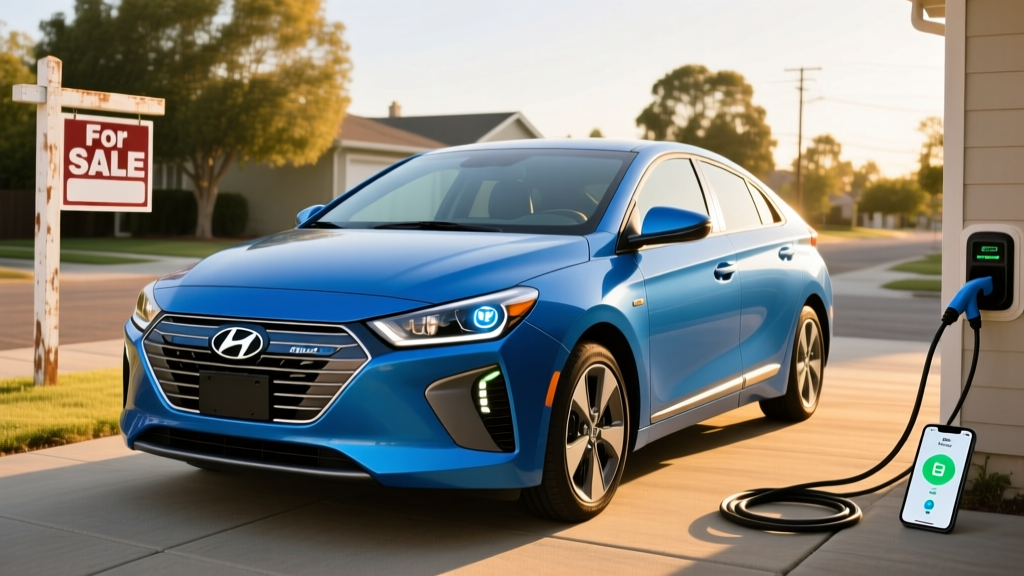
If you're shopping the used hybrid market for maximum fuel efficiency on a tight budget, the 2017 Hyundai Ioniq Hybrid Blue remains one of the most compelling choices available. With an EPA-estimated 58 MPG combined, it held the title of the most fuel-efficient gasoline-electric hybrid sold in the United States when it launched — and nearly a decade later, very few conventional hybrids have surpassed it. The Ioniq Blue's 1.56 kWh lithium-ion polymer battery pack, 1.6-liter Atkinson-cycle engine, and obsessive aerodynamic tuning (a 0.24 drag coefficient) combine to deliver efficiency that translates directly into real-world fuel savings.
This guide covers everything a used-car buyer in 2026 needs to know: exact EPA and real-world MPG figures, the hybrid powertrain breakdown, battery longevity and replacement costs, reliability data, and how the Ioniq Hybrid Blue compares to plug-in hybrids and full battery-electric vehicles.
HEV vs PHEV vs EV: Where the Ioniq Hybrid Blue Fits
The 2017 Hyundai Ioniq was sold in three distinct powertrain variants. Understanding the difference is essential before you shop:
| Variant | Type | Plug-In Required? | Electric-Only Range | EPA Combined |
|---|---|---|---|---|
| Ioniq Hybrid Blue | Conventional HEV | No — charges via regenerative braking and engine | ~1 mile (low-speed assist only) | 58 MPG |
| Ioniq Plug-In Hybrid | PHEV | Yes — Level 2 (240V) charging | 29 miles (EV mode) | 52 MPG (hybrid) / 119 MPGe |
| Ioniq Electric | BEV | Yes — Level 2 + DC fast charging | 124 miles (full EV) | 136 MPGe |
Key distinction: The Ioniq Hybrid Blue is a conventional hybrid (HEV). It never plugs in. The small 1.56 kWh battery charges exclusively through regenerative braking and the gasoline engine. If you want plug-in electric-only driving, you need the Ioniq Plug-In Hybrid (PHEV) or the Ioniq Electric (BEV) — both different vehicles with different batteries, pricing, and charging requirements.
EPA Fuel Economy and Real-World MPG
The EPA rates the 2017 Hyundai Ioniq Hybrid Blue at the following fuel economy figures:
| Metric | EPA Estimate | Real-World Expectation |
|---|---|---|
| City MPG | 57 MPG | 55–62 MPG (hybrids often exceed EPA in city driving) |
| Highway MPG | 59 MPG | 52–56 MPG (highway speeds reduce regenerative braking benefit) |
| Combined MPG | 58 MPG | 54–58 MPG (mixed driving) |
| Fuel Tank Capacity | 11.9 gallons | ~640–700 miles per tank |
| Annual Fuel Cost (EPA) | ~$850/year | Varies with local gas prices and mileage |
Real-world note: Conventional hybrids like the Ioniq Blue tend to exceed their EPA city estimate in stop-and-go traffic, where regenerative braking recovers the most energy. Highway driving at 75+ MPH reduces efficiency because the electric motor provides less assist at sustained high speeds and aerodynamic drag increases. In cold weather (below 35°F), expect a 5–10% MPG reduction as the engine runs more frequently to maintain cabin heat and battery temperature.
Other Ioniq Hybrid trims (SEL, Limited) carry slightly lower EPA ratings — 55 MPG combined — due to heavier wheels, additional equipment weight, and different tire rolling resistance.
Powertrain and Performance Specifications
| Specification | 2017 Ioniq Hybrid Blue |
|---|---|
| Engine | 1.6L GDI Atkinson-cycle 4-cylinder |
| Engine Horsepower | 104 hp @ 5,700 rpm |
| Engine Torque | 109 lb-ft @ 4,000 rpm |
| Electric Motor Output | 43 hp (32 kW) |
| Combined Net Horsepower | 139 hp |
| Combined Net Torque | 195 lb-ft |
| Transmission | 6-speed dual-clutch automatic (DCT) |
| Drivetrain | Front-wheel drive |
| Battery Capacity | 1.56 kWh (lithium-ion polymer) |
| 0–60 mph | ~9.3 seconds |
| Top Speed | 115 mph (electronically limited) |
| Curb Weight | 3,078 lbs |
| Drag Coefficient | 0.24 Cd |
| Cargo Volume | 26.5 cu ft (rear seats up) / 55.0 cu ft (folded) |
The Ioniq Hybrid Blue uses a 6-speed dual-clutch transmission rather than the continuously variable transmission (CVT) found in the Toyota Prius. This gives the Ioniq a more conventional, stepped gear-change feel that many drivers prefer, though it sacrifices a small amount of efficiency in the process. The 139 combined horsepower is adequate for city merging and highway cruising but won't win any acceleration contests. The 195 lb-ft of combined torque, however, provides responsive low-speed thrust off the line thanks to the electric motor's instant torque delivery.
Battery Longevity, Warranty, and Replacement Cost
Hybrid Battery Warranty
Original coverage: 8 years / 100,000 miles (10 years / 100,000 miles in CARB states including California, New York, Massachusetts, and others adopting California emissions standards).
Capacity threshold: Hyundai warrants the battery against defects and excessive capacity loss. If the battery drops below approximately 70% of its original capacity within the warranty period, Hyundai will repair or replace it.
For 2017 models in 2026: Most vehicles are now outside the standard 8-year federal warranty window (which expired in 2025). However, vehicles originally sold in CARB states may still have coverage through 2027 under the 10-year provision. Always verify with a Hyundai dealer using the VIN.
Real-world battery degradation: The 1.56 kWh lithium-ion polymer battery in the Ioniq Hybrid Blue is small and operates within a narrow state-of-charge window (roughly 40–80%), which significantly reduces stress and extends cycle life. Based on fleet data and owner reports, Hyundai's hybrid batteries typically retain 85–90% of their original capacity after 100,000 miles. Many Prius and Ioniq hybrids have surpassed 200,000 miles on the original battery pack with minimal degradation.
Replacement cost: If the hybrid battery does need replacement outside of warranty, expect to pay between $2,000 and $3,500 for a new OEM battery pack including labor at a Hyundai dealership. Third-party refurbished batteries are available for $1,200–$2,000. Given the battery's small size and conservative charge management, full replacement is uncommon before 150,000+ miles.
Pricing and Tax Credit Eligibility
Original MSRP (2017): The Ioniq Hybrid Blue started at $22,200 (plus destination). Higher trims — the SEL at ~$24,800 and Limited at ~$28,600 — added features like leather seats, adaptive cruise control, and a premium audio system.
Used market pricing (2026): Expect to pay between $10,000 and $16,000 for a 2017 Ioniq Hybrid Blue depending on mileage, condition, and region. Low-mileage examples (under 60,000 miles) in excellent condition command the higher end of that range. The Ioniq's strong reliability reputation and exceptional MPG keep resale values firm relative to other used compacts.
Federal tax credit: The 2017 Ioniq Hybrid Blue does not qualify for the federal §30D new clean vehicle tax credit (up to $7,500), which applies only to new plug-in vehicles meeting battery sourcing and MSRP requirements. As a conventional hybrid that doesn't plug in, it was never eligible for §30D even when new. However, if you purchase a used Ioniq Hybrid from a dealer for $25,000 or less, you may qualify for the used clean vehicle credit (up to $4,000 or 30% of the sale price, whichever is less) — but only if the vehicle is a PHEV or BEV. The conventional HEV version does not qualify for this credit either. The Ioniq Plug-In Hybrid and Ioniq Electric versions may qualify for the used credit. Always verify current rules at IRS.gov.
Reliability and Ownership Costs
The 2017 Ioniq Hybrid has compiled a strong reliability record. The 1.6L Kappa engine is a proven, low-stress design, and the 6-speed DCT has been largely trouble-free in this application (unlike some earlier Hyundai DCT implementations). The hybrid system's simplicity — no plug-in hardware, no large battery thermal management system — means fewer components that can fail.
Common maintenance items:
- Engine oil and filter: every 7,500 miles (~$45–$70 at a shop)
- Brake pads: 60,000–90,000+ miles (regenerative braking reduces wear significantly)
- Coolant flush: every 60,000 miles (two separate cooling circuits — engine and hybrid system)
- Transmission fluid: every 60,000 miles
- 12V auxiliary battery: every 4–5 years (~$180–$250 replacement)
Insurance: The Ioniq Hybrid is inexpensive to insure, averaging $1,100–$1,400 annually depending on driver profile and state — comparable to a Toyota Corolla and lower than most EVs.
5-year estimated ownership cost: For a driver covering 12,000 miles per year at $3.40/gallon gas, annual fuel costs run approximately $700–$800. Add in insurance, maintenance, and depreciation, and total 5-year ownership typically falls between $18,000 and $24,000 — among the lowest of any vehicle in its class.
Who Should Choose the Ioniq Hybrid Blue (and Who Shouldn't)
Choose the Ioniq Hybrid Blue If:
- You want maximum MPG without plugging in or changing your driving habits
- You lack access to home or workplace charging (apartment dwellers, street parkers)
- Your budget is $10,000–$16,000 for a reliable, efficient daily driver
- You drive mostly city/suburban routes where regenerative braking shines
- You want low maintenance costs and proven hybrid reliability
Look Elsewhere If:
- You want electric-only driving (consider the Ioniq PHEV or a used BEV like the Chevy Bolt)
- You need all-wheel drive (the Ioniq is FWD only — look at the Toyota Prius AWD-e)
- You regularly carry 4+ adults (rear seat headroom is tight due to the sloping roofline)
- You prioritize acceleration (9.3-second 0–60 is leisurely; the Prius Prime is similar)
- You want the latest infotainment and driver-assist tech (2017-era systems feel dated)
Frequently Asked Questions
How many MPG does the 2017 Hyundai Ioniq Hybrid Blue get?
The EPA rates it at 57 city / 59 highway / 58 combined MPG. In real-world driving, owners commonly report 54–62 MPG depending on driving conditions. City-heavy routes often yield higher numbers than the EPA estimate thanks to regenerative braking, while sustained highway driving at high speeds can drop efficiency to the low 50s.
Does the Ioniq Hybrid Blue need to be plugged in?
No. The Ioniq Hybrid Blue is a conventional hybrid (HEV), not a plug-in. Its 1.56 kWh battery charges entirely through regenerative braking and the gasoline engine. You simply fill up with gas and drive. If you want plug-in capability, look at the Ioniq Plug-In Hybrid variant, which offers 29 miles of electric-only range and requires Level 2 (240V) charging.
Is the 2017 Ioniq Hybrid reliable?
Yes. The 2017 Ioniq Hybrid has a strong reliability record. The 1.6L engine, 6-speed dual-clutch transmission, and hybrid system have proven durable. The hybrid battery is small and conservatively managed, reducing degradation risk. Many examples have exceeded 150,000 miles without major powertrain issues. Hyundai's original hybrid battery warranty covered 8 years/100,000 miles (10 years in CARB states).
What does it cost to replace the hybrid battery?
A new OEM replacement battery from Hyundai costs approximately $2,000–$3,500 including labor. Third-party refurbished options are available for $1,200–$2,000. However, full battery replacement is uncommon before 150,000+ miles. The small 1.56 kWh pack operates within a narrow charge window, which significantly extends its lifespan compared to larger PHEV or BEV batteries.
Does the 2017 Ioniq Hybrid qualify for any tax credit?
No. As a conventional hybrid (HEV) that does not plug in, the Ioniq Hybrid Blue does not qualify for the federal §30D new vehicle credit or the used clean vehicle credit. These credits require plug-in capability with a minimum battery capacity. The Ioniq Plug-In Hybrid and Ioniq Electric versions may qualify for the used credit if purchased from a dealer for $25,000 or less and if the buyer meets income requirements. Check current eligibility at IRS.gov.
How does the Ioniq Hybrid Blue compare to the Toyota Prius?
The 2017 Prius Eco is rated at 56 MPG combined — just 2 MPG less than the Ioniq Blue. The Prius offers more interior space, available AWD (on newer model years), and a larger dealer network. The Ioniq counters with a more conventional driving feel (6-speed DCT vs CVT), a lower starting price on the used market, and slightly better highway MPG. Both are excellent choices; the decision often comes down to styling preference, cargo needs, and which is available locally in your price range.
What is the Ioniq Hybrid Blue's total driving range?
With an 11.9-gallon fuel tank and 58 MPG combined, the Ioniq Hybrid Blue can travel approximately 690 miles on a single tank under ideal conditions. Real-world range typically falls between 640 and 700 miles depending on driving style and conditions — enough for most drivers to visit the gas station only once every two to three weeks.