Quick Verdict: The 2017 Accord Hybrid Touring in 2026
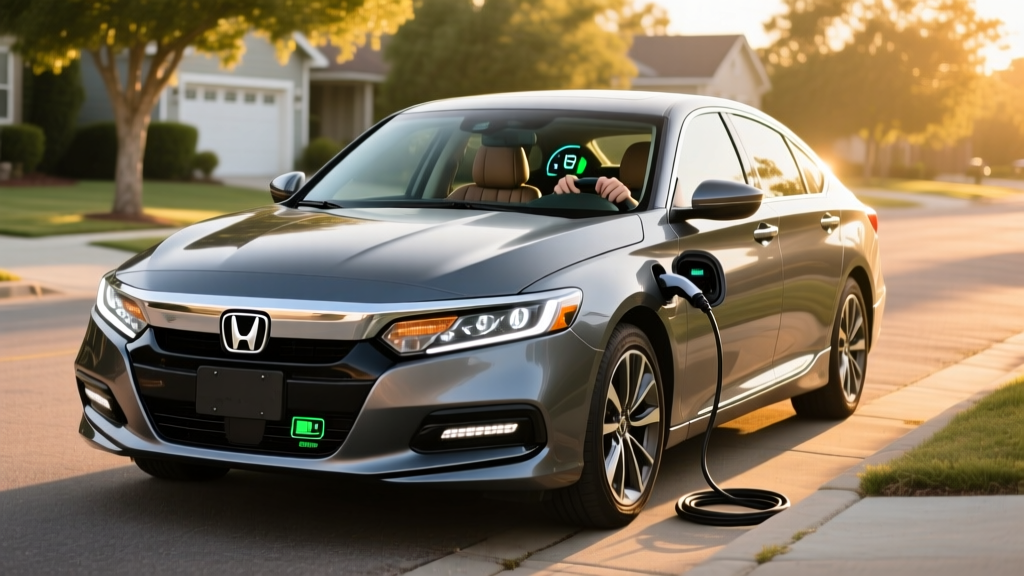
The 2017 Honda Accord Hybrid Touring remains one of the most compelling used midsize hybrid sedans on the market. With an EPA-estimated 48 MPG combined, a 212-horsepower two-motor hybrid powertrain, and Honda's reputation for long-term reliability, it holds up well nearly a decade after its debut. For buyers in 2026 who want hybrid efficiency without plug-in complexity — and who don't need the latest infotainment tech — the Accord Hybrid Touring delivers real-world fuel savings that still rival newer competitors.
This guide covers everything a used-car buyer needs: exact fuel economy figures, the hybrid powertrain breakdown, battery longevity and replacement cost, and how this conventional hybrid (HEV) stacks up against plug-in hybrids and full EVs in today's market.
HEV vs PHEV vs EV: Where the Accord Hybrid Fits
The 2017 Honda Accord Hybrid is a conventional hybrid electric vehicle (HEV). It does not plug in. It does not have a large battery you charge from the grid. Instead, it uses a small lithium-ion battery pack that charges exclusively through regenerative braking and the gasoline engine. This is fundamentally different from a plug-in hybrid (PHEV) like the Toyota Prius Prime or a battery-electric vehicle (BEV) like the Tesla Model 3.
| Feature | HEV (2017 Accord Hybrid) | PHEV (e.g., Prius Prime) | BEV (e.g., Model 3) |
|---|---|---|---|
| Plugs in? | No | Yes | Yes |
| Electric-only range | ~1-2 miles at low speed | 25-44 miles | 250-350+ miles |
| Battery size | 1.3 kWh (gross) | 13.6 kWh (Prius Prime) | 60-82 kWh |
| Fuel/energy source | Gasoline only | Gasoline + electricity | Electricity only |
| Home charging needed? | No | Recommended (Level 1/2) | Required |
| Federal tax credit (new) | None | Up to $7,500 (§30D) | Up to $7,500 (§30D) |
Bottom line: If you lack access to home or workplace charging, or simply don't want to think about plugging in, the HEV Accord Hybrid is the right choice. If you have a garage outlet and a short commute, a PHEV can eliminate most gasoline use. If you're ready to go fully electric with home charging, a BEV offers the lowest operating cost.
Fuel Economy: EPA Ratings and Real-World MPG
The 2017 Honda Accord Hybrid is rated by the EPA at 48 MPG combined, with a breakdown of 49 MPG city and 47 MPG highway. The Touring trim shares these figures with lower trims (LX, EX, EX-L) because the powertrain is identical across the lineup.
| Driving Cycle | EPA Estimate | Real-World Expectation |
|---|---|---|
| City | 49 MPG | 48-52 MPG (hybrids excel in stop-and-go) |
| Highway | 47 MPG | 42-46 MPG (sustained 75+ mph reduces regen benefit) |
| Combined | 48 MPG | 44-49 MPG depending on driving mix |
Real-world nuance: Like most Honda hybrids using the i-MMD (Intelligent Multi-Mode Drive) system, the Accord Hybrid tends to meet or slightly exceed its EPA city rating in actual urban driving. The two-motor system runs the electric motor for propulsion at low speeds and only engages the gasoline engine as a generator — meaning city stop-and-go traffic is where this car shines. Highway fuel economy, however, often falls 3-5 MPG below the sticker when cruising at 75-80 mph, because the engine must directly drive the wheels and aerodynamic drag dominates.
In cold weather (below 30°F), expect a 5-10% fuel economy reduction as the engine runs more frequently to provide cabin heat and maintain battery temperature. This is normal for all hybrids and far less severe than the 20-30% range loss EVs experience in winter.
Powertrain Deep Dive: 212 HP Two-Motor System
The 2017 Accord Hybrid uses Honda's Sport Hybrid i-MMD system, which pairs a 2.0-liter Atkinson-cycle four-cylinder engine with two electric motors and a 1.3 kWh lithium-ion battery pack. Total system output is 212 horsepower.
| Specification | Detail |
|---|---|
| Engine | 2.0L Atkinson-cycle inline-4 (143 hp, 129 lb-ft) |
| Drive motor | AC permanent-magnet (184 hp, 232 lb-ft) |
| Generator motor | AC permanent-magnet (acts as starter/generator) |
| Combined system output | 212 hp |
| Battery | 1.3 kWh lithium-ion (located behind rear seat) |
| Transmission | Direct-drive (no traditional CVT or planetary gearset) |
| 0-60 mph | ~7.5 seconds |
| Drivetrain | Front-wheel drive |
The i-MMD system operates in three modes:
- EV Drive: Battery powers the drive motor alone (brief, low-speed only — about 1-2 miles at most).
- Hybrid Drive: Engine spins the generator motor to produce electricity, which powers the drive motor. Excess energy charges the battery. This is the predominant mode in city driving.
- Engine Drive: At highway speeds (roughly 45+ mph under light load), a lockup clutch connects the engine directly to the wheels for maximum efficiency.
This architecture is why the Accord Hybrid feels smooth and responsive in city driving — the electric motor provides instant torque — while still delivering strong highway fuel economy through direct engine drive.
Battery Longevity, Warranty, and Replacement Cost
Hybrid battery lifespan is the number-one concern for used hybrid buyers. Here's what the data shows for the 2017 Accord Hybrid's 1.3 kWh lithium-ion pack:
Factory Battery Warranty
- Standard: 8 years / 80,000 miles (whichever comes first)
- CARB states: 10 years / 150,000 miles (California, New York, Massachusetts, and other states adopting California emissions standards)
- Capacity threshold: Honda warrants the battery against failure or significant capacity loss that triggers a malfunction indicator
Real-world longevity: Honda's i-MMD hybrid batteries have proven durable. The 1.3 kWh pack is relatively small and operates within a conservative state-of-charge window (roughly 20-80%), which minimizes degradation stress. Many Accord Hybrids from the 2014-2017 generation have surpassed 150,000 miles on the original battery without issues. Owner forums and repair databases show battery failures are uncommon before 180,000-200,000 miles when the vehicle is maintained properly.
Replacement cost if needed: As of 2026, a replacement hybrid battery pack for the 2017 Accord Hybrid runs approximately $2,000-$3,500 (parts and labor) at a Honda dealer. Independent hybrid specialists may offer refurbished packs for $1,500-$2,500. This is significantly less than a full EV battery replacement and comparable to a major engine repair on a conventional car.
Buying tip for 2026: A 2017 model is now 9 years old. If the car was originally sold in a CARB state, the 10-year/150,000-mile battery warranty may still have some remaining coverage. Ask for the battery health report from a Honda dealer diagnostic scan before purchasing — it shows individual cell voltages and overall pack condition.
Touring Trim: What You Get at the Top of the Line
The Touring was the highest trim level for the 2017 Accord Hybrid, and it came fully loaded. Here's what distinguishes it from lower trims:
- Leather-trimmed seats with heated front and rear outboard seats
- Honda Sensing suite (adaptive cruise control, lane-keeping assist, forward collision warning, collision mitigation braking, road departure mitigation)
- Navigation system with 7-inch touchscreen
- LED headlights with auto high-beam
- Rain-sensing wipers
- Front and rear parking sensors
- HomeLink universal transceiver
- Trunk-mounted spoiler and chrome exterior accents
The Honda Sensing suite was standard on all 2017 Accord Hybrid trims, which is noteworthy — you don't need the Touring to get these safety features. However, the Touring adds the premium comfort and convenience items that make it the most desirable used option.
One limitation to note: The 2017 Accord Hybrid's infotainment system uses a dual-screen setup that was already dated at launch. Apple CarPlay and Android Auto are supported on the EX-L and Touring trims via USB, but the interface is sluggish compared to modern systems. If current-generation infotainment is a priority, this will be the car's weakest point.
Tax Credits and Incentives: What Applies in 2026
Because the 2017 Honda Accord Hybrid is a conventional HEV (not a PHEV or BEV), it has never qualified for the federal §30D tax credit. That credit is reserved for plug-in vehicles with battery packs of at least 7 kWh, and the Accord Hybrid's 1.3 kWh pack falls far short.
When purchased new, the Accord Hybrid also did not qualify for most state EV rebates or HOV lane stickers (with limited historical exceptions in some states that have since expired).
For used buyers in 2026: There is no federal or state tax credit available for purchasing a used conventional hybrid. The financial case for the Accord Hybrid rests entirely on its fuel savings versus a gasoline-only vehicle.
Fuel cost savings calculation: At an average gas price of $3.30/gallon and 15,000 miles driven annually, the Accord Hybrid (48 MPG) uses roughly 312 gallons per year ($1,032). A comparable gasoline 2017 Accord 2.4L (30 MPG combined) uses 500 gallons ($1,650). That's approximately $618 in annual fuel savings, or about $3,090 over five years — meaningful, though it should be weighed against the used-market price premium the Hybrid commands over the gas model.
Who Should Choose the 2017 Accord Hybrid Touring?
Pros
- 48 MPG combined — excellent real-world efficiency, especially in city driving
- 212 hp provides confident acceleration (quicker than most 2017 midsize rivals)
- No plug-in charging required — refuel at any gas station
- Proven battery longevity with low replacement cost
- Honda Sensing safety suite standard across all trims
- Touring trim fully loaded with premium features
- Spacious cabin with 15.8 cu-ft trunk (only 0.4 cu-ft less than gas Accord)
Cons
- Dated dual-screen infotainment system
- No plug-in option — cannot drive meaningful distances on electricity alone
- No federal or state tax credit eligibility
- Highway MPG drops at sustained 75+ mph speeds
- Used market premium over gasoline Accord ($1,500-$3,000 typical)
- Rear seat doesn't fold flat (battery placement blocks pass-through)
Choose the 2017 Accord Hybrid Touring if:
- You drive 12,000+ miles per year, mostly in mixed city/highway conditions
- You don't have access to home or workplace charging
- You want a reliable, spacious sedan with low running costs and no plug-in hassle
- You value a fully loaded interior without paying luxury-brand prices
Consider a PHEV or BEV instead if:
- You have a garage with a 120V or 240V outlet and a commute under 30 miles (a PHEV like the 2017 Prius Prime eliminates most gas use)
- You want zero tailpipe emissions and have reliable home charging (a used BEV like the Chevy Bolt or Nissan Leaf offers dramatically lower fuel costs)
- You want current-year tech features, wireless CarPlay, and modern driver-assist systems
Frequently Asked Questions
How many MPG does the 2017 Honda Accord Hybrid Touring get?
The EPA rates it at 49 city / 47 highway / 48 combined MPG. In real-world driving, owners typically report 44-52 MPG depending on their driving mix. City-heavy commutes often yield results at or above the EPA rating, while sustained highway driving at high speeds can drop to the low 40s.
Does the 2017 Accord Hybrid need to be plugged in?
No. This is a conventional hybrid (HEV), not a plug-in hybrid. The battery charges itself through regenerative braking and the gasoline engine. You refuel only at gas stations, exactly like a conventional car.
How far can the 2017 Accord Hybrid drive on electric power alone?
Only about 1-2 miles at very low speeds (under 25 mph) in EV mode. The 1.3 kWh battery is too small for meaningful electric-only driving. The system uses electric assist primarily to boost efficiency, not to replace gasoline entirely. If you want substantial electric-only range, you need a PHEV or BEV.
Is the 2017 Accord Hybrid reliable?
Yes. The Accord Hybrid's i-MMD powertrain has a strong reliability record. The two-motor system has fewer moving parts than a conventional automatic transmission (no torque converter, no planetary gears, no belt-driven CVT). NHTSA data shows no significant powertrain-related complaints or recalls specific to the hybrid system. The 2017 Accord earned a 5-star overall safety rating from NHTSA and a Top Safety Pick+ from IIHS when equipped with Honda Sensing.
What does it cost to replace the hybrid battery?
A new OEM replacement battery at a Honda dealer costs approximately $2,000-$3,500 including labor. Refurbished or aftermarket packs from independent hybrid specialists run $1,500-$2,500. Battery failure before 150,000 miles is uncommon, and the original warranty covers 8 years/80,000 miles (10 years/150,000 miles in CARB states).
Does the 2017 Accord Hybrid qualify for any tax credit?
No. As a conventional hybrid, it does not qualify for the federal §30D tax credit (which requires plug-in capability and a minimum 7 kWh battery). Some states historically offered small hybrid incentives, but most have expired or shifted exclusively to plug-in vehicles. The financial benefit comes entirely from fuel savings.
How does the trunk space compare to the gas Accord?
The 2017 Accord Hybrid has 11.6 cubic feet of trunk space, compared to 15.8 cubic feet in the gas Accord. The hybrid battery pack is positioned behind the rear seat, which reduces cargo volume. The rear seats also do not fold flat, limiting your ability to carry long items. If maximum cargo space is essential, this is a meaningful trade-off.
Should I buy the Accord Hybrid or the gasoline Accord?
If you drive more than 12,000 miles per year and a significant portion is city or mixed driving, the Hybrid's ~$600/year fuel savings will recoup the typical $1,500-$3,000 used-market price premium within 3-5 years. For low-mileage drivers or those who drive almost exclusively on highways at high speeds, the gas Accord's lower purchase price may make more financial sense. The Hybrid also delivers smoother, more responsive acceleration in city driving thanks to its electric motor.