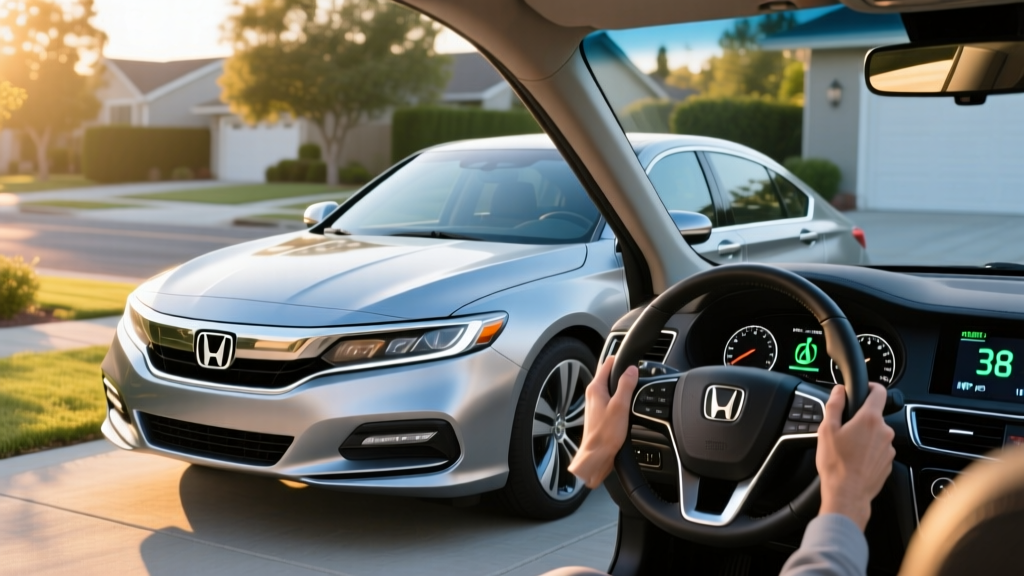
If you are shopping the used midsize sedan market and want maximum fuel efficiency without plugging in, the 2017 Honda Accord Hybrid remains a compelling option nearly a decade after its debut. Its two-motor hybrid powertrain delivers impressive city MPG, a spacious cabin, and Honda's reputation for long-term reliability. This guide breaks down the 2017 Honda Accord Hybrid fuel economy numbers, real-world efficiency expectations, powertrain details, battery longevity, and whether this HEV still makes sense in 2026 versus a newer hybrid, PHEV, or full EV.
2017 Honda Accord Hybrid Fuel Economy: EPA Numbers and Real-World MPG
The EPA rated the 2017 Honda Accord Hybrid at 49 MPG city / 47 MPG highway / 48 MPG combined. These figures apply to all trims (Hybrid, Hybrid EX-L, and Hybrid Touring) because they share the same powertrain and weight class. For context, the conventional 2017 Accord with the 2.4L four-cylinder and CVT was rated at 27 city / 36 highway / 30 combined — making the hybrid roughly 60% more efficient in city driving.
| Configuration | City MPG | Highway MPG | Combined MPG |
|---|---|---|---|
| 2017 Accord Hybrid (all trims) | 49 | 47 | 48 |
| 2017 Accord 2.4L I-4 (CVT) | 27 | 36 | 30 |
| 2017 Accord 3.5L V6 (6AT) | 21 | 33 | 25 |
How the Two-Motor Hybrid Powertrain Works
The 2017 Accord Hybrid uses Honda's Intelligent Multi-Mode Drive (i-MMD) system, which operates differently from the planetary-gear hybrid setups found in Toyotas. Here is the hardware:
| Specification | 2017 Accord Hybrid |
|---|---|
| Engine | 2.0L Atkinson-cycle I-4, 143 hp / 129 lb-ft |
| Drive Motor | AC permanent-magnet, 184 hp / 232 lb-ft |
| Generator Motor | AC permanent-magnet (starter/generator) |
| Combined System Output | 212 hp |
| Hybrid Battery | 1.3 kWh lithium-ion (usable ~0.9 kWh) |
| Transmission | Direct-drive (no traditional gearbox); engine clutch for highway cruise |
| 0-60 mph | ~7.1 seconds |
| Curb Weight | ~3,470 lbs |
The i-MMD system operates in three modes:
- EV Drive: Battery powers the drive motor alone (short distances at low speed, typically under 1-2 miles).
- Hybrid Drive: The gasoline engine spins the generator motor to produce electricity, which feeds the drive motor. The engine is not mechanically connected to the wheels.
- Engine Drive: At steady highway speeds (roughly 45-75 mph), a lockup clutch connects the engine directly to the front wheels for maximum efficiency.
This means the Accord Hybrid drives more like an EV in city conditions than a traditional hybrid. The electric motor provides immediate torque from a stop, and the engine only revs to match electrical demand rather than road speed — resulting in a smoother, quieter experience than parallel-hybrid competitors.
HEV vs PHEV vs EV: Where Does the Accord Hybrid Fit?
A common question from buyers researching the 2017 Accord Hybrid is whether they should consider a plug-in hybrid or full electric vehicle instead. Understanding the distinction is essential.
| Feature | HEV (e.g., Accord Hybrid) | PHEV (e.g., Toyota Prius Prime) | BEV (e.g., Tesla Model 3) |
|---|---|---|---|
| Plug-in charging required? | No — self-charging via regen + engine | Yes — for electric-only miles | Yes — sole energy source |
| Electric-only range | ~1 mile (low speed only) | 25-44 miles (model dependent) | 250-360+ miles |
| Gasoline backup | Yes, always available | Yes, always available | No |
| Home charging install needed | No | Recommended (Level 2) | Essential (Level 2) |
| Federal tax credit (§30D) | Not eligible | Eligible (new PHEVs, up to $7,500) | Eligible (new BEVs, up to $7,500) |
| Best for | No home charging access; long highway commutes | Short commutes + home charging + road-trip flexibility | Home charging + mostly under 250-mi daily needs |
Important note: The 2017 Honda Accord Hybrid is a conventional HEV. It does not plug in. Honda did produce an Accord Plug-In Hybrid for the 2014-2015 model years (with 13 miles of electric-only range), but it was discontinued well before 2017. If you see "Accord Plug-In" listings, they are earlier models. The 2017 model year was exclusively a self-charging HEV.
Battery Longevity, Warranty, and Replacement Cost
The lithium-ion hybrid battery in the 2017 Accord Hybrid is small (1.3 kWh) and is not the same as the large traction batteries in EVs. Because it operates in a narrow state-of-charge window (typically 40-80% SoC), degradation is minimal over time.
- Coverage: 8 years / 100,000 miles (10 years / 150,000 miles in CARB states — CA, CT, ME, MD, MA, NJ, NY, OR, RI, VT, WA, and others adopting California emissions standards)
- What's covered: Hybrid battery pack, drive motor, generator motor, power control unit, and other hybrid-system components
- Capacity threshold: Honda covers defects and abnormal degradation; there is no published minimum capacity retention percentage (unlike EV warranties that guarantee 70% SoH)
Real-world battery lifespan: By 2026, most 2017 Accord Hybrids are 9 years old and approaching or exceeding the federal 8-year/100,000-mile warranty window. However, Honda's i-MMD hybrid batteries have proven durable. Taxi fleet data and owner forums report original batteries functioning well past 150,000 miles with minimal capacity loss. The small battery size and conservative charge management mean thermal stress is low.
Replacement cost if needed: A new OEM hybrid battery from Honda runs approximately $2,000-$3,000 (parts only). Including labor at a dealership, total replacement typically costs $3,000-$4,500. Independent hybrid specialists and refurbished battery options can reduce this to $1,500-$2,500. For context, this is far less than EV battery replacements, which can exceed $10,000-$15,000 for large NMC packs.
Used 2017 Accord Hybrid Pricing in 2026
As a 9-year-old vehicle in 2026, the 2017 Accord Hybrid is exclusively available on the used market. Pricing varies by mileage, condition, trim level, and region.
| Trim | Original MSRP (2017) | Estimated Used Price (2026) |
|---|---|---|
| Hybrid (base) | $29,605 | $13,000 - $16,000 |
| Hybrid EX-L | $32,905 | $15,000 - $18,500 |
| Hybrid Touring | $35,955 | $16,500 - $20,000 |
Tax credit eligibility: The 2017 Honda Accord Hybrid does not qualify for the federal §30D clean vehicle credit. That credit applies only to new plug-in vehicles (BEVs and PHEVs) meeting battery-sourcing, MSRP cap, and buyer income requirements as outlined by the IRS. Used hybrids of any kind are not eligible for the $4,000 used-EV credit either, since that applies only to used BEVs and PHEVs under $25,000 — not conventional HEVs. Some states may offer minimal incentives for used hybrid purchases, but these are rare and vary by jurisdiction. Check your state's energy office for current programs.
Reliability, Safety, and Common Issues
The 2017 Accord Hybrid earned strong safety credentials. The NHTSA gave it a 5-star overall safety rating, and the IIHS named it a Top Safety Pick+ when equipped with Honda Sensing (standard on EX-L and Touring, optional on base Hybrid).
Common owner-reported concerns:
- 12V auxiliary battery drain: If the car sits unused for weeks, the 12V battery can discharge. This is a common issue across all hybrids and EVs — not specific to the Accord.
- Infotainment lag: The 2017 Honda infotainment system is known for slow response times and an unintuitive interface. This is a technology-era limitation, not a reliability failure.
- Brake feel: The transition between regenerative braking and friction braking can feel slightly abrupt at low speeds. This is normal for Honda's hybrid system and not a defect.
- Hybrid system cooling fan noise: Under heavy load (steep hills, hot weather), the hybrid battery cooling fan behind the rear seat can become audible. This is normal operation.
Overall, the 2017 Accord Hybrid has proven to be one of the most reliable vehicles in its class. The powertrain is mechanically simpler than a conventional automatic transmission (no multi-gear gearbox), and the electric motors have no wear items.
Who Should Buy the 2017 Accord Hybrid in 2026?
Choose the 2017 Accord Hybrid if:
- You lack access to home or workplace charging (apartment, street parking)
- Your commute is city-heavy with frequent stop-and-go traffic
- You want a proven, spacious midsize sedan under $20,000
- You drive 12,000-15,000+ miles per year and want to minimize fuel costs without lifestyle changes
- You prefer not to think about charging — just fill up with gas and go
Consider a PHEV or BEV instead if:
- You have home Level 2 charging and a commute under 30 miles (a PHEV like the 2026 Toyota Prius Prime gives 44 electric-only miles)
- You want to eliminate gasoline entirely and have predictable daily driving under 250 miles (a BEV like the Hyundai Ioniq 6 or Tesla Model 3)
- You want access to the federal §30D tax credit — only available on new plug-in vehicles
- You prioritize the latest ADAS technology (the 2017 Accord's Honda Sensing is basic compared to 2026 systems)
Ownership Cost Comparison: Accord Hybrid vs Gas Accord
At 48 MPG combined versus 30 MPG combined (gas 2.4L), the hybrid saves approximately 2.5 gallons per 100 miles driven. At $3.25/gallon (2026 national average), that translates to roughly $812 in annual fuel savings for a driver covering 15,000 miles per year. Over five years, the hybrid saves approximately $4,000 in fuel compared to the gas four-cylinder — which often covers the used-market price premium of the hybrid over a comparable gas Accord.
Frequently Asked Questions
How many MPG does the 2017 Honda Accord Hybrid get?
The EPA rates it at 49 city / 47 highway / 48 combined MPG. In real-world driving, owners often exceed 50 MPG in warm-weather city conditions and see 42-45 MPG on the highway at speeds above 70 mph.
Does the 2017 Accord Hybrid need to be plugged in?
No. The 2017 Accord Hybrid is a conventional HEV (self-charging hybrid). It regenerates energy through braking and the gasoline engine to keep its small 1.3 kWh battery charged. There is no plug and no electric-only commuting range to speak of (under 1 mile at very low speeds).
Is the 2017 Accord Hybrid battery expensive to replace?
OEM replacement runs $3,000-$4,500 at a dealer, or $1,500-$2,500 through independent hybrid shops using refurbished packs. However, Honda's hybrid batteries have proven extremely durable, with many exceeding 150,000 miles without significant degradation. The original warranty was 8 years/100,000 miles (10 years/150,000 miles in CARB states).
Does the 2017 Accord Hybrid qualify for any tax credit?
No. The federal §30D clean vehicle credit applies only to new plug-in vehicles (BEVs and PHEVs). Conventional hybrids like the Accord Hybrid are not eligible. The used clean vehicle credit (up to $4,000) also does not apply, as it covers only used BEVs and PHEVs.
How does the 2017 Accord Hybrid compare to a 2026 Toyota Camry Hybrid?
The current-generation Toyota Camry Hybrid (2025-2026) is rated at 51 city / 53 highway / 52 combined MPG with a newer powertrain, more advanced safety tech (Toyota Safety Sense 3.0), and a starting MSRP around $30,000. The 2017 Accord Hybrid is roughly $14,000-$18,000 cheaper on the used market and delivers comparable city efficiency, making it a strong value play for budget-conscious buyers who don't need the latest technology.
What is the driving range on a full tank?
The 2017 Accord Hybrid has a 14.0-gallon fuel tank. At 48 MPG combined, that yields approximately 672 miles of total range — enough for most drivers to go 2-3 weeks between fill-ups.