Quick Verdict: A Proven Hybrid Sedan With Real Staying Power
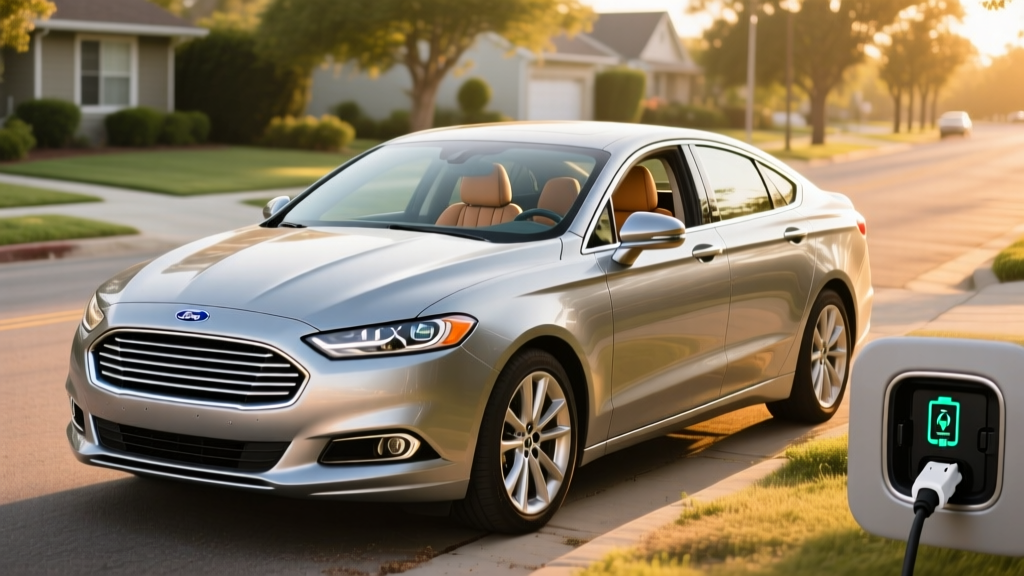
The 2017 Ford Fusion Hybrid Titanium remains one of the most compelling used hybrid sedans on the market nearly a decade after its debut. As a conventional hybrid (HEV) — not a plug-in — it requires zero behavior change from its owner: no charging cables, no range planning, no plug-in routines. You simply fill it with gas and drive. The Titanium trim packs premium features that rival luxury compact sedans, while the 2.0-liter Atkinson-cycle engine paired with Ford's hybrid electric motor delivers an EPA-rated 42 MPG combined. In 2026, with used EV prices still elevated and charging infrastructure uneven outside major metros, a well-maintained Fusion Hybrid Titanium represents a pragmatic, low-risk path to serious fuel savings.
| Spec | Value |
|---|---|
| Powertrain | 2.0L Atkinson-cycle I4 + electric motor (HEV) |
| Combined Horsepower | 188 HP |
| EPA Fuel Economy | 42 MPG combined (43 city / 41 highway) |
| Battery Type | 1.4 kWh lithium-ion (traction battery) |
| Drivetrain | Front-wheel drive, eCVT |
| 0–60 mph | ~7.8 seconds |
| Cargo Volume | 12.0 cu ft (trunk) |
| Original MSRP (Titanium) | ~$34,595 (2017) |
| Typical Used Price (2026) | $12,000–$18,000 depending on mileage/condition |
| Hybrid Battery Warranty | 8 years / 100,000 miles (original, transferable) |
HEV vs. PHEV vs. EV: Which Electrified Sedan Fits You?
The 2017 Fusion lineup actually came in three flavors, and understanding the difference is critical before you buy:
| Attribute | Fusion Hybrid (HEV) | Fusion Energi (PHEV) | Fusion Gas (2.0T EcoBoost) |
|---|---|---|---|
| Plug-in Required? | No | Yes (Level 1/2) | No |
| EPA Combined MPG / MPGe | 42 MPG | 97 MPGe (electric) / 42 MPG (gas) | |
| Electric-Only Range | N/A (motor assists engine) | 22 miles | |
| Battery Capacity | 1.4 kWh | 7.6 kWh | |
| Total Range | ~550+ miles | ~360 miles (EV + gas) | |
| DC Fast Charging | N/A | No (Level 2 AC only, ~2.5 hrs) | |
| Federal Tax Credit (2017) | None | $4,007 (expired) | |
| Trunk Space | 12.0 cu ft | 8.2 cu ft (battery intrusion) |
The conventional hybrid (HEV) uses regenerative braking and engine optimization to charge its small 1.4 kWh battery. You never plug it in. The electric motor assists the gas engine during acceleration and enables low-speed electric-only driving in stop-and-go traffic, but the car always has gasoline as its primary energy source.
The Fusion Energi (PHEV) is a different vehicle altogether. With a 7.6 kWh battery, it delivers 22 miles of electric-only range before the gas engine kicks in. It can be plugged into a standard 120V outlet (Level 1, ~7 hours for a full charge) or a 240V Level 2 charger (~2.5 hours). It does not support DC fast charging. If your commute is under 22 miles round-trip and you have home charging access, the Energi can run almost entirely on electricity during the week.
A full EV (like a used Tesla Model 3 or Chevrolet Bolt) eliminates gasoline entirely but demands reliable charging access — either at home or through public infrastructure. If you lack a garage or driveway for a charger, a conventional HEV like the Fusion Hybrid remains the most practical electrified option.
Fuel Economy: EPA Numbers vs. Real-World MPG
| Driving Cycle | EPA Rating |
|---|---|
| City | 43 MPG |
| Highway | 41 MPG |
| Combined | 42 MPG |
Source: EPA Fuel Economy Guide — 2017 Ford Fusion Hybrid
The Fusion Hybrid's city MPG actually exceeds its highway rating — a hallmark of conventional hybrids. Regenerative braking recaptures energy during frequent stops, and the electric motor handles low-speed driving where gas engines are least efficient. On the highway, the gasoline engine does most of the work with less regen opportunity, so efficiency drops slightly.
Real-world expectations: Owners on Fuelly and hybrid forums consistently report 40–46 MPG in mixed suburban driving. City-heavy commuters often see 44–47 MPG, exceeding the EPA estimate. Highway-only road trips at 75+ mph tend to yield 37–40 MPG. In cold weather (below 30°F), expect a 3–5 MPG reduction as the engine runs more frequently to provide cabin heat and maintain battery temperature. This is normal hybrid behavior, not a defect.
With a 13.5-gallon fuel tank, real-world total range typically falls between 520 and 600 miles — enough for most drivers to visit a gas station once every two weeks or less.
Powertrain Deep Dive: How 188 HP Gets Delivered
The Fusion Hybrid pairs a 2.0-liter Atkinson-cycle inline-four engine (141 HP, 129 lb-ft torque) with a 120 HP electric motor integrated into Ford's electronically controlled continuously variable transmission (eCVT). The combined system output is 188 HP. The Atkinson cycle sacrifices some low-end power density for superior thermal efficiency — it keeps the intake valve open longer during the compression stroke, reducing pumping losses.
The eCVT is not a belt-driven CVT like those found in some Nissan or Subaru models. Ford uses a planetary gearset that blends engine and motor power seamlessly. There are no rubber belts to wear out, and the design has proven extremely durable — a significant reliability advantage over traditional automatic or belt-CVT transmissions.
Acceleration is adequate for daily driving: 0–60 mph in approximately 7.8 seconds. The electric motor provides instant torque from a stop, making the car feel responsive in city traffic even though it is not a performance vehicle. The transition between electric-only and engine-assisted driving is nearly imperceptible — one of Ford's strongest engineering achievements with this powertrain.
Titanium Trim: What You Get at the Top of the Line
The Titanium was the premium trim in the 2017 Fusion Hybrid lineup, sitting above the SE. Key features include:
- Sony 12-speaker premium audio system
- Leather-trimmed heated and cooled front seats
- SYNC 3 infotainment with 8-inch touchscreen, Apple CarPlay, and Android Auto
- Push-button start with intelligent access
- Lane-keeping system and BLIS (Blind Spot Information System) with cross-traffic alert
- Adaptive cruise control (optional on some builds)
- 18-inch alloy wheels
- Ambient interior lighting
- Rear parking sensors and a rearview camera
For a 2017 vehicle, the SYNC 3 system holds up surprisingly well. Apple CarPlay and Android Auto support means you get modern navigation and app integration through your phone, bypassing the aging native interface. The driver-assistance features, while not comparable to modern SAE Level 2+ systems like Ford's current BlueCruise, still provide useful lane-centering and collision warnings.
Battery Lifespan, Warranty, and Replacement Cost
Hybrid Battery Warranty — Original Terms
Ford warranted the 2017 Fusion Hybrid's 1.4 kWh lithium-ion traction battery for 8 years or 100,000 miles (whichever comes first). In California Air Resources Board (CARB) states, the warranty extends to 10 years or 150,000 miles. This warranty is transferable to subsequent owners.
For a 2017 model, the standard 8-year warranty expired in 2025. The CARB-state 10-year coverage runs through 2027. If you are buying in 2026, verify the vehicle's mileage and registration state to determine any remaining coverage.
Battery longevity in practice: Ford's 1.4 kWh lithium-ion pack is notably smaller and less stressed than a full EV battery. Because the hybrid system never fully depletes or fully charges the battery (it operates in a narrow state-of-charge window, typically 40–80%), degradation is minimal. High-mileage Fusion Hybrids used in taxi and fleet service have exceeded 200,000 miles on the original battery pack.
That said, age-related degradation is real. By year 9 or 10, some owners report a 5–10% reduction in electric-assist range, which translates to a 1–3 MPG decrease. This is gradual and rarely renders the vehicle undrivable.
Replacement cost: A new OEM replacement hybrid battery from Ford runs approximately $2,500–$3,500 including installation at a dealership. Third-party refurbished or reconditioned batteries are available for $1,200–$2,000 installed. Independent hybrid specialists in most metro areas can perform the swap in 2–3 hours. This is a fraction of full EV battery replacement costs, which can exceed $10,000–$20,000.
Tax Credits and Incentives: What Applies in 2026
Federal tax credit (§30D): The 2017 Ford Fusion Hybrid does not qualify for the federal §30D new clean vehicle credit. That credit applies only to the purchase of new qualifying EVs and PHEVs with sufficient battery capacity. Conventional hybrids (HEVs) have never been eligible. The Fusion Energi (PHEV) originally qualified for a $4,007 credit when purchased new, but that credit expired and does not transfer to used buyers.
Used clean vehicle credit (§25E): The IRS §25E credit allows up to $4,000 (30% of sale price, capped) for qualifying used EVs and PHEVs purchased from a dealer for $25,000 or less. However, this credit applies only to plug-in electric vehicles — conventional hybrids like the Fusion Hybrid are not eligible. The Fusion Energi (PHEV) would qualify if purchased from a dealer for under $25,000, subject to buyer income caps ($75,000 single / $150,000 joint) and the vehicle's original MSRP being under the applicable cap. See the IRS §25E page for current eligibility details.
State incentives: Some states offer rebates or HOV lane access for hybrids, but these vary widely and change frequently. Check your state's energy office or DMV for current programs.
Reliability and Ownership Costs
The 2017 Fusion Hybrid benefits from one of the most proven hybrid powertrains Ford has ever built. The planetary eCVT has no belts, clutches, or torque converters to fail. The regenerative braking system significantly reduces wear on the friction brakes — many owners report original brake pads lasting 80,000–100,000 miles.
According to NHTSA, the 2017 Fusion Hybrid earned a 5-star overall safety rating. The IIHS rated it a Top Safety Pick+ when equipped with optional front crash prevention.
Common issues reported by high-mileage owners include:
- 12V auxiliary battery drain: Like many hybrids, the Fusion can experience 12V battery issues if left sitting for extended periods. The 12V battery powers electronics and must be healthy for the hybrid system to boot. Replacement is a standard $150–$250 job.
- EVAP system codes: Some owners report evaporative emissions system faults around 80,000–120,000 miles. Usually a purge valve or gas cap issue — inexpensive to fix.
- Infotainment glitches: SYNC 3 can occasionally freeze or lag. A master reset (holding power + skip-forward buttons) typically resolves this.
Estimated annual maintenance cost: $400–$600 per year for routine service (oil changes, tire rotation, cabin filter, brake inspection). This is comparable to a gas sedan and significantly lower than most European luxury alternatives.
Who Should Buy the 2017 Fusion Hybrid Titanium in 2026?
Choose the Fusion Hybrid Titanium if:
- You want 40+ MPG without plugging in or changing your driving habits
- You lack reliable home or workplace charging access for a PHEV or EV
- You want a comfortable, well-equipped midsize sedan under $18,000
- Your commute involves significant stop-and-go city driving (where hybrids excel)
- You want low maintenance costs and proven long-term reliability
Consider a PHEV or full EV instead if:
- You have home Level 2 charging and a commute under 30 miles (a PHEV like the Fusion Energi or a modern EV could eliminate most gasoline use)
- You want the latest ADAS features — modern vehicles offer more advanced SAE Level 2 driver assistance
- You need more cargo space — the Fusion's 12.0 cu ft trunk is modest for the class
- You want all-wheel drive (the Fusion Hybrid is FWD only; consider the Toyota Camry Hybrid AWD or a used Tesla Model 3)
Pros
- 42 MPG EPA combined; often exceeds in city driving
- Smooth, quiet hybrid powertrain with no plug-in hassle
- Titanium trim offers near-luxury interior at a budget used price
- Proven planetary eCVT — no belt or clutch failures
- Low brake wear thanks to regenerative braking
- Hybrid battery replacement is affordable ($1,200–$3,500)
- 5-star NHTSA safety rating
Cons
- Trunk space (12.0 cu ft) is smaller than non-hybrid competitors
- No all-wheel-drive option
- SYNC 3 infotainment is functional but dated by 2026 standards
- Original hybrid battery warranty has mostly expired (CARB states excepted)
- Highway MPG drops to ~37–40 at sustained 75+ mph speeds
- Discontinued after 2020 — no new model updates or parts pipeline concerns, but sedan segment support is declining
Frequently Asked Questions
How many MPG does the 2017 Ford Fusion Hybrid actually get?
The EPA rates it at 43 city / 41 highway / 42 combined. Real-world owners typically see 40–46 MPG in mixed driving, with city-heavy commuters often exceeding 44 MPG. Highway-only driving at 75+ mph yields 37–40 MPG. Cold weather reduces efficiency by roughly 3–5 MPG.
Does the 2017 Fusion Hybrid need to be plugged in?
No. The Fusion Hybrid is a conventional hybrid (HEV). It charges its 1.4 kWh battery through regenerative braking and the gasoline engine. You never plug it in. If you want plug-in capability, look for the Fusion Energi (PHEV), which has a larger 7.6 kWh battery and 22 miles of electric-only range.
How far can the Fusion Energi (PHEV) go on electric only?
The 2017 Fusion Energi delivers an EPA-rated 22 miles of electric-only range. Total combined range (electric + gasoline) is approximately 360 miles. It charges via Level 1 (120V, ~7 hours) or Level 2 (240V, ~2.5 hours) and does not support DC fast charging.
Is the 2017 Fusion Hybrid reliable? What about battery replacement?
Yes, it is considered one of Ford's most reliable modern vehicles. The planetary eCVT has no wear-prone belts or clutches. The 1.4 kWh hybrid battery is lightly stressed and commonly lasts 150,000+ miles. If replacement is needed, expect $1,200–$2,000 for a refurbished unit or $2,500–$3,500 for a new OEM battery, installed.
Does the 2017 Fusion Hybrid qualify for any tax credit in 2026?
No. The federal §30D credit applies only to new plug-in vehicles, and the §25E used clean vehicle credit applies only to used EVs and PHEVs — not conventional hybrids. The Fusion Energi (PHEV) may qualify for the §25E used credit if purchased from a dealer for under $25,000, subject to IRS income limits. Check IRS guidelines for current rules.
Hybrid vs. PHEV vs. EV — which should I choose?
If you cannot charge at home, a conventional hybrid (HEV) like the Fusion Hybrid is the safest choice — no infrastructure needed. If you have Level 2 home charging and a short commute, a PHEV gives you electric daily driving with gas backup. A full EV makes sense if you have reliable charging access and want to eliminate gasoline entirely. Each step up in electrification requires more charging infrastructure but offers lower per-mile energy costs.