Quick Verdict: A Proven Midsize Hybrid at a Used-Car Bargain Price
The 2017 Ford Fusion Hybrid SE FWD occupies a specific niche in the 2026 used-car market: a comfortable, tech-forward midsize sedan that delivers genuine fuel savings without requiring a plug, a lifestyle change, or a five-figure budget. With an EPA-rated 42 MPG combined, a 188-horsepower hybrid powertrain, and a battery warranty that in many cases still has residual coverage, the Fusion Hybrid SE remains one of the more compelling used hybrid pickups available today — often changing hands for $10,000 to $15,000 depending on mileage and condition.
But before you sign the papers, you need to know exactly what you're getting: real-world fuel economy that shifts dramatically between city and highway driving, a battery system that's durable but not immortal, and zero eligibility for current federal tax credits on a vehicle of this age. This guide breaks down every number that matters.
EPA Fuel Economy vs. Real-World MPG
The 2017 Ford Fusion Hybrid carries an EPA rating that remains competitive even against newer hybrids in 2026. Here is the official breakdown from fueleconomy.gov:
| Metric | Value |
|---|---|
| City MPG | 43 |
| Highway MPG | 41 |
| Combined MPG | 42 |
| Fuel Tank Capacity | 13.5 gallons |
| EPA Total Range | ~567 miles |
| Annual Fuel Cost (EPA est.) | ~$1,350 (15,000 mi/yr) |
Powertrain Specs: Engine, Motor, and Combined Output
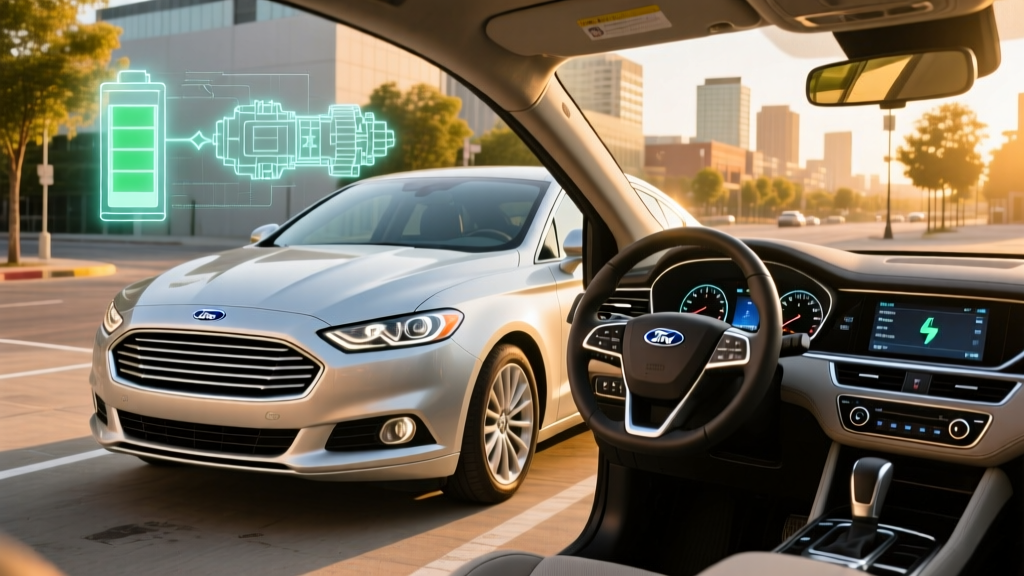
The 2017 Fusion Hybrid pairs a 2.0-liter Atkinson-cycle four-cylinder engine with an electric motor and a lithium-ion battery pack. This is a conventional hybrid (HEV), meaning it generates all its electricity internally — you never plug it in.
| Component | Specification |
|---|---|
| Gas Engine | 2.0L Atkinson-cycle I-4 |
| Engine Horsepower | 141 HP @ 6,000 RPM |
| Engine Torque | 129 lb-ft @ 4,000 RPM |
| Electric Motor Output | 118 HP (88 kW) |
| Combined System Horsepower | 188 HP |
| Transmission | eCVT (electronic continuously variable) |
| Drive Configuration | Front-wheel drive (FWD) |
| 0–60 MPH (est.) | ~8.3 seconds |
| Battery Type | Lithium-ion (Li-ion) |
| Battery Capacity | 1.4 kWh |
The eCVT in the Fusion Hybrid is not a belt-and-pulley CVT like those in some competitors. Ford uses a planetary gearset that blends engine and motor power seamlessly — there are no rubber bands or slipping belts, which contributes to the powertrain's long-term durability. Acceleration is adequate for merging and passing, though the 188 HP combined output won't thrill anyone coming from a turbocharged sport sedan.
HEV vs. PHEV vs. EV: Which Powertrain Fits You?
The 2017 Fusion was sold in three distinct powertrain variants, and buyers frequently confuse them. Here is the critical distinction:
| Feature | Fusion Hybrid (HEV) | Fusion Energi (PHEV) | Fusion Gas (ICE) |
|---|---|---|---|
| Plug-in Charging | No — self-charging | Yes — plug in for EV range | No |
| Electric-Only Range | ~1 mile (low speed) | 22 miles (EPA) | None |
| Battery Size | 1.4 kWh | 7.6 kWh | N/A |
| Combined MPG / MPGe | 42 MPG | 97 MPGe (electric) / 42 MPG (gas) | |
| Total Range | ~567 miles | ~610 miles (EV + gas) | |
| Federal Tax Credit (new) | None | $4,007 (expired) | None |
| Trunk Space | 12.0 cu ft | 8.2 cu ft (battery intrusion) | 16.0 cu ft |
Choose the Fusion Hybrid (HEV) if: You want better fuel economy with zero behavior change. No home charger needed, no route planning, no range anxiety. You drive a mix of city and highway miles and want a car that simply sips less fuel.
Choose a PHEV (like the Fusion Energi or a newer Toyota RAV4 Prime) if: You have access to home or workplace charging, your commute is under 25 miles, and you want to drive most weekdays on electricity while keeping a gas engine for road trips.
Choose a full EV (like a used Chevrolet Bolt or Tesla Model 3) if: You have reliable home Level 2 charging, your daily driving is under 200 miles, and you want to eliminate gas station visits and oil changes entirely.
Reliability, Battery Lifespan, and Replacement Cost
The 2017 Fusion Hybrid's lithium-ion battery pack and eCVT powertrain have proven durable in fleet and consumer use. Ford's hybrid system, shared with the C-Max and later refined in the Maverick hybrid, has a strong track record — many examples have exceeded 150,000 miles with minimal battery degradation.
Ford warranted the 2017 Fusion Hybrid's high-voltage battery for 8 years / 100,000 miles (whichever comes first) in most states, and 10 years / 150,000 miles in California Air Resources Board (CARB) states (CA, CT, ME, MA, NJ, NY, OR, RI, VT, WA, MD, NM, CO, NV, DE, MN, RI).
2026 Implication: Since the 2017 model is now 9 years old, the standard 8-year warranty has expired for most original owners. However, if the car was first sold in early 2018 or if you're in a CARB state, you may still have residual coverage through early 2027. Always verify with a Ford dealer using the VIN.
Battery Degradation: The 1.4 kWh battery in the Fusion Hybrid is small and is managed conservatively by Ford's battery management system (BMS), which keeps the state of charge within a narrow window (roughly 40–60%) to minimize stress. Real-world degradation is typically 10–15% capacity loss over 100,000 miles. Since the battery is already small, you may notice slightly less electric-assist at low speeds, but the impact on overall MPG is usually 1–3 MPG at most.
Battery Replacement Cost: If the hybrid battery fails out of warranty, a new OEM replacement from Ford runs approximately $2,500 to $4,000 including labor at a dealership. Independent hybrid specialists and refurbished battery options can reduce this to $1,500–$2,500. Given that a failed hybrid battery will trigger a check-engine light and severely limit performance (the car may still drive on the gas engine alone, but fuel economy drops to roughly 25–30 MPG), replacement is effectively mandatory.
General Reliability: According to NHTSA data, the 2017 Fusion Hybrid has average to above-average reliability for its class. Common non-powertrain complaints include SYNC 3 infotainment glitches, minor electrical gremlins, and standard wear items (brakes, suspension). The hybrid-specific components — battery, inverter, eCVT — have a low failure rate relative to the broader fleet.
Used-Car Pricing and Tax Credit Reality in 2026
As of early 2026, the 2017 Ford Fusion Hybrid SE FWD typically trades in the used market between $9,500 and $15,500, depending on mileage (60,000–120,000 miles is the common range), condition, and regional demand. Well-maintained examples under 80,000 miles command the top of that range.
Federal Tax Credits: The 2017 Fusion Hybrid (HEV) was never eligible for the federal §30D plug-in electric vehicle tax credit because it is a conventional hybrid — it has no plug and no meaningful electric-only range. The Fusion Energi (PHEV) qualified for $4,007 when new, but that credit is long expired for the original purchaser and does not transfer to used buyers.
Under current IRS §30D rules, the Used Clean Vehicle Credit (up to $4,000 or 30% of the sale price, whichever is less) applies only to plug-in electric vehicles (BEVs and PHEVs) with a battery capacity of at least 7 kWh, purchased from a dealer for $25,000 or less, with income caps. The conventional Fusion Hybrid does not qualify. The Fusion Energi (PHEV) with its 7.6 kWh battery could theoretically qualify, but the buyer must meet all IRS requirements including income limits ($75,000 single / $150,000 joint) and purchase through a licensed dealer.
What the SE Trim Gets You (and What It Doesn't)
The SE was the mid-level trim for the 2017 Fusion Hybrid, sitting above the base S and below the Titanium and Platinum. Here's what defines the SE FWD package:
Included: SYNC 3 infotainment with 8-inch touchscreen, Apple CarPlay and Android Auto, dual-zone automatic climate control, push-button start, 17-inch alloy wheels, power-adjustable driver's seat, rearview camera, Ford Co-Pilot360 precollision assist with pedestrian detection, lane-keeping system, and auto high-beam headlamps.
Not included (available on Titanium/Platinum): Leather seating, heated/ventilated front seats, Sony premium audio, navigation, adaptive cruise control with stop-and-go, blind-spot monitoring (BLIS), and the upgraded 12-speaker audio system.
For most used-car buyers, the SE trim hits the sweet spot: you get the critical safety tech and modern infotainment without paying a premium for luxury features that depreciate fastest.
Pros and Cons at a Glance
✓ Pros
- 42 MPG combined EPA; 44–48 MPG achievable in real city driving
- Smooth, quiet hybrid powertrain with no plug-in requirement
- Comfortable ride quality and well-insulated cabin
- SYNC 3 with Apple CarPlay/Android Auto remains usable in 2026
- Strong safety ratings (IIHS Top Safety Pick when new)
- Low used-car entry price ($10K–$15K)
- eCVT planetary gearset is mechanically robust
✗ Cons
- Highway MPG drops to 36–39 at sustained 75+ MPH speeds
- Trunk space reduced to 12.0 cu ft by battery placement (vs. 16.0 in gas model)
- Original 8-year battery warranty mostly expired by 2026
- No DC fast charging or plug-in capability (HEV only)
- 8.3-second 0–60 time feels leisurely by 2026 standards
- Ford discontinued the Fusion after 2020 — no new parts pipeline for body panels
- No eligibility for any current federal EV/hybrid tax credit
Frequently Asked Questions
How many MPG does the 2017 Ford Fusion Hybrid SE FWD actually get?
The EPA rates it at 43 city / 41 highway / 42 combined MPG. In real-world city driving with frequent stops, owners commonly see 44–48 MPG thanks to aggressive regenerative braking. Sustained highway driving above 70 MPH typically yields 36–39 MPG. Cold weather reduces these figures by roughly 5–10%.
Does the 2017 Fusion Hybrid need to be plugged in?
No. The 2017 Fusion Hybrid is a conventional hybrid (HEV). It charges its own 1.4 kWh battery through regenerative braking and the gas engine. You fuel it like any other car — with gasoline. If you want plug-in capability, you need the separate Fusion Energi (PHEV) model.
How far can the 2017 Fusion Hybrid drive on electric power alone?
Effectively less than 1 mile, and only at very low speeds (under 25 MPH) with a fully charged battery. The 1.4 kWh battery is not designed for electric-only driving. Its role is to assist the gas engine during acceleration and capture energy during braking. For meaningful electric-only range (22 miles EPA), you need the Fusion Energi PHEV.
Is the 2017 Fusion Hybrid battery reliable, and what does replacement cost?
The hybrid battery has a strong reliability record, with many examples surpassing 150,000 miles. The original warranty was 8 years/100,000 miles (10 years/150,000 in CARB states). By 2026, most original warranties have expired. An OEM replacement battery costs approximately $2,500–$4,000 at a dealer, or $1,500–$2,500 through independent hybrid specialists using refurbished units.
Does the 2017 Ford Fusion Hybrid qualify for any tax credit in 2026?
No. The conventional Fusion Hybrid (HEV) never qualified for the federal §30D plug-in vehicle credit because it has no plug and no significant battery capacity. The Used Clean Vehicle Credit (up to $4,000) applies only to qualifying plug-in vehicles (BEVs and PHEVs). The Fusion Energi PHEV could potentially qualify under the used-vehicle credit if purchased from a dealer and the buyer meets income limits, but the standard Hybrid does not.
Should I buy the Fusion Hybrid over a newer Toyota Prius or Honda Accord Hybrid?
It depends on budget. A 2017 Fusion Hybrid at $12,000 offers comparable fuel economy to a newer Prius at twice the price, plus a more comfortable ride and a quieter cabin. However, newer hybrids (2022+ Prius, Accord Hybrid) benefit from updated safety tech, remaining factory warranties, and slightly better highway efficiency. If your budget allows $25,000+, a newer hybrid is the safer long-term bet. If you need reliable hybrid transportation under $15,000, the Fusion Hybrid SE is a strong value pick — just budget for a potential battery replacement down the road.
What maintenance does the Fusion Hybrid require compared to a gas car?
Less, in most areas. The hybrid system eliminates the traditional starter motor and alternator (the high-voltage motor/generator handles both roles). Brake pads last significantly longer — often 80,000–120,000 miles — because regenerative braking handles most deceleration. You still need regular oil changes (Ford recommends every 10,000 miles or 12 months with synthetic), coolant flushes, air filter replacements, and tire rotations. The eCVT requires no fluid changes under normal driving conditions.