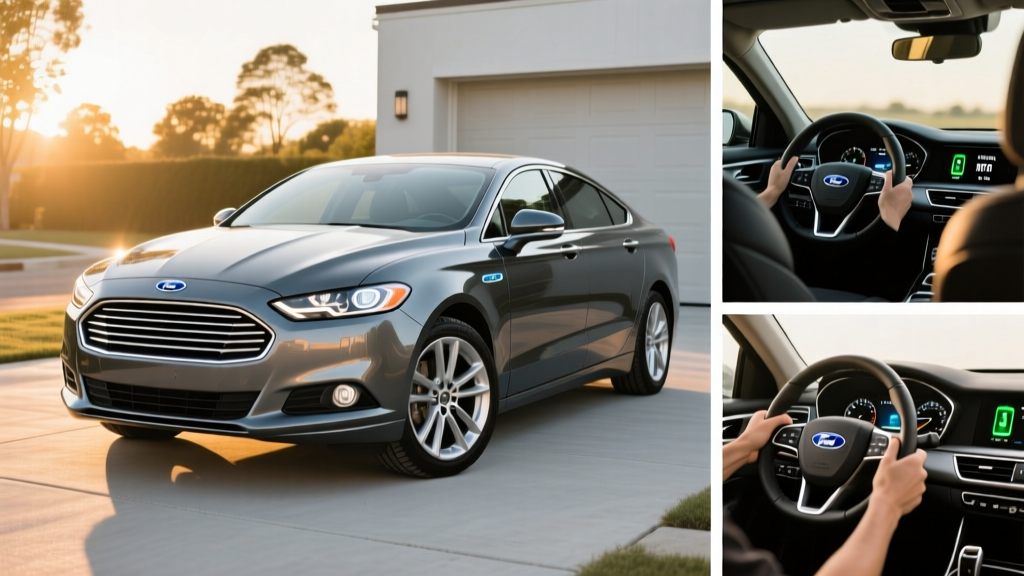
The Ford Fusion Hybrid was discontinued after the 2020 model year, but the 2017 model remains one of the most popular used midsize hybrids on the market. If you're searching for a fusion hybrid 2017 in 2026, you're likely weighing its strong city fuel economy, proven reliability, and lower used-car price against newer hybrid and EV alternatives. This guide covers the exact numbers — EPA MPG, battery specs, real-world efficiency, warranty status, and ownership costs — so you can decide whether a nine-year-old Fusion Hybrid still makes financial sense.
HEV vs PHEV: Which 2017 Fusion Did Ford Sell?
Ford offered two electrified Fusion variants for the 2017 model year, and confusing them is the most common buyer mistake:
2017 Fusion Hybrid (HEV)
- Type: Conventional hybrid — no plug
- Battery: 1.4 kWh lithium-ion
- Charging: Self-charges via regenerative braking and the gasoline engine; you never plug it in
- Electric-only driving: Brief low-speed EV mode (typically under 1 mile at speeds below ~25 mph)
- EPA Combined: 42 MPG
2017 Fusion Energi (PHEV)
- Type: Plug-in hybrid — requires plugging in to access full electric range
- Battery: 7.6 kWh lithium-ion (usable ~5.8 kWh)
- Charging: Level 1 (120V) ~7 hours; Level 2 (240V) ~2.5 hours; no DC fast charging
- Electric-only range: 22 miles (EPA)
- Total range: ~610 miles (electric + gasoline)
- EPA Combined (charge-sustaining): 38 MPG / 88 MPGe
This article focuses primarily on the 2017 Fusion Hybrid (HEV), with Energi PHEV data included where it helps buyers compare. If you're looking at a listing that says "Fusion Energi," you're looking at the plug-in version with different economics entirely.
Fuel Economy: EPA Ratings and Real-World MPG
The EPA rates the 2017 Ford Fusion Hybrid at 42 MPG combined, broken down as follows (source: fueleconomy.gov):
| Driving Cycle | EPA Rating | Real-World Expectation |
|---|---|---|
| City | 42 MPG | 43–48 MPG (regenerative braking shines in stop-and-go) |
| Highway | 41 MPG | 36–40 MPG (less regen benefit, higher aero drag at 70+ mph) |
| Combined | 42 MPG | 38–45 MPG depending on driving mix |
Why real-world city MPG often beats the EPA sticker: Hybrids recover kinetic energy during braking. City driving with frequent stops lets the Fusion Hybrid's regenerative braking system recharge the 1.4 kWh battery repeatedly, allowing the electric motor to handle more low-speed propulsion. On the highway, the gasoline engine does most of the work, and efficiency drops.
Cold-weather note: Expect a 5–10% MPG reduction in winter months (roughly 36–39 MPG combined). The engine runs more often to provide cabin heat, and battery internal resistance increases in cold temperatures, reducing the electric motor's contribution.
2017 Fusion Energi (PHEV) Efficiency
The plug-in Energi variant delivers 22 miles of electric-only range (EPA) before the gasoline engine engages. After battery depletion, it operates as a conventional hybrid at 38 MPG combined. Total range with a full tank and full battery is approximately 610 miles. Level 2 charging takes about 2.5 hours; DC fast charging is not supported.
Powertrain Specs: Engine, Motor, and Combined Output
| Specification | Fusion Hybrid (HEV) | Fusion Energi (PHEV) |
|---|---|---|
| Engine | 2.0L Atkinson-cycle I4 | 2.0L Atkinson-cycle I4 |
| Engine HP | 141 hp @ 6,000 rpm | 141 hp @ 6,000 rpm |
| Electric Motor | 88 kW (118 hp) permanent-magnet AC | 88 kW (118 hp) permanent-magnet AC |
| Combined Net HP | 188 hp | 188 hp |
| Transmission | eCVT (planetary gearset) | eCVT (planetary gearset) |
| Battery Capacity | 1.4 kWh Li-ion | 7.6 kWh Li-ion (5.8 kWh usable) |
| 0–60 mph | ~8.4 seconds | ~9.1 seconds (heavier battery) |
| Drivetrain | Front-wheel drive | Front-wheel drive |
| Curb Weight | ~3,472 lbs | ~3,918 lbs |
The eCVT is not a belt-driven continuously variable transmission like those in some competitors. Ford uses a planetary gearset that blends engine and motor power mechanically — it's more durable and has fewer wear components than a traditional CVT or automatic transmission. This is a reliability advantage for used buyers.
Used Pricing in 2026 and Tax Credit Eligibility
The 2017 Fusion Hybrid originally started at approximately $25,995 MSRP (S trim) and climbed to roughly $32,000 for a loaded Titanium. In the 2026 used market, expect to pay:
- SE trim, 80k–110k miles: $9,000–$12,000
- Titanium trim, 60k–90k miles: $12,000–$15,500
- Energi (PHEV) Titanium, 70k–100k miles: $10,500–$14,000
Federal tax credit status: The IRS §30D Clean Vehicle Credit applies only to new vehicle purchases or leases. Since the Fusion Hybrid has been out of production since 2020, no federal credit applies to a new purchase.
For the Used Clean Vehicle Credit (§25E), the maximum benefit is $4,000 or 30% of the sale price (whichever is lower), but the vehicle must have a sale price at or below $25,000 and meet battery sourcing requirements. The 2017 Fusion Hybrid's used price typically falls under $25,000, but the battery's critical-mineral sourcing may not satisfy current-year requirements. Additionally, buyer income caps apply ($75,000 single / $150,000 joint filers). Consult a tax professional and verify current IRS guidance before counting on this credit.
Battery Longevity, Warranty, and Replacement Cost
This is the top concern for any used hybrid buyer, and it's where the Fusion Hybrid performs well.
Original Hybrid Battery Warranty
Ford warranted the 2017 Fusion Hybrid's high-voltage battery for 8 years / 100,000 miles (extended to 10 years / 150,000 miles in California Air Resources Board states: CA, CT, ME, MD, MA, NJ, NY, OR, RI, VT, WA). The warranty covers defects and capacity loss below approximately 60% of original capacity.
In 2026, most 2017 Fusion Hybrids are out of factory warranty. A vehicle purchased new in early 2017 would have its 8-year/100k-mile warranty expire by early 2025 at the latest. CARB-state vehicles with 10-year coverage may still have residual protection through 2027, but only if under 150,000 miles.
Real-world battery degradation data: The 1.4 kWh lithium-ion pack in the Fusion Hybrid is relatively small and operates within a conservative state-of-charge window (roughly 40%–60% SoC in normal driving). This shallow cycling significantly reduces degradation. Owner reports and fleet data suggest the Fusion Hybrid battery typically retains 85–92% of original capacity at 150,000 miles. Catastrophic battery failure is uncommon.
Battery replacement cost (2026):
- New OEM battery (Ford dealer): $2,500–$3,500 (part) + $500–$800 labor = $3,000–$4,300 total
- Remanufactured battery (independent hybrid specialist): $1,500–$2,200 + $400–$600 labor = $1,900–$2,800 total
- Individual cell/module replacement: $800–$1,500 if only a subset of modules has degraded
Before purchasing, request a hybrid battery health report from a Ford dealer or qualified hybrid technician. The OBD-II system stores State of Health (SoH) data that can be read with a scan tool. Look for SoH above 80%.
Reliability, Safety, and Common Issues
The 2017 Fusion Hybrid benefits from Ford's second-generation hybrid system, which debuted in 2013 and had four years of refinement by 2017. Key reliability points:
- eCVT transmission: The planetary gearset design has no belts, clutches, or torque converter to wear out. Failures are rare and typically related to the inverter or cooling system rather than the gearset itself.
- Brakes: Regenerative braking reduces wear on the friction brakes. Original brake pads often last 80,000–100,000+ miles.
- 12V auxiliary battery: Like all hybrids, the Fusion has a standard 12V battery that powers accessories. This is a common failure point around years 4–6 and costs ~$150–$200 to replace. It is separate from the high-voltage traction battery.
- Coolant system: The hybrid system has its own coolant loop. Check for coolant level and condition during pre-purchase inspection; coolant should be replaced per Ford's maintenance schedule (typically every 100,000 miles).
Safety ratings: The 2017 Fusion earned a 5-Star Overall rating from NHTSA and was an IIHS Top Safety Pick with Good ratings in all crashworthiness tests (source: NHTSA). Standard safety features include forward collision warning, lane-keeping assist, and a rearview camera. Blind-spot monitoring and adaptive cruise control were optional on SE and standard on Titanium.
Who Should Buy the 2017 Fusion Hybrid in 2026?
Pros
- 42 MPG EPA combined; real-world city driving often exceeds 45 MPG
- No plug-in charging required — refuel at any gas station
- Spacious midsize cabin with 16 cu ft trunk (hybrid battery reduces trunk slightly vs gas model)
- Proven eCVT powertrain with low failure rates
- Strong safety ratings (5-star NHTSA, IIHS Top Safety Pick)
- Used pricing of $9,000–$15,500 represents strong value per MPG
- Low brake wear thanks to regenerative braking
Cons
- Out of production since 2020 — no new units available
- Most examples are now out of factory battery warranty
- Highway MPG (36–40 real-world) trails city MPG
- Infotainment (SYNC 3) is dated compared to 2026 systems; no wireless CarPlay/Android Auto
- No DC fast charging capability (Energi PHEV)
- Not eligible for new-vehicle federal tax credits
- Trunk space reduced to ~12 cu ft due to battery placement (vs 16 cu ft in gas Fusion)
Decision Framework: Is the 2017 Fusion Hybrid Right for You?
Choose the 2017 Fusion Hybrid if:
- Your budget is under $15,000 and you want maximum MPG without plug-in infrastructure
- You drive primarily in city or suburban stop-and-go traffic (where hybrids excel)
- You don't have access to home or workplace charging (making a PHEV or BEV impractical)
- You want a midsize sedan with strong safety ratings and a comfortable ride
Choose a newer hybrid (2023+ Toyota Camry Hybrid, Honda Accord Hybrid) if:
- You want a remaining factory warranty and modern infotainment
- You drive mostly highway miles (where newer hybrids close the gap)
- Your budget allows $25,000–$35,000
Choose a full EV (BEV) if:
- You have reliable Level 2 home charging
- Your daily commute is under 200 miles round-trip
- You want zero tailpipe emissions and lower per-mile fuel cost
- You qualify for the §30D federal tax credit on a new EV purchase
Frequently Asked Questions
How many MPG does the 2017 Ford Fusion Hybrid get?
The EPA rates it at 42 MPG city, 41 MPG highway, and 42 MPG combined. In real-world driving, city MPG often reaches 43–48 MPG thanks to regenerative braking, while highway driving at 70+ mph typically yields 36–40 MPG. Cold weather can reduce combined MPG by 5–10%.
How far can the 2017 Fusion Energi go on electric only?
The Fusion Energi (PHEV variant) delivers 22 miles of EPA-rated electric-only range before the gasoline engine engages. After battery depletion, it continues as a conventional hybrid at 38 MPG combined. Total range with a full battery and full tank is approximately 610 miles.
Does the 2017 Fusion Hybrid need to be plugged in?
No. The standard Fusion Hybrid (HEV) is a self-charging conventional hybrid. It generates electricity through regenerative braking and the gasoline engine. You never plug it in — you simply refuel at a gas station. Only the Fusion Energi (PHEV) requires plugging in to access its 22-mile electric range.
Is the 2017 Fusion Hybrid reliable?
Yes. The second-generation Ford hybrid powertrain (2.0L Atkinson-cycle engine + eCVT planetary gearset) has a strong reliability record. The eCVT has no belts or clutches to fail, and the hybrid battery's shallow cycling reduces degradation. The main wear items are the 12V auxiliary battery (replace every 4–6 years) and the hybrid coolant (flush per maintenance schedule).
What does a replacement hybrid battery cost?
A new OEM battery from a Ford dealer runs $3,000–$4,300 installed. A remanufactured battery from an independent hybrid specialist costs $1,900–$2,800 installed. Individual module replacement is possible for $800–$1,500 if only partial degradation is present. Most 2017 Fusion Hybrid batteries retain 85–92% capacity at 150,000 miles, so full replacement is not immediately necessary for most examples.
Does the 2017 Fusion Hybrid qualify for any tax credit?
Not for new-vehicle credits — the car has been out of production since 2020. The IRS §25E Used Clean Vehicle Credit could theoretically apply (up to $4,000 or 30% of sale price), but the vehicle must meet battery critical-mineral sourcing rules and the buyer must fall under income caps ($75,000 single / $150,000 joint). Given the vehicle's age and sourcing, eligibility is uncertain. Consult a tax professional before relying on this credit.
Hybrid vs PHEV vs EV — which should I choose?
If you lack home charging access and want maximum simplicity, the conventional hybrid (HEV) is the right choice — no plug, no behavior change. If you have Level 2 charging at home and a short commute, a PHEV lets you drive 20–40 miles on electricity before the engine kicks in. If you have reliable home charging, a commute under 200 miles, and want the lowest per-mile fuel cost, a full EV (BEV) eliminates gasoline entirely but requires charging infrastructure planning.