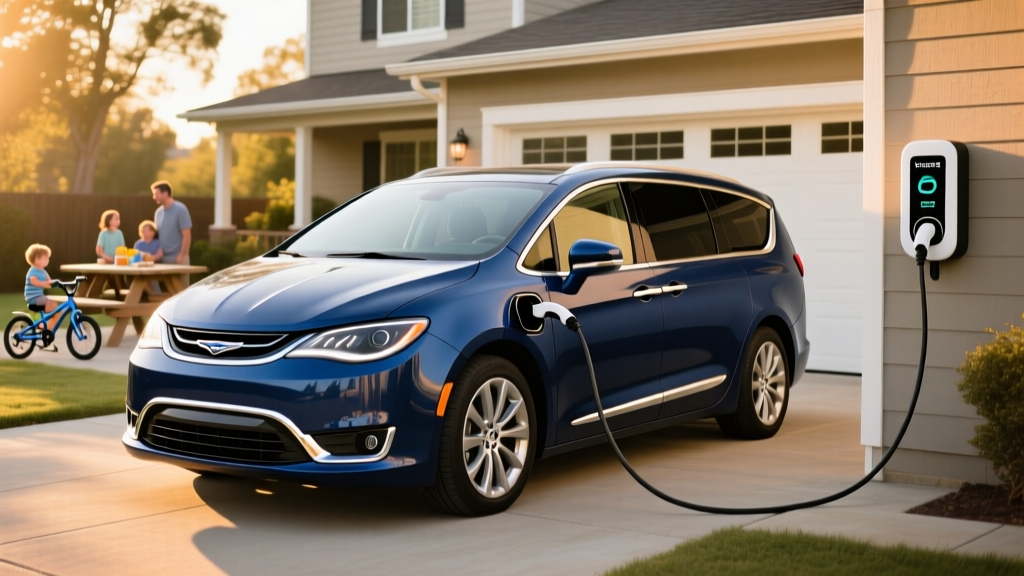
The 2017 Chrysler Pacifica Hybrid was the first plug-in hybrid minivan sold in the United States, and nearly a decade later, it remains one of the most practical used PHEVs on the market. With a 33-mile EPA electric-only range and 32 MPG combined once the battery depletes, it still holds up for family hauling in 2026 — especially for buyers who want electric commuting without range anxiety on road trips.
But as a used PHEV now approaching 8–9 years old, the Pacifica Hybrid comes with specific ownership considerations: battery degradation, out-of-warranty repair costs, and the reality of older charging hardware. This guide covers every number you need before buying one.
2017 Chrysler Pacifica Hybrid: Key Specs at a Glance
| Specification | Value |
|---|---|
| Powertrain | 3.6L V6 + 2 electric motors (e-CVT) |
| Combined Horsepower | 260 hp |
| Battery (usable) | 16 kWh lithium-ion (NMC chemistry) |
| EPA Electric-Only Range | 33 miles |
| EPA MPGe (electric + gas) | 84 MPGe |
| EPA MPG (charge-sustaining / gas only) | 32 combined (29 city / 30 hwy — EPA sticker; see real-world below) |
| Total Combined Range | ~566 miles (EPA) |
| Level 1 Charging (120V) | ~14 hours (0–100%) |
| Level 2 Charging (240V, 3.3 kW) | ~2 hours (0–100%) |
| DC Fast Charging | Not supported |
| 0–60 mph | ~7.0 seconds |
| Original MSRP (base) | $41,995 (before incentives) |
| 2026 Used Price Range | $14,000–$22,000 (depending on mileage and condition) |
| Battery/Powertrain Warranty (original) | 8 yr / 100,000 mi (10 yr / 150,000 mi in CARB states) |
Sources: fueleconomy.gov, Stellantis (FCA) 2017 press materials.
Understanding the Powertrain: PHEV, Not a Conventional Hybrid
The 2017 Pacifica Hybrid is a plug-in hybrid electric vehicle (PHEV), not a conventional hybrid (HEV). This distinction matters enormously for ownership:
HEV vs. PHEV — What's the Difference?
| Feature | Conventional Hybrid (HEV) | Plug-In Hybrid (PHEV) |
|---|---|---|
| Plugs in to charge? | No — charges via regen & engine | Yes — plugs in for full electric range |
| Electric-only driving | Minimal (~1 mi at low speed) | Substantial (33 mi EPA for Pacifica) |
| Battery size | 1–2 kWh | 16 kWh (Pacifica Hybrid) |
| Gas engine role | Always supplements electric | Kicks in only after battery depletes |
| Tax credit eligibility | Generally none | Originally qualified for up to $7,500 (now expired for this model) |
The Pacifica Hybrid's powertrain pairs a 3.6-liter Pentastar V6 (running an Atkinson-cycle variant for efficiency) with two electric motors integrated into a specialized e-CVT transmission. The combined system output is 260 horsepower. In EV mode, the gas engine stays off entirely until the battery drops to its buffer threshold (roughly 15–20% state of charge), at which point the vehicle seamlessly switches to hybrid mode.
Real-World MPG and Electric Range: What to Actually Expect
The EPA rates the 2017 Pacifica Hybrid at 33 miles of electric-only range and 32 MPG combined once the battery is depleted. Here's what that translates to in real-world driving:
| Driving Scenario | Expected Electric Range | Expected Gas MPG |
|---|---|---|
| City, mild weather (65–80°F) | 30–35 mi | 30–34 MPG |
| Highway (70 mph cruise) | 22–26 mi | 27–30 MPG |
| Cold weather (20–35°F), city | 20–25 mi (battery + cabin heating penalty) | 25–28 MPG |
| Cold weather, highway | 16–20 mi | 24–27 MPG |
| Hot weather, A/C heavy | 26–30 mi | 29–32 MPG |
Key factors that reduce the Pacifica Hybrid's real-world efficiency:
- Battery degradation: A 2017 model in 2026 is 8–9 years old. Expect 10–20% capacity loss depending on climate and charging habits, meaning electric-only range may be closer to 25–28 miles even in ideal conditions.
- Cold-weather penalty: Lithium-ion batteries lose efficiency below 40°F, and cabin heating draws significant energy. Expect a 25–35% range reduction in winter.
- Highway speeds: Like all PHEVs, electric range drops sharply above 60 mph due to aerodynamic drag. The Pacifica's minivan profile is particularly affected.
- Regenerative braking recovery: City driving with frequent stops lets the Pacifica recapture more energy, which is why city MPG often exceeds highway MPG in hybrid mode.
Charging the 2017 Pacifica Hybrid: Level 2 Only, No DC Fast Charging
The 2017 Pacifica Hybrid uses a J1772 connector for AC charging and does not support DC fast charging. This is a critical limitation for road-trip scenarios but is typical of PHEVs from this era (and most PHEVs even today).
| Charging Level | Power | Time (0–100%) | Practical Notes |
|---|---|---|---|
| Level 1 (120V household outlet) | ~1.4 kW | ~14 hours | Overnight charge possible but tight; best for low-mileage days |
| Level 2 (240V, 3.3 kW onboard charger) | 3.3 kW | ~2 hours | Recommended; a full charge during a workday or shopping trip |
| DC Fast Charge | N/A | N/A | Not supported — no CCS or CHAdeMO port |
kW vs. kWh refresher: The battery holds 16 kWh of energy (capacity). The onboard charger accepts up to 3.3 kW of power (charge rate). Dividing 16 kWh by 3.3 kW gives roughly 4.8 hours at maximum rate, but the actual charge time is closer to 2 hours because the onboard charger can draw at higher rates on certain Level 2 circuits (the 2017 model's onboard charger is rated for up to 6.6 kW on some configurations — verify your specific VIN).
Home charging setup: Most Pacifica Hybrid owners install a Level 2 home charger (240V, 32A circuit). Installation costs range from $500–$1,500 depending on electrical panel proximity. At an average electricity cost of $0.14/kWh, a full 16 kWh charge costs roughly $2.24 — far cheaper than the ~$5.50 in gasoline needed to cover the same 33 miles at 32 MPG with gas at $3.50/gallon.
Battery Health, Warranty, and Replacement Costs
Battery Warranty Status in 2026
The original 8-year/100,000-mile battery warranty (10-year/150,000-mile in CARB states: CA, CT, ME, MD, MA, NJ, NY, OR, RI, VT, WA) was tied to the vehicle's in-service date. For a 2017 model:
- Non-CARB states: Warranty expired in 2025 at the latest (8 years from 2017). Most 2017 Pacifica Hybrids are now out of battery warranty.
- CARB states: The 10-year/150,000-mile warranty may still apply through 2027 if the vehicle was first sold in 2017 and has fewer than 150,000 miles.
Verify your specific VIN with a Chrysler dealer to confirm warranty status.
Battery Degradation: What 8–9 Years Looks Like
The Pacifica Hybrid's 16 kWh lithium-ion battery (NMC chemistry) typically loses 10–20% of its original capacity over 8–9 years. Owners on forums and in long-term tests report electric-only ranges dropping from the original 33 miles to roughly 25–30 miles under normal conditions. This is less severe than early Nissan Leaf degradation because the Pacifica uses active liquid thermal management, which significantly slows capacity loss.
Battery Replacement Cost
As of 2026, a replacement high-voltage battery for the 2017 Pacifica Hybrid costs approximately $6,500–$9,000 including parts and labor at a Chrysler dealer. Independent hybrid-battery specialists may offer refurbished or reconditioned packs for $4,000–$6,000. Individual module replacement (the pack contains 96 cells grouped into modules) can sometimes be done for $1,500–$3,000 if only specific modules have failed.
Before buying used: Request a battery health report from a dealer or use an OBD2 scanner with PHEV-capable software (such as a ScanGauge or the AlfaOBD app) to check the battery's state of health (SoH). A pack showing less than 80% SoH should factor into your price negotiation.
Used Pricing in 2026 and Tax Credit Reality
The 2017 Pacifica Hybrid originally qualified for a $7,500 federal tax credit under the pre-2023 IRS §30D rules. However, the Inflation Reduction Act of 2022 fundamentally changed credit eligibility, and the 2017 Pacifica Hybrid does not qualify for any federal tax credit as a used vehicle purchase in 2026 under the current used-EV credit (which caps at $4,000 for vehicles under $25,000 and requires specific battery-sourcing compliance that this model does not meet).
Some states offer their own used-EV or PHEV rebates — check your state's energy office or DMV for current programs. California's CVRP, for example, has offered rebates on used PHEVs, but amounts and availability change annually.
| Condition / Mileage | Typical Price Range |
|---|---|
| Excellent, under 60,000 mi | $19,000–$22,000 |
| Good, 60,000–100,000 mi | $15,000–$19,000 |
| Fair, 100,000–140,000 mi | $12,000–$15,000 |
| High mileage / needs battery work | $9,000–$12,000 |
Compare this to a 2026 new Chrysler Pacifica Hybrid (which starts around $51,000 before incentives) and the used 2017 model represents significant value — provided the battery checks out.
Pacifica Hybrid vs. Full EV vs. Gas Minivan: Which Fits You?
Decision Framework
Choose the 2017 Pacifica Hybrid (PHEV) if:
- Your daily commute is under 30 miles round-trip and you can charge at home
- You take regular road trips where charging infrastructure is sparse
- You need minivan space (7 seats, power sliding doors, flat-folding third row)
- You want to reduce fuel costs without committing to a fully electric vehicle
Choose a full EV (like a used Tesla Model X or new Kia EV9) if:
- You have reliable home charging and your daily driving is under 250 miles
- You want zero tailpipe emissions and minimal maintenance (no oil changes, no gas engine)
- You can access DC fast chargers for road trips
Choose a gas-only minivan (like a Toyota Sienna hybrid or Honda Odyssey) if:
- You cannot install a home charger (apartment, street parking)
- You drive high annual mileage and don't want battery replacement risk
- You want simpler maintenance with no high-voltage system concerns
Pros and Cons of the 2017 Pacifica Hybrid in 2026
Pros
- 33-mile electric range covers most daily school runs and commutes
- True minivan utility: 7 seats, Stow 'n Go second row (limited by battery placement), power doors
- Liquid-cooled battery degrades more slowly than passively cooled competitors
- Smooth, quiet EV-mode driving around town
- Significantly cheaper used than new PHEV minivans
- 32 MPG in hybrid mode beats most gas-only minivans of the era
Cons
- No DC fast charging — road trips rely entirely on gasoline
- Battery placement reduces Stow 'n Go capability (second-row seats don't fold into the floor)
- Most 2017 models are now out of battery warranty
- $6,500–$9,000 battery replacement cost is a real financial risk
- 3.3 kW onboard charger is slow by 2026 standards
- Early 2017 models had some software and electrical gremlins (check for TSBs and recall completion)
Reliability and Common Issues
The 2017 Pacifica Hybrid was a first-year PHEV for Chrysler, and early models experienced some teething issues. Common problems reported by owners and tracked by NHTSA include:
- 12V auxiliary battery failures: The separate 12V battery (which powers electronics) was prone to premature failure. Many owners replaced it within the first 3–4 years.
- Software glitches: Early infotainment and powertrain control module software had bugs. Ensure all Technical Service Bulletins (TSBs) have been applied — a Chrysler dealer can check this by VIN.
- Power sliding door issues: A known issue across the Pacifica line (not specific to the hybrid) involving door motor and sensor failures.
- High-voltage battery recalls: Chrysler issued recalls for certain 2017–2018 Pacifica Hybrids related to potential battery fire risk when the vehicle is parked with a high state of charge. Verify recall completion before purchasing.
Overall, the powertrain itself (V6 + electric motors + e-CVT) has proven reasonably durable. The e-CVT has no traditional transmission bands or clutches to wear out, and the electric motors are essentially maintenance-free. The primary reliability concern in 2026 is the high-voltage battery's remaining lifespan.
Frequently Asked Questions
How many MPG does the 2017 Chrysler Pacifica Hybrid get?
The EPA rates it at 32 MPG combined (gasoline-only, after battery depletion), with an 84 MPGe rating when factoring in electric driving. In real-world use, expect 28–34 MPG depending on conditions. City driving tends to yield higher MPG thanks to regenerative braking, while sustained highway speeds at 70+ mph will pull figures toward the mid-to-high 20s.
How far can the 2017 Pacifica Hybrid go on electric only?
The EPA rates it at 33 miles of electric-only range when new. In 2026, with 8–9 years of battery aging, expect 25–30 miles in mild conditions and 18–22 miles in cold weather. Highway driving at 70 mph reduces electric range to roughly 20–24 miles even with a healthy battery.
Does the 2017 Pacifica Hybrid qualify for any tax credit in 2026?
No. The original $7,500 federal tax credit applied only to the original purchaser when new. Under current IRS §30D rules and the used-EV credit (which caps at $4,000 for vehicles under $25,000 with compliant battery sourcing), the 2017 Pacifica Hybrid does not qualify. Some state-level incentives may apply — check your state energy office.
Is the hybrid battery reliable, and what does replacement cost?
The liquid-cooled NMC battery has held up better than many early PHEV batteries. Most 2017 models show 80–90% state of health in 2026. A full dealer replacement costs $6,500–$9,000; independent shops may offer refurbished packs for $4,000–$6,000. Always check battery SoH before purchasing.
Can I charge the Pacifica Hybrid at a public DC fast charger?
No. The 2017 Pacifica Hybrid only accepts AC charging via a J1772 connector at up to 3.3 kW (Level 2). It has no DC fast-charging port. On road trips, you simply drive it as a conventional hybrid using gasoline.
Does the battery affect cargo space or seating?
Yes. The 16 kWh battery pack is mounted under the second-row floor, which eliminates the Stow 'n Go feature for the second-row seats (they fold forward but do not disappear into the floor). The third row still folds flat, and overall cargo volume behind the third row is comparable to the gas Pacifica at approximately 32.3 cubic feet.
Hybrid vs. PHEV vs. EV — which should I choose?
If you can charge at home and your daily driving is under 30 miles, the Pacifica Hybrid's PHEV setup lets you drive mostly on electricity while keeping a gas engine for longer trips. A full EV eliminates gasoline entirely but requires reliable charging access and road-trip planning. A conventional hybrid (like the Toyota Sienna, rated at 36 MPG combined) needs no plug-in charging and has no battery-replacement anxiety but offers no electric-only driving.
Always verify specifications, recall status, and warranty coverage for any specific vehicle by VIN through NHTSA.gov or a Chrysler dealer. Tax credit rules are subject to change — consult IRS.gov or a tax professional for current eligibility.