Quick Verdict: The 2017 Malibu Hybrid in 2026
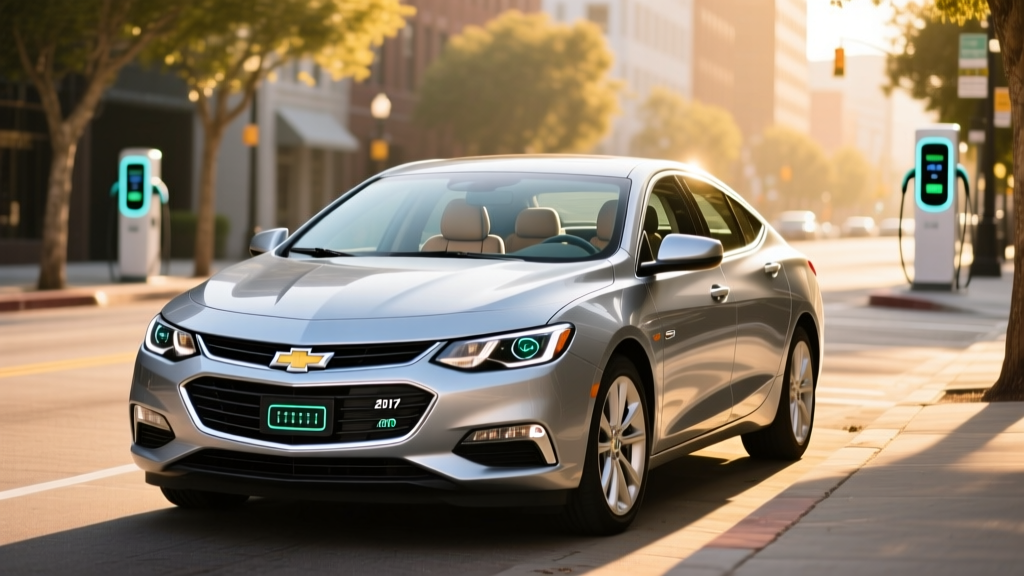
The 2017 Chevrolet Malibu Hybrid is a conventional hybrid electric vehicle (HEV) — not a plug-in — that pairs a 1.8-liter four-cylinder engine with a two-motor drive unit to deliver an EPA-estimated 49 MPG city and 43 MPG highway. Nearly a decade after its debut, this midsize sedan remains one of the most fuel-efficient used cars on the market, routinely exceeding its EPA city estimate in stop-and-go driving thanks to aggressive regenerative braking.
For 2026 used-car shoppers, the Malibu Hybrid occupies a specific niche: buyers who want EV-like city efficiency without plugging in, without range anxiety, and at a fraction of the cost of a new hybrid or BEV. With used examples typically running between $9,000 and $14,000 depending on mileage and condition, it undercuts nearly every new hybrid on the market on price while still delivering competitive fuel economy. The key question is whether the 1.5 kWh lithium-ion battery pack — and the rest of the powertrain — holds up as these cars approach 100,000+ miles.
This guide covers everything a prospective used buyer needs: exact EPA and real-world MPG figures, powertrain specs, battery warranty and replacement costs, reliability data, and how the Malibu Hybrid stacks up against full EVs, plug-in hybrids, and its direct hybrid competitors.
HEV vs. PHEV vs. EV: Where the Malibu Hybrid Fits
Before diving into specs, it's critical to understand what the 2017 Malibu Hybrid is — and what it isn't. Chevrolet sold the Malibu in three distinct powertrains that year, and confusing them is a common buyer mistake:
| Attribute | 2017 Malibu Hybrid (HEV) | Plug-In Hybrid (PHEV) Example | Battery Electric (BEV) Example |
|---|---|---|---|
| Powertrain | 1.8L engine + 2 electric motors | Engine + larger motor + bigger battery | Electric motor(s) only |
| Battery Size | 1.5 kWh (Li-ion) | Typically 10–20 kWh | Typically 60–100 kWh |
| Plug In to Charge? | No — self-charging via regen & engine | Yes — Level 1 or Level 2 | Yes — Level 1, 2, or DC fast |
| Electric-Only Range | ~1 mile at low speed (not rated) | 20–45 miles EPA | 200–400+ miles EPA |
| Total Range | ~560 miles (12.9-gal tank) | 350–500+ miles combined | 200–400+ miles |
| Fuel Required | Regular unleaded gasoline | Regular unleaded gasoline | None — electricity only |
| Federal Tax Credit (2026) | Not eligible | Up to $7,500 (new only, §30D rules apply) | Up to $7,500 (new only, §30D rules apply) |
The 2017 Malibu Hybrid is strictly a conventional hybrid. You never plug it in. The small 1.5 kWh battery charges itself through regenerative braking and the gasoline engine. If you're looking for electric-only commuting range, you need a PHEV like the Chevy Volt (discontinued after 2019) or a current model like the Toyota RAV4 Prime. If you want zero gasoline, you need a full BEV.
Fuel Economy: EPA Numbers and Real-World MPG
The EPA rates the 2017 Chevy Malibu Hybrid at the following fuel economy figures, per fueleconomy.gov:
| Driving Cycle | EPA Estimate | Real-World Expectation |
|---|---|---|
| City | 49 MPG | 48–54 MPG (hybrids often beat EPA city) |
| Highway | 43 MPG | 38–43 MPG (highway reduces regen benefit) |
| Combined | 46 MPG | 43–48 MPG depending on driving mix |
The Malibu Hybrid's 12.9-gallon fuel tank yields a theoretical maximum range of approximately 593 miles at the EPA combined rating, though real-world range typically falls between 530 and 600 miles depending on driving conditions. That's comparable to or better than most gas-only midsize sedans, with far fewer stops at the pump.
Powertrain and Performance Specs
The 2017 Malibu Hybrid uses a powertrain architecture derived from the second-generation Chevrolet Volt's Voltec system, adapted for hybrid (non-plug-in) duty. Here are the exact specifications:
| Specification | Detail |
|---|---|
| Engine | 1.8L direct-injected 4-cylinder (Atkinson cycle) |
| Engine Power | 122 hp @ 5,000 rpm |
| Electric Motors | Two AC permanent-magnet motors integrated into drive unit |
| Combined System Output | 182 hp |
| Battery Pack | 1.5 kWh lithium-ion (80-cell, LG Chem) |
| Transmission | Voltec 2-motor continuously variable drive unit (no traditional CVT belt) |
| 0–60 MPH | ~7.5 seconds (Car and Driver tested) |
| Drivetrain | Front-wheel drive |
| Curb Weight | ~3,457 lbs |
| Fuel Tank | 12.9 gallons |
| EPA Combined MPG | 46 MPG |
The two-motor drive unit is the engineering highlight. Rather than using a conventional belt-driven CVT, Chevrolet employs a planetary gearset that blends power from the engine and both electric motors seamlessly. One motor primarily drives the wheels while the other can act as a generator or provide supplemental torque. The result is smooth, stepless acceleration without the rubber-band feel that plagued earlier CVT-equipped hybrids.
The 182 combined horsepower figure is respectable for a midsize hybrid sedan. The Malibu Hybrid doesn't feel slow in daily driving — it merges onto highways and passes without drama. However, it's not a performance car; the Prius Eco (121 hp combined) feels noticeably more lethargic, while the Honda Accord Hybrid (212 hp) and Hyundai Sonata Hybrid (192 hp) have a slight edge in passing power.
Battery Health, Warranty, and Replacement Cost
Battery longevity is the single biggest concern for any used hybrid buyer. The 2017 Malibu Hybrid's 1.5 kWh lithium-ion pack is small compared to a BEV's battery, but it works hard — cycling through charge and discharge dozens of times per drive. Here's what you need to know:
Real-world battery degradation: The 1.5 kWh pack in the Malibu Hybrid uses a relatively conservative state-of-charge window — the car's software prevents full 100% charges and deep 0% discharges, keeping the battery in a longevity-friendly middle range. Based on owner reports and hybrid battery testing data, most Malibu Hybrid batteries retain 85–95% of original capacity at 100,000 miles. Noticeable fuel economy degradation (2–4 MPG drop) typically doesn't appear until 150,000+ miles, if it appears at all.
Battery replacement cost: If the battery does fail outside warranty, a new OEM replacement pack from Chevrolet runs approximately $2,500–$3,500 for the part, plus $500–$900 in labor, for a total of roughly $3,000–$4,400 at a dealership. Independent hybrid-specialty shops and refurbished battery options can reduce this to the $1,800–$2,800 range. Given that these packs are proving durable well past 150,000 miles in most cases, the replacement cost — while not trivial — is a manageable worst-case scenario, not an imminent certainty.
12V auxiliary battery: Like all hybrids, the Malibu Hybrid also has a conventional 12V lead-acid battery that powers accessories and starts the computer systems. This is separate from the high-voltage hybrid battery and typically needs replacement every 3–5 years at a cost of $150–$250 — standard maintenance for any car.
Reliability, Safety, and Ownership Costs
The 2017 Malibu Hybrid benefits from sharing its core hybrid architecture with the second-generation Volt, which proved to be one of GM's most reliable powertrains. The 1.8L Atkinson-cycle engine is under-stressed and runs intermittently, reducing wear. The Voltec drive unit has no friction belts or traditional transmission clutches to wear out.
Key reliability considerations for a 2026 used purchase:
- Hybrid system: Very low failure rate. The inverter, motors, and planetary gearset have proven durable well past 150,000 miles in fleet and owner data.
- Brake wear: Regenerative braking significantly reduces friction brake usage. Original brake pads often last 80,000–120,000 miles. This is a genuine cost savings over gas-only models.
- Cooling system: The hybrid battery has its own dedicated cooling circuit. Coolant should be flushed per the maintenance schedule (typically every 5 years/150,000 miles). Neglect here can shorten battery life.
- Common non-hybrid issues: Some 2016–2017 Malibus (all powertrains) reported infotainment screen freezes and occasional power steering assist faults. These are not hybrid-specific and are generally fixable via software updates or component replacement.
Safety ratings: The 2017 Malibu earned a 5-star overall rating from NHTSA and was an IIHS Top Safety Pick when equipped with optional front crash prevention and acceptable headlights. Standard safety equipment includes 10 airbags, a rearview camera, and StabiliTrak electronic stability control.
Insurance and maintenance: Insurance premiums for the Malibu Hybrid are generally comparable to the gas-only Malibu — insurers don't typically surcharge hybrids. Maintenance costs are actually lower than the gas model thanks to reduced brake wear and the absence of a traditional automatic transmission.
Used Pricing and Tax Credit Eligibility
As of early 2026, the 2017 Chevy Malibu Hybrid trades in the used market at the following approximate price ranges:
| Condition / Mileage | Approximate Price Range |
|---|---|
| Under 60,000 miles, excellent | $12,500–$14,500 |
| 60,000–100,000 miles, good | $10,500–$13,000 |
| 100,000–140,000 miles, fair | $8,500–$11,000 |
| 140,000+ miles, high-mileage | $6,500–$9,000 |
Original MSRP for the 2017 Malibu Hybrid was $28,870 (single, well-equipped trim level). Current used pricing represents a 50–75% depreciation from new — typical for a 9-year-old midsize sedan and a strong value proposition.
How the Malibu Hybrid Compares to Alternatives
The 2017 Malibu Hybrid doesn't exist in a vacuum. Here's how it stacks up against its most likely alternatives on the used market and in the new-car showroom:
| Vehicle | Type | EPA Combined | Used Price (2026) | Key Trade-Off |
|---|---|---|---|---|
| 2017 Malibu Hybrid | HEV | 46 MPG | $8,500–$14,500 | Best value; no plug-in needed |
| 2017 Toyota Prius | HEV | 52–56 MPG | $11,000–$16,000 | Better MPG; less power, smaller trunk |
| 2017 Honda Accord Hybrid | HEV | 48 MPG | $11,000–$15,500 | More power; slightly less city MPG |
| 2017 Ford Fusion Hybrid | HEV | 42 MPG | $9,000–$13,000 | Lower MPG; strong reliability record |
| 2017 Chevy Volt (PHEV) | PHEV | 53 mi electric + 42 MPG gas | $10,000–$15,000 | Electric commute; must plug in for benefit |
| 2025 Toyota Prius (new) | HEV | 57 MPG | $29,445 MSRP | Latest tech; 2–3× the used price |
The Malibu Hybrid's advantage is its combination of low used pricing, strong city MPG, and a spacious midsize-sedan interior with a 15.3-cubic-foot trunk. The Prius delivers better fuel economy but in a smaller, less refined package. The Accord Hybrid offers more power at a slight MPG penalty. The Volt provides electric-only commuting but requires access to charging to realize its benefit.
Who Should Buy the 2017 Malibu Hybrid?
- You drive primarily in city and suburban traffic (where it hits 48–54 MPG)
- You can't charge at home or work (no plug-in required)
- You want maximum fuel savings on a tight budget ($10K–$14K)
- You need a spacious midsize sedan, not a compact hatchback
- You want lower maintenance costs (brakes last 80K+ miles)
- You drive 12,000–15,000+ miles/year (high mileage amplifies fuel savings)
- You want electric-only driving (get a PHEV or BEV)
- You drive mostly highway miles (hybrid advantage shrinks to 38–43 MPG)
- You want the latest infotainment and ADAS features (2017 tech is dated)
- You need all-wheel drive (the Malibu Hybrid is FWD only)
- You qualify for the $7,500 federal credit on a new BEV/PHEV and can afford the higher upfront cost
- You want a hatchback or SUV body style
The economics at 15,000 miles/year: At 46 MPG combined and $3.20/gallon regular unleaded, the Malibu Hybrid costs approximately $1,043/year in fuel. A comparable gas-only midsize sedan averaging 28 MPG combined would cost $1,714/year — a difference of about $671/year in fuel savings. Over five years, that's roughly $3,355 in savings, which covers a significant portion of the purchase price and any potential battery service.
Frequently Asked Questions
How many MPG does the 2017 Chevy Malibu Hybrid get?
The EPA rates it at 49 MPG city, 43 MPG highway, and 46 MPG combined. In real-world city driving, many owners report 48–54 MPG thanks to frequent regenerative braking. Highway-only driving at 70+ MPH typically yields 38–43 MPG. Cold weather (below 30°F) can reduce combined MPG by 5–10%.
Does the 2017 Malibu Hybrid need to be plugged in?
No. The 2017 Malibu Hybrid is a conventional hybrid (HEV), not a plug-in hybrid (PHEV). The 1.5 kWh battery charges itself entirely through regenerative braking and the gasoline engine. There is no charging port and no plug. You simply fill it with regular unleaded gasoline like any other car.
Is the hybrid battery reliable, and what does replacement cost?
The 1.5 kWh lithium-ion battery has proven durable, with most units retaining 85–95% capacity at 100,000 miles. The original warranty was 8 years/100,000 miles (10 years/150,000 miles in CARB states). As of 2026, most 2017 models have aged out of the standard warranty. OEM replacement costs approximately $3,000–$4,400 including labor; refurbished options can reduce this to $1,800–$2,800. Battery failure before 150,000 miles is uncommon based on owner data.
Does the 2017 Malibu Hybrid qualify for any tax credit?
No. Federal tax credits under IRS §30D apply only to new plug-in vehicles (BEVs and PHEVs). Conventional hybrids like the Malibu Hybrid are not eligible for the new-vehicle credit or the used clean vehicle credit. Check your state's energy office for any local incentives, but most state programs also prioritize plug-in vehicles.
How does the Malibu Hybrid compare to the Toyota Prius?
The 2017 Prius achieves 52–56 MPG combined (depending on trim) versus the Malibu Hybrid's 46 MPG — a 6–10 MPG advantage for Toyota. However, the Malibu Hybrid offers significantly more interior space (15.3 cu-ft trunk vs. the Prius's 24.6 cu-ft hatchback, but a more traditional sedan layout), more horsepower (182 vs. 121), and a quieter, more refined ride. The Prius wins on pure efficiency; the Malibu Hybrid wins on comfort and value.
What should I check before buying a used 2017 Malibu Hybrid?
Prioritize a pre-purchase inspection by a technician familiar with GM hybrid systems. Key items: (1) hybrid battery state-of-health readout via OBD-II scanner, (2) brake pad thickness (should be substantial if regen is working properly), (3) hybrid battery coolant level and condition, (4) 12V auxiliary battery age, (5) infotainment system functionality, and (6) any outstanding recalls or TSBs. Request maintenance records showing regular oil changes and coolant service.