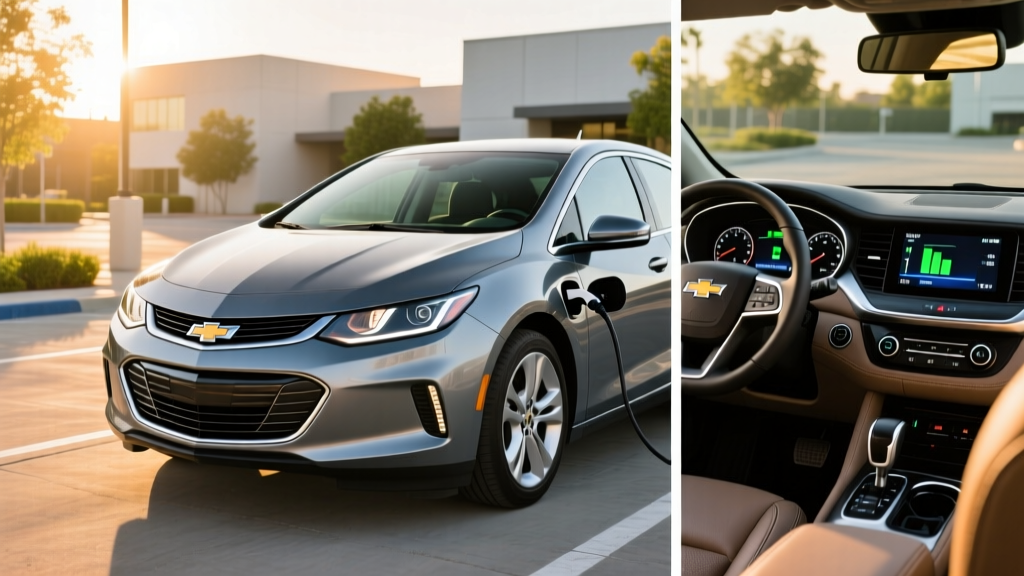
The 2017 Chevrolet Volt occupies a unique space in the used electrified-vehicle market. It is not a conventional hybrid like the Toyota Prius — it is a plug-in hybrid electric vehicle (PHEV) with a substantial 53-mile electric-only range, meaning most daily commutes can be completed without burning a single drop of gasoline. Nearly a decade after its release, the second-generation Volt remains one of the most practical bridges between full electric and gas-only ownership, especially for buyers without reliable home charging or those who take frequent road trips.
This guide breaks down exactly what the 2017 Volt delivers in 2026: real-world range expectations, charging logistics, powertrain specs, used-market pricing, battery longevity, and whether it still makes sense against modern PHEVs and affordable BEVs.
HEV vs PHEV: Where the Volt Fits
Before evaluating the Volt, it's critical to distinguish the two hybrid categories, because the Volt is frequently — and incorrectly — called a "hybrid" in casual conversation.
Conventional Hybrid (HEV)
- No plug — battery charges via regenerative braking and the engine
- Small battery (typically 1–2 kWh)
- Electric-only driving limited to low-speed, short-distance creeping
- Example: Toyota Prius, Honda CR-V Hybrid
Plug-In Hybrid (PHEV) — The Volt
- Plugs in to charge — Level 1 (120V) or Level 2 (240V)
- Larger battery (18.4 kWh in the Volt)
- Substantial electric-only range (53 miles EPA)
- Gas engine activates after battery depletes, functioning like a hybrid
The 2017 Volt is an extended-range electric vehicle (EREV), a PHEV subtype where the gasoline engine never mechanically drives the wheels. Instead, the 1.5L engine acts as a generator to produce electricity for the electric motors once the battery is depleted. This gives the Volt a driving feel closer to a pure EV than most PHEVs, which blend engine and motor torque through a transmission.
Electric-Only Range and Total Range
The EPA rates the 2017 Chevrolet Volt at 53 miles of electric-only range. This was class-leading when the car launched and remains competitive with many 2024–2026 PHEVs that offer 30–45 miles.
Real-World Expectation: 40–50 miles in mixed driving; 35–42 miles in sustained highway or cold weather (below 40°F); up to 55 miles in mild-weather city driving with light acceleration.
Total Combined Range (Electric + Gas): Approximately 420 miles per EPA estimates.
The Volt's 18.4 kWh lithium-ion battery pack has roughly 14 kWh of usable capacity — GM buffers the top and bottom of the state of charge to protect long-term battery health. This means you'll never see the pack charge to a true 100% or deplete to 0%, which is a deliberate longevity strategy.
After the battery depletes, the 1.5L four-cylinder engine kicks on as a range extender. The transition is nearly seamless — most drivers notice only a slight hum and a change in the dash display from EV mode to "Extended Range."
Fuel Economy: EPA MPG and Real-World Results
Once the battery is depleted and the Volt operates in extended-range (hybrid) mode, fuel economy becomes the key metric. Here's the EPA breakdown per fueleconomy.gov:
| Mode | City | Highway | Combined |
|---|---|---|---|
| Electric Only (MPGe) | 113 MPGe | 99 MPGe | 106 MPGe |
| Gas Only (Extended Range) | 42 MPG | 42 MPG | 42 MPG |
Real-world MPG observations: In extended-range mode, owners frequently report 38–45 MPG depending on terrain, temperature, and driving style. City driving often exceeds the EPA estimate thanks to aggressive regenerative braking. Highway driving at 75+ mph in cold weather can drop to 35–37 MPG. The Volt's combined fuel economy is heavily dependent on how often you charge — a Volt owner who charges nightly and commutes 30 miles may use gasoline only a handful of times per year.
Charging: Speeds, Times, and Connectors
The 2017 Volt uses the SAE J1772 connector for AC charging, the North American standard. It does not support DC fast charging — there is no CCS or CHAdeMO port. This is a deliberate engineering decision: with an 18.4 kWh battery, Level 2 charging fills the pack quickly enough that DC fast charging adds cost and complexity for minimal benefit.
| Charging Level | Power (kW) | Time to Full (0–100%) | Notes |
|---|---|---|---|
| Level 1 (120V, 12A) | 1.4 kW | ~13 hours | Standard outlet; adequate for overnight if driven less than 40 mi/day |
| Level 1 (120V, 8A default) | 0.96 kW | ~19 hours | Default setting on 120V cordset for older wiring safety |
| Level 2 (240V, 3.6 kW) | 3.6 kW | ~4.5 hours | Onboard charger max; requires 240V outlet or hardwired EVSE |
Practical note for used buyers: The Volt's onboard charger is limited to 3.6 kW. Even if you plug into a 7.2 kW or 11.5 kW Level 2 station, the Volt will only draw 3.6 kW. Plan your home charging setup accordingly — a 16-amp, 240V circuit is sufficient. No need to invest in a 48-amp charger for this vehicle.
The included Level 1 cordset (EVSE) ships with the car and can toggle between 8A and 12A modes. On a standard 120V household outlet at 12A, expect roughly 4 miles of range per hour of charging — enough to replenish a daily commute overnight.
Powertrain and Performance
| Specification | Detail |
|---|---|
| Drive Type | Front-wheel drive |
| Electric Motors | Dual-motor Voltec drive unit |
| Combined System Output | 149 hp / 294 lb-ft torque |
| Gas Engine | 1.5L naturally aspirated 4-cylinder (101 hp, generator only) |
| Battery Pack | 18.4 kWh total / ~14 kWh usable, lithium-ion (LG Chem) |
| 0–60 mph | 7.5 seconds (EV mode) |
| Top Speed | 98 mph (electronically limited) |
| Curb Weight | ~3,543 lbs |
The Volt's dual-motor drive unit is sophisticated. Below ~35 mph, one motor does most of the work. At higher speeds or under heavy acceleration, both motors engage through a planetary gearset, optimizing efficiency across the speed range. The result is smooth, linear acceleration that feels more like a BEV than a traditional PHEV with a clutch-based engine handoff.
The 294 lb-ft of torque is available from zero RPM in electric mode, giving the Volt confident city and suburban acceleration. Highway passing is adequate but not thrilling — this is an efficiency-first vehicle, not a performance machine.
Used Pricing in 2026 and Tax Credit Eligibility
The 2017 Volt was originally priced from $33,220 (LT trim) to $37,620 (Premier trim), before the now-expired $7,500 federal tax credit. In the 2026 used market:
- LT trim (base): $11,000–$15,000 depending on mileage and condition
- Premier trim (leather, heated seats, adaptive cruise): $13,000–$17,000
- Low-mileage examples (under 50K miles): $16,000–$19,000
Federal Used EV Tax Credit (§25E)
Under IRS §25E, the 2017 Volt qualifies for the Used Clean Vehicle Credit when purchased from a licensed dealer. Key rules:
- Credit amount: 30% of the sale price, up to a maximum of $4,000
- Vehicle price cap: Sale price must be $25,000 or less (virtually all used Volts qualify)
- Buyer income limits (MAGI): $75,000 single / $112,500 head of household / $150,000 joint
- Dealer requirement: Must be purchased from a licensed dealer, not a private party
- Model year requirement: Vehicle must be at least 2 model years old (2017 easily qualifies)
- Transfer: Credit can be transferred to the dealer at point of sale for an immediate price reduction
Example: A 2017 Volt LT purchased for $13,500 from a dealer yields a 30% credit = $4,000 (hitting the cap). Effective price: $9,500. This makes the Volt one of the most affordable ways into plug-in electrification in 2026.
Battery Health, Warranty, and Replacement Cost
Current Status in 2026: The 8-year warranty window has expired for all 2017 Volts. The 100,000-mile warranty may still apply to lower-mileage examples — verify with a GM dealer using the VIN.
Hybrid/EV Components Warranty: 8 years / 100,000 miles on the power electronics and drive unit.
Battery degradation reality: The 2017 Volt's LG Chem battery pack has proven remarkably durable. Data from owner forums and fleet analyses show most Volts retaining 85–92% of original capacity after 100,000 miles. The large top/bottom buffer (only ~14 kWh usable of 18.4 kWh total) is a primary reason — the cells are never stressed to their electrochemical limits.
Real-world impact: a Volt that originally delivered 53 EV miles may deliver 45–48 EV miles at 100,000 miles. This is modest degradation compared to early-generation BEVs.
Battery replacement cost: If the pack does fail out of warranty, a refurbished 2017 Volt battery from a GM-certified supplier typically runs $3,500–$5,500 installed. New OEM packs from GM can exceed $7,000–$9,000. Third-party rebuilt packs are increasingly available as the Volt fleet ages.
Reliability track record: The second-generation Volt (2016–2019) is widely regarded as one of GM's most reliable modern vehicles. The Voltec powertrain has few moving parts compared to a conventional transmission, and the engine runs only intermittently, reducing wear. Common issues reported include:
- 12V auxiliary battery failure (common to all modern cars — $150–$250 replacement)
- Charge port door latch wear ($100–$200 repair)
- Infotainment screen delamination on early builds (cosmetic)
Who Should Buy the 2017 Volt in 2026?
Choose the 2017 Volt if:
- Your daily commute is under 45 miles round-trip and you can charge at home (Level 1 is sufficient)
- You take road trips where charging infrastructure is unreliable
- You want electrified driving without range anxiety
- You're budget-conscious and want maximum electrification per dollar on the used market
- You live in a region with extreme cold that slashes BEV range
Choose a full BEV instead if:
- You have reliable Level 2 home charging and rarely drive over 250 miles in a day
- You want zero maintenance on an internal combustion engine (no oil changes, no spark plugs)
- You prefer a newer vehicle with current infotainment and ADAS features
Choose a conventional HEV instead if:
- You have no access to any charging — not even a 120V outlet
- You want simplicity with no plug-in behavior to manage
Pros
- 53 miles EV range covers most commutes gas-free
- Smooth, quiet EV driving feel with 294 lb-ft torque
- 42 MPG in gas mode is competitive with dedicated hybrids
- 420-mile total range eliminates road-trip anxiety
- Used pricing as low as $9,500 after §25E credit
- Strong reliability record; minimal engine wear
- Regenerative driving modes (including one-pedal "L" mode)
Cons
- No DC fast charging — not ideal for multi-leg EV-only road trips
- 3.6 kW onboard charger limits Level 2 speed
- Rear seats are tighter than a compact crossover; only seats 4 (no middle rear seat)
- Cargo space (10.6 cu ft) is modest due to battery placement
- Original battery warranty largely expired in 2026
- Infotainment (MyLink) feels dated vs. modern systems
- No advanced ADAS beyond available adaptive cruise and lane keep
2017 Volt vs Modern PHEV Alternatives
| Spec | 2017 Chevy Volt | 2026 Toyota Prius Prime | 2026 Hyundai Tucson PHEV |
|---|---|---|---|
| EV Range | 53 mi | 44 mi | 33 mi |
| Battery (kWh) | 18.4 | 13.6 | 13.8 |
| Gas MPG (Combined) | 42 | 52 | 35 |
| Combined HP | 149 | 220 | 261 |
| 0–60 mph | 7.5s | 6.6s | 7.0s |
| DC Fast Charge | No | No | No |
| Starting MSRP / Used Price | ~$11K–$17K used | $33,450 new | $39,990 new |
| Federal Credit (New) | N/A (used §25E only) | Up to $7,500 (§30D) | Up to $7,500 (§30D) |
The Volt's 53-mile EV range still beats most new PHEVs in 2026. The trade-off is age: a 9-year-old vehicle will have more wear items, older safety tech, and an expired battery warranty. However, at one-third the price of a new PHEV — and potentially under $10K after the used credit — the value proposition is compelling for mechanically sound, lower-mileage examples.
Frequently Asked Questions
How many MPG does the 2017 Chevrolet Volt get?
In extended-range (gas) mode, the EPA rates the Volt at 42 MPG combined (42 city / 42 highway). In electric-only mode, it achieves 106 MPGe combined. Real-world gas MPG ranges from 35–45 depending on conditions.
How far can the 2017 Volt go on electric only?
The EPA rates it at 53 miles of pure electric range. Real-world results vary: expect 40–50 miles in typical mixed driving, and as low as 35 miles in cold-weather highway driving.
Does the 2017 Volt qualify for any tax credit in 2026?
It no longer qualifies for the new-vehicle §30D credit. However, it qualifies for the §25E Used Clean Vehicle Credit: 30% of the sale price up to $4,000, subject to buyer income caps ($75K single / $150K joint) and a dealer purchase requirement. Most used Volt transactions hit the $4,000 maximum.
Is the 2017 Volt reliable, and what does a battery replacement cost?
The second-generation Volt has a strong reliability record. The LG Chem battery pack typically retains 85–92% capacity at 100,000 miles. Out-of-warranty battery replacement runs $3,500–$5,500 for a refurbished pack, or $7,000–$9,000 for a new OEM unit.
Can the Volt charge at a DC fast charger?
No. The 2017 Volt only supports AC charging via the J1772 connector — Level 1 (120V) or Level 2 (240V up to 3.6 kW). It has no DC fast-charge port.
Hybrid vs PHEV vs EV — which is right for me?
If you can charge at home and your daily driving stays under the EV range, a PHEV like the Volt gives you electric commuting with gas backup for road trips. A conventional HEV (Prius) is better if you can't plug in at all. A full BEV (Bolt, Model 3) is ideal if you have Level 2 charging, rarely exceed 250 miles per day, and want zero engine maintenance.
Does the gas engine ever drive the wheels directly?
Rarely. The Volt is primarily an extended-range EV — the engine generates electricity for the motors. At sustained highway speeds above ~70 mph, the Volt's Voltec drive unit can mechanically couple the engine to the wheels through a clutch for marginal efficiency gains, but this is transparent to the driver.
What should I check when buying a used 2017 Volt?
Pull the battery state-of-health via the onboard diagnostics or an OBD-II scanner app like myChevrolet or Torque Pro. Check for any outstanding recalls (GM issued a few for high-voltage wiring harnesses on early second-gen builds). Verify the Level 1 EVSE cordset is included — replacements cost $300–$500. Inspect the charge port door mechanism for smooth operation.
The 2017 Chevrolet Volt remains a pragmatic, data-backed choice for buyers who want electric commuting without committing to a full BEV. At 2026 used prices — especially with the §25E credit — it delivers more electrified miles per dollar than almost anything on the market. The key is buying smart: check battery health, verify mileage against the powertrain warranty, and ensure you have at least a 120V outlet to plug into nightly.