Quick Verdict: The 2017 Malibu Hybrid Still Delivers
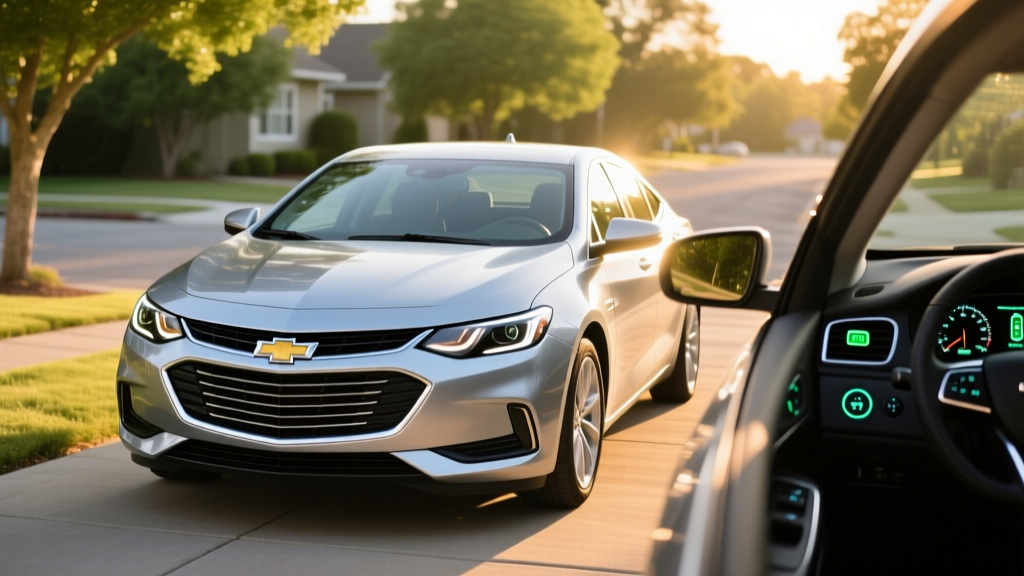
The 2017 Chevrolet Malibu Hybrid is a conventional hybrid electric vehicle (HEV) — not a plug-in — that pairs a 1.8-liter four-cylinder engine with a two-motor electric drive system to achieve an EPA-estimated 49 MPG city, 43 MPG highway, and 46 MPG combined. Now available exclusively on the used market, it remains one of the most fuel-efficient midsize sedans from its era and a practical choice for buyers who want hybrid efficiency without plugging in.
Chevrolet built the Malibu Hybrid on the same Voltec-derived hybrid architecture found in the second-generation Volt, though with a smaller battery and no plug-in capability. The result is a seamless hybrid experience that requires no behavioral change from a standard gas car — you fuel up at the pump and the system handles the rest.
| Spec | Value |
|---|---|
| EPA Fuel Economy (City / Hwy / Combined) | 49 / 43 / 46 MPG |
| Powertrain | 1.8L I4 + 2-motor electric drive (Voltec-derived) |
| Combined System Horsepower | 182 hp |
| 0–60 mph | ~7.5 seconds |
| Battery Type / Capacity | Lithium-ion (Li-ion) / 1.5 kWh (80-cell) |
| Plug-In Capable? | No (conventional HEV) |
| EV-Only Driving | Limited low-speed electric assist, not sustained EV mode |
| Fuel Tank | 13.0 gallons |
| Total Driving Range | ~598 miles (EPA est.) |
| Original MSRP (base) | $28,270 |
| Battery Warranty (original) | 8 years / 100,000 miles |
HEV vs. PHEV: Where the Malibu Hybrid Fits
A common source of confusion is whether the Malibu Hybrid needs to be plugged in. It does not. Here's how the two hybrid types differ:
| Feature | Conventional Hybrid (HEV) | Plug-In Hybrid (PHEV) |
|---|---|---|
| Example | 2017 Chevy Malibu Hybrid | Chevy Volt, Toyota RAV4 Prime |
| Plugs in? | No | Yes |
| Electric-only range | Negligible (low-speed assist only) | 20–50+ miles typical |
| Battery size | 1–2 kWh | 8–20+ kWh |
| Gas engine | Always available, primary power | Backup after battery depletes |
| Fueling | Gas station only | Gas station + Level 1/2 charging |
| Tax credit (new, when eligible) | None under §30D | Up to $7,500 (subject to sourcing/income rules) |
The 2017 Malibu Hybrid is firmly in the HEV column. If you're looking for electric-only commuting range, you'd want a PHEV like the contemporaneous Chevrolet Volt (53 miles EV range) or a full BEV. The Malibu Hybrid's advantage is simplicity — no charging infrastructure, no range planning, just excellent fuel economy.
Fuel Economy: EPA Numbers vs. Real-World MPG
| Driving Cycle | EPA Estimate | Real-World Expectation |
|---|---|---|
| City | 49 MPG | 47–52 MPG (hybrids often exceed EPA in stop-and-go) |
| Highway | 43 MPG | 39–44 MPG (sustained high speed reduces regen benefit) |
| Combined | 46 MPG | 43–48 MPG depending on driving mix |
Hybrids like the Malibu tend to outperform their EPA city estimates because regenerative braking recaptures energy during frequent stops — exactly the condition where gas-only cars are least efficient. On the highway, the advantage narrows because the electric motor contributes less at sustained speeds and aerodynamic drag dominates.
In mixed real-world driving, owners on forums and fuel-tracking sites like fueleconomy.gov's My MPG feature commonly report averages between 43 and 48 MPG. Cold weather can knock 3–5 MPG off city figures because the engine runs more often to provide cabin heat and maintain battery temperature. Expect roughly 580–620 miles of total range on a 13-gallon tank under normal conditions.
Powertrain and Driving Experience
The Malibu Hybrid's powertrain is a detuned variant of GM's Voltec system. The 1.8-liter direct-injected four-cylinder produces 122 hp on its own, while the two-motor electric drive unit contributes additional torque for a combined system output of 182 hp. Power flows through an electronically controlled continuously variable transmission (eCVT) — not a belt-driven CVT like some competitors, but a planetary gearset arrangement similar to Toyota's Hybrid Synergy Drive.
The driving experience is smooth and quiet. The transition between electric and gas power is nearly imperceptible under normal acceleration. The eCVT avoids the "rubber-band" feel of traditional CVTs, and regenerative braking is progressive rather than abrupt. The Malibu Hybrid does not offer a dedicated EV mode or one-pedal driving — it operates as a conventional car that happens to be very efficient.
At 182 combined horsepower, the Malibu Hybrid is adequate for merging and passing but not sporty. The 0–60 mph time of approximately 7.5 seconds places it behind turbocharged gas competitors like the Honda Accord 1.5T but ahead of the Toyota Camry Hybrid of the same year (which rated 200 hp but felt slower due to its CVT tuning).
Battery Longevity, Warranty, and Replacement Cost
Original Battery Warranty: 8 years / 100,000 miles (whichever comes first), covering defects and capacity loss below a defined threshold. For a 2017 model, this factory warranty expired in 2025 at the latest.
Battery Chemistry: Lithium-ion (Li-ion), 80-cell pack, 1.5 kWh total capacity. This is a small pack relative to PHEVs and BEVs, meaning individual cell stress is moderate and thermal management is handled via an active liquid cooling loop.
The 1.5 kWh battery in the Malibu Hybrid is small and, in practice, has proven durable. Unlike large BEV packs where degradation is a major ownership concern, the Malibu's hybrid battery cycles through a narrow state-of-charge window — GM's software keeps it between roughly 20% and 80% to maximize longevity. The active liquid cooling system further reduces thermal stress.
That said, any 2017 Malibu Hybrid on the used market is now 8–9 years old. Lithium-ion batteries degrade with time regardless of mileage. Most owners report minimal noticeable degradation at this age — perhaps a 1–2 MPG drop from new — because the battery's role is supplemental rather than primary. The gas engine always carries the load; the battery smooths it out.
Replacement cost: If the hybrid battery does fail outside warranty, a new OEM replacement from Chevrolet typically runs between $2,500 and $3,500 including labor. Refurbished or salvaged packs from low-mileage donors are available for $1,200–$2,000 installed through independent hybrid specialists. Given the vehicle's current used-market value (roughly $10,000–$16,000 depending on mileage and condition), a full OEM battery replacement represents a significant percentage of the car's worth — a factor to weigh at purchase.
Pricing, Tax Credits, and Used-Buyer Economics
The 2017 Malibu Hybrid originally carried an MSRP of $28,270 for the single available trim (based on the 1LT equipment group). It was not eligible for the federal §30D plug-in vehicle tax credit when new because it is a conventional hybrid — that credit applies exclusively to plug-in vehicles (PHEVs and BEVs) with battery capacities of at least 4 kWh.
Current tax credit situation (2026): The federal §30D Clean Vehicle Credit remains available only for new plug-in vehicles meeting battery-sourcing, critical-mineral, MSRP-cap, and buyer-income requirements. Conventional hybrids like the Malibu Hybrid do not qualify. Some states offer modest incentives for used hybrid purchases, but these vary by jurisdiction — check your state's energy or DMV website for current programs.
On the used market as of early 2026, a 2017 Malibu Hybrid with 60,000–90,000 miles typically lists between $11,000 and $16,000. That positions it competitively against used Toyota Camry Hybrids (often $1,000–$2,000 more for comparable mileage due to Toyota's resale premium) and used Hyundai Sonata Hybrids.
Pros
- EPA 46 MPG combined — among the best in its class for the model year
- No plug-in required; zero behavioral change from a gas car
- Voltec-derived powertrain is proven and refined
- Spacious midsize cabin with competitive trunk room (15.8 cu ft)
- Lower used-market pricing than Camry Hybrid equivalents
Cons
- Original battery warranty has expired on all examples
- Battery replacement cost is high relative to vehicle value
- No EV-only mode or plug-in capability
- Fewer available on the used market than Camry or Accord Hybrids
- Infotainment system (MyLink) feels dated by 2026 standards
Who Should Choose the Malibu Hybrid vs. a PHEV or Full EV?
Choose the 2017 Malibu Hybrid (HEV) if:
- You lack access to home or workplace charging (apartment, street parking)
- You want maximum MPG with zero charging hassle
- Your daily commute is long (50+ miles) and exceeds typical PHEV electric range
- You want a midsize sedan under $16,000 with low fuel costs
Choose a PHEV (e.g., Toyota Prius Prime, RAV4 Prime) if:
- You can charge at home and want 25–45 miles of electric-only commuting
- Your daily driving is under 40 miles round-trip (you may rarely use gas)
- You want the option of electric driving while retaining gas flexibility for road trips
Choose a full EV (BEV) if:
- You have reliable home Level 2 charging
- You want zero tailpipe emissions and minimal maintenance
- Your typical drives fall within 200–300 miles and you're comfortable with DC fast charging on road trips
The Malibu Hybrid occupies a specific niche: maximum efficiency with minimum infrastructure. If you can charge at home, a modern PHEV or BEV will deliver lower per-mile energy costs and, in the PHEV's case, a similar total range. But if charging access is a barrier, the Malibu Hybrid's 46 MPG combined is hard to beat at its price point.
Reliability and What to Check Before Buying Used
The 2017 Malibu Hybrid's powertrain has no widespread failure patterns. GM's Voltec-derived system, shared in concept with the Volt, accumulated millions of real-world miles with strong reliability data. The NHTSA gave the 2017 Malibu a 5-star overall safety rating, and the IIHS rated it a Top Safety Pick when equipped with optional front crash prevention.
When evaluating a used 2017 Malibu Hybrid, prioritize these checks:
- Hybrid system diagnostics: Ask a Chevrolet dealer or qualified hybrid technician to pull the battery state-of-health (SoH) reading. A pack still above 85–90% capacity is ideal.
- Transmission behavior: The eCVT should shift seamlessly. Any shuddering, hesitation, or whining under acceleration warrants further inspection.
- 12V battery: Like all hybrids and EVs, the Malibu has a conventional 12V auxiliary battery that powers electronics. These typically last 4–5 years and are inexpensive to replace (~$150–$200), but a dead 12V will prevent the car from starting even if the hybrid battery is fine.
- Coolant system: The hybrid battery's liquid cooling loop should be inspected for leaks and serviced per the maintenance schedule (coolant exchange every 150,000 miles or 5 years per GM's recommendation).
- Service records: Regular oil changes (every 7,500 miles or 12 months with dexos1 synthetic) and transmission fluid checks are essential for longevity.
Frequently Asked Questions
How many MPG does the 2017 Chevrolet Malibu Hybrid get?
The EPA rates it at 49 MPG city, 43 MPG highway, and 46 MPG combined. Real-world results typically fall between 43 and 48 MPG combined, with city driving sometimes exceeding the EPA estimate thanks to regenerative braking.
Is the 2017 Malibu Hybrid a plug-in hybrid?
No. It is a conventional hybrid (HEV). It cannot be plugged in and has no meaningful electric-only driving range. The 1.5 kWh battery charges exclusively through regenerative braking and the gas engine.
How far can it drive on electric power alone?
The Malibu Hybrid can operate on electric power at very low speeds (under ~20 mph) for short distances — typically a few hundred yards in stop-and-go traffic. It does not have a sustained EV mode. If electric-only range is a priority, consider the Chevrolet Volt (53 miles EV) or a modern PHEV.
Does the 2017 Malibu Hybrid qualify for any tax credit?
No. The federal §30D Clean Vehicle Credit applies only to plug-in vehicles (PHEVs and BEVs) with battery capacities of at least 4 kWh. Conventional hybrids are not eligible. No used-EV credit applies either, as that credit (§25E) also requires a plug-in vehicle.
Is the hybrid battery reliable and what does replacement cost?
The 1.5 kWh lithium-ion pack has proven reliable with GM's conservative state-of-charge management and liquid cooling. Original warranty coverage (8 years/100,000 miles) has now expired on all 2017 examples. OEM replacement costs $2,500–$3,500 installed; refurbished packs run $1,200–$2,000 through independent shops.
How does it compare to the 2017 Toyota Camry Hybrid?
The 2017 Camry Hybrid rated 40/38/40 MPG (LE trim) — notably lower than the Malibu Hybrid's 49/43/46. However, the Camry Hybrid benefits from Toyota's stronger resale value and wider dealer network. The Malibu Hybrid is typically $1,000–$2,000 cheaper on the used market for comparable mileage.
What is the total driving range on a full tank?
With a 13-gallon fuel tank and 46 MPG combined, the EPA-estimated total range is approximately 598 miles. Real-world range of 560–620 miles is typical depending on driving conditions.