The 2017 Acura MDX Sport Hybrid: A Quick Verdict for Used Buyers
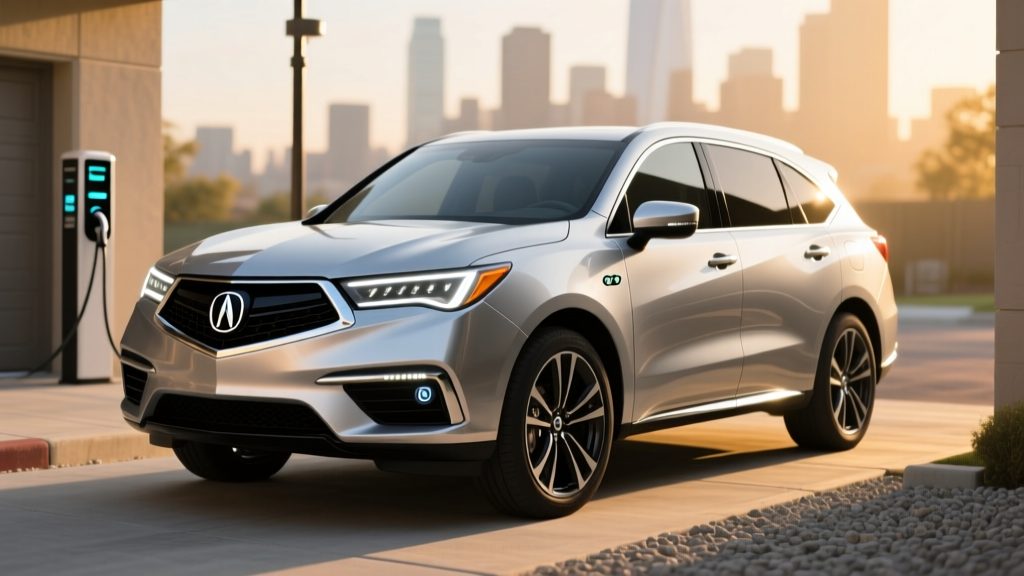
The 2017 Acura MDX Sport Hybrid paired a 3.0-liter V6 with a three-motor system to deliver 321 combined horsepower and 26 MPG combined — figures that made it one of the most efficient three-row luxury SUVs of its era. Acura discontinued the hybrid variant after the 2020 model year, so today's buyers encounter it exclusively on the used market. For families seeking a fuel-sipping luxury hauler without committing to a plug, the MDX Sport Hybrid remains a compelling option — provided you understand what you're getting, what to inspect, and how it stacks up against modern hybrids and PHEVs.
| Attribute | Value |
|---|---|
| Powertrain | 3.0L V6 + 3-motor SH-AWD system |
| Combined Horsepower | 321 HP |
| Combined Torque | 289 lb-ft |
| Transmission | 7-speed dual-clutch automatic (no traditional gearbox in rear) |
| EPA MPG (City / Hwy / Combined) | 26 / 27 / 26 |
| Drivetrain | SH-AWD (torque-vectoring rear motors) |
| Battery Type | Lithium-ion (1.3 kWh, HEV — not plug-in) |
| 0–60 mph | 6.4 seconds |
| Seating | 7 passengers |
| Cargo (behind 3rd row) | 15.8 cu ft |
| Towing Capacity | 3,500 lbs |
| Original MSRP (Advance trim) | ~$59,950 |
HEV vs. PHEV: Understanding What the MDX Sport Hybrid Actually Is
Before evaluating this SUV, it's critical to distinguish between the two hybrid architectures available in the market:
| Feature | HEV (like the 2017 MDX Sport Hybrid) | PHEV (e.g., Toyota RAV4 Prime) |
|---|---|---|
| Plugs in to charge? | No — charges via regenerative braking and engine | Yes — has a charge port for grid charging |
| Electric-only range | Very short (under 1 mile at low speed) | 20–45 miles typical |
| Battery size | Small (1–2 kWh) | Larger (13–20+ kWh) |
| Federal tax credit (§30D) | Not eligible | May qualify if new (not on used purchases) |
| Best for | Drivers who want better MPG without lifestyle changes | Drivers with home charging who want EV-like daily commutes |
The 2017 Acura MDX Sport Hybrid is a conventional hybrid (HEV). It does not have a plug, cannot charge from a wall outlet, and offers no meaningful electric-only driving range. Its hybrid system recovers energy during braking and coasting, stores it in a small lithium-ion pack, and uses that energy to assist the gasoline engine and power the rear axle motors. If you're searching for an acura suv hybrid 2017 expecting plug-in capability, this is not it — but what it does offer is seamless efficiency improvement with zero behavior change required.
Fuel Economy: EPA Numbers vs. Real-World MPG
| Driving Condition | EPA Estimate | Real-World Expectation |
|---|---|---|
| City | 26 MPG | 26–29 MPG (hybrids often beat EPA in stop-and-go) |
| Highway | 27 MPG | 24–26 MPG (less regen benefit at sustained speed) |
| Combined | 26 MPG | 25–27 MPG |
According to fueleconomy.gov, the 2017 MDX Sport Hybrid achieves 26 MPG combined. This represents a meaningful improvement over the non-hybrid 2017 MDX with SH-AWD, which was rated at 21 MPG combined — a 5 MPG or roughly 24% gain.
In real-world driving, conventional hybrids tend to exceed their EPA city estimates because stop-and-go traffic maximizes regenerative braking. Highway driving is where hybrids lose their advantage somewhat, as sustained speeds don't allow for energy recovery. Owners who do mostly urban and suburban driving frequently report 27–29 MPG in mixed city use. Expect highway-only road trips to yield closer to 24–25 MPG.
For context, the non-hybrid 2017 MDX AWD costs roughly $650–$800 more per year in fuel (assuming 15,000 miles/year and $3.50/gallon), making the hybrid's fuel savings tangible over ownership.
Powertrain Deep Dive: The Three-Motor SH-AWD System
Acura's Sport Hybrid SH-AWD (Super Handling All-Wheel Drive) is genuinely sophisticated engineering. The powertrain consists of:
- Front axle: A 3.0-liter SOHC V6 (257 HP) paired with a 47-HP electric motor integrated into the 7-speed dual-clutch transmission.
- Rear axle: Two independent 36-HP electric motors — one per rear wheel — enabling true torque vectoring. The system can send up to 100% of rear-axle torque to a single wheel during cornering.
The combined system output is 321 HP and 289 lb-ft of torque. The result is not just efficiency — the MDX Sport Hybrid actually handles better than its gas-only sibling. The rear motors provide instantaneous torque response that a mechanical AWD system simply cannot match, and the 0–60 mph time of 6.4 seconds is brisk for a three-row SUV of this era.
One important note: the 7-speed dual-clutch transmission in the hybrid differs from the 9-speed automatic in the conventional MDX. Some drivers note the DCT can feel slightly jerky at very low speeds (parking lot maneuvers), though it's smooth during normal driving.
Battery Health, Warranty, and Replacement Costs
Hybrid Battery Warranty & Lifespan
- Original warranty: 8 years / 100,000 miles (10 years / 150,000 miles in CARB states including CA, NY, MA, and others)
- Current status (2026): Most 2017 models have exceeded the 8-year mark — check remaining mileage coverage and state-specific CARB extensions
- Battery chemistry: Lithium-ion (small 1.3 kWh pack)
- Expected lifespan: 150,000–200,000+ miles with normal use
- Replacement cost: $2,000–$4,000 (aftermarket/refurbished options available for less)
Because the 2017 MDX Sport Hybrid uses a relatively small battery pack that never undergoes deep discharge cycles (the system keeps it in a narrow state-of-charge window for longevity), degradation is typically minimal. Unlike full EVs that cycle through large portions of battery capacity, HEV batteries experience shallow, frequent charge-discharge cycles that are far less stressful on the cells.
That said, any 2017 model you evaluate in 2026 is at least 9 years old. Lithium-ion cells degrade with time as well as use. Before purchasing:
- Request a hybrid battery health report from an Acura dealer (they can read state-of-health via diagnostic scan).
- Check for any dashboard warning lights related to the IMA (Integrated Motor Assist) or hybrid system.
- Verify whether the original hybrid battery has ever been replaced — a recent replacement is actually a positive.
- Confirm your state's CARB warranty status — some states extend hybrid battery coverage to 10 years / 150,000 miles.
Reliability Record and Common Issues
The 2017 MDX Sport Hybrid carries a generally solid reliability reputation, though a few patterns have emerged from owner reports and service bulletins:
- Dual-clutch transmission shudder: Some owners report hesitation or shudder during low-speed engagement. Acura issued software updates to address this — verify the TCU (transmission control unit) has been updated.
- Infotainment system: The dual-screen setup in the 2017 MDX is widely regarded as sluggish and unintuitive. This is a usability frustration, not a reliability failure.
- Brake feel: The transition between regenerative braking and friction braking can feel slightly non-linear — this is characteristic of most hybrids, not a defect.
- 12V auxiliary battery: Like all modern vehicles, the 12V battery can fail every 3–5 years. This is separate from the hybrid traction battery and is an inexpensive replacement.
For a thorough pre-purchase inspection, prioritize a dealer or shop familiar with Acura's SH-AWD hybrid system. The rear electric motors and their associated power electronics are unique to this platform.
Tax Credits and Purchase Economics
As a conventional hybrid (HEV), the 2017 Acura MDX Sport Hybrid does not qualify for the federal §30D clean vehicle tax credit. That credit applies only to plug-in electric vehicles (BEVs and PHEVs) meeting specific battery-sourcing, MSRP, and buyer-income requirements, as detailed on IRS.gov. Conventional hybrids have never been eligible for §30D.
Some states offer their own incentives for hybrid vehicles, but these are typically modest (a few hundred dollars) and often expired or discontinued. Check your state's DMV or energy office for any current programs.
On the used market in 2026, expect to find the 2017 MDX Sport Hybrid in the $18,000–$26,000 range depending on mileage, condition, and trim (the hybrid was offered primarily in the Technology and Advance trims). The Advance trim, which included premium features like ventilated seats, a surround-view camera, and rear entertainment, commands a premium.
Who Should Buy This Hybrid — And Who Should Look Elsewhere
Decision Framework
Choose the 2017 MDX Sport Hybrid if:
- You want a three-row luxury SUV with better fuel economy but no charging hassle
- You don't have access to home or workplace charging (making a PHEV or EV impractical)
- You value the torque-vectoring AWD system for all-weather confidence
- Your budget is in the $18K–$26K range and you want maximum features per dollar
Look at a PHEV or full EV instead if:
- You have home Level 2 charging and want electric-only daily commuting (consider a used BMW X5 xDrive45e or Toyota Highlander Hybrid)
- You want eligibility for the federal used-EV tax credit (up to $4,000 under §25E for qualifying pre-owned plug-in vehicles)
- You prioritize the latest driver-assistance technology (2017-era AcuraWatch is basic by 2026 standards)
- You want a warranty that starts fresh rather than one that's largely expired
Pros
- 26 MPG combined in a 3-row luxury SUV — 24% better than gas-only MDX
- 321 HP with torque-vectoring SH-AWD provides confident handling
- No plug-in charging required — works like a normal gas car
- Advance trim loaded with luxury features at a steep used-market discount
- Small hybrid battery means lower replacement cost vs. PHEV/EV
Cons
- No electric-only range — not eligible for any federal tax credits
- Dual-clutch transmission can be jerky at parking-lot speeds
- Dated infotainment system with frustrating dual-screen interface
- Hybrid battery warranty largely expired on most examples
- Discontinued platform — no future OTA updates or feature additions
Frequently Asked Questions
How many MPG does the 2017 Acura MDX Sport Hybrid get?
The EPA rates it at 26 city / 27 highway / 26 combined. In real-world city-heavy driving, many owners report 27–29 MPG thanks to regenerative braking. Highway-only trips typically yield 24–25 MPG.
Does the 2017 MDX Sport Hybrid plug in?
No. It is a conventional hybrid (HEV), not a plug-in hybrid (PHEV). The battery charges exclusively through regenerative braking and the gasoline engine. You never need to plug it in — you simply fill it with gasoline like any other car.
How far can it drive on electric power alone?
Effectively zero miles in practical terms. The hybrid system can move the vehicle at very low speeds for brief distances (such as creeping in a parking lot), but the 1.3 kWh battery is far too small for any meaningful electric-only driving. If electric-only range is a priority, look at a PHEV like the Toyota RAV4 Prime (42 miles electric) or a full BEV.
Is the 2017 Acura MDX Sport Hybrid reliable?
Overall reliability is good, with the main concerns being the dual-clutch transmission's low-speed behavior (addressed by software updates) and the aging infotainment system. The hybrid battery and rear electric motors have proven durable, but any 9-year-old vehicle needs a thorough pre-purchase inspection.
What does hybrid battery replacement cost?
Expect $2,000–$4,000 for a replacement lithium-ion hybrid battery pack through a dealer. Independent hybrid specialists and refurbished battery options can reduce this cost to $1,200–$2,500. Given the small pack size, this is significantly less expensive than a full EV or PHEV battery replacement.
Does it qualify for any tax credit?
No. The federal §30D new clean vehicle credit and the §25E used clean vehicle credit both require a plug-in vehicle (BEV or PHEV) with a minimum battery capacity. Conventional hybrids like the MDX Sport Hybrid have never qualified for federal purchase incentives. Check your state's energy office for any local hybrid incentives, though most have expired.
How does the 2017 MDX Sport Hybrid compare to a modern hybrid SUV?
Modern hybrid SUVs like the 2026 Toyota Grand Highlander Hybrid (35 MPG combined) or the Hyundai Santa Fe Hybrid (34 MPG combined) deliver significantly better fuel economy with updated technology. However, the MDX Sport Hybrid offers more power (321 HP vs. ~245 HP for the Grand Highlander) and a more sophisticated AWD system at a lower used-market price point.
Sources: EPA fuel economy data from fueleconomy.gov; IRS clean vehicle credit rules from irs.gov; Acura specifications from manufacturer archives.