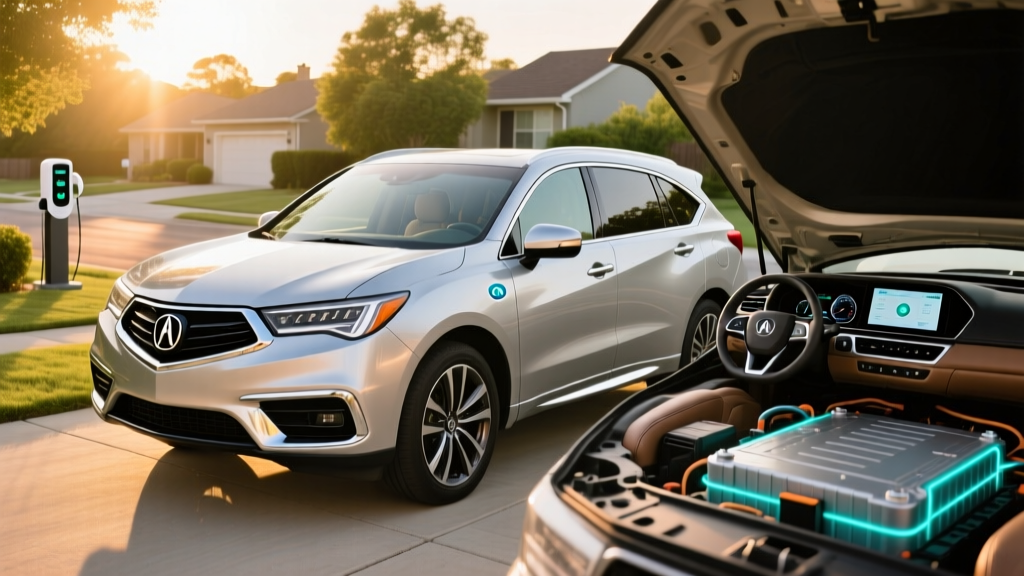
If you're researching the 2017 Acura MDX Hybrid Sport on the used market in 2026, you're likely weighing its three-row luxury and standard Super Handling All-Wheel Drive (SH-AWD) against questions about hybrid battery longevity, real-world fuel economy, and ownership costs nearly a decade after its debut. Acura's first hybridized MDX arrived for the 2017 model year as a conventional hybrid (HEV)—not a plug-in—and it used a unique twin-motor rear axle to deliver both efficiency and all-weather traction without ever needing to be plugged in.
This guide covers the exact EPA numbers, powertrain specs, battery warranty and replacement outlook, and whether this used hybrid SUV still makes financial sense versus a newer PHEV or full EV in today's market.
HEV vs PHEV: What the 2017 MDX Hybrid Actually Is
Before diving into specs, it's critical to understand that the 2017 Acura MDX Sport Hybrid is a conventional hybrid (HEV), not a plug-in hybrid (PHEV). This distinction shapes everything about ownership:
| Feature | HEV (2017 MDX Sport Hybrid) | PHEV (e.g., newer competitors) |
|---|---|---|
| Plug-in charging required? | No — charges via regenerative braking and engine | Yes — plug in for electric-only range |
| Electric-only driving | Very limited (low-speed, short distances) | 20–40+ miles typical |
| Battery size | ~1.3 kWh (small, nickel-metal hydride) | 15–30+ kWh (lithium-ion) |
| Federal tax credit (§30D) | Not eligible (not a PHEV or EV) | Up to $7,500 if new and eligible |
| Fueling | Gasoline only, like any car | Gasoline + electricity |
The MDX Sport Hybrid's small battery pack recovers energy during braking and deceleration, then deploys it to assist acceleration and power the rear wheels. You fuel it exclusively at the gas pump. There is no charging port, no electric-only commute mode, and no home charger to install.
EPA Fuel Economy: City, Highway, and Combined MPG
The 2017 Acura MDX Sport Hybrid was rated by the EPA at 26 MPG city / 27 MPG highway / 27 MPG combined. For context, the non-hybrid 2017 MDX with the 3.5L V6 and 9-speed automatic was rated at 19/27/22 MPG (FWD) or 18/26/21 (AWD). The hybrid's biggest advantage is in city driving, where electric motor assist and regenerative braking recover the most energy.
| Model | City MPG | Highway MPG | Combined MPG |
|---|---|---|---|
| 2017 MDX Sport Hybrid (SH-AWD) | 26 | 27 | 27 |
| 2017 MDX 3.5L V6 (FWD) | 19 | 27 | 22 |
| 2017 MDX 3.5L V6 (AWD) | 18 | 26 | 21 |
Real-World MPG: What Owners Actually Report
Conventional hybrids like the MDX Sport Hybrid often exceed their EPA city rating in stop-and-go traffic because regenerative braking is most effective at lower speeds. However, highway-heavy driving tends to bring the combined number down slightly. Based on owner-reported data from Fuelly and enthusiast forums, expect:
- City-dominant driving: 26–29 MPG (matching or slightly exceeding EPA)
- Highway-dominant driving (70+ mph): 24–26 MPG
- Mixed real-world average: 25–27 MPG
- Cold-weather penalty: Expect 1–3 MPG drop in winter months due to reduced battery efficiency and increased engine idling for cabin heat
That 25–27 MPG combined real-world figure represents a meaningful improvement over the AWD V6 model's ~21 MPG, saving roughly $400–$600 per year in fuel at 15,000 miles driven annually (assuming $3.50/gallon regular unleaded—the MDX Hybrid requires premium 91-octane fuel, which shifts this calculation; see the ownership section below).
Powertrain: 321 HP and the Twin-Motor SH-AWD System
The 2017 MDX Sport Hybrid uses a powertrain unlike anything else in Acura's lineup at the time. It pairs a 3.0L V6 (different from the non-hybrid's 3.5L) with a 7-speed dual-clutch transmission and a twin-motor rear axle unit:
| Specification | Detail |
|---|---|
| Engine | 3.0L SOHC V6 (257 hp, 218 lb-ft) |
| Front electric motor | Integrated in transmission (47 hp) |
| Rear twin-motor unit | Twin motors, 36 hp each (72 hp combined rear) |
| Combined system output | 321 hp / 289 lb-ft |
| Transmission | 7-speed dual-clutch automatic (front) |
| Drivetrain | SH-AWD (torque-vectoring rear axle) |
| 0–60 mph | ~6.0 seconds (Car and Driver tested) |
| Towing capacity | 3,500 lbs |
| Battery type | Nickel-metal hydride (NiMH), ~1.3 kWh |
| Curb weight | ~4,451 lbs |
The twin-motor rear axle is the engineering highlight. Rather than using a mechanical driveshaft from the engine to the rear wheels, the hybrid system powers the rear axle entirely via electricity. Each rear motor can independently vary torque to its respective wheel, giving the SH-AWD system genuine torque-vectoring capability. This makes the MDX Sport Hybrid handle more nimbly than its weight suggests, especially in wet or snowy conditions.
The 321 combined horsepower is a genuine step up from the non-hybrid V6's 290 hp, and the 0–60 time of approximately 6.0 seconds makes it one of the quicker three-row SUVs in its class for the model year.
Interior, Tech, and the Sport Hybrid Trim Positioning
For 2017, the MDX Sport Hybrid was offered in two trims: the base Sport Hybrid and the Sport Hybrid with the Advance Package. Key features included:
- Standard: AcuraWatch suite (adaptive cruise control, lane-keeping assist, collision mitigation braking, road departure mitigation), leather seats, heated front seats, power tailgate, 8-inch dual-screen infotainment, Apple CarPlay and Android Auto
- Advance Package adds: Ventilated front seats, heated rear seats, heated steering wheel, remote engine start, front and rear parking sensors, roof rails, upgraded leather, and a 120V household-style outlet in the rear cargo area
The Advance Package's 120V outlet is a notable feature for families—useful for laptops or small appliances on road trips, though it's not a full vehicle-to-load (V2L) system like you'd find on a modern Hyundai Ioniq 5 or Ford F-150 Lightning.
Battery Warranty, Longevity, and Replacement Cost
Hybrid battery reliability is the top concern for any used hybrid buyer, and it's worth addressing in detail for a 2017 model that's now approaching nine years old in 2026.
Acura Hybrid Battery Warranty (Original)
- Coverage: 8 years / 100,000 miles (whichever comes first)
- Extended in CARB states: 10 years / 150,000 miles in California and states adopting CARB emissions standards (CT, ME, MD, MA, NJ, NY, OR, RI, VT, WA)
- What's covered: Hybrid battery pack, hybrid control module, electric motors, and related hybrid-system components
Real-World Battery Longevity
The MDX Sport Hybrid's NiMH battery pack is small (~1.3 kWh) and is never deeply discharged or fully charged in normal operation—Acura's hybrid management system keeps it in a narrow state-of-charge window to maximize longevity. This shallow-cycling strategy is proven to extend NiMH battery life significantly.
Based on owner reports and the track record of Honda/Acura hybrid systems (the Accord Hybrid and Insight use similar architecture), the hybrid battery in the MDX Sport Hybrid typically lasts well beyond the warranty period. Many Honda/Acura hybrids reach 150,000–200,000 miles without hybrid battery issues. That said, at 9 years old, some early 2017 examples may be approaching the age where capacity loss or cell imbalance could surface.
Battery Replacement Cost
If the hybrid battery does fail outside warranty:
- OEM replacement (dealer): $3,000–$5,000 for the battery pack, plus $500–$1,000 in labor
- Aftermarket/reconditioned: $1,500–$3,000 from hybrid battery specialists
- Individual cell replacement: Some shops can replace individual cells for $500–$1,200 if only a few cells have degraded
The relatively small battery and proven NiMH chemistry keep replacement costs lower than what you'd face with a large PHEV or EV battery pack. It's also worth noting that the 7-speed dual-clutch transmission (unique to the Sport Hybrid) is a more expensive potential repair than the conventional 9-speed automatic in the non-hybrid MDX—budget $3,000–$5,000 if it ever needs replacement.
Used Pricing in 2026 and Tax Credit Reality
The 2017 MDX Sport Hybrid originally carried an MSRP of approximately $52,000 (base Sport Hybrid) to $57,000 (Advance Package), including destination. In the 2026 used market, expect to pay:
- Sport Hybrid (80,000–120,000 miles): $16,000–$22,000 depending on condition, mileage, and market
- Sport Hybrid Advance (60,000–100,000 miles): $19,000–$26,000
- Low-mileage examples (<50,000 miles): $25,000–$30,000
Tax Credit Eligibility
The 2017 Acura MDX Sport Hybrid is a conventional hybrid (HEV), not a plug-in hybrid or battery electric vehicle. It does not qualify for the federal §30D Clean Vehicle Credit (up to $7,500), which applies only to new PHEVs and BEVs meeting battery-sourcing and MSRP/income requirements.
For the used EV credit (§25E, up to $4,000), the law requires the vehicle to be a qualified plug-in electric vehicle or fuel cell vehicle. Since the MDX Sport Hybrid cannot be plugged in, it does not qualify for the used EV credit either. There is no federal tax incentive for purchasing this conventional hybrid.
Some states offer modest incentives for hybrid purchases, but most state-level programs have shifted focus exclusively to PHEVs and BEVs. Check your state's energy office or Alternative Fuels Data Center for any remaining state hybrid incentives.
Who Should Buy the 2017 MDX Sport Hybrid vs. Alternatives
Pros
- 321 hp with genuine torque-vectoring SH-AWD — excellent in snow and rain
- 27 MPG combined is strong for a 3-row, 4,451-lb luxury SUV
- AcuraWatch ADAS suite was standard (not a pricey add-on)
- No plug-in charging required — works with any lifestyle
- Hybrid battery replacement cost is relatively low (~$3K–$5K)
- Used pricing offers significant luxury-per-dollar value in 2026
Cons
- Requires premium 91-octane fuel, eroding some fuel savings
- 7-speed dual-clutch transmission can be jerky at low speeds and is costly to replace
- Infotainment system (dual-screen) is dated and widely criticized
- No electric-only driving — not a PHEV
- No federal tax credit eligibility
- Third-row space is tight for adults compared to rivals
Decision Framework: Is This the Right Hybrid for You?
Choose the 2017 MDX Sport Hybrid if:
- You need three rows and AWD but want better fuel economy than a standard V6 SUV
- You can't charge at home (no garage, apartment living, no workplace charger) and a PHEV or EV doesn't make sense
- You prioritize all-weather traction — the torque-vectoring SH-AWD is genuinely superior to most AWD systems
- You want a luxury SUV under $25K and are comfortable with a used vehicle
Look at a PHEV or EV instead if:
- You have home charging and a short commute — a PHEV like the Toyota RAV4 Prime or a newer Volvo XC90 Recharge can cover daily driving on electricity alone
- You want to eliminate gasoline entirely — consider a used Tesla Model X, Rivian R1S, or newer three-row EV
- You want current-generation infotainment and driver-assist technology
- Tax credit eligibility matters — a new or used PHEV/BEV may net you $4,000–$7,500 in credits
Ownership Costs: Fuel, Insurance, and Maintenance
Beyond the purchase price, here's what ongoing ownership looks like for the 2017 MDX Sport Hybrid in 2026:
- Annual fuel cost: At 15,000 miles/year and 26 MPG combined on premium fuel ($4.00/gal), expect ~$2,300/year. The non-hybrid AWD V6 at 21 MPG would cost ~$2,860/year—a $560/year savings for the hybrid.
- Insurance: Moderate for a luxury SUV. Expect $1,400–$2,000/year depending on your profile and state. The hybrid designation doesn't significantly impact insurance premiums for used vehicles.
- Maintenance: Acura maintenance costs are moderate among luxury brands. The hybrid system adds no routine maintenance (no fluids to change in the electric motors). Budget $800–$1,500/year for standard maintenance (oil changes, brakes, tires). Regenerative braking extends brake pad life significantly.
- Tires: The SH-AWD system and 4,451-lb curb weight mean tire wear can be higher than a lighter SUV. Budget $800–$1,400 for a set of four all-season tires every 40,000–50,000 miles.
Frequently Asked Questions
How many MPG does the 2017 Acura MDX Hybrid get?
The EPA rates it at 26 city / 27 highway / 27 combined. Real-world driving typically yields 25–27 MPG combined, with city-dominant driving sometimes reaching 28–29 MPG thanks to regenerative braking. Highway-heavy driving at 75+ mph may drop to 24–25 MPG. Note that it requires premium 91-octane fuel.
Can the 2017 MDX Sport Hybrid be plugged in to charge?
No. This is a conventional hybrid (HEV), not a plug-in hybrid (PHEV). It has no charging port. The hybrid battery charges exclusively through regenerative braking and the gasoline engine. You fuel it only at the gas pump.
Is the 2017 MDX Sport Hybrid reliable?
The Honda/Acura hybrid powertrain has a strong reliability track record, and the NiMH battery pack is designed to last well beyond its 8-year/100,000-mile warranty. The main reliability concern is the 7-speed dual-clutch transmission, which can exhibit hesitation at low speeds and is expensive to replace ($3,000–$5,000). Overall, Acura's hybrid system is considered robust, but a pre-purchase inspection by an Acura-qualified technician is strongly recommended for any used example.
What does it cost to replace the hybrid battery?
An OEM dealer replacement runs $3,000–$5,000 for the battery pack plus labor. Aftermarket or reconditioned packs cost $1,500–$3,000. Individual cell repair may be possible for $500–$1,200. Because the battery is small (1.3 kWh NiMH) and shallow-cycled, outright failure is uncommon before 150,000+ miles.
Does the 2017 Acura MDX Hybrid qualify for any tax credit?
No. As a conventional hybrid (HEV), it is not eligible for the federal §30D Clean Vehicle Credit (up to $7,500) or the §25E Used Clean Vehicle Credit (up to $4,000). Both programs require a plug-in electric vehicle or fuel cell vehicle. Some states may have offered hybrid incentives in the past, but most have transitioned to PHEV/BEV-only programs.
How does the Sport Hybrid compare to the regular 2017 MDX?
The Sport Hybrid gives you 31 more horsepower (321 vs 290), significantly better city fuel economy (26 vs 18–19 MPG city), standard SH-AWD with torque vectoring, and the AcuraWatch safety suite as standard equipment. The trade-offs are a higher original price, premium fuel requirement, a dual-clutch transmission that's less smooth than the conventional 9-speed, and slightly less cargo space due to the rear motor unit. If you do mostly city and suburban driving, the hybrid is the better choice. If you drive mostly highway miles, the fuel economy gap narrows and the non-hybrid V6 may be a simpler, cheaper option.
What should I check before buying a used 2017 MDX Sport Hybrid?
Request a pre-purchase inspection that specifically includes: hybrid battery state-of-health diagnostics (an Acura dealer can pull this data), dual-clutch transmission behavior at low speeds and during gear changes, SH-AWD system operation (the rear motors should engage smoothly), and a check for any outstanding recalls. Verify the hybrid system warranty status—if the car was originally sold in a CARB state, the hybrid components may still be covered under the 10-year/150,000-mile warranty through part of 2026 or into 2027.