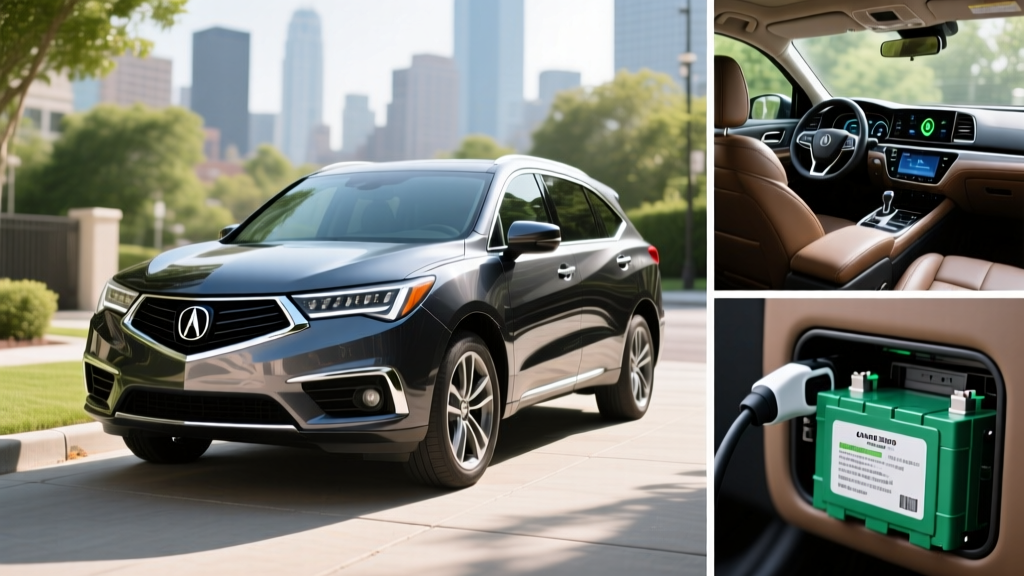
The 2017 Acura MDX Sport Hybrid occupies a specific niche: a three-row luxury SUV that uses electrification primarily for performance rather than maximum fuel savings. Acura paired its 3.0-liter V6 with a three-motor system to produce 321 combined horsepower while returning 26 MPG combined — a modest but meaningful improvement over the gas-only MDX's 21 MPG. For used-car shoppers in 2026 evaluating a high-mileage example, the key questions center on long-term battery health, real-world efficiency, and whether this conventional hybrid (HEV) still makes financial sense against newer plug-in hybrids and full EVs.
HEV vs PHEV: What the 2017 MDX Sport Hybrid Actually Is
Before examining specs, it is essential to classify this vehicle correctly. The 2017 Acura MDX Sport Hybrid is a conventional hybrid (HEV), not a plug-in hybrid (PHEV). This distinction matters for ownership expectations:
Conventional Hybrid (HEV) — 2017 MDX Sport Hybrid
- No plug, no charging cord required
- Battery recharges via regenerative braking and the gas engine
- Small battery (~1.3 kWh usable) — assists the engine, cannot drive on electric alone for meaningful distances
- No electric-only range to manage
- No eligibility for federal §30D EV tax credit
Plug-In Hybrid (PHEV) — e.g., Chrysler Pacifica PHEV, Toyota RAV4 Prime
- Requires plug-in charging to access full benefits
- Larger battery (typically 12–20 kWh) enabling 20–45 miles of electric-only driving
- Can operate as a pure EV for daily commutes, then switch to hybrid mode
- May qualify for federal or state incentives (rules vary by model year and sourcing)
The MDX Sport Hybrid's system is closer in philosophy to Toyota's hybrid synergy drive scaled up for a luxury performance application. You never plug it in. You simply drive it, and the system manages energy recapture and deployment automatically.
Powertrain Specs: 321 HP from Three Motors and a V6
| Component | Specification |
|---|---|
| Engine | 3.0L V6, SOHC i-VTEC, 257 hp / 218 lb-ft |
| Front Motor | Integrated in 7-speed DCT, 47 hp |
| Rear Motors (Twin) | Direct-drive, 36 hp each (72 hp total rear) |
| Combined System Output | 321 hp / 289 lb-ft |
| Transmission | 7-speed dual-clutch automatic (front) |
| Drivetrain | SH-AWD (electric rear axle, no mechanical driveshaft) |
| Hybrid Battery | ~1.3 kWh lithium-ion (located under cargo floor) |
| 0–60 mph | 6.0 seconds (est.) |
| Towing Capacity | 3,500 lbs |
Acura's Sport Hybrid SH-AWD system is mechanically interesting. The rear axle has no mechanical connection to the engine. Instead, two independent rear motors provide torque-vectoring all-wheel drive, sending up to 100% of available rear torque to either side. This gives the MDX Sport Hybrid sharper cornering behavior than its gas-only sibling, where SH-AWD relies on a mechanical rear differential.
The 7-speed dual-clutch transmission replaces the conventional 9-speed automatic found in the gas MDX. It is paired with the front electric motor, which smooths low-speed operation — a common DCT weakness — by filling in torque during gear changes and launch.
Fuel Economy: EPA Ratings and Real-World MPG
| Driving Cycle | EPA Rating | Real-World Expectation |
|---|---|---|
| City | 26 MPG | 25–28 MPG (hybrids often exceed EPA in stop-and-go) |
| Highway | 27 MPG | 24–26 MPG (aerodynamic drag limits hybrid advantage at speed) |
| Combined | 26 MPG | 24–27 MPG depending on driving mix |
Source: fueleconomy.gov
The 2017 MDX Sport Hybrid's 26 MPG combined represents a 5 MPG improvement over the gas-only AWD MDX (21 MPG combined). That translates to roughly 75 fewer gallons per year at 15,000 miles, or about $225–$300 in annual fuel savings depending on local gas prices.
In real-world use, conventional hybrids like this one tend to exceed their EPA city rating because regenerative braking recaptures more energy in heavy traffic. Highway driving is where the advantage narrows — at 75 mph, the MDX is pushing a 4,600-pound SUV through the air, and the hybrid system's contribution becomes marginal. Owners who do mostly suburban and city driving will see the best results; those with long, high-speed highway commutes will see numbers closer to 23–24 MPG.
Hybrid Battery Longevity, Warranty, and Replacement Cost
For a 2017 model being evaluated in 2026, the hybrid battery is approaching or past its 8-year mark — a critical consideration for used buyers.
Acura Hybrid Battery Warranty (Original)
- Coverage: 8 years / 100,000 miles (whichever comes first)
- Extended states: 10 years / 150,000 miles in CARB states (CA, NY, MA, and others adopting California emissions standards)
- Capacity threshold: Acura does not publish a specific degradation percentage trigger, but warranty covers defects and significant capacity loss that impairs hybrid system function
Replacement cost in 2026: A new OEM hybrid battery pack for the MDX Sport Hybrid runs approximately $3,000–$4,500 installed at a dealership. Independent hybrid specialists may offer refurbished packs for $1,800–$2,800 installed. Given the small 1.3 kWh pack size, these costs are substantially lower than full EV battery replacements.
Degradation reality: Lithium-ion hybrid batteries in Honda/Acura applications have proven durable. The small pack size means the system cycles it less aggressively than a PHEV or EV battery. Failures before 150,000 miles are uncommon, though individual cell imbalance can occur. Warning signs include reduced fuel economy, the IMA (Integrated Motor Assist) warning light, or the system defaulting to engine-only operation. A pre-purchase scan via OBD-II can reveal hybrid battery state-of-health metrics.
2017 Acura MDX Hybrid: Pros and Cons for Today's Buyer
Pros
- 321 hp provides confident acceleration and merging (0–60 in ~6 sec)
- SH-AWD torque vectoring via electric rear axle improves handling
- 26 MPG combined is strong for a 3-row luxury SUV of this era
- No plug-in requirement — works with any lifestyle or parking situation
- Three-row seating for up to 7 passengers
- Lower battery replacement cost than EVs or PHEVs due to small pack
- Acura reliability reputation; shared powertrain architecture with Honda
Cons
- Only 5 MPG advantage over gas MDX — fuel savings take years to recoup
- No electric-only driving capability whatsoever
- DCT can feel slightly jerky at very low speeds despite motor assist
- Hybrid battery under cargo floor slightly reduces under-floor storage
- No federal tax credit eligibility (conventional hybrid)
- Infotainment system (dual-screen) is dated by 2026 standards
- Approaching end of original hybrid battery warranty window
Pricing and Tax Credit Eligibility
Original MSRP (2017): The MDX Sport Hybrid started at approximately $52,000 (base with SH-AWD) and reached $58,000+ with the Advance and Entertainment packages.
Used market (2026): Expect to find 2017 MDX Sport Hybrid examples between $18,000 and $27,000 depending on mileage, condition, and trim. Well-maintained examples under 80,000 miles command a premium.
Federal tax credit: The 2017 Acura MDX Sport Hybrid does not qualify for the federal §30D clean vehicle credit. That credit applies only to plug-in electric vehicles (BEVs and PHEVs) meeting specific battery capacity, critical mineral sourcing, MSRP, and buyer income requirements per current IRS guidelines. Conventional hybrids like this MDX have not qualified for federal purchase incentives since the early 2010s.
State incentives: A handful of states offer modest rebates or HOV lane access for hybrids, but most have shifted incentive focus to PHEVs and BEVs. Check your state's energy or environmental agency for current programs.
Who Should Choose the 2017 MDX Sport Hybrid vs a PHEV or EV?
Choose the 2017 MDX Sport Hybrid if:
- You need three rows and AWD but cannot charge at home (apartment, street parking, no garage outlet)
- You want luxury-badge performance (321 hp) without the fuel cost of a non-hybrid V6 SUV
- Your daily driving is a mix of city and highway, and you prefer zero behavior change (no plugging in)
- You are buying used and want a lower purchase price than a comparable PHEV or EV
Choose a PHEV (e.g., Toyota Highlander Hybrid, Chrysler Pacifica PHEV) if:
- You can install a Level 2 charger at home and want 20–40 miles of electric-only commuting
- Your weekday driving is under 35 miles round-trip (you may rarely use gas)
- You want to reduce fuel consumption more dramatically than a 5 MPG improvement
Choose a full EV (e.g., Tesla Model X, Rivian R1S, Kia EV9) if:
- You have reliable home charging and want to eliminate gas entirely
- You drive under 300 miles daily and can plan road trips around DC fast charging
- You want access to the federal §30D credit (up to $7,500 on eligible new models) and lower per-mile energy costs
Frequently Asked Questions
How many MPG does the 2017 Acura MDX Hybrid get?
The EPA rates the 2017 MDX Sport Hybrid at 26 MPG city, 27 MPG highway, and 26 MPG combined. Real-world results typically range from 24 to 28 MPG depending on driving conditions. City-dominant driving tends to push results toward the higher end due to regenerative braking efficiency.
Does the 2017 MDX Hybrid need to be plugged in?
No. The 2017 MDX Sport Hybrid is a conventional hybrid (HEV), not a plug-in hybrid. It has no charging port. The 1.3 kWh battery recharges automatically through regenerative braking and the gasoline engine. You fuel it exclusively at gas stations.
How far can the 2017 MDX Hybrid drive on electric only?
Effectively zero miles. The hybrid system uses its electric motors to assist the V6 engine and provide torque-vectoring AWD, but it cannot propel the vehicle on electric power alone for any meaningful distance at normal speeds. This is fundamentally different from a PHEV, which offers 20–45 miles of electric-only range.
Is the 2017 Acura MDX Hybrid reliable?
Acura (and parent company Honda) has a strong track record with hybrid powertrains. The three-motor SH-AWD system is complex but has not shown widespread failure patterns. The main long-term concern is hybrid battery degradation as these vehicles age past 8–10 years. Pre-purchase diagnostics scanning the hybrid battery state-of-health are strongly recommended for any used example.
What does a replacement hybrid battery cost?
As of 2026, expect $3,000–$4,500 for a new OEM battery at an Acura dealer, or $1,800–$2,800 for a refurbished pack from an independent hybrid specialist. The small 1.3 kWh pack is far less expensive to replace than a full EV traction battery.
Does the 2017 MDX Hybrid qualify for any tax credit?
No. The federal §30D clean vehicle credit applies only to plug-in vehicles (BEVs and PHEVs) meeting current battery sourcing, MSRP, and buyer income requirements. Conventional hybrids have not qualified for federal purchase credits for over a decade. Some states may offer minor incentives, but most have redirected hybrid incentives toward plug-in vehicles.
How does the MDX Sport Hybrid compare to the gas-only MDX?
The Sport Hybrid gains 5 MPG combined (26 vs 21), adds 31 horsepower (321 vs 290), and replaces the mechanical rear axle with electric torque-vectoring motors for sharper handling. The trade-off is a higher original price, slightly reduced under-floor cargo space, and DCT transmission character that some drivers find less smooth than the gas model's 9-speed automatic at parking speeds.