Quick Verdict: A Proven Hybrid Sedan With Real-World Efficiency
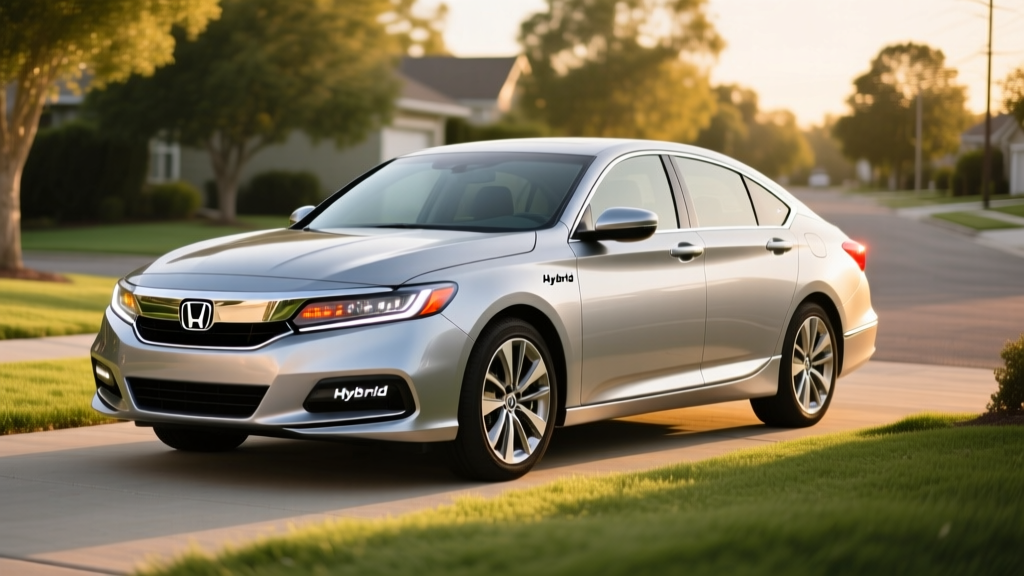
The 2017 Honda Accord Hybrid Touring remains one of the most compelling used midsize hybrid sedans on the market. With an EPA-rated 48 MPG combined, Honda's two-motor hybrid powertrain delivers genuine fuel savings without requiring any plug-in charging or behavioral changes. The Touring trim piles on premium features — leather seats, navigation, Honda Sensing safety suite, and a premium audio system — making it a practical daily driver that sips fuel in city traffic.
If you're shopping the used market in 2026 and weighing a conventional hybrid against a plug-in hybrid (PHEV) or a full battery-electric vehicle (BEV), the Accord Hybrid occupies a specific niche: zero charging hassle, proven long-term reliability, and strong highway manners. But it's important to understand exactly what this car is — and isn't — before signing the paperwork.
HEV vs PHEV vs EV: Where the Accord Hybrid Fits
Before diving into specs, let's clarify the fundamental distinction between electrified vehicle types, because the 2017 Accord Hybrid is a conventional hybrid (HEV), not a plug-in.
| Feature | Conventional Hybrid (HEV) | Plug-In Hybrid (PHEV) | Battery Electric (BEV) |
|---|---|---|---|
| Plug-in charging? | No — gas only | Yes — gas + plug-in | Yes — plug-in only |
| Electric-only range | ~1-2 miles at low speed | 20-50 miles typical | 200-400+ miles |
| Battery size | 1.3 kWh (Accord Hybrid) | 8-20 kWh typical | 60-100+ kWh |
| Fuel needed? | Yes — gasoline | Yes — gasoline | No |
| Federal tax credit? | No | Up to $7,500 (§30D, new only) | Up to $7,500 (§30D, new only) |
| Example | 2017 Accord Hybrid | Toyota RAV4 Prime | Honda Prologue |
The 2017 Accord Hybrid does not plug into any charger. It recovers energy through regenerative braking and its gasoline engine, storing it in a small 1.3 kWh lithium-ion battery. That battery powers an electric motor that assists the gas engine and enables brief electric-only motoring at low speeds — but you'll never see meaningful electric-only range. If you want 25-40 miles of electric commuting before the gas engine kicks in, you need a PHEV like the Toyota RAV4 Prime or a Chrysler Pacifica Hybrid. If you want zero gasoline, you're looking at a BEV.
Fuel Economy: EPA Ratings and Real-World MPG
The headline number for the 2017 Accord Hybrid Touring is its EPA-rated fuel economy. Here's the official breakdown from fueleconomy.gov:
| Driving Cycle | EPA Rating | Real-World Expectation |
|---|---|---|
| City | 49 MPG | 47-52 MPG (hybrids often beat EPA in city) |
| Highway | 47 MPG | 42-46 MPG (aerodynamic drag, higher speeds) |
| Combined | 48 MPG | 44-49 MPG depending on driving mix |
Real-world note: Conventional hybrids like the Accord Hybrid tend to perform better in city driving than highway driving — the opposite of most gas-only cars. Stop-and-go traffic maximizes regenerative braking, and the electric motor handles low-speed motoring where gas engines are least efficient. On sustained 75+ MPH highway runs, expect closer to 42-44 MPG, especially with air conditioning and cargo load. In cold weather (below 35°F), expect a 5-10% MPG reduction as the engine runs more frequently to maintain cabin heat and battery temperature.
With a 14.0-gallon fuel tank, the theoretical maximum range is approximately 672 miles at the combined EPA rating. Realistically, plan for 550-620 miles between fill-ups in mixed driving — still exceptional for a midsize sedan.
Powertrain Specs: Two-Motor Hybrid System
The 2017 Accord Hybrid uses Honda's two-motor hybrid system, which operates differently from the planetary-gear setups in Toyota hybrids. Here's the full powertrain breakdown:
| Specification | 2017 Accord Hybrid Touring |
|---|---|
| Engine | 2.0L Atkinson-cycle 4-cylinder |
| Engine horsepower | 143 hp @ 6,200 RPM |
| Engine torque | 129 lb-ft @ 4,000 RPM |
| Electric motor output | 166 hp / 226 lb-ft |
| Combined system output | 212 hp |
| Hybrid battery | 1.3 kWh lithium-ion |
| Transmission | Single-speed direct drive (no traditional CVT) |
| 0-60 MPH | ~7.2 seconds |
| Drivetrain | Front-wheel drive |
| Curb weight | ~3,470 lbs |
Honda's system primarily drives the wheels via the electric motor, with the gas engine acting as a generator in most conditions. At higher highway speeds, a lock-up clutch connects the engine directly to the wheels for efficiency. This architecture gives the Accord Hybrid a smoother, more EV-like feel around town compared to the drone of a conventional CVT hybrid. The 212 combined horsepower provides confident merging and passing, a noticeable step up from many competitors in the hybrid midsize segment.
Battery Health, Warranty, and Replacement Costs
Hybrid Battery Warranty (Original)
Coverage: 8 years / 80,000 miles (10 years / 150,000 miles in CARB states including CA, NY, MA, and others)
Capacity threshold: Honda warrants the hybrid battery against defects and excessive capacity loss. There is no published minimum capacity retention percentage — Honda evaluates on a case-by-case basis.
2026 status: The original 8-year/80,000-mile warranty has expired for most 2017 Accord Hybrids unless the vehicle was registered in a CARB state and has under 150,000 miles. Check your VIN and registration state to confirm.
Battery longevity in practice: Honda's hybrid batteries in the Accord have demonstrated strong long-term durability. Owner reports and fleet data suggest most units retain functional capacity well past 150,000 miles. Unlike full EVs with 60-100 kWh batteries that face measurable degradation curves, the Accord Hybrid's 1.3 kWh pack operates within a narrow state-of-charge window managed by the hybrid control system — this shallow cycling significantly extends cell life.
Replacement cost if needed: A new OEM hybrid battery from Honda runs approximately $2,000-$3,000 for the part, with labor adding $300-$600 depending on the shop. Refurbished or aftermarket replacement batteries are available for $1,000-$1,800 installed. Individual cell module replacement (if only a few cells are degraded) can be done by specialist hybrid shops for $500-$1,000. Compared to a full EV battery replacement ($8,000-$20,000+), the financial risk here is modest.
The 12V auxiliary battery (standard lead-acid or AGM) is a separate maintenance item and typically needs replacement every 4-6 years at a cost of $150-$250.
2017 Accord Hybrid Touring: Features and What You Get
The Touring was the top-tier trim for the 2017 Accord Hybrid, and it came loaded. Key standard equipment includes:
- Honda Sensing suite: Collision Mitigation Braking, Road Departure Mitigation, Adaptive Cruise Control, Lane Keeping Assist
- Leather-trimmed seats with heated front seats and heated rear seats
- 8-inch touchscreen with navigation, Apple CarPlay, and Android Auto
- Premium audio: 7-speaker system with subwoofer
- LED headlights with auto high-beam
- Moonroof
- Remote start
- Parking sensors (front and rear) with multi-angle rearview camera
For a 2026 used buyer, the Honda Sensing suite is a significant value-add. While this is an SAE Level 1 system (it assists with braking and lane centering but does not provide hands-free or automated driving), it remains competitive with current base-level ADAS offerings from many brands.
Pricing, Tax Credits, and Total Cost of Ownership
Original MSRP (2017): The Accord Hybrid Touring stickered at approximately $35,605 including destination.
2026 used market pricing: Expect to pay $14,000-$20,000 depending on mileage, condition, and region. Examples under 80,000 miles in clean condition command the higher end of that range. Always request maintenance records and a pre-purchase inspection that includes a hybrid battery health check.
Federal tax credit: The 2017 Accord Hybrid does not qualify for the federal §30D new clean vehicle credit. That credit applies only to new plug-in vehicles (PHEVs and BEVs) meeting current battery-sourcing, MSRP, and buyer income requirements as outlined on IRS.gov. Conventional hybrids are excluded. The used EV credit (up to $4,000 under §25E) also applies only to used BEVs and PHEVs, not HEVs.
5-year ownership cost estimate (buying used in 2026):
| Category | Estimated 5-Year Cost |
|---|---|
| Purchase price (avg) | $17,000 |
| Fuel (12,000 mi/yr @ 48 MPG, $3.40/gal) | $4,250 |
| Insurance (avg) | $6,000-$7,500 |
| Maintenance (oil, brakes, tires, fluids) | $2,500-$3,500 |
| Potential hybrid battery replacement | $0-$3,000 (most likely $0) |
| Total estimated 5-year cost | $29,750-$35,250 |
Compare this to a comparable gas-only 2017 Accord (EPA ~30 MPG combined): fuel cost over 5 years would be approximately $6,800 — a $2,550 fuel savings with the hybrid. The hybrid's regenerative braking also extends brake pad life significantly, often cutting maintenance costs.
Who Should Choose the Accord Hybrid vs a PHEV or EV?
Choose the 2017 Accord Hybrid if:
- You don't have access to home or workplace charging (apartment, street parking)
- You want maximum fuel savings with zero behavioral change — just fill up with gas
- Your budget is $15,000-$20,000 for a well-equipped used sedan
- You drive 12,000-18,000 miles/year in mixed city/highway conditions
- You prioritize proven reliability and low repair risk
Consider a PHEV instead if:
- You can install a Level 2 home charger and your commute is under 30 miles round-trip
- You want electric-only daily driving with gas backup for road trips
- You're buying new and want to capture the $7,500 federal tax credit
Consider a full EV instead if:
- You have reliable home charging and want zero gasoline expenses
- Your daily driving is under 250 miles and you're comfortable with public DC fast charging for road trips
- You want the lowest per-mile energy cost and minimal drivetrain maintenance
Pros and Cons
Pros
- 48 MPG combined EPA — real-world city driving often exceeds 49 MPG
- No plug-in charging required; zero lifestyle adjustment
- Touring trim includes Honda Sensing, leather, nav, and premium audio
- Smooth two-motor powertrain feels EV-like around town
- Hybrid battery replacement cost is modest ($2,000-$3,000 OEM) if ever needed
- Strong long-term reliability track record for Honda's hybrid system
Cons
- No federal or state tax credit eligibility (conventional hybrid)
- Highway MPG drops to low 40s at sustained 75+ MPH speeds
- 2017 infotainment system feels dated by 2026 standards despite CarPlay/Android Auto
- Cargo space slightly reduced vs gas Accord due to hybrid battery placement
- Original 8-year battery warranty has expired for most examples
- No all-wheel-drive option (FWD only)
Frequently Asked Questions
How many MPG does the 2017 Accord Hybrid Touring get?
The EPA rates it at 49 city / 47 highway / 48 combined MPG. In real-world driving, city MPG often reaches 50+ thanks to regenerative braking, while sustained highway driving at 75+ MPH typically yields 42-44 MPG.
Does the 2017 Accord Hybrid plug in?
No. The 2017 Accord Hybrid is a conventional hybrid (HEV). It charges its small 1.3 kWh battery through regenerative braking and the gasoline engine. You never plug it in — you simply fill the gas tank as you would with any conventional car.
How far can it go on electric only?
Only about 1-2 miles at very low speeds (under 25 MPH) in EV mode. This is not a plug-in hybrid — the electric motor's primary role is to assist the gas engine and improve efficiency, not to provide meaningful electric-only range.
Is the 2017 Accord Hybrid reliable?
Yes. Honda's two-motor hybrid system has a strong reliability record. The hybrid battery uses shallow charge cycling that extends cell life, and most units remain functional well past 150,000 miles. The IIHS rated the 2017 Accord a Top Safety Pick+, adding confidence for used buyers. Routine maintenance (oil changes, brake fluid, coolant) follows standard Honda intervals.
What does a hybrid battery replacement cost?
A new OEM Honda hybrid battery costs approximately $2,000-$3,000 for the part, plus $300-$600 in labor. Refurbished replacements are available for $1,000-$1,800 installed. Most 2017 Accord Hybrids will never need a replacement, but this is the worst-case financial exposure.
Does the 2017 Accord Hybrid qualify for any tax credit?
No. Federal §30D and §25E credits apply only to plug-in vehicles (PHEVs and BEVs). Conventional hybrids like the Accord Hybrid do not qualify for federal tax credits. Some states may offer small incentives for hybrids — check your state's energy office or DMV for current programs.
Hybrid vs PHEV vs EV — which should I buy?
If you lack home charging access or want zero lifestyle change, a conventional hybrid like the Accord Hybrid is ideal. If you can charge at home and have a short commute, a PHEV gives you electric-only daily driving with gas flexibility. If you have home charging and want the lowest operating cost with zero gas, a BEV is the answer — but it requires planning for road trips and a higher upfront investment.
What should I check before buying a used 2017 Accord Hybrid?
Request a pre-purchase inspection from a Honda dealer or hybrid-experienced mechanic that includes a hybrid battery health diagnostic. Check for maintenance records (especially oil changes and inverter coolant service). Verify whether the vehicle was registered in a CARB state, which would extend the hybrid battery warranty to 10 years / 150,000 miles. Also inspect the 12V auxiliary battery age — if it's over 4 years old, budget for replacement.