Quick Verdict: The 2016 RAV4 Hybrid Still Earns Its Reputation
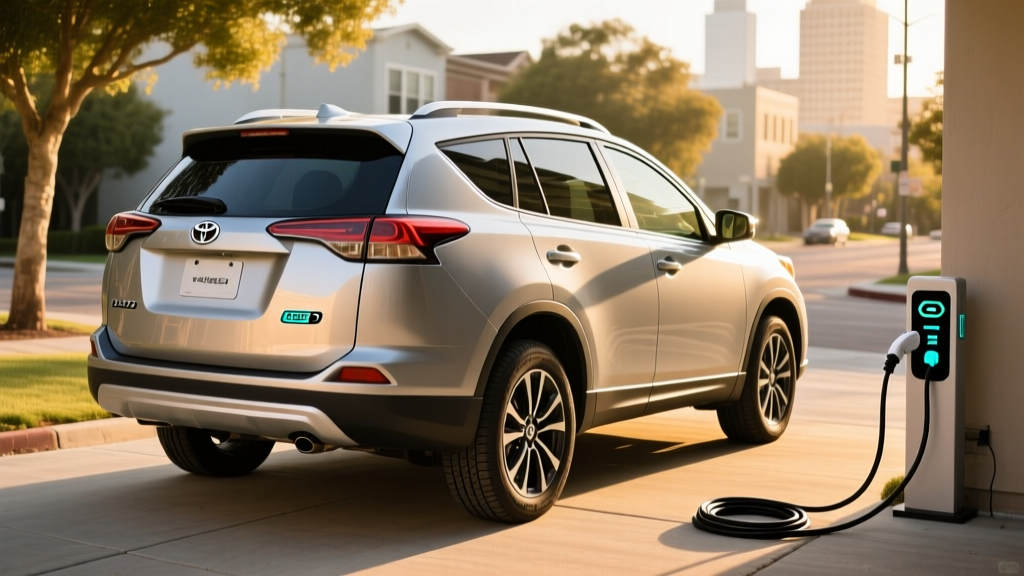
Toyota introduced the RAV4 Hybrid for the 2016 model year, and it quickly became the benchmark for compact hybrid SUVs. A decade later, the 2016 Toyota RAV4 Hybrid remains one of the most practical used-vehicle purchases in the electrified space — offering genuine fuel savings over its gas-only counterpart, standard all-wheel drive (on most trims), and Toyota's proven hybrid reliability. If you're shopping the used market in 2026, this guide covers everything you need to know about real-world MPG, battery longevity, and whether a conventional hybrid (HEV) like this one still fits your needs compared to a PHEV or full EV.
2016 Toyota RAV4 Hybrid: Full Spec Table
| Specification | 2016 RAV4 Hybrid |
|---|---|
| Powertrain Type | Conventional Hybrid (HEV) — no plug |
| Engine | 2.5L 4-cylinder Atkinson-cycle + electric motor(s) |
| Combined System Horsepower | 194 hp |
| Drivetrain | AWD (AWD-i with rear electric motor, standard on XLE/Limited) |
| Transmission | eCVT (electronically controlled continuously variable) |
| Hybrid Battery | Nickel-Metal Hydride (NiMH), ~1.6 kWh (not plug-in) |
| EPA Fuel Economy (XLE AWD) | 34 city / 31 highway / 32 combined MPG |
| EPA Fuel Economy (Limited AWD) | 33 city / 30 highway / 32 combined MPG |
| 0-60 mph | ~7.8 seconds |
| Cargo Volume | 35.6 cu ft (rear seats up) / 73.4 cu ft (rear seats folded) |
| Towing Capacity | 1,750 lbs |
| Original MSRP (2016) | ~$29,270 (XLE) / ~$34,510 (Limited) |
| Typical Used Price (2026) | ~$13,000–$18,500 depending on mileage/condition |
| Hybrid Battery Warranty (Original) | 8 years / 100,000 miles (10 yr/150,000 mi in CARB states) |
Sources: EPA Fuel Economy — 2016 Toyota RAV4 Hybrid, Toyota Motor Corporation specifications.
Fuel Economy: EPA Numbers vs. Real-World MPG
| Driving Scenario | MPG | Notes |
|---|---|---|
| EPA Combined (XLE) | 32 MPG | Official sticker figure |
| EPA City | 34 MPG | Hybrids excel in stop-and-go |
| EPA Highway | 31 MPG | Less regen benefit at steady speed |
| Real-World City (owner reports) | 33–38 MPG | Many owners exceed EPA in city driving |
| Real-World Highway (70+ mph) | 28–31 MPG | Aerodynamic drag reduces efficiency |
| Real-World Cold Weather (below 30°F) | 26–30 MPG | Engine runs more for cabin heat; battery less efficient |
| Combined Real-World Average | 30–34 MPG | Varies by driving style and climate |
The 2016 RAV4 Hybrid's Atkinson-cycle engine and regenerative braking system are optimized for city driving. In stop-and-go traffic, the electric motor handles low-speed propulsion and the engine shuts off at stops, which is why many owners report exceeding the 34 MPG EPA city figure in moderate climates. Highway driving is less impressive — at sustained 75-80 mph speeds, expect closer to 28-30 MPG, as the hybrid system provides less benefit and the boxy SUV shape creates aerodynamic drag.
Cold-weather reality check: In sub-freezing temperatures, the gasoline engine must run more frequently to provide cabin heating (there's no electric heater in the 2016 model) and to keep the NiMH battery at operating temperature. Owners in northern climates typically see a 3-5 MPG drop in winter months. This is normal for all conventional hybrids.
Powertrain and Driving Experience
The 2016 RAV4 Hybrid pairs a 2.5-liter Atkinson-cycle four-cylinder engine with Toyota's Hybrid Synergy Drive system. The front axle is driven by a combined gasoline engine and electric motor through an eCVT, while the AWD-i system uses a separate rear-mounted electric motor (no mechanical driveshaft) to power the rear wheels when traction is needed.
Output breakdown:
- Gasoline engine: 150 hp / 135 lb-ft torque
- Front electric motor: 105 kW (141 hp)
- Rear electric motor (AWD-i): 50 kW (67 hp)
- Combined net system output: 194 hp
The result is a 0-60 mph time of approximately 7.8 seconds — about 1.5 seconds quicker than the non-hybrid 2016 RAV4 AWD. The electric motor's instant torque makes the hybrid feel noticeably more responsive in city driving and highway merging. The eCVT is smooth but can produce the characteristic "rubber-band" drone under hard acceleration — a trait common to all Toyota hybrids of this era.
The AWD-i system is seamless and fully automatic. Unlike mechanical AWD, the rear motor engages only when slip is detected or during hard acceleration, minimizing efficiency losses. It's adequate for rain, light snow, and gravel roads, but this is not an off-road vehicle.
Hybrid Battery: Lifespan, Warranty, and Replacement Cost
Toyota's original hybrid battery warranty for the 2016 RAV4 Hybrid is 8 years / 100,000 miles (extended to 10 years / 150,000 miles in California and states adopting CARB emissions standards). As of 2026, most 2016 models are at or past the 8-year mark, meaning federal-warranty coverage has likely expired unless the vehicle was purchased late in the model year.
Real-world battery lifespan: Toyota's NiMH hybrid batteries have an exceptional track record. Data from owner surveys and fleet usage shows most RAV4 Hybrid batteries last 150,000–200,000+ miles before significant degradation. The NiMH chemistry is less energy-dense than modern lithium-ion but extremely durable and tolerant of thousands of shallow charge-discharge cycles.
Replacement cost if the battery fails:
- New OEM Toyota battery: $3,000–$4,500 (installed at dealer)
- Refurbished/remanufactured battery: $1,500–$2,500 (installed at independent hybrid shop)
- Individual module replacement: $300–$800 (only failed cells replaced — requires a skilled hybrid technician)
The good news: complete battery failure on the 2016 RAV4 Hybrid is uncommon. More often, if degradation occurs, it manifests as a slight reduction in fuel economy (1-3 MPG) and more frequent engine engagement rather than a total failure. Many 2016 examples with 120,000+ miles are still running on their original hybrid battery with minimal capacity loss.
Maximizing battery life: Avoid leaving the vehicle sitting for extended periods (weeks) with the battery at very low or very high state of charge. Regular driving — even short trips — keeps the NiMH pack conditioned. Unlike lithium-ion EV batteries, NiMH packs don't require careful charge-limiting; Toyota's battery management system keeps the pack in a safe 40-80% window automatically.
HEV vs. PHEV vs. Full EV: Which Is Right for You?
| Factor | HEV (e.g., 2016 RAV4 Hybrid) | PHEV (e.g., RAV4 Prime) | Full EV (e.g., Tesla Model Y) |
|---|---|---|---|
| Plugs In? | No | Yes | Yes |
| Electric-Only Range | None (motor assists engine) | ~42 miles (RAV4 Prime) | 270–330+ miles |
| Fuel/Energy Cost per Mile | ~$0.10–$0.13/mi | ~$0.04/mi (electric) / ~$0.11/mi (gas) | ~$0.04–$0.06/mi |
| Home Charging Needed? | No | Recommended (Level 2) | Essential |
| Federal Tax Credit (§30D) | Not eligible | Up to $7,500 (if eligible, new purchase) | Up to $7,500 (if eligible, new purchase) |
| Upfront Cost (Used Market 2026) | $13,000–$18,500 | $30,000–$40,000 | $22,000–$38,000 |
| Maintenance Complexity | Low (proven Toyota hybrid) | Moderate (two full powertrains) | Low (fewer moving parts) |
| Best For | No home charging, budget buyers, simple ownership | Short commutes + occasional road trips | Home charging access, daily commuting, lowest running cost |
- You don't have access to home or workplace charging
- Your budget is under $20,000
- You want a simple, proven, low-maintenance vehicle
- You drive 10,000–15,000 miles/year and want to reduce fuel costs without lifestyle changes
- You live in an area with limited public charging infrastructure
- You have Level 2 home charging and a short commute (PHEV or EV)
- You want to eliminate gasoline use for daily driving (PHEV/EV)
- You're buying new and can leverage the $7,500 federal tax credit (PHEV/EV)
- You want the lowest possible per-mile energy cost (EV with home solar)
Tax Credits and Incentives: What Applies in 2026?
The 2016 Toyota RAV4 Hybrid is a conventional hybrid (HEV) and does not qualify for the federal §30D Clean Vehicle Credit, which applies only to plug-in electric vehicles (BEVs and PHEVs) meeting battery-sourcing, MSRP, and buyer income requirements as defined by the IRS.
What about state incentives? A small number of states have historically offered rebates or tax credits for conventional hybrids, but most have phased these out in favor of plug-in vehicle incentives. Check your state's energy or environmental agency website for current programs — but assume no incentive is available for a used HEV purchase.
Used hybrid buyer note: The federal used clean vehicle credit (up to $4,000 under §25E) also applies only to used plug-in vehicles (BEVs and PHEVs), not conventional hybrids. The 2016 RAV4 Hybrid does not qualify.
The financial case for the 2016 RAV4 Hybrid rests entirely on fuel savings and lower used-market pricing — not incentives. At 32 MPG combined versus the gas-only 2016 RAV4 AWD's 25 MPG combined, and with gas at $3.25/gallon, the hybrid saves roughly $575 per year for a driver covering 12,000 miles annually. Over five years of ownership, that's approximately $2,875 in fuel savings.
Reliability, Safety, and Ownership Costs
The 2016 RAV4 Hybrid benefits from Toyota's extensive hybrid experience (dating back to the 1997 Prius in Japan). The hybrid system adds complexity in theory but has proven remarkably robust in practice. The eCVT has no traditional transmission bands or clutches to wear out, and the regenerative braking system significantly extends brake pad life — many owners report original brake pads lasting 80,000+ miles.
Safety ratings: The 2016 RAV4 (including Hybrid) earned the IIHS Top Safety Pick+ designation when equipped with the optional front crash prevention system. It received Good ratings in all crashworthiness tests. Toyota Safety Sense-P (TSS-P) — including pre-collision braking, lane departure alert, automatic high beams, and dynamic radar cruise control — became standard on the RAV4 Hybrid for 2017. For 2016, these features were optional or unavailable depending on trim. Verify the specific vehicle's equipment before purchase.
Annual ownership cost estimate (2026 used purchase):
- Insurance: $1,100–$1,500/year (varies by state, driver, coverage)
- Fuel (12,000 mi/yr at 32 MPG, $3.25/gal): ~$1,220/year
- Maintenance: $400–$700/year (oil changes, tires, brakes — hybrid requires no special maintenance)
- Estimated annual total: $2,720–$3,420
This compares favorably to both a full EV (higher insurance and upfront cost, lower fuel/maintenance) and a gas-only compact SUV (higher fuel cost, similar maintenance).
Pros and Cons: 2016 Toyota RAV4 Hybrid
Pros
- Genuine fuel savings: 32 MPG combined vs. 25 MPG for gas RAV4 AWD
- Standard AWD on most trims (AWD-i with rear electric motor)
- Proven, reliable Toyota hybrid system with excellent battery longevity
- Quick for its class (194 hp, ~7.8 sec 0-60)
- No plug-in charging required — zero lifestyle change from a gas car
- Strong cargo space (35.6 cu ft) and practical SUV packaging
- Regenerative braking extends brake pad life significantly
- Affordable on the used market ($13K–$18.5K in 2026)
Cons
- No electric-only driving — always burns gasoline
- Highway MPG drops to 28-30 at sustained high speeds
- Cold weather reduces efficiency by 3-5 MPG
- 2016 model lacks standard Toyota Safety Sense (TSS-P added for 2017)
- eCVT drone under hard acceleration
- Modest 1,750-lb towing capacity
- No federal or state tax credit eligibility
- Hybrid battery warranty likely expired on most 2016 examples by 2026
Frequently Asked Questions
How many MPG does the 2016 Toyota RAV4 Hybrid get?
The EPA rates the 2016 RAV4 Hybrid XLE at 34 city / 31 highway / 32 combined MPG. In real-world driving, most owners average 30-34 MPG combined, with city driving often exceeding the EPA figure (33-38 MPG) and highway driving sometimes falling slightly below (28-31 MPG at 70+ mph). Cold weather reduces these numbers by 3-5 MPG.
Does the 2016 RAV4 Hybrid need to be plugged in?
No. The 2016 RAV4 Hybrid is a conventional hybrid (HEV), not a plug-in hybrid (PHEV). The battery charges automatically through regenerative braking and the gasoline engine. You simply fill up with gas as you would with any conventional vehicle.
Is the 2016 RAV4 Hybrid reliable, and what does battery replacement cost?
Yes — the 2016 RAV4 Hybrid is among the most reliable vehicles in its class. Toyota's NiMH hybrid batteries routinely last 150,000-200,000+ miles. If replacement is needed, expect $3,000-$4,500 for a new OEM battery or $1,500-$2,500 for a refurbished unit. Complete battery failure is rare; gradual capacity loss may reduce MPG by 1-3 over time.
Does the 2016 RAV4 Hybrid qualify for any tax credit?
No. As a conventional hybrid (HEV) with no plug-in capability, the 2016 RAV4 Hybrid does not qualify for the federal §30D Clean Vehicle Credit or the §25E used clean vehicle credit. These credits apply only to plug-in electric vehicles (BEVs and PHEVs). Some states may offer minor incentives, but most hybrid incentive programs have ended. Check with your IRS resources and state energy office for current rules.
How does the 2016 RAV4 Hybrid compare to the RAV4 Prime (PHEV)?
The RAV4 Prime (introduced for 2021) is a plug-in hybrid with 42 miles of electric-only range, a 302-hp combined powertrain, and eligibility for the $7,500 federal tax credit when purchased new. It's a significantly more capable and efficient vehicle, but used 2021-2023 RAV4 Primes typically cost $30,000-$40,000+ in 2026 — roughly double the price of a 2016 RAV4 Hybrid. The Prime requires home Level 2 charging to realize its full benefit.
Should I buy a 2016 RAV4 Hybrid or a full EV?
If you have reliable home Level 2 charging, drive under 250 miles daily, and can spend $22,000+, a used full EV (like a 2020-2022 Tesla Model Y or Hyundai Ioniq 5) offers lower per-mile energy costs, zero tailpipe emissions, and a smoother driving experience. If you lack home charging, drive long distances frequently, live in an area with sparse public charging, or need to stay under $20,000, the 2016 RAV4 Hybrid is the more practical choice — no charging infrastructure required, no range anxiety, and proven reliability. See our EPA comparison tool to run the numbers for your specific commute.
What should I check before buying a used 2016 RAV4 Hybrid?
Prioritize these inspections: (1) Check the hybrid battery health — many Toyota dealers can run a hybrid system diagnostic showing battery block voltage variance. (2) Verify whether the vehicle has the Toyota Safety Sense-P package (pre-collision, lane departure, cruise control) — it was not standard in 2016. (3) Review service records for regular oil changes (every 10,000 miles with synthetic). (4) Check for any outstanding recalls via NHTSA's recall lookup. (5) Confirm the AWD-i rear motor engages properly during a test drive on a low-traction surface or during hard acceleration from a stop.