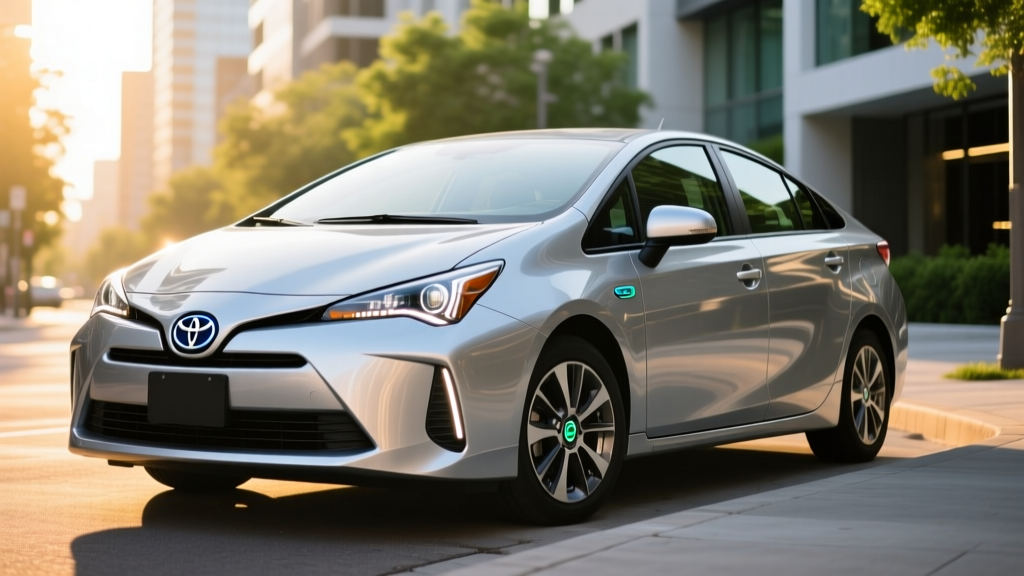
The fourth-generation Toyota Prius (model code XW50) debuted for the 2016 model year on the TNGA-C platform, bringing a more rigid chassis, independent rear suspension, and a noticeable bump in fuel economy over its predecessor. A decade later, the 2016 Toyota Prius hybrid remains one of the most common vehicles on the used-EV-adjacent market — and a benchmark for what a conventional hybrid (HEV) can deliver when range anxiety and charging infrastructure aren't part of the equation.
If you're cross-shopping this against a newer plug-in hybrid or a full battery-electric vehicle, this guide breaks down the exact numbers that matter: EPA and real-world MPG, battery longevity, replacement cost, and whether the 2016 Prius still makes financial sense in 2026.
HEV vs PHEV: What the 2016 Prius Actually Is
The 2016 Prius sold in the U.S. is a conventional hybrid electric vehicle (HEV). It does not plug in. It has no meaningful electric-only driving range. Its small nickel-metal hydride or lithium-ion traction battery (depending on trim) is recharged exclusively through regenerative braking and the gasoline engine.
This is a critical distinction from the Prius Prime, which launched as a 2017 model year PHEV with an 8.8 kWh battery and 25 miles of electric-only range. If a listing advertises a "2016 Prius plug-in," it's either mislabeled or refers to the outgoing second-generation Prius Plug-in (2012–2015), which carried over into early 2016 calendar-year sales in limited markets.
| Attribute | 2016 Prius (HEV) | 2017 Prius Prime (PHEV) |
|---|---|---|
| Plug-in capable | No | Yes (Level 1 / Level 2) |
| Traction battery | ~0.75 kWh (NiMH) or ~0.6 kWh (Li-ion, Eco trim) | 8.8 kWh (Li-ion) |
| Electric-only range | None (low-speed assist only) | 25 mi (EPA) |
| Combined MPG / MPGe | 52 MPG (Two) / 56 MPG (Two Eco) | 133 MPGe (EV mode) / 54 MPG (hybrid) |
| Federal tax credit (new) | None | $4,500 (expired) |
Fuel Economy: EPA Stickers vs Real-World MPG
The EPA rates the 2016 Prius across trims as follows, per fueleconomy.gov:
| Trim | City MPG | Highway MPG | Combined MPG | Est. Range (mi) |
|---|---|---|---|---|
| Two | 54 | 50 | 52 | ~590 |
| Two Eco | 58 | 53 | 56 | ~640 |
| Three / Four / Four Touring | 54 | 50 | 52 | ~590 |
The Two Eco trim achieves its higher rating through lighter 15-inch alloy wheels, lower rolling-resistance tires, and a weight reduction of roughly 60 lbs versus the base Two. The lithium-ion battery pack in the Eco trim is also marginally lighter than the NiMH pack in other trims.
Real-World MPG: What Owners Actually See
Conventional hybrids like the Prius tend to exceed EPA city estimates in stop-and-go driving because regenerative braking recaptures kinetic energy that a gas-only car wastes as heat. In warm-weather city driving, 60+ MPG is common among careful drivers.
Highway driving tells a different story. Above 70 mph, aerodynamic drag dominates and the gasoline engine carries the load without regen assistance. Expect 45–48 MPG at sustained 75 mph, and as low as 40–42 MPG in winter highway driving when cold temperatures reduce battery efficiency and increase engine idling for cabin heat.
Aggregated owner data from Fuelly and similar tracking platforms consistently shows lifetime averages in the 48–54 MPG range for mixed driving — right in line with or slightly above the EPA combined figure.
Powertrain and Performance Specifications
| Specification | Value |
|---|---|
| Engine | 1.8L 4-cylinder Atkinson-cycle (2ZR-FXE) |
| Engine horsepower | 96 HP @ 5,200 RPM |
| Electric motor output | 71 HP (53 kW) |
| Net combined system HP | 121 HP |
| Transmission | eCVT (planetary gearset, no belt) |
| 0–60 mph | ~10.5 seconds |
| Drivetrain | Front-wheel drive |
| Curb weight | 3,042–3,117 lbs (trim dependent) |
| Fuel tank | 11.4 gallons |
The 121 HP combined output places the 2016 Prius firmly in "adequate commuter" territory. The eCVT is Toyota's proven planetary gearset design — it has no belt, no cones, and no traditional shifting mechanism, which is a key reason for the model's exceptional transmission reliability record. Acceleration is leisurely by modern standards, but the low-end electric torque makes city driving feel responsive despite the 0–60 time.
Hybrid Battery: Health, Longevity, and Replacement Cost
The most common concern among used-hybrid buyers is traction battery failure. Here's the data-driven picture for the 2016 Prius:
Battery Warranty (Original)
10 years / 150,000 miles in CARB states (CA, CT, ME, MA, NJ, NY, OR, RI, VT, WA, and others adopting California emissions standards). 8 years / 100,000 miles in all other states. Coverage applies to capacity loss below a defined threshold and outright failure.
By 2026, a 2016 Prius is at or past the 10-year warranty mark. Most original battery warranties have expired unless the vehicle was purchased late in the model year in a CARB state and has under 150,000 miles.
Real-World Battery Degradation
Toyota's hybrid battery management system is conservative by design — it never charges the pack above ~80% state of charge or below ~40%, creating a large buffer that limits cycle wear. As a result, the NiMH and Li-ion packs in the 2016 Prius are known to last 150,000–200,000+ miles before significant capacity loss.
What "significant" means in practice: a degraded hybrid battery doesn't strand you. It reduces fuel economy (the engine runs more often to compensate) and may trigger a check-engine light with codes like P0A80 (replace hybrid battery). The car remains drivable, but MPG may drop to the mid-30s.
Battery Replacement Cost in 2026
- New OEM Toyota battery: $2,000–$2,500 (part only, before labor)
- Remanned/refurbished pack: $1,000–$1,500 from suppliers like Green Bean Battery or Dorman
- Individual module replacement: $200–$500 if only 1–2 of the 28 NiMH modules have failed (requires a knowledgeable hybrid shop)
- Full dealer-installed replacement: $2,500–$3,500 out the door
For a 2016 Prius with a market value of $10,000–$16,000 in 2026, a battery replacement is a meaningful but not catastrophic expense — especially compared to a transmission or engine replacement on a conventional vehicle.
Safety, Reliability, and Ownership Costs
The 2016 Prius earned the IIHS Top Safety Pick+ designation when equipped with Toyota Safety Sense P (TSS-P), which became standard on all trims. TSS-P includes pre-collision braking with pedestrian detection, lane departure alert with steering assist, automatic high beams, and full-speed-range adaptive cruise control — a remarkable ADAS suite for a 2016 compact car.
NHTSA awarded the 2016 Prius an overall 5-star safety rating, with 5 stars in side crash and 4 stars in frontal crash and rollover (NHTSA vehicle detail).
On reliability, the 2016 Prius consistently ranks at or near the top of J.D. Power and Consumer Reports dependability studies for the compact car segment. The eCVT, Atkinson-cycle engine, and hybrid battery system have been in continuous refinement since 1997. There are no widespread failure patterns beyond normal battery aging at high mileage.
Estimated Annual Ownership Costs (2026)
| Category | Estimated Cost |
|---|---|
| Fuel (52 MPG, $3.40/gal avg) | ~$785/year |
| Insurance (national avg) | ~$1,100–$1,400/year |
| Maintenance (oil, filters, brakes) | ~$350–$500/year |
| Total (excl. depreciation/repairs) | ~$2,235–$2,685/year |
For comparison, a 2016 non-hybrid compact sedan averaging 30 MPG combined would cost roughly $1,360/year in fuel at the same rate — making the Prius about $575 cheaper per year to fuel, or nearly $2,900 over five years.
Tax Credits and Incentives in 2026
The 2016 Prius HEV does not qualify for the federal §30D new clean vehicle tax credit (up to $7,500) or the §25E used clean vehicle credit (up to $4,000). Both credits apply only to plug-in vehicles — BEVs and PHEVs with sufficient battery capacity. A conventional hybrid, regardless of efficiency, is excluded under current IRS rules.
Some states and municipalities offer registration fee reductions, HOV lane access, or local utility rebates for hybrid vehicles, but these programs have largely shifted focus to plug-in vehicles. Check your state's energy office for current programs.
Who Should Buy a 2016 Prius in 2026?
Choose the 2016 Prius (HEV) if:
- You lack access to home or workplace charging (apartment, street parking, no 240V outlet)
- You drive 15,000+ miles/year and want to minimize fuel cost without behavioral change
- Your budget is $10,000–$16,000 and you want the lowest total cost of ownership in that range
- You prioritize proven reliability and low maintenance over acceleration or tech features
Choose a PHEV (e.g., 2017+ Prius Prime) if:
- You can charge at home and your daily commute is under 25–40 miles
- You want to drive mostly on electricity but need gas flexibility for road trips
- You're buying newer and can still capture remaining warranty coverage
Choose a full BEV (e.g., used Model 3, Bolt, Ioniq 5) if:
- You have reliable Level 2 home charging
- You want zero tailpipe emissions and the lowest per-mile energy cost (~$0.04/mi vs $0.07/mi for the Prius)
- You're eligible for the §25E used EV credit ($4,000 on vehicles under $25,000)
Pros and Cons at a Glance
Pros
- 52–56 MPG EPA combined; 60+ MPG achievable in city driving
- Standard Toyota Safety Sense P (AEB, ACC, lane assist) on all trims
- IIHS Top Safety Pick+ / NHTSA 5-star
- Proven hybrid system with 200K+ mile battery lifespan common
- No charging infrastructure dependency
- Low annual fuel cost (~$785/year at 12K miles)
Cons
- 10.5-second 0–60 — slow by 2026 standards
- No electric-only driving capability
- No federal tax credit eligibility (HEV exclusion)
- 2016 infotainment is dated: no Apple CarPlay/Android Auto on most trims
- Rear-seat headroom compromised by battery-pack packaging on some trims
- Battery warranty likely expired on most 2016 examples by 2026
Frequently Asked Questions
How many MPG does the 2016 Toyota Prius get?
The EPA rates the 2016 Prius Two at 54 city / 50 highway / 52 combined MPG, and the Two Eco trim at 58 city / 53 highway / 56 combined. Real-world mixed driving typically yields 48–54 MPG, with city driving sometimes exceeding 60 MPG and cold-weather highway driving dropping to 40–42 MPG.
Can I plug in the 2016 Prius to charge?
No. The 2016 Prius is a conventional hybrid (HEV), not a plug-in hybrid. Its traction battery charges exclusively through regenerative braking and the gasoline engine. If you want plug-in capability, look for a 2017 or newer Prius Prime.
How long does the 2016 Prius hybrid battery last?
Most 2016 Prius hybrid batteries last 150,000–200,000+ miles before significant degradation. Toyota's battery management system maintains a large state-of-charge buffer (never charging above ~80% or below ~40%) to minimize cycle wear. When failure does occur, the car remains drivable but with reduced fuel economy.
How much does it cost to replace a 2016 Prius hybrid battery?
A new OEM replacement runs $2,500–$3,500 installed at a dealer. Remanufactured packs cost $1,000–$1,500, and individual module replacement (if only a few cells fail) can be done for $200–$500 at a hybrid specialist shop.
Does the 2016 Prius qualify for any tax credit in 2026?
No. The federal §30D new vehicle credit and §25E used vehicle credit both require a plug-in vehicle (BEV or PHEV). The 2016 Prius HEV does not qualify. Some state or local programs may offer minor incentives, but these are increasingly rare for non-plug-in hybrids.
Is the 2016 Prius reliable at high mileage?
Yes. The 2016 Prius is among the most reliable vehicles in its class. The eCVT transmission has no belt or friction components that wear in a conventional transmission. The Atkinson-cycle engine operates under less thermal stress than a standard Otto-cycle engine. With regular oil changes, examples at 200,000+ miles are common and well-documented.
Hybrid vs PHEV vs EV — which is right for me?
If you can't charge at home, the HEV (like this 2016 Prius) is the lowest-risk choice. If you can charge at home and commute under 30 miles, a PHEV lets you drive mostly on electricity while keeping gas for road trips. If you have Level 2 home charging and want the lowest per-mile cost and zero tailpipe emissions, a full BEV is the answer — but verify your local charging infrastructure for road trips.