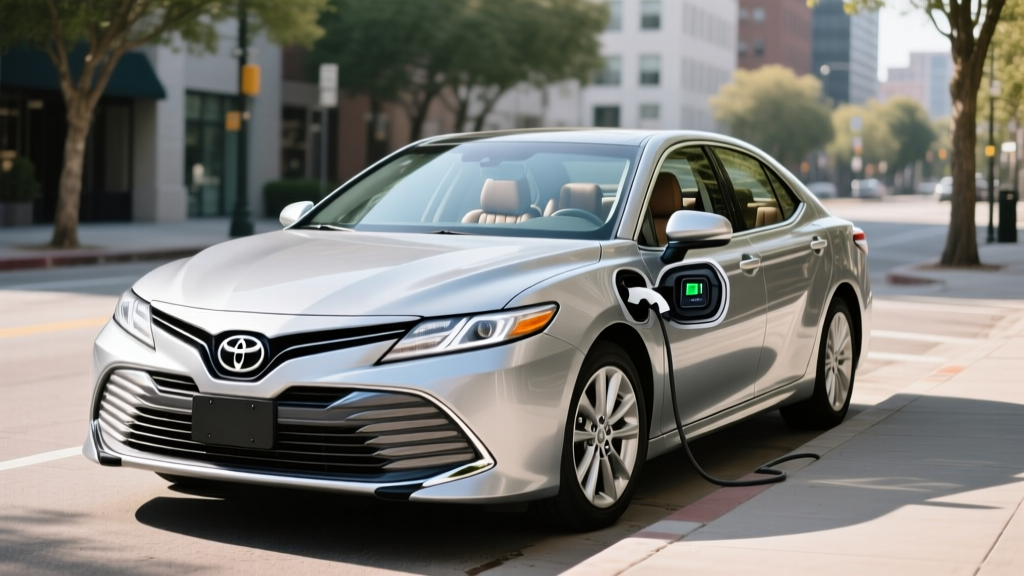
The 2016 Toyota Camry Hybrid XLE occupies a specific niche in the used-car market: a midsize sedan that sips fuel without requiring a plug, a charging routine, or any change in driving habits. A decade after its debut, it remains one of the most practical hybrid vehicles available on the pre-owned lot, particularly for buyers who want EV-adjacent efficiency without range anxiety or infrastructure dependence.
This guide breaks down the real-world fuel economy, powertrain specs, battery longevity, ownership costs, and how the 2016 Camry Hybrid XLE stacks up against plug-in hybrids and full battery-electric vehicles in 2026.
2016 Toyota Camry Hybrid XLE: Core Specifications
| Attribute | 2016 Camry Hybrid XLE |
|---|---|
| Powertrain Type | Conventional Hybrid (HEV) |
| Engine | 2.5L 4-cylinder Atkinson-cycle |
| Combined System Horsepower | 200 hp |
| Electric Motor | Permanent-magnet AC synchronous (integrated into transaxle) |
| Hybrid Battery | 1.6 kWh nickel-metal hydride (NiMH) |
| EPA Fuel Economy (City / Hwy / Combined) | 40 / 38 / 40 MPG |
| Fuel Tank Capacity | 17.0 gallons |
| Total Driving Range | ~680 miles |
| 0–60 mph | ~7.6 seconds |
| Plug-In Charging | Not required — self-charging via regenerative braking and engine |
| Original MSRP (2016) | $27,510 |
| Typical Used Price (2026) | $12,000–$17,500 depending on mileage and condition |
Fuel Economy: EPA Sticker vs. Real-World MPG
The EPA rates the 2016 Camry Hybrid XLE at 40 MPG city, 38 MPG highway, and 40 MPG combined. Those figures hold across the LE, SE, and XLE trims for the 2016 model year.
In practice, the Camry Hybrid tends to exceed its EPA city rating in stop-and-go traffic. The hybrid system recovers energy during braking and uses the electric motor for low-speed crawling, which is where gasoline engines are least efficient. Owners consistently report 42–45 MPG in urban driving. Highway driving at sustained 70–80 mph speeds typically yields 36–39 MPG, since the gasoline engine carries more of the load and aerodynamic drag increases.
| Driving Scenario | EPA Estimate | Real-World Expectation |
|---|---|---|
| City (stop-and-go, under 40 mph) | 40 MPG | 42–45 MPG |
| Highway (steady 70–80 mph) | 38 MPG | 36–39 MPG |
| Combined (mixed driving) | 40 MPG | 39–42 MPG |
| Cold weather (below 32°F, short trips) | — | 34–37 MPG |
Cold weather reduces fuel economy in any vehicle. In the Camry Hybrid, the engine runs more frequently in winter to provide cabin heat (since there's no resistive heater drawing from a large battery pack like in an EV), which drops efficiency by roughly 5–8 MPG on short trips. Once the engine and cabin are warm, the penalty diminishes.
HEV vs. PHEV vs. EV: Which Powertrain Fits You?
The 2016 Camry Hybrid is a conventional hybrid electric vehicle (HEV). It cannot be plugged in. Its small 1.6 kWh battery charges through regenerative braking and the gasoline engine. This is fundamentally different from a plug-in hybrid (PHEV) or a battery-electric vehicle (BEV).
| Feature | HEV (Camry Hybrid) | PHEV (e.g., Prius Prime) | BEV (e.g., Tesla Model 3) |
|---|---|---|---|
| Plugs in? | No | Yes | Yes |
| Electric-only range | ~1 mile at low speed | 25–44 miles (model dependent) | 250–360+ miles |
| Gasoline engine | Yes (primary) | Yes (backup) | No |
| Home charging needed | No | Recommended (Level 2) | Essential (Level 2) |
| Federal tax credit (§30D) | No | Yes (up to $7,500 if eligible) | Yes (up to $7,500 if eligible) |
| Best for | No garage/outlet access; high-mileage commuters | Short commutes + road trips; has home charging | Home charging access; mostly under 250 mi/day |
The Camry Hybrid XLE makes the most sense if you lack access to a garage or dedicated outlet for charging, drive long distances regularly, or simply want maximum simplicity. If you have home charging and a commute under 40 miles, a PHEV like the current Prius Prime can cover most daily driving on electricity alone while still offering a gasoline engine for road trips. A full BEV eliminates gasoline entirely but requires reliable charging access.
Powertrain Deep Dive: How the Hybrid System Works
The 2016 Camry Hybrid pairs a 2.5-liter Atkinson-cycle four-cylinder engine (156 hp, 156 lb-ft torque) with a permanent-magnet electric motor integrated into the transaxle. Combined system output is 200 horsepower. Toyota's Hybrid Synergy Drive uses a planetary gearset — not a traditional transmission — to seamlessly blend power from the engine and motor.
The XLE trim adds features that slightly affect efficiency compared to the LE: standard leather-trimmed seats, dual-zone automatic climate control, a 7-inch touchscreen with navigation, heated front seats, and a smart key system. Despite the added weight and electrical load, the XLE carries the same EPA rating as the LE.
Acceleration to 60 mph takes approximately 7.6 seconds — adequate for highway merging and passing but not sporty. The transition between electric-only and gasoline power is nearly imperceptible in normal driving, which was a significant achievement for Toyota's third-generation hybrid system.
Battery Longevity, Warranty, and Replacement Cost
Original Hybrid Battery Warranty: 8 years / 100,000 miles (10 years / 150,000 miles in California and states adopting CARB emissions standards).
Battery Chemistry: Nickel-metal hydride (NiMH) — proven, durable, less energy-dense than lithium-ion but highly tolerant of temperature extremes and deep cycling.
2026 Status: The original warranty has expired for virtually all 2016 Camry Hybrids. Battery replacement is an out-of-pocket expense unless covered by an extended warranty.
The NiMH battery in the 2016 Camry Hybrid has demonstrated exceptional longevity. Data from fleet operators and owner surveys indicates that the majority of these batteries last 150,000–200,000 miles before significant capacity loss. Unlike lithium-ion packs in EVs, NiMH batteries degrade gradually rather than suffering sudden capacity cliffs.
If replacement becomes necessary, here's what to expect:
- New OEM battery (Toyota dealer): $2,500–$3,500 installed
- Refurbished/remanufactured battery: $1,200–$2,000 installed
- Individual cell/module replacement (specialist shop): $500–$1,000 if only specific modules have failed
Many independent hybrid specialists can diagnose and replace individual bad modules rather than the entire pack, which significantly reduces cost. The battery is located behind the rear seat and does not intrude on trunk space in the 2016 model year.
Tax Credits and Incentives
The 2016 Toyota Camry Hybrid XLE does not qualify for the federal §30D clean vehicle tax credit. That credit applies only to plug-in electric vehicles (BEVs and PHEVs) with battery packs of at least 7 kWh. The Camry Hybrid's 1.6 kWh NiMH pack falls well below that threshold.
On the used market, the IRS used clean vehicle credit (§25E) also does not apply, as it is limited to plug-in vehicles with a minimum 7 kWh battery and a sale price of $25,000 or less. Conventional hybrids have never been eligible for federal purchase incentives.
Some states previously offered hybrid-specific rebates or HOV lane access, but most of these programs have sunsetted or shifted exclusively to plug-in vehicles. Check your state's current incentive database for any remaining programs.
Reliability and Ownership Costs in 2026
The 2016 Camry Hybrid benefits from Toyota's long-standing reliability reputation and the inherent simplicity of its hybrid system. There is no traditional starter motor, no alternator, and no conventional automatic transmission — all common failure points in gasoline cars. The planetary gearset in the hybrid transaxle has no clutch packs or bands to wear out.
Regenerative braking also reduces wear on the friction brakes. It's common for Camry Hybrid owners to reach 80,000–100,000 miles on original brake pads.
Insurance costs for the 2016 Camry Hybrid XLE are generally in line with the gasoline Camry, averaging $1,200–$1,500 annually depending on driver profile and location. There is no EV-specific insurance premium as there can be with battery-electric vehicles.
Pros
- 40+ MPG real-world in city driving with no plug-in requirement
- Proven NiMH battery with 150k–200k+ mile lifespan
- No range anxiety — 680-mile total range on one tank
- Low maintenance: no starter, alternator, or traditional transmission
- Comfortable XLE ride with leather, heated seats, and dual-zone climate
- Strong resale value relative to non-hybrid competitors
Cons
- No electric-only driving beyond parking-lot speeds
- Not eligible for any federal tax credit (new or used)
- CVT-like driving feel lacks engagement for enthusiasts
- Infotainment system dated by 2026 standards (no Apple CarPlay/Android Auto)
- Battery replacement cost ($1,200–$3,500) falls on owner post-warranty
- Highway MPG drops below EPA estimate at sustained high speeds
Who Should Buy the 2016 Camry Hybrid XLE?
This car is the right choice if you:
- Drive 15,000+ miles per year and want to minimize fuel costs without changing your routine
- Live in an apartment or lack access to a dedicated parking spot with an electrical outlet
- Want a comfortable, well-equipped midsize sedan with low running costs
- Are risk-averse about battery technology — the NiMH pack is as proven as it gets
- Need a reliable daily driver in the $12,000–$17,500 range
Look elsewhere if you:
- Have home charging and want electric-only commuting (consider a used Prius Prime or a BEV)
- Want modern infotainment with smartphone integration (the 2016 Camry predates Apple CarPlay)
- Prioritize acceleration and handling over fuel economy
Frequently Asked Questions
How many MPG does the 2016 Toyota Camry Hybrid XLE get?
The EPA rates it at 40 MPG city, 38 MPG highway, and 40 MPG combined. In real-world driving, owners typically see 42–45 MPG in city traffic and 36–39 MPG on the highway, with a combined average around 39–42 MPG.
Does the 2016 Camry Hybrid need to be plugged in?
No. It is a conventional hybrid (HEV), not a plug-in hybrid. The battery charges through regenerative braking and the gasoline engine. You fuel it like any other car — just less often.
How long does the hybrid battery last?
The NiMH battery typically lasts 150,000–200,000 miles before significant degradation. Many original batteries in 2016 Camry Hybrids are still in service. If replacement is needed, expect $1,200–$3,500 depending on whether you choose refurbished or new OEM.
Is the 2016 Camry Hybrid reliable?
Yes. The hybrid system eliminates several common failure points (starter, alternator, traditional transmission). The planetary gearset is extremely durable. NHTSA records show no systemic powertrain issues specific to the hybrid variant.
Does it qualify for any tax credit?
No. The federal §30D credit applies only to plug-in vehicles (BEVs and PHEVs) with at least 7 kWh of battery capacity. The Camry Hybrid's 1.6 kWh pack does not qualify for any federal purchase incentive, new or used.
How does it compare to a used Tesla Model 3 or Chevy Bolt?
A used BEV offers lower per-mile energy costs and zero tailpipe emissions but requires reliable home or workplace charging. The Camry Hybrid has no charging requirement, a longer total range (~680 miles vs. 250–310 for most BEVs), and lower upfront cost on the used market. Choose the Camry Hybrid if charging access is uncertain; choose a BEV if you can charge at home and want to eliminate gasoline entirely.