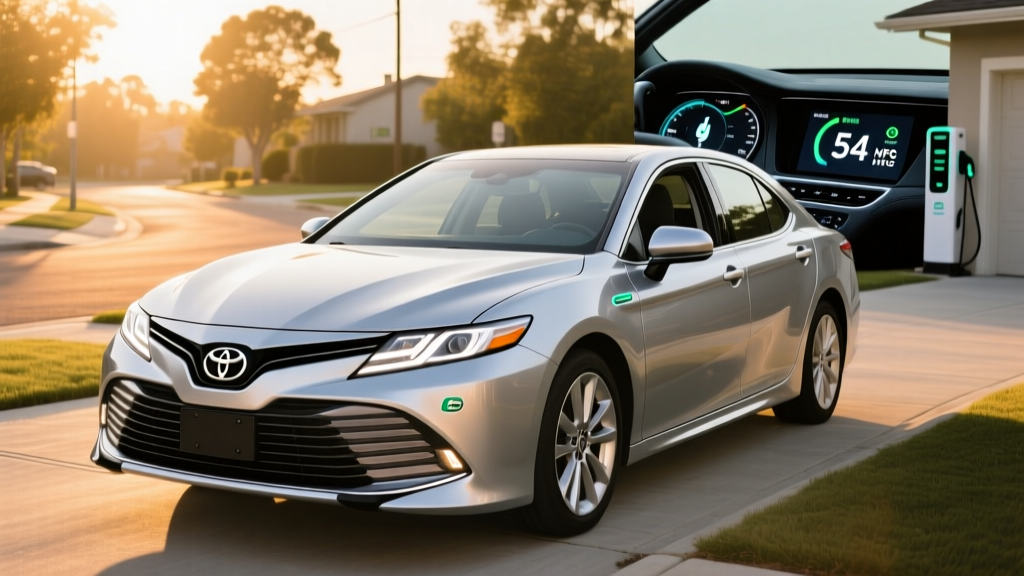
Quick Verdict: The 2016 Camry Hybrid a Decade Later
The 2016 Toyota Camry Hybrid remains one of the most sensible used midsize sedans on the market for drivers who want electrified efficiency without plugging in. A decade after its launch, this conventional hybrid (HEV) still posts impressive real-world fuel economy, carries Toyota's legendary reliability reputation, and avoids the range anxiety and charging infrastructure dependencies of a full battery-electric vehicle. If you're shopping the used market and searching for a 2016 Toyota Camry Hybrid, this guide covers every number you need — from EPA MPG to battery replacement cost.
Fuel Economy: EPA Ratings and Real-World MPG
| Metric | LE Trim | SE / XLE Trim |
|---|---|---|
| City MPG | 42 | 40 |
| Highway MPG | 38 | 38 |
| Combined MPG | 41 | 40 |
| Fuel Tank | 17.2 gal | 17.2 gal |
| Total Range (est.) | ~705 mi | ~688 mi |
Source: EPA Fuel Economy Guide
How many MPG does the 2016 Camry Hybrid actually get? The LE trim is rated at 42 city / 38 highway / 41 combined. The slightly heavier SE and XLE trims drop to 40/38/40. The LE's higher city figure comes from low-rolling-resistance tires and lighter equipment.
Real-world MPG vs. EPA: Toyota's Hybrid Synergy Drive excels in stop-and-go traffic where regenerative braking recovers energy constantly. Many owners report exceeding the EPA city rating — 43-47 MPG is common in urban driving. Highway driving at 75+ mph, however, typically drops to 34-37 MPG because the electric motor contributes less at sustained high speed and aerodynamic drag dominates. In cold weather (below 30°F), expect a 5-10% reduction as the engine runs more frequently to provide cabin heat and warm up the catalytic converter.
Powertrain Specs: Engine, Motor, and Combined Output
| Component | Specification |
|---|---|
| Engine | 2.5L inline-4, Atkinson cycle |
| Engine Power | 156 hp @ 5,700 rpm |
| Engine Torque | 156 lb-ft @ 4,500 rpm |
| Electric Motor | Permanent-magnet AC synchronous |
| Motor Power | 105 kW (141 hp) |
| Net Combined System Power | 200 hp |
| Transmission | eCVT (planetary gearset) |
| Drivetrain | Front-wheel drive |
| 0-60 mph | ~7.6 seconds |
| Hybrid Battery | 1.6 kWh NiMH (sealed) |
The 200 hp combined output places the 2016 Camry Hybrid ahead of the gas-only 2.5L four-cylinder Camry (178 hp) and close to the V6 (268 hp). The eCVT is not a belt-driven CVT — it uses a planetary gearset that blends engine and motor power with no fixed gear ratios, resulting in smooth, linear acceleration with none of the rubber-band feel associated with Nissan's older CVTs.
The 1.6 kWh nickel-metal hydride (NiMH) battery is small by modern standards — by design. Toyota's hybrid system uses the battery as a buffer, constantly cycling small charges and discharges rather than deep-cycling. This shallow-cycle strategy is the primary reason Toyota hybrid batteries routinely last 150,000-200,000+ miles.
Hybrid Battery Warranty, Lifespan, and Replacement Cost
Is the 2016 Camry Hybrid reliable, and what does battery replacement cost? The 2016 Camry Hybrid scores highly in long-term reliability. Toyota's hybrid system is among the most proven in the industry, with over two decades of Prius data supporting its durability. The hybrid battery (NiMH) in the XV50-generation Camry Hybrid has a strong track record — failure before 150,000 miles is uncommon when the vehicle is driven regularly.
If the hybrid battery does fail out of warranty, here is what replacement costs look like in 2026:
- New OEM battery (Toyota dealer): $2,500–$3,500 installed
- Refurbished/remanufactured battery: $1,200–$2,000 installed
- Individual module replacement (independent hybrid specialist): $400–$800 — only the failed cells are swapped
Many independent hybrid shops now offer module-level repair, replacing only the weak cells rather than the entire pack. This is a cost-effective option for a 10-year-old vehicle. A NHTSA search shows no major battery-related recalls for the 2016 Camry Hybrid.
HEV vs PHEV vs EV: Which Powertrain Fits You?
Shopping a 10-year-old hybrid means weighing it against newer PHEVs and EVs on the used market. Here is how the 2016 Camry Hybrid stacks up against the alternatives:
| Factor | HEV (2016 Camry Hybrid) | PHEV (e.g., Prius Prime) | BEV (e.g., Model 3, Bolt) |
|---|---|---|---|
| Plug in required? | No | Yes (for EV range) | Yes (always) |
| Electric-only range | ~1 mi (low-speed creep) | 25–44 mi | 200–350+ mi |
| Home charging needed? | No | Recommended (120V OK) | Yes (Level 2 ideal) |
| Fuel cost per mile (avg) | ~$0.08–0.10 | ~$0.04–0.08 | ~$0.03–0.05 |
| Road trip ease | Gas station, 5 min | Gas station, 5 min | DC fast charge, 20-40 min |
| Used price range (2026) | $11,000–$17,000 | $18,000–$28,000 | $14,000–$25,000 |
Choose the 2016 Camry Hybrid if: you lack access to home charging (apartment, street parking), you drive a mix of city and highway miles, you want the lowest purchase price for an efficient car, and you don't want to think about charging logistics.
Choose a PHEV if: you can charge at home overnight, your daily commute is under 30 miles round-trip (covering most days on electricity alone), but you still want gas-engine flexibility for road trips.
Choose a full EV if: you have reliable home Level 2 charging, your daily driving is predictable, you want the lowest per-mile energy cost, and you're willing to plan longer road trips around DC fast-charging stops.
Tax Credits and Incentives for a Used 2016 Camry Hybrid
Does the 2016 Toyota Camry Hybrid qualify for any tax credit? As a conventional hybrid (HEV), the 2016 Camry Hybrid does not qualify for the federal §30D clean vehicle credit — that credit applies only to plug-in vehicles (PHEVs and BEVs) with a minimum battery capacity of 7 kWh. The Camry Hybrid's 1.6 kWh NiMH pack falls well short of that threshold, and the vehicle was never eligible for the plug-in credit even when new.
The used EV credit (§25E), which offers up to $4,000 on pre-owned plug-in vehicles priced under $25,000, also does not apply — again, because the Camry Hybrid is not a plug-in vehicle. The IRS maintains a list of qualifying vehicles at irs.gov.
Some states historically offered small rebates for conventional hybrids, but most of these programs have ended or shifted focus to PHEVs and BEVs. Check your state's current energy office or DMV website for any remaining hybrid incentives, but expect none at the federal level.
What to Inspect When Buying a Used 2016 Camry Hybrid
At 10 years old, most 2016 Camry Hybrids on the used market have between 80,000 and 150,000 miles. Here is what matters most:
- Hybrid battery health check: Ask a Toyota dealer or hybrid specialist to run a battery health diagnostic. This checks individual module voltage variance — a spread greater than 0.3V between modules signals aging cells.
- Hybrid system cooling fan: Located behind the rear seat, this fan keeps the battery cool. Listen for unusual noise or check for dust buildup in the vent, which can cause battery overheating and accelerated degradation.
- Brake actuator: Toyota's regenerative braking system uses an electronic brake actuator. Listen for unusual clicking or delayed brake response at low speeds — replacement runs $800–$1,200.
- 12V auxiliary battery: Like any car, the 12V battery (located in the trunk on the Camry Hybrid) typically needs replacement every 4-5 years. A weak 12V battery can cause hybrid system error codes.
- Service records: Regular oil changes (every 5,000-10,000 miles with 0W-20 synthetic) and inverter coolant checks are essential. The inverter coolant should be replaced at 100,000 miles per Toyota's schedule.
Pros and Cons of the 2016 Camry Hybrid in 2026
Pros
- 41 MPG combined EPA; often exceeds 43 MPG in real city driving
- 200 hp — more responsive than the gas-only 4-cylinder Camry
- No plug-in required — works anywhere gas is available
- Proven NiMH hybrid battery with 150K+ mile track record
- Spacious trunk (13.1 cu ft) — battery is packaged under rear seat
- Low annual fuel cost: ~$1,050/year at 15K mi and $3.20/gal
- Strong resale value relative to non-hybrid competitors
Cons
- No electric-only driving beyond low-speed parking-lot creep
- Not eligible for any federal tax credit (new or used)
- Outdated infotainment by 2026 standards (no Apple CarPlay/Android Auto)
- Highway MPG drops to 34-37 at 75+ mph
- NiMH battery is heavier and less energy-dense than modern Li-ion
- FWD only — no AWD option (available on 2020+ Camry Hybrid)
- Original hybrid battery warranty has expired on all examples
Frequently Asked Questions
How many MPG does the 2016 Toyota Camry Hybrid get in real driving?
The EPA rates the LE trim at 42 city / 38 highway / 41 combined. In real-world driving, owners commonly see 43-47 MPG in city traffic thanks to aggressive regenerative braking. Highway driving at 75+ mph typically yields 34-37 MPG. Cold weather (below 30°F) reduces efficiency by 5-10% as the engine runs longer for cabin heat.
Can I drive the 2016 Camry Hybrid on electric power only?
Only at very low speeds (under ~25 mph) for roughly one mile under light load, such as creeping through a parking lot. The 1.6 kWh NiMH battery is too small for meaningful electric-only driving. This is by design — the hybrid system uses the battery as a buffer to assist the engine and capture regenerative energy, not as a primary power source.
How long does the 2016 Camry Hybrid battery last?
Toyota's NiMH hybrid batteries in this generation routinely last 150,000 to 200,000 miles. Some taxi-fleet Camry Hybrids have exceeded 300,000 miles on the original battery. Key longevity factors: drive the car regularly (prolonged sitting degrades NiMH cells), keep the battery cooling fan vent clean, and avoid letting the car sit with a very low state of charge for weeks.
What does it cost to replace the hybrid battery?
A new OEM battery from a Toyota dealer runs $2,500–$3,500 installed. Refurbished packs cost $1,200–$2,000. Module-level repair at a hybrid specialist (replacing only the failed cells) costs $400–$800. For a 10-year-old vehicle, refurbished or module repair is the most cost-effective path.
Does the 2016 Camry Hybrid qualify for any tax credits?
No. The federal §30D new clean vehicle credit and §25E used clean vehicle credit both require plug-in vehicles with a minimum battery capacity. The Camry Hybrid is a conventional hybrid (HEV) with a 1.6 kWh battery and no plug-in capability. It does not qualify for federal EV tax credits. Check your state energy office for any remaining local hybrid incentives, though most have shifted to plug-in vehicles.
Is the 2016 Camry Hybrid better than a used EV like the Chevy Bolt?
It depends on your charging situation. If you have home Level 2 charging and a predictable commute, a used Bolt (238 mi EPA range) will cost less per mile to operate and qualify for the $4,000 used EV credit. If you live in an apartment without charging access, frequently take road trips, or live in an area with sparse public charging infrastructure, the Camry Hybrid's go-anywhere convenience and 41 MPG make it the lower-risk choice.