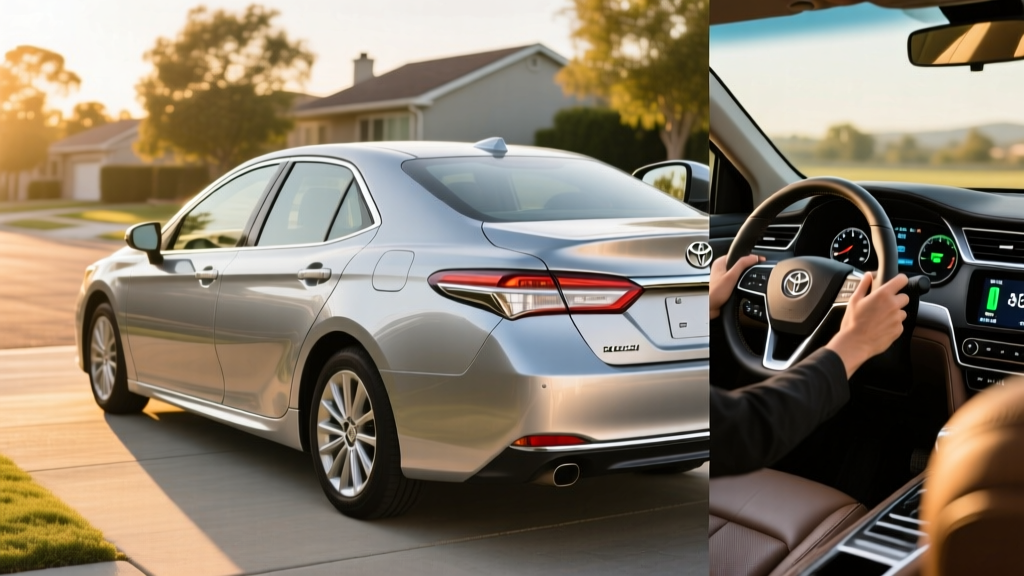
The 2016 Toyota Camry Hybrid LE sedan remains one of the most pragmatic midsize hybrid purchases on the used market in 2026. With an EPA-rated 40 MPG combined, a proven nickel-metal hydride (NiMH) battery pack, and Toyota's decade-long track record of hybrid durability, this generation appeals to buyers who want electrified efficiency without plug-in complexity or range anxiety. Below, we break down every number that matters — from real-world fuel economy to battery replacement cost — so you can decide if this HEV fits your commute.
HEV vs PHEV: Where the Camry Hybrid Fits
Before evaluating specs, it is critical to understand what the 2016 Camry Hybrid is — and what it is not.
Conventional Hybrid (HEV) — 2016 Camry Hybrid LE
- No plug required. The battery recharges through regenerative braking and the gasoline engine.
- No electric-only range to speak of — the 1.6 kWh NiMH pack assists the engine at low speeds but cannot propel the car on electricity alone for meaningful distances.
- Refuels exclusively at gas stations, like a conventional car.
Plug-In Hybrid (PHEV) — e.g., Toyota Prius Prime, RAV4 Prime
- Plugs in to a standard 120V outlet or Level 2 (240V) charger.
- Electric-only range of 25–42 miles depending on model, before the gas engine engages.
- Larger battery (typically 8–18 kWh) and higher upfront cost.
The 2016 Camry Hybrid LE is a conventional series-parallel HEV. It never needs to be plugged in and has no meaningful electric-only mode. If you want plug-in capability from Toyota in a similar package, the Prius Prime (PHEV) is the adjacent option — but the Camry Hybrid prioritizes interior space and highway comfort over electric-only commuting.
Fuel Economy: EPA Ratings and Real-World MPG
The 2016 Camry Hybrid LE carries distinct EPA ratings from the SE and XLE trims due to lighter weight and lower rolling-resistance tires on the LE.
| Trim | City MPG | Highway MPG | Combined MPG |
|---|---|---|---|
| LE (this review) | 42 | 38 | 40 |
| SE / XLE | 40 | 37 | 38 |
Source: fueleconomy.gov
Real-World MPG: What Owners Actually See
Toyota's Hybrid Synergy Drive excels in stop-and-go traffic where regenerative braking recaptures energy frequently. In real-world driving:
- City-heavy commutes: Many owners report 41–45 MPG, occasionally exceeding the EPA city rating. Short trips with frequent stops maximize regen contribution.
- Highway-dominant driving (70+ mph): Expect 35–38 MPG. At sustained high speeds, the 2.5-liter Atkinson-cycle engine does most of the work with less electric assist.
- Cold weather (below 32°F): MPG drops 5–10% as the engine runs longer to heat the cabin and bring the catalytic converter to operating temperature. Expect 36–38 MPG combined in winter conditions.
- Mixed driving (50/50 city-highway): 38–41 MPG is typical, aligning closely with the 40 MPG EPA combined figure.
For a midsize sedan carrying five passengers and 15.4 cubic feet of trunk space, these numbers remain competitive even against 2026 hybrid offerings.
Powertrain Specs: Engine, Motor, and Combined Output
| Specification | 2016 Camry Hybrid LE |
|---|---|
| Engine | 2.5L 4-cylinder Atkinson-cycle |
| Engine Power | 156 hp @ 5,700 rpm / 156 lb-ft torque |
| Electric Motor | Permanent-magnet synchronous AC motor |
| Motor Power | 105 kW (141 hp) |
| Combined Net Horsepower | 200 hp |
| Transmission | Electronically controlled CVT (eCVT) |
| Drivetrain | Front-wheel drive |
| 0–60 mph | ~7.6 seconds |
| Curb Weight | ~3,470 lbs |
| Fuel Tank | 17.2 gallons |
| Total Range (est.) | ~688 miles (at 40 MPG combined) |
The combined 200 hp output is adequate for highway merging and passing. The eCVT is not a belt-driven CVT — it uses a planetary gearset to blend engine and motor power, which eliminates the rubber-band feel associated with conventional CVTs and contributes to Toyota's reliability reputation.
Battery Pack: Chemistry, Capacity, and Longevity
2016 Camry Hybrid Battery Specifications
- Chemistry: Nickel-Metal Hydride (NiMH)
- Capacity: 1.6 kWh (gross) — smaller than PHEV packs, as it buffers energy rather than storing it for electric-only driving
- Location: Behind the rear seat (reduces trunk space slightly vs. gas Camry)
- Original Warranty: 8 years / 100,000 miles (10 years / 150,000 miles in CARB states including CA, NY, MA, and others)
Battery Degradation and Replacement Cost
The NiMH pack in the 2016 Camry Hybrid is one of the most proven hybrid batteries on the road. Unlike the lithium-ion packs in PHEVs and BEVs, NiMH chemistry degrades more gradually and is less sensitive to temperature extremes.
- Typical lifespan: 150,000–200,000+ miles before significant capacity loss. Many first-generation Prius batteries exceeded 200,000 miles.
- Degradation symptoms: Reduced fuel economy (2–4 MPG drop), more frequent engine cycling, and eventually a hybrid system warning light.
- Replacement cost (2026):
- New OEM Toyota battery: $2,500–$3,500 installed at a dealership
- Refurbished/remanufactured battery: $1,200–$2,000 installed at an independent hybrid specialist
- Individual cell replacement (if only a few modules fail): $500–$1,000 at a specialist shop
- Warranty status in 2026: The original 8-year/100,000-mile warranty has expired for virtually all 2016 models. CARB-state 10-year/150,000-mile coverage may still apply to low-mileage examples — verify with a Toyota dealer using the VIN.
When evaluating a used 2016 Camry Hybrid, request a hybrid battery health check via Toyota's Techstream diagnostic tool or an independent hybrid shop. This reports individual module voltages and internal resistance — the most reliable predictor of remaining battery life.
Pricing: What a 2016 Camry Hybrid LE Costs in 2026
The 2016 Camry Hybrid LE had an original MSRP of approximately $27,510 (including destination). In the 2026 used market:
- Private-party sale: $12,000–$16,000 depending on mileage (80,000–130,000 miles typical for a 10-year-old daily driver)
- Dealer retail: $14,000–$18,500 for certified or low-mileage examples
- High-mileage (150,000+ miles): $9,000–$12,000 — viable if the hybrid battery has been replaced or tests healthy
Tax Credit Eligibility
The 2016 Camry Hybrid LE does not qualify for the federal §30D new clean vehicle credit — it is a conventional HEV, not a PHEV or BEV, and the vehicle is no longer new. Under current IRS rules, the §30D credit applies only to new plug-in vehicles meeting battery-sourcing, MSRP, and buyer-income requirements.
The used clean vehicle credit (§25E, up to $4,000 or 30% of sale price) also requires a plug-in electric vehicle (PHEV or BEV) with a minimum 7 kWh battery. The Camry Hybrid's 1.6 kWh NiMH pack does not qualify.
Bottom line: no federal tax credits apply. Check your state's energy office for any local hybrid incentives, though most have shifted focus to plug-in vehicles.
Hybrid vs PHEV vs EV: Which Powertrain Fits You?
Choose the 2016 Camry Hybrid LE (HEV) if:
- You lack access to home or workplace charging (apartment, street parking, no garage)
- Your budget is under $18,000 and you want proven reliability
- You drive a mix of city and highway miles and want 40 MPG without behavioral changes
- You want a midsize sedan with a full trunk (no large battery eating cargo space)
Choose a PHEV (e.g., Prius Prime, RAV4 Prime) if:
- You can charge at home (even a standard 120V outlet adds ~4 miles/hour)
- Your daily commute is under 40 miles round-trip and you want electric-only driving most days
- You want to reduce gasoline consumption by 60–80% while keeping a gas engine for road trips
Choose a full BEV (e.g., Tesla Model 3, Hyundai Ioniq 6) if:
- You have reliable Level 2 home charging and access to DC fast charging for road trips
- You want zero tailpipe emissions and the lowest per-mile energy cost
- You are eligible for the §30D federal tax credit (up to $7,500) on a new EV purchase
Ownership Costs: Fuel, Maintenance, and Insurance
At 40 MPG combined and a national average gas price of ~$3.20/gallon (early 2026), the Camry Hybrid LE costs approximately $0.08 per mile in fuel. Compare that to:
- A 2016 Camry gas 4-cylinder (28 MPG combined): ~$0.114/mile
- A 2026 BEV charging at $0.13/kWh and 3.5 miles/kWh: ~$0.037/mile
The hybrid saves roughly $340/year in fuel versus the gas Camry at 12,000 miles/year. Maintenance costs are modest — the eCVT has no belts or clutch packs to replace, and regenerative braking extends pad life (50,000–70,000 miles between brake jobs is common). Oil changes use 0W-20 synthetic at 10,000-mile intervals.
Insurance premiums for the 2016 Camry Hybrid LE are comparable to the gas model — typically $1,200–$1,600/year depending on driver profile and state. No EV-specific surcharge applies.
Pros and Cons at a Glance
Pros
- 40 MPG combined — still competitive with 2026 midsize hybrids
- Proven NiMH battery with 200,000+ mile lifespan potential
- No plug-in infrastructure required — ideal for renters and street parkers
- Spacious cabin with 15.4 cu ft trunk (only slightly reduced vs gas model)
- Strong reliability record; low cost of ownership
- Comfortable ride quality for long highway commutes
Cons
- No electric-only driving mode — always uses gasoline
- No federal or state tax credit eligibility
- Hybrid battery warranty has expired on most examples
- Infotainment system is dated (no Apple CarPlay/Android Auto in 2016)
- NiMH battery is heavier and less energy-dense than modern Li-ion packs
- Trunk pass-through is narrower due to battery placement
Frequently Asked Questions
How many MPG does the 2016 Toyota Camry Hybrid LE get?
The EPA rates it at 42 city / 38 highway / 40 combined. Real-world city driving often yields 41–45 MPG, while sustained highway driving at 70+ mph returns 35–38 MPG.
Does the 2016 Camry Hybrid need to be plugged in?
No. It is a conventional hybrid (HEV). The 1.6 kWh NiMH battery charges through regenerative braking and the gasoline engine. There is no plug and no electric-only driving range.
How far can the 2016 Camry Hybrid go on electric only?
Effectively zero miles. The battery assists the engine during acceleration and low-speed maneuvers, but it cannot propel the car on electricity alone for any meaningful distance. For electric-only capability, you need a PHEV like the Prius Prime (25–42 miles electric-only) or a full BEV.
Is the 2016 Camry Hybrid reliable, and what does a battery replacement cost?
Yes — Toyota's Hybrid Synergy Drive is among the most reliable powertrains ever produced. The NiMH battery typically lasts 150,000–200,000+ miles. A new OEM replacement costs $2,500–$3,500 installed; refurbished options run $1,200–$2,000. The eCVT planetary gearset has no wear items like belts or clutches.
Does the 2016 Camry Hybrid qualify for any tax credit?
No. The federal §30D new vehicle credit and §25E used vehicle credit both require a plug-in vehicle (PHEV or BEV) with a minimum battery capacity. The Camry Hybrid's 1.6 kWh NiMH pack and HEV configuration do not qualify. No federal incentives apply to conventional hybrids purchased new or used.
What should I check before buying a used 2016 Camry Hybrid?
Prioritize a hybrid battery health check (individual module voltage and resistance readings via Techstream or equivalent), verify maintenance records for regular oil changes, and inspect brake pad thickness (regen extends pad life, so uneven wear may indicate a caliper issue). Also confirm whether the car was originally sold in a CARB state, which extended the hybrid battery warranty to 10 years/150,000 miles.
How does the Camry Hybrid compare to a 2026 hybrid like the new Camry or Accord Hybrid?
The 2026 Toyota Camry Hybrid (all trims now hybrid-only) achieves 44–51 MPG combined thanks to a fifth-generation hybrid system with a lithium-ion battery. The 2026 Honda Accord Hybrid returns 44–48 MPG combined. However, a used 2016 Camry Hybrid LE at $12,000–$16,000 delivers 80–90% of the efficiency at roughly 40% of the cost of a new model, making it a strong value proposition for budget-conscious buyers.