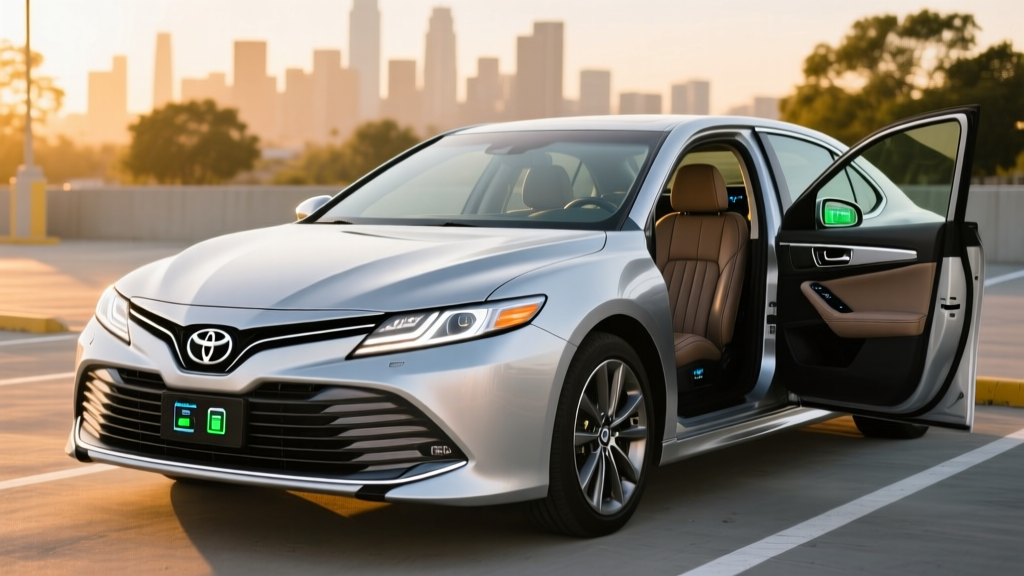
The 2016 Toyota Camry Hybrid LE remains one of the most dependable midsize hybrid sedans on the used market. With an EPA-rated 40 MPG combined and Toyota's proven Hybrid Synergy Drive powertrain, it delivers consistent fuel savings without requiring a plug, a charging routine, or any behavioral change from the driver. For buyers in 2026 weighing a used hybrid against a new EV or a conventional gas car, the Camry Hybrid LE offers a compelling middle ground: proven reliability, low running costs, and zero range anxiety.
This guide covers everything a used-car buyer needs to know — from exact EPA fuel economy figures and real-world MPG expectations, to the hybrid battery's longevity, warranty status in 2026, and replacement costs. We'll also clarify how this conventional hybrid (HEV) differs from a plug-in hybrid (PHEV) or a full battery-electric vehicle (BEV), and whether any tax credits apply.
Fuel Economy: EPA Ratings and Real-World MPG
| Driving Cycle | EPA Rating | Real-World Expectation |
|---|---|---|
| City | 42 MPG | 40–44 MPG (hybrids excel in stop-and-go) |
| Highway | 38 MPG | 35–38 MPG (aerodynamic drag reduces regen benefit) |
| Combined | 40 MPG | 37–42 MPG depending on driving mix |
Source: EPA Fuel Economy Guide — 2016 Toyota Camry Hybrid LE.
The 2016 Camry Hybrid LE's 40 MPG combined is a standout figure, especially because conventional hybrids like this one tend to exceed their EPA city rating in real-world stop-and-go driving. Regenerative braking recaptures energy that a gas car wastes as heat, and the electric motor handles low-speed propulsion where internal combustion engines are least efficient. On the highway, however, the hybrid advantage narrows — the gasoline engine does most of the work at sustained speeds, and aerodynamic drag dominates.
Owners who drive mostly in urban or suburban conditions frequently report 42–45 MPG in warm weather. In cold climates (below 30°F), expect a 5–10% reduction as the engine runs more often to maintain cabin heat and battery temperature. This is far less severe than the 20–30% range loss a full EV experiences in winter, because the Camry Hybrid's gasoline engine generates waste heat that warms the cabin essentially for free.
Powertrain: How the Hybrid Synergy Drive Works
| Specification | 2016 Camry Hybrid LE |
|---|---|
| Gasoline Engine | 2.5L 4-cylinder Atkinson-cycle (156 hp, 156 lb-ft) |
| Electric Motor | Permanent-magnet synchronous (105 kW / 141 hp) |
| Net Combined Horsepower | 200 hp |
| Transmission | eCVT (planetary gearset, no fixed gears) |
| Hybrid Battery | 1.6 kWh nickel-metal hydride (NiMH) |
| Drivetrain | Front-wheel drive |
| 0–60 mph | ~7.6 seconds |
The 2016 Camry Hybrid LE pairs a 2.5-liter Atkinson-cycle four-cylinder engine with an electric motor through Toyota's eCVT — a planetary gearset that seamlessly blends power from both sources. There are no traditional gear shifts. The result is smooth, linear acceleration and an EPA-rated 200 net horsepower, which is adequate for highway merging and passing.
The 1.6 kWh NiMH battery pack is small by modern standards — a PHEV typically carries 12–20 kWh, and a full EV 60–100 kWh — but that's by design. A conventional hybrid's battery doesn't need to store miles of electric-only range; it simply buffers energy captured from regenerative braking and assists the gas engine during acceleration. This smaller battery also means lower replacement cost and less weight penalty.
HEV vs. PHEV vs. EV: Which Fits Your Needs?
| Factor | HEV (Camry Hybrid) | PHEV (e.g., RAV4 Prime) | BEV (e.g., Model 3) |
|---|---|---|---|
| Plug-in required? | No — self-charging via regen + engine | Yes — for electric-only miles | Yes — sole energy source |
| Electric-only range | ~1 mile at low speed | 25–42 miles typical | 250–350+ miles |
| Home charging needed | No | Recommended (Level 2) | Essential (Level 2) |
| Gasoline use | Always blended | Only after battery depletes | None |
| Federal tax credit (new) | None | Up to $7,500 (§30D) | Up to $7,500 (§30D) |
| Best for | No home charging access; high-mileage commuters | Short commutes + road-trip flexibility | Home charging + mostly under 250 mi/day |
The 2016 Camry Hybrid LE is a conventional hybrid (HEV), not a plug-in hybrid. It cannot be plugged in, and it does not have meaningful electric-only range. The hybrid system charges its own battery through regenerative braking and the gasoline engine. This is a critical distinction: if you're looking for electric-only commuting, you need a PHEV (like the Toyota RAV4 Prime or Prius Prime) or a full BEV.
Choose the Camry Hybrid if you lack access to home or workplace charging, drive long or unpredictable distances, live in an area with sparse public charging infrastructure, or simply want maximum fuel efficiency with zero lifestyle adjustment. It's also the right call if your budget points to the used market — a 2016 Camry Hybrid LE typically sells for $12,000–$17,000 in 2026 depending on mileage and condition, far less than a new PHEV or EV.
Hybrid Battery Longevity and Replacement Cost
Battery Warranty & Lifespan
Original warranty: 8 years / 100,000 miles (10 years / 150,000 miles in California Air Resources Board states: CA, CO, CT, MA, MD, ME, MN, NJ, NY, OR, RI, VT, WA).
Warranty status in 2026: Expired for all 2016 models (10 years have elapsed since manufacture).
Expected battery lifespan: 150,000–200,000+ miles with normal use. Many Toyota hybrid batteries from this era outlast the vehicle itself.
Replacement cost (2026): $2,000–$3,500 for a refurbished/remanufactured NiMH pack; $3,500–$5,000 for a new OEM battery from Toyota, plus ~$500–$800 labor.
Toyota's hybrid batteries have an outstanding longevity track record. The NiMH chemistry in the 2016 Camry Hybrid is less energy-dense than modern lithium-ion but is extremely durable and tolerant of the shallow charge-discharge cycles that hybrid systems use. The battery management system keeps the pack in a narrow state-of-charge window (roughly 40–80%), which dramatically reduces degradation.
Real-world data from fleet operators and long-term owners shows that Camry and Prius hybrid batteries routinely last 150,000–200,000 miles. Failures before 100,000 miles are rare and were covered under warranty. In 2026, a 2016 model's original warranty has expired regardless of mileage, so any battery replacement is an out-of-pocket expense.
If the hybrid battery does fail, you have options. Independent hybrid-battery specialists offer refurbished packs for $2,000–$3,500 installed, and individual module replacement (replacing only the weak cells) can cost as little as $800–$1,500. A new OEM battery from a Toyota dealer runs $3,500–$5,000. Given that a well-maintained 2016 Camry Hybrid LE can reach 250,000+ miles, the replacement investment often pays for itself in continued fuel savings.
Reliability, Safety, and Ownership Costs
The 2016 Camry earned a 5-star overall safety rating from NHTSA and was an IIHS Top Safety Pick+ when equipped with optional front crash prevention. Toyota's reputation for reliability is well-earned here: the Camry Hybrid's powertrain has fewer wear items than a conventional gas car (no traditional transmission to fail, regenerative braking extends brake pad life to 80,000–100,000+ miles), and the hybrid system adds remarkably little complexity.
Ownership costs to budget for in 2026:
- Fuel: At 40 MPG combined and $3.20/gallon (national average), annual fuel cost for 12,000 miles is roughly $960 — compared to ~$1,600 for a 24 MPG gas-only midsize sedan.
- Maintenance: Oil changes every 10,000 miles, brake pads rarely before 80k miles, no transmission fluid changes on the eCVT. Annual maintenance averages $400–$600.
- Insurance: Comparable to a gas Camry; hybrids don't carry the insurance premium that EVs often do.
- Depreciation: Already largely absorbed on a 2016 model. Expect ~$1,000–$1,500/year in continued depreciation.
Does the 2016 Camry Hybrid Qualify for Any Tax Credits?
No. The 2016 Toyota Camry Hybrid LE does not qualify for the federal §30D new clean vehicle credit, which applies only to new plug-in vehicles (PHEVs and BEVs) with sufficient battery capacity. Conventional hybrids without a plug have not been eligible for the federal EV tax credit since the early 2010s.
For used purchases, the IRS §25E used clean vehicle credit (up to $4,000 or 30% of sale price, whichever is less) also requires the vehicle to be a plug-in EV or fuel-cell vehicle. A conventional hybrid like the Camry Hybrid LE does not qualify.
Some states and local utilities have offered rebates for hybrid purchases, but most of these programs have shifted focus to PHEVs and BEVs. Check your state energy office or utility provider for any remaining hybrid incentives, but don't count on them for a 2016 used purchase.
For current federal credit rules, see the IRS Clean Vehicle Credits page.
2016 Camry Hybrid LE: Used Market Pricing in 2026
As of early 2026, used 2016 Toyota Camry Hybrid LE pricing typically falls in these ranges:
- 80,000–100,000 miles: $14,000–$17,000
- 100,000–130,000 miles: $12,000–$15,000
- 130,000–160,000+ miles: $10,000–$13,000
Higher trims (XLE, SE) command a $1,000–$2,500 premium. The LE is the volume trim and offers the best fuel economy due to lighter weight and standard 16-inch wheels. When shopping, prioritize service records showing regular oil changes and, ideally, a hybrid battery health check (any Toyota dealer can pull this data via OBD-II).
Pros and Cons
Pros
- 40 MPG combined — excellent for a midsize sedan
- No plug-in required; zero charging infrastructure dependency
- Proven hybrid battery longevity (150k–200k+ miles)
- Low maintenance costs; extended brake pad life from regen
- Spacious interior with 15.4 cu ft trunk (battery doesn't eat cargo room)
- Strong resale value and parts availability
- Smooth, quiet eCVT with no shift shock
Cons
- No electric-only driving capability
- No federal or state tax credits (new or used)
- Original hybrid battery warranty expired as of 2026
- Modest acceleration (7.6 sec 0–60) compared to turbocharged rivals
- Electric power steering feels numb to enthusiasts
Frequently Asked Questions
How many MPG does the 2016 Toyota Camry Hybrid LE get?
The EPA rates it at 42 MPG city, 38 MPG highway, and 40 MPG combined. In real-world driving, urban commuters often achieve 42–45 MPG, while highway-heavy drivers should expect 35–38 MPG. Cold weather reduces efficiency by roughly 5–10%.
Is the 2016 Camry Hybrid a plug-in hybrid?
No. It is a conventional hybrid (HEV). You never plug it in. The hybrid battery charges through regenerative braking and the gasoline engine. If you want plug-in capability with electric-only range, look at the Toyota Prius Prime (PHEV) instead.
How long does the hybrid battery last, and what does replacement cost?
Toyota's NiMH hybrid batteries typically last 150,000–200,000+ miles. The original 8-year/100,000-mile warranty has expired on all 2016 models as of 2026. A refurbished replacement battery costs $2,000–$3,500 installed; a new OEM battery runs $3,500–$5,000.
Does the 2016 Camry Hybrid qualify for any tax credits?
No. Neither the federal §30D new vehicle credit nor the §25E used vehicle credit applies to conventional hybrids. These credits are reserved for plug-in electric vehicles (PHEVs and BEVs) and fuel-cell vehicles.
Should I buy this hybrid or a full EV?
Choose the Camry Hybrid LE if you lack reliable home charging access, regularly drive more than 250 miles in a day, live in a region with limited public charging, or want to minimize upfront cost on the used market. Choose a full EV if you have home Level 2 charging, drive under 250 miles daily, want to eliminate gasoline entirely, and can absorb a higher purchase price for lower per-mile energy costs.
Is the eCVT transmission reliable?
Yes. Toyota's eCVT is a planetary gearset with no belts, pulleys, or clutch packs — the components that fail in conventional CVTs. It is one of the most durable transmissions in the industry and requires no scheduled fluid changes under normal use. Failures are extremely rare.
What should I check before buying a used 2016 Camry Hybrid?
Prioritize: (1) a pre-purchase inspection including a hybrid battery health report from a Toyota dealer or hybrid specialist, (2) service records showing regular oil changes at 10,000-mile intervals, (3) brake pad thickness (regen braking should have preserved them), and (4) no warning lights on the dashboard, particularly the hybrid system or check-engine indicators.
Bottom Line: Who Should Buy the 2016 Camry Hybrid LE?
The 2016 Toyota Camry Hybrid LE is the pragmatic choice for buyers who want hybrid fuel savings without the cost, complexity, or charging dependency of a plug-in vehicle. At 40 MPG combined, it cuts fuel expenses by roughly 40% compared to a gas-only midsize sedan. Its hybrid battery is proven to last well beyond 150,000 miles, and even a full replacement at $2,000–$5,000 doesn't erase the cumulative fuel savings.
For apartment dwellers without charging access, high-mileage commuters, rural drivers far from public chargers, and budget-conscious buyers who want a dependable daily driver under $17,000, the 2016 Camry Hybrid LE remains one of the smartest used-car purchases available in 2026.