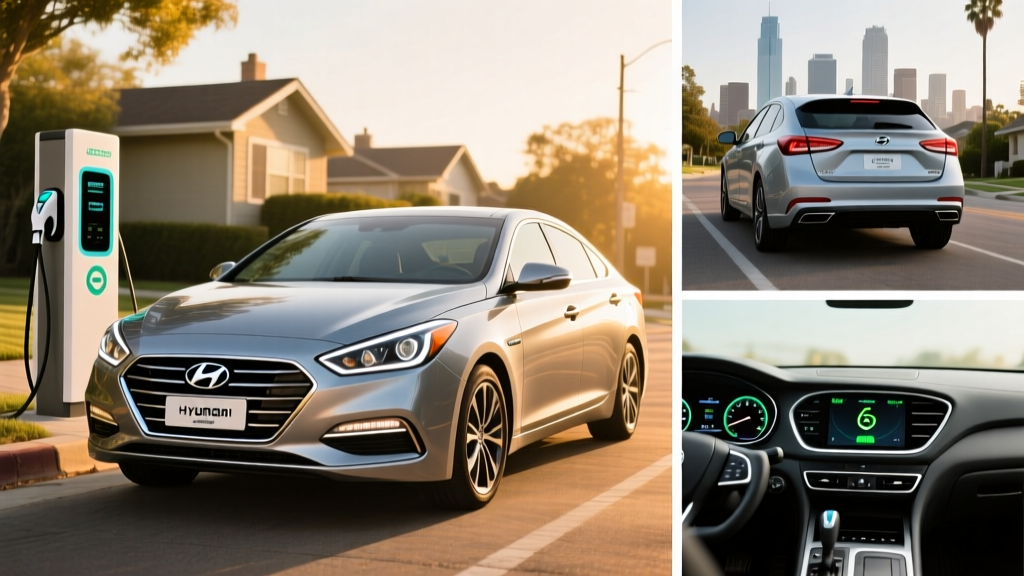
The 2016 Hyundai Sonata Hybrid represents a pivotal model year for Hyundai's midsize hybrid sedan. It was the first year of the second-generation system, pairing a 2.0-liter four-cylinder engine with a more powerful electric motor and a conventional six-speed automatic transmission — a deliberate departure from the CVT and dual-clutch setups used by competitors. For used-car shoppers in 2026 evaluating affordable hybrid sedans, the 2016 Sonata Hybrid remains a compelling option with strong EPA fuel economy, a proven powertrain, and one of the best hybrid battery warranties Hyundai has ever offered. Here's everything you need to know before buying one.
2016 Sonata Hybrid EPA Fuel Economy and Real-World MPG
The 2016 Sonata Hybrid is a conventional hybrid electric vehicle (HEV) — it does not plug in. It recharges its small lithium-ion battery through regenerative braking and the gasoline engine. There is no electric-only driving range to speak of beyond low-speed creeping.
| Trim | City MPG | Highway MPG | Combined MPG |
|---|---|---|---|
| Blue (base) | 39 | 43 | 40 |
| Limited | 38 | 43 | 40 |
Source: EPA / fueleconomy.gov
HEV vs. PHEV: Understanding What the 2016 Sonata Hybrid Is (and Isn't)
Hyundai sold two electrified Sonata variants around this era, and buyers frequently confuse them. Here's the distinction:
| Attribute | 2016 Sonata Hybrid (HEV) | 2016 Sonata Plug-In Hybrid (PHEV) |
|---|---|---|
| Plugs in to charge? | No | Yes (Level 1 / Level 2) |
| Electric-only range | None (motor assists only) | 27 miles (EPA) |
| Battery capacity | 1.62 kWh (lithium-ion) | 9.8 kWh (lithium-ion polymer) |
| Combined MPG / MPGe | 40 MPG | 99 MPGe (electric) / 40 MPG (gas) |
| DC fast charging? | N/A | No — AC only (Level 2 max) |
| Total driving range | ~600 miles | ~590 miles (gas + electric) |
| Federal tax credit (new) | None | Up to $4,543 (expired for new purchases) |
The 2016 Sonata Hybrid (HEV) is the model this guide covers. If you see a Sonata with a charge port on the front fender, that's the PHEV — a different vehicle with a larger battery and plug-in capability. Both share the same 2.0L engine, but the PHEV pairs it with a 50 kW electric motor versus the HEV's 38 kW motor.
Powertrain Specs: Engine, Motor, and Combined Output
| Component | Specification |
|---|---|
| Engine | 2.0L GDI 4-cylinder (Nu MPI Atkinson cycle) |
| Engine horsepower | 154 HP @ 6,000 RPM |
| Engine torque | 140 lb-ft @ 5,000 RPM |
| Electric motor | 38 kW (51 HP) permanent-magnet synchronous |
| Motor torque | 151 lb-ft |
| Combined system output | 193 HP |
| Transmission | 6-speed automatic (no CVT) |
| Drivetrain | Front-wheel drive |
| 0–60 mph | ~8.5 seconds (tested) |
| Hybrid battery | 1.62 kWh lithium-ion polymer |
Hyundai's choice of a conventional six-speed automatic rather than a CVT gives the 2016 Sonata Hybrid a more natural driving feel. Acceleration is linear, and there's no rubber-band sensation common to Toyota and Honda hybrid CVTs. The trade-off is marginally lower efficiency at steady-state highway cruising, but Hyundai largely closes the gap with its Atkinson-cycle engine tuning and aggressive regenerative braking calibration.
Battery Warranty, Lifespan, and Replacement Cost
For a 2016 model year vehicle in 2026, the original 10-year battery warranty is either expired or expiring soon depending on the in-service date. This is the critical factor for used buyers.
Real-world battery longevity: Hyundai's lithium-ion polymer hybrid batteries have proven durable. Unlike the early nickel-metal hydride packs in first-generation hybrids, these lithium-ion units experience slower degradation. Owner reports and fleet data suggest the 1.62 kWh pack retains 85–90% of its original capacity after 150,000 miles. Because the HEV battery is small and the system never deeply cycles it (the software maintains a narrow state-of-charge window between roughly 30% and 70%), stress on the cells is minimal.
Battery replacement cost: If the hybrid battery does fail out of warranty, a refurbished replacement from a Hyundai dealer typically runs $2,000–$3,500 including labor. Independent hybrid battery specialists can often replace individual modules or provide reconditioned packs for $1,200–$2,000. A brand-new OEM battery pack from Hyundai lists around $3,800–$4,500 before labor. These costs are significantly lower than EV traction battery replacements because the HEV pack is small (1.62 kWh vs. 60–100 kWh in a BEV).
Pricing and Tax Credit Eligibility in 2026
The 2016 Sonata Hybrid is available exclusively on the used market. Pricing varies by mileage, condition, and region:
| Condition / Mileage | Estimated Price Range |
|---|---|
| Excellent, under 60,000 mi | $14,000–$17,500 |
| Good, 60,000–100,000 mi | $10,500–$14,000 |
| Fair, 100,000–150,000 mi | $7,500–$10,500 |
Federal tax credit: The 2016 Sonata Hybrid (HEV) never qualified for the federal plug-in vehicle tax credit because it cannot be plugged in — that credit applies only to BEVs and PHEVs with batteries of at least 7 kWh. The Sonata PHEV variant did qualify for up to $4,543 when new, but that credit is unavailable for used purchases under current IRS §30D rules.
Used clean vehicle credit (§25E): Under the Inflation Reduction Act, the used clean vehicle credit (up to $4,000 or 30% of sale price, whichever is less) applies only to used BEVs and PHEVs purchased from a licensed dealer. The 2016 Sonata Hybrid (HEV) does not qualify. However, the 2016 Sonata Plug-In Hybrid may qualify if purchased from a dealer for $25,000 or less, subject to buyer income caps ($75,000 single / $150,000 joint) and the vehicle meeting the model-year requirement (at least 10 years old — the 2016 model year qualifies starting 2026).
Reliability, Safety, and Known Issues
The 2016 Sonata Hybrid earned strong safety marks. The IIHS named it a Top Safety Pick, with Good ratings in all crashworthiness tests. NHTSA awarded it 5 stars overall.
Reliability highlights:
- The 2.0L Nu engine is proven and generally trouble-free, though some owners report oil consumption above 100,000 miles — check oil levels between changes.
- The 6-speed automatic avoids the reliability concerns associated with early dual-clutch and CVT transmissions in competing hybrids.
- The hybrid system's power electronics (inverter, motor) have an excellent track record with very few reported failures.
- Common non-hybrid complaints include infotainment screen delamination, brake caliper sticking in salt-belt states, and occasional hybrid system warning lights caused by 12V auxiliary battery failure (not the traction battery).
Pre-purchase checklist for used buyers:
- Run a VIN check for open recalls — the 2016 Sonata has had recalls for ABS module fire risk and trunk latch release.
- Verify hybrid battery state of health (SoH) via a Hyundai dealer scan tool or an independent hybrid shop.
- Check whether the 12V auxiliary battery has been replaced recently — a weak 12V battery can trigger false hybrid system warnings.
- Inspect for transmission fluid service history; Hyundai recommends fluid changes at 60,000-mile intervals under severe use.
Who Should Choose the 2016 Sonata Hybrid vs. a Full EV or Gas Car?
Choose the 2016 Sonata Hybrid If:
- You want 40 MPG without changing your driving or fueling habits
- You lack access to home or workplace charging (apartment, street parking)
- Your budget is under $15,000 for a fuel-efficient sedan
- You drive 12,000–20,000 miles/year and want low cost-per-mile
- You want a spacious midsize sedan with a large trunk (13.3 cu ft)
Consider a Full EV Instead If:
- You have reliable Level 2 home charging and a short commute
- You want zero tailpipe emissions and lower per-mile fuel cost
- You can spend $20,000+ on a used BEV (e.g., 2019–2021 Bolt, Leaf, Model 3)
- You want minimal drivetrain maintenance (no oil changes, no transmission fluid)
A Conventional Gas Car May Make Sense If:
- You drive under 8,000 miles/year (fuel savings won't offset hybrid premium)
- You're buying a fleet vehicle and need the lowest upfront cost
- You prefer a sportier driving experience (hybrid tuning prioritizes efficiency)
The economics in 2026: At 40 MPG combined and a national average gas price around $3.20/gallon, the Sonata Hybrid costs roughly $0.08 per mile in fuel. A comparable gas-only midsize sedan at 28 MPG costs about $0.114 per mile. Over 15,000 miles annually, the hybrid saves approximately $510 per year in fuel. Against a BEV charging at $0.14/kWh with 3.5 mi/kWh efficiency, the BEV costs about $0.04 per mile — saving roughly $600/year versus the hybrid. The hybrid's advantage is zero infrastructure dependency.
Frequently Asked Questions
How many MPG does the 2016 Sonata Hybrid actually get?
The EPA rates it at 39 city / 43 highway / 40 combined MPG (Blue trim). In real-world mixed driving, owners typically see 38–42 MPG. City driving often matches or exceeds the EPA estimate because regenerative braking recovers energy in stop-and-go traffic. Sustained highway driving at 75+ mph tends to yield 35–38 MPG.
Does the 2016 Sonata Hybrid need to be plugged in?
No. The 2016 Sonata Hybrid is a conventional HEV. It charges its 1.62 kWh battery through regenerative braking and the gasoline engine. You fuel it like any other car. If you want plug-in capability, look for the separate 2016 Sonata Plug-In Hybrid (PHEV) variant, which offers 27 miles of electric-only range.
Is the 2016 Sonata Hybrid reliable?
Yes. The hybrid powertrain — 2.0L Nu engine, electric motor, and 6-speed automatic — has a strong reliability record. The lithium-ion hybrid battery is small and lightly stressed, contributing to longevity. The most common issues are non-hybrid related: infotainment screen problems, 12V battery failures, and brake caliper corrosion in winter-weather states.
What does it cost to replace the hybrid battery?
A refurbished hybrid battery pack costs $1,200–$2,000 from an independent hybrid specialist or $2,000–$3,500 from a Hyundai dealer including labor. A brand-new OEM pack is $3,800–$4,500 before labor. Most 2016 Sonata Hybrid batteries are lasting well beyond 150,000 miles without replacement.
Does the 2016 Sonata Hybrid qualify for any tax credit?
The HEV version does not qualify for any federal tax credit — neither the new-vehicle §30D credit nor the used-vehicle §25E credit, because it cannot be plugged in and has a battery below 7 kWh. The 2016 Sonata Plug-In Hybrid (PHEV) may qualify for the used clean vehicle credit (§25E) of up to $4,000 if purchased from a licensed dealer for $25,000 or less, subject to buyer income limits. Check current IRS §25E guidelines for eligibility details.
How does the 2016 Sonata Hybrid compare to a 2016 Toyota Camry Hybrid?
The 2016 Camry Hybrid LE is EPA-rated at 40/38/40 MPG (city/highway/combined), essentially identical to the Sonata Hybrid. The Camry uses a CVT, which some drivers find less engaging. The Sonata Hybrid offers slightly more rear legroom and a larger trunk. Both are strong used hybrid picks — the decision often comes down to which has lower mileage and better service history in your market.