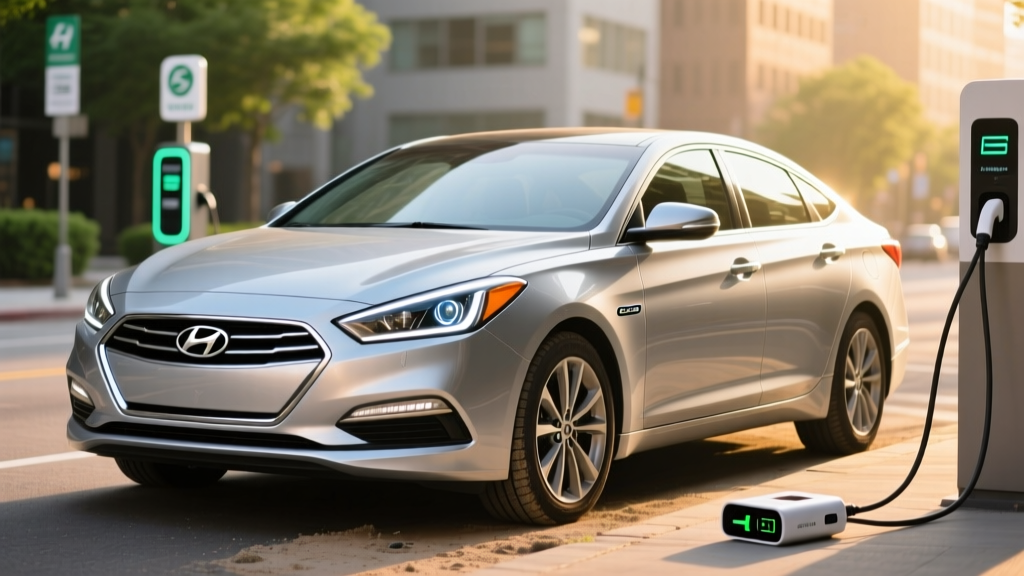
The 2016 Hyundai Sonata Hybrid Limited represents a pivotal redesign year for Hyundai's midsize hybrid sedan. Built on the seventh-generation Sonata platform, this model year introduced a more conventional six-speed automatic transmission (replacing the previous CVT-like unit), a upgraded lithium-ion polymer battery, and a host of premium features in the Limited trim that still hold up a decade later. For 2026 used-car shoppers eyeing an efficient daily driver without plug-in complexity, the 2016 Sonata Hybrid Limited remains a compelling, data-backed option — but only if you understand what you're buying.
This guide covers the exact EPA fuel economy figures, real-world MPG expectations, powertrain specifications, battery longevity data, replacement costs, and whether any tax incentives still apply. We'll also clarify where this conventional hybrid (HEV) fits against plug-in hybrids and full battery-electric vehicles in today's market.
2016 Sonata Hybrid Limited: Core Specifications at a Glance
| Specification | Value |
|---|---|
| Powertrain Type | Conventional Hybrid (HEV) — no plug-in required |
| Engine | 2.0L GDI inline-4 (154 hp @ 6,000 rpm) |
| Electric Motor | Permanent magnet synchronous (38 kW / 51 hp) |
| Combined System Output | 193 hp |
| Transmission | 6-speed automatic with torque converter |
| Hybrid Battery | 1.62 kWh lithium-ion polymer (Li-Po) |
| EPA Fuel Economy | 39 city / 43 highway / 40 combined MPG |
| Fuel Tank | 18.5 gallons |
| Estimated Total Range | ~740 miles (EPA combined) |
| 0–60 mph | ~8.3 seconds (est.) |
| Curb Weight | ~3,527 lbs |
| Cargo Volume | 13.3 cu ft (trunk) |
| Original MSRP (Limited) | $30,705 (2016) |
| 2026 Used Market Range | $9,000–$14,500 (depending on mileage/condition) |
Fuel Economy: EPA Sticker vs. Real-World MPG
The EPA rates the 2016 Sonata Hybrid at 39 MPG city, 43 MPG highway, and 40 MPG combined per fueleconomy.gov. These numbers reflect the hybrid system's ability to recapture energy during braking and run the electric motor at low speeds, shutting off the gasoline engine entirely when stopped.
Real-World MPG Expectations
Hybrid sedans like the Sonata often exceed their EPA city rating in stop-and-go driving because regenerative braking works hardest in urban conditions. Owners on fuel-tracking platforms consistently report:
- City driving: 38–45 MPG (frequent stops maximize regen)
- Highway cruising (65–75 mph): 38–42 MPG (less regen benefit, more aerodynamic drag)
- Combined mixed driving: 38–42 MPG
- Cold weather (below 30°F): 33–37 MPG (engine runs more for cabin heat, battery efficiency drops)
With an 18.5-gallon tank and 40 MPG combined, the Sonata Hybrid delivers roughly 740 miles of total range — enough for most drivers to go 2–3 weeks between fill-ups. This is a significant advantage over full EVs for drivers who regularly take long road trips through areas with sparse charging infrastructure.
Powertrain and Driving Dynamics
The 2016 Sonata Hybrid pairs Hyundai's 2.0-liter GDI four-cylinder engine (154 hp) with a 38 kW (51 hp) electric motor integrated into the transmission housing. Combined system output is 193 horsepower, routed through a traditional six-speed automatic with a torque converter — a deliberate departure from the CVT-style transmissions used in competitors like the Toyota Camry Hybrid.
This choice gives the Sonata Hybrid a more familiar, linear acceleration feel. There's no rubber-band effect common to CVTs. The electric motor provides instant torque at low speeds, making the car feel responsive around town. At highway speeds, the gasoline engine handles most of the work, with the electric motor assisting during acceleration and recapturing energy during deceleration.
The hybrid battery is a 1.62 kWh lithium-ion polymer pack located behind the rear seat. This is a relatively small battery by modern standards (for comparison, a Toyota Prius Prime PHEV carries an 11.3 kWh pack), but it's appropriately sized for a conventional hybrid that never needs to travel on electric power alone for extended distances. The battery primarily serves as a buffer for regenerative energy capture and brief electric-only assist at low speeds.
HEV vs. PHEV vs. Full EV: Where Does the Sonata Hybrid Fit?
Understanding the distinction between hybrid types is critical before purchasing. The 2016 Sonata Hybrid is a conventional hybrid (HEV). It does not have a plug. It does not charge from a wall outlet. It generates all its electricity from the gasoline engine and regenerative braking. This is fundamentally different from a plug-in hybrid (PHEV) or a battery-electric vehicle (BEV).
| Feature | HEV (e.g., Sonata Hybrid) | PHEV (e.g., Sonata Plug-In Hybrid) | BEV (e.g., Ioniq 6) |
|---|---|---|---|
| Plug-in Charging | No — gas only | Yes — Level 1/Level 2 | Yes — Level 1/2/DC fast |
| Electric-Only Range | ~1 mile at low speed | 20–30 miles (typical) | 250–360+ miles |
| Total Range | ~740 miles | ~500+ miles combined | 250–360+ miles |
| Home Charging Needed | No | Recommended | Essential |
| Fuel Cost per Mile | ~$0.10–$0.12 | ~$0.04 (electric) / $0.10 (gas) | ~$0.03–$0.06 |
| Maintenance | Standard (oil, filters) | Standard + battery system | Minimal (no oil changes) |
| Best For | No home charging access; long trips | Short commute + home charging | Home charging + mostly <250 mi trips |
- You lack access to home or workplace charging
- You regularly drive 300+ miles in a single trip
- You want maximum simplicity — no plugs, no charging apps, no range planning
- You want lower fuel costs without changing your refueling habits
- You have reliable Level 2 home charging and a commute under 30 miles
- You want to minimize gasoline use and emissions
- You qualify for federal or state EV/PHEV incentives that significantly reduce purchase cost
Battery Longevity, Warranty, and Replacement Cost
Hybrid battery lifespan is the single most common concern among used hybrid buyers — and for good reason. A failed hybrid battery can cost thousands to replace, potentially exceeding the vehicle's value. Here's what the data shows for the 2016 Sonata Hybrid.
Real-World Battery Degradation Data
The 2016 Sonata Hybrid's 1.62 kWh Li-Po battery is managed conservatively by the vehicle's battery management system (BMS). Unlike full EVs that regularly cycle between 10% and 90% state of charge, the Sonata Hybrid's BMS keeps the battery in a narrow operating window — typically between 40% and 80% SoC. This shallow-cycling approach dramatically extends cell life.
Based on owner reports and fleet data from similar Hyundai/Kia hybrid systems:
- At 100,000 miles: Most batteries retain 85–92% of original capacity; fuel economy degradation is negligible (1–2 MPG at most)
- At 150,000 miles: Expect 78–88% capacity retention; some drivers notice slightly more frequent engine engagement
- Failure rate: Complete battery failure before 150,000 miles is uncommon but not unheard of — estimated at 3–5% of vehicles
Battery Replacement Cost in 2026
If the hybrid battery does fail out of warranty, here are the current replacement options:
- New OEM battery (Hyundai dealer): $2,800–$3,800 (parts + labor)
- Refurbished/remanufactured battery: $1,500–$2,200 (from third-party hybrid specialists)
- Individual cell/module replacement: $400–$900 (if only specific modules have failed — requires diagnostic testing)
For a 2016 Sonata Hybrid Limited valued at $9,000–$14,500 in 2026, a full OEM battery replacement represents a significant percentage of the car's value. This makes a pre-purchase hybrid battery health check essential. Many independent hybrid specialists can perform a capacity test for $100–$150 before you buy.
Limited Trim Features and Interior Assessment
The Limited was the top-tier trim for the 2016 Sonata Hybrid, and it came well-equipped even by 2026 standards. Standard equipment includes:
- Leather seating surfaces (heated and ventilated front seats)
- 8-inch touchscreen with navigation and Hyundai's Blue Link telematics
- Infinity premium audio system (9 speakers)
- Blind Spot Detection with Rear Cross-Traffic Alert
- Lane Departure Warning
- Adaptive cruise control with full stop-and-go capability
- LED daytime running lights and HID headlights
- Proximity key with push-button start
- Dual-zone automatic climate control
The infotainment system, while dated compared to 2026 interfaces, supports Apple CarPlay and Android Auto (added via a 2017 software update for most units). The adaptive cruise control functions as a basic SAE Level 1 system — it manages speed and following distance but provides no steering assistance. The driver must remain fully engaged at all times.
Cargo space is 13.3 cubic feet, slightly reduced from the non-hybrid Sonata's 16.3 cu ft due to the hybrid battery's placement behind the rear seat. The trunk pass-through is also narrower. This is a meaningful trade-off for families who regularly haul bulky items.
Tax Credits, Incentives, and Used Purchase Economics
The 2016 Sonata Hybrid Limited originally qualified for a $2,500 federal Alternative Fuel Vehicle Tax Credit under the pre-2023 IRS §30 framework, based on its battery capacity. This credit was available only to the original purchaser and has long since expired for this model year. No federal tax credit is available for the 2016 Sonata Hybrid in 2026, whether purchased new (impossible, as it's discontinued) or used.
For used hybrid buyers in 2026, the relevant incentive is the Used Clean Vehicle Credit under the revised §25E, which provides up to $4,000 (30% of sale price, capped) for qualifying used plug-in hybrids and BEVs purchased from a dealer. However, conventional hybrids (HEVs) like the Sonata Hybrid do not qualify for this credit — only plug-in models do. The related Sonata Plug-In Hybrid (which offered ~27 miles of electric range) may qualify if it meets all §25E requirements, including the $25,000 sale price cap and buyer income limits. Always verify current eligibility at IRS.gov.
Total Cost of Ownership: 5-Year Projection (Used Purchase)
| Cost Category | Estimated 5-Year Total | Notes |
|---|---|---|
| Purchase Price | $11,500 | Average 2026 market price, ~95K miles |
| Fuel (gasoline) | $6,800 | @ $3.30/gal avg, 40 MPG combined |
| Insurance | $5,500 | ~$1,100/yr avg (varies by state/driver) |
| Maintenance | $2,800 | Oil, filters, brakes, tires, fluids |
| Repairs (out of warranty) | $1,500–$4,000 | Includes potential hybrid battery reserve |
| Depreciation | $3,500 | Estimated residual value ~$8,000 at year 5 |
| Total Estimated | $31,600–$34,100 | ~$6,320–$6,820/year all-in |
Compared to a similarly priced used gasoline-only midsize sedan getting 28 MPG combined, the Sonata Hybrid saves approximately $2,100 in fuel costs over five years at 12,000 miles per year and $3.30/gallon. That savings narrows if the hybrid battery needs replacement but widens if gas prices rise above $3.50.
Pros, Cons, and Verdict for 2026 Buyers
Strengths
- 40 MPG combined — excellent for a midsize sedan
- Real-world city MPG often exceeds EPA rating
- Conventional 6-speed automatic feels natural (no CVT drone)
- Limited trim is well-equipped (ventilated seats, adaptive cruise)
- No plug-in infrastructure needed
- 740-mile total range eliminates refueling anxiety
- Hybrid battery warranty may still have coverage (check by VIN)
Weaknesses
- Trunk space reduced to 13.3 cu ft (vs. 16.3 in gas Sonata)
- No federal tax credit available for conventional HEV in 2026
- Acceleration (8.3 sec 0–60) is adequate, not quick
- Infotainment interface feels dated by 2026 standards
- Battery replacement cost ($2,800+) is significant relative to car value
- Blue Link telematics may have limited functionality on older hardware
- No Apple CarPlay/Android Auto on units without software update
Verdict: The 2016 Sonata Hybrid Limited is a rational, fuel-efficient choice for 2026 buyers who need a dependable midsize sedan without plug-in dependency. Its 40 MPG combined, premium Limited features, and Hyundai's reputation for hybrid reliability make it competitive against the Toyota Camry Hybrid (42 MPG combined) and Ford Fusion Hybrid (42 MPG combined) from the same era. The key purchase decision hinges on battery health — insist on a pre-purchase hybrid battery diagnostic and verify remaining warranty coverage by VIN at a Hyundai dealer.
Frequently Asked Questions
How many MPG does the 2016 Sonata Hybrid get?
The EPA rates it at 39 city / 43 highway / 40 combined MPG. In real-world driving, city-heavy commuters often achieve 41–45 MPG thanks to regenerative braking, while highway-dominant driving at 70+ mph typically yields 37–41 MPG. Cold weather can reduce these figures by 3–5 MPG.
Is the 2016 Sonata Hybrid a plug-in hybrid?
No. The 2016 Sonata Hybrid is a conventional hybrid (HEV). It has no plug and cannot be charged from an outlet. All electricity is generated by the gasoline engine and regenerative braking. Hyundai did sell a separate model called the Sonata Plug-In Hybrid (PHEV) in 2016, which offered approximately 27 miles of electric-only range and could be charged from a standard outlet — but that is a different vehicle.
Is the 2016 Sonata Hybrid reliable, and what is the battery replacement cost?
The 2016 Sonata Hybrid has above-average reliability for its class, per owner surveys and NHTSA data. The lithium-ion polymer hybrid battery is managed conservatively and typically lasts 150,000+ miles with gradual capacity loss. If replacement is needed, expect $2,800–$3,800 for a new OEM battery or $1,500–$2,200 for a refurbished unit. The original warranty covered the battery for 8–10 years / 100,000 miles depending on state, and this warranty transfers to subsequent owners — check your VIN at a Hyundai dealer to see if any coverage remains.
Does the 2016 Sonata Hybrid qualify for any tax credit in 2026?
No. The 2016 Sonata Hybrid (conventional HEV) does not qualify for any federal tax credit under current IRS rules. The Used Clean Vehicle Credit (§25E) applies only to plug-in hybrids and battery-electric vehicles, not conventional hybrids. Some states may offer separate incentives for efficient vehicles, but these vary by jurisdiction — check your state's energy office or DMV for details.
How does it compare to the 2016 Toyota Camry Hybrid?
The 2016 Camry Hybrid LE is EPA-rated at 42 MPG combined (vs. the Sonata's 40 MPG) and has a larger trunk (13.1 cu ft with battery vs. the Sonata's 13.3 cu ft — very close). The Camry uses a CVT-style eCVT, which some drivers find less engaging than the Sonata's 6-speed automatic. The Sonata Limited typically offers more premium features (ventilated seats, adaptive cruise) at similar used-market prices. Both are strong choices; the decision often comes down to driving feel preference and specific vehicle condition at the time of purchase.
Should I buy this hybrid or a full EV in 2026?
Choose the Sonata Hybrid if you lack home charging, regularly take road trips exceeding 300 miles, or want the lowest-complexity ownership experience. Choose a full EV (like a used Tesla Model 3 or Chevy Bolt) if you have reliable Level 2 home charging, drive under 250 miles daily, and want to eliminate gasoline costs entirely. A full EV will cost more upfront but typically costs less per mile to operate and requires less routine maintenance.