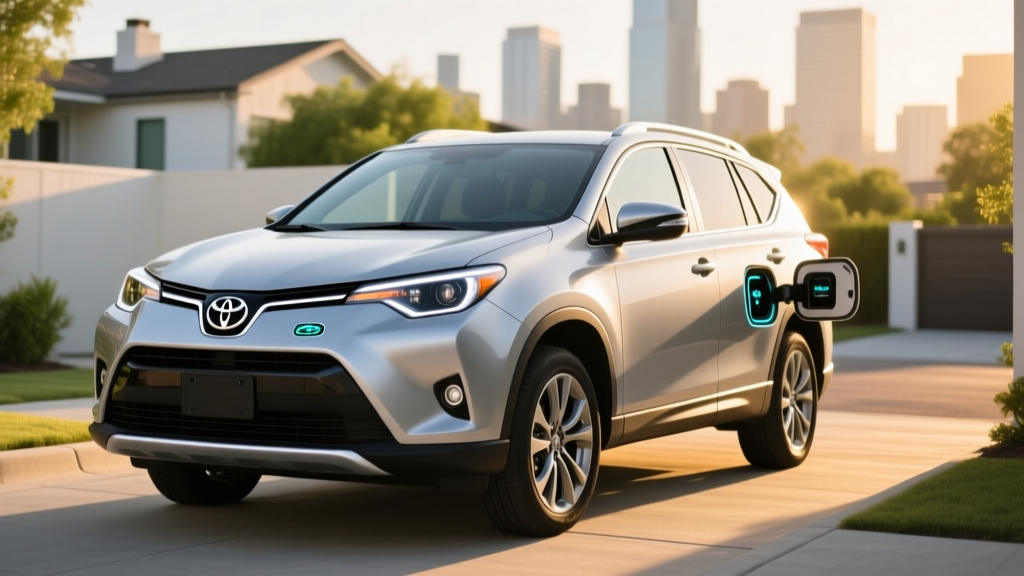
The 2016 Toyota RAV4 Hybrid was Toyota's first attempt at electrifying its best-selling compact SUV in the United States, and nearly a decade later it remains one of the most searched used hybrid crossovers on the market. With an EPA-rated 32 MPG combined and Toyota's reputation for bulletproof hybrid powertrains, the 2016 RAV4 Hybrid is a pragmatic choice for buyers who want hybrid efficiency without the complexity, cost, or charging requirements of a plug-in hybrid or full battery-electric vehicle.
This guide breaks down everything a 2026 used-car shopper needs to know: real-world fuel economy, the hybrid battery's expected lifespan and replacement cost, powertrain specs, and whether this first-generation RAV4 Hybrid still makes sense compared to newer hybrids, PHEVs, and EVs.
2016 RAV4 Hybrid Fuel Economy: EPA vs. Real-World MPG
The 2016 RAV4 Hybrid's headline number is its fuel efficiency. Toyota paired a 2.5-liter Atkinson-cycle four-cylinder engine with an electric motor and a nickel-metal hydride (NiMH) traction battery to deliver MPG figures that still hold up against newer competitors.
| Metric | EPA Rating | Real-World Expectation (2026) |
|---|---|---|
| City MPG | 34 MPG | 33–36 MPG (hybrids often exceed EPA in stop-and-go) |
| Highway MPG | 31 MPG | 28–31 MPG (highway driving favors gas engines) |
| Combined MPG | 32 MPG | 30–33 MPG depending on driving mix |
| Fuel Tank Capacity | 14.8 gallons | ~440–470 miles per tank |
Source: fueleconomy.gov — 2016 RAV4 Hybrid
The real-world advantage of the 2016 RAV4 Hybrid is its city driving performance. Because the electric motor handles low-speed propulsion and regenerative braking recaptures energy during stop-and-go traffic, many owners report exceeding the 34 MPG city EPA estimate in urban commuting. Highway driving is the opposite story: at sustained 70–80 MPH speeds, the gasoline engine does most of the work, and the hybrid system provides less benefit. Expect 28–31 MPG on long highway trips.
For a 2026 used buyer, the critical variable is battery health. A 10-year-old NiMH hybrid battery that has degraded 10–15% will reduce electric-motor assist and slightly lower MPG. Most 2016 RAV4 Hybrids with original batteries still achieve within 1–2 MPG of their EPA sticker, but it's worth having a hybrid-system health check done at a Toyota dealer before purchase.
HEV vs. PHEV: What the 2016 RAV4 Hybrid Actually Is
A common point of confusion for shoppers entering the hybrid market is the difference between a conventional hybrid (HEV) and a plug-in hybrid (PHEV). The 2016 RAV4 Hybrid is a conventional self-charging hybrid (HEV). It does not have a charging port, cannot be plugged in, and has no meaningful electric-only driving range.
| Feature | HEV (2016 RAV4 Hybrid) | PHEV (e.g., RAV4 Prime) | BEV (e.g., Tesla Model Y) |
|---|---|---|---|
| Plug-in charging required? | No — self-charging via regen and engine | Yes — Level 1/Level 2 | Yes — Level 2 and DC fast charging |
| Electric-only range | ~0.5 miles at very low speed | 42 miles (RAV4 Prime, EPA) | 260–330+ miles (varies by model) |
| Gasoline engine? | Yes | Yes | No |
| Federal tax credit (§30D)? | No | Up to $7,500 (if eligible, new purchase only) | Up to $7,500 (if eligible) |
| Home charging install needed? | No | Recommended (Level 2, ~$500–$2,000) | Required ($500–$2,500+) |
| Ideal buyer | No home charging access; wants simplicity | Home charging + short commutes + road trips | Home charging + mostly electric lifestyle |
The 2016 RAV4 Hybrid's hybrid system works seamlessly in the background. The electric motor assists during acceleration, the engine shuts off at stops, and regenerative braking recharges the small 1.6 kWh NiMH battery pack. You never think about it — you just drive and fill up at a gas station as usual.
If you want electric-only commuting capability, the RAV4 Prime (introduced for the 2021 model year) is the plug-in variant with 42 miles of EPA-rated electric range and a combined 302 hp. But the RAV4 Prime commands a significant premium on the used market and requires home charging infrastructure to realize its benefits.
Powertrain and Performance Specs
| Specification | Detail |
|---|---|
| Engine | 2.5L Atkinson-cycle 4-cylinder (150 hp, 152 lb-ft) |
| Electric Motor | Front: 105 kW (141 hp); Rear: 50 kW (67 hp) — AWD models |
| Combined System Horsepower | 194 hp |
| Transmission | eCVT (electronically controlled continuously variable) |
| Drivetrain | AWD (standard on all Hybrid trims — electronic rear motor, no mechanical driveshaft) |
| Hybrid Battery | 1.6 kWh, Nickel-Metal Hydride (NiMH), located under rear seat |
| 0–60 MPH | ~7.8 seconds |
| Curb Weight | ~3,950 lbs |
| Towing Capacity | 1,750 lbs |
The 194 combined horsepower figure was competitive for 2016 and remains adequate for 2026 daily driving. The eCVT delivers smooth, linear acceleration without the shift-shock of a traditional automatic. The electronic AWD system (Toyota calls it AWD-i) uses a dedicated rear electric motor rather than a mechanical driveshaft, engaging the rear wheels only when slip is detected. This keeps weight down and efficiency up, but it's a light-duty system designed for rain and snow traction, not off-road use.
Hybrid Battery Lifespan, Warranty, and Replacement Cost
Battery longevity is the single biggest concern for any used hybrid buyer. Here's what you need to know about the 2016 RAV4 Hybrid's NiMH traction battery.
Expected battery lifespan: Toyota's NiMH hybrid batteries are among the most durable in the industry. Data from fleet usage and owner reports shows these batteries commonly last 150,000–200,000 miles before significant degradation. Unlike the lithium-ion batteries in EVs and PHEVs, NiMH batteries degrade more gradually and predictably. A degraded NiMH battery doesn't suddenly fail — it slowly loses capacity, which reduces electric-motor assist and slightly lowers MPG.
Replacement cost (2026 estimates):
| Option | Cost Range | Notes |
|---|---|---|
| New OEM Toyota battery | $3,000–$4,500 (parts + labor) | Full warranty from Toyota dealer; best longevity |
| Refurbished/reconditioned battery | $1,500–$2,500 | Replaced weak cells; shorter warranty (1–3 years typical) |
| Used salvage battery | $500–$1,200 | Highest risk; unknown remaining life; may void future warranty |
For most 2016 RAV4 Hybrids with under 150,000 miles, the original battery should still be functional. If you're evaluating a high-mileage example (160,000+ miles), budget for a potential battery replacement within your first few years of ownership. A Toyota dealer can perform a hybrid battery health check that shows remaining capacity percentage — request this before purchase.
Trims, Pricing, and Tax Credit Eligibility in 2026
The 2016 RAV4 Hybrid was offered in two trims: XLE and Limited. Both came standard with AWD-i.
| Trim | Original MSRP (2016) | 2026 Used Market Estimate |
|---|---|---|
| XLE Hybrid | $29,270 | $14,000–$18,000 |
| Limited Hybrid | $34,510 | $17,000–$22,000 |
Used prices vary significantly based on mileage, condition, and regional demand. Hybrids tend to hold value better than their gas-only counterparts, and the RAV4's reputation for reliability supports strong resale.
Reliability, Safety, and Ownership Costs
The 2016 RAV4 Hybrid benefits from Toyota's decades of hybrid experience (the Prius launched in 1997). The hybrid powertrain adds complexity, but Toyota's system has proven remarkably durable. The eCVT transmission has no traditional gears or clutch packs to wear out — it uses a planetary gearset that is mechanically simple and long-lived.
Safety ratings: The 2016 RAV4 earned the IIHS Top Safety Pick+ designation when equipped with the optional front crash prevention package. It received a "Good" rating in all crashworthiness tests. Standard Toyota Safety Sense-P (TSS-P) includes pre-collision braking, lane departure alert, automatic high beams, and full-speed adaptive cruise control — impressive standard equipment for a 2016 model year. Source: IIHS
Common issues to check: The 12-volt auxiliary battery (standard lead-acid, not the hybrid traction battery) may need replacement every 4–5 years. Some owners report water pump failures around 100,000–120,000 miles. The rear cargo area is slightly smaller than the gas-only RAV4 due to hybrid battery placement under the rear seat, reducing cargo volume from 38.4 to 35.6 cubic feet behind the second row.
Who Should Buy the 2016 RAV4 Hybrid in 2026?
Choose the 2016 RAV4 Hybrid if:
- You want 30+ MPG without ever plugging in
- You lack access to home or workplace charging
- You want AWD for snow/rain with minimal fuel penalty
- You prioritize long-term reliability and low maintenance costs
- Your budget is $14,000–$22,000 for a used compact SUV
- You drive mostly in city/suburban conditions where hybrid efficiency shines
Look elsewhere if:
- You want electric-only commuting (consider RAV4 Prime or a BEV)
- You need more than 1,750 lbs towing capacity
- You want the latest infotainment (no Apple CarPlay/Android Auto in 2016)
- You drive mostly highway miles (the hybrid advantage diminishes)
- You want federal tax credit eligibility (requires a new BEV or PHEV)
- You need maximum cargo space (the gas-only RAV4 offers slightly more)
Frequently Asked Questions
How many MPG does the 2016 RAV4 Hybrid get?
The EPA rates it at 34 city / 31 highway / 32 combined MPG. In real-world driving, owners frequently exceed the city estimate (33–36 MPG) in stop-and-go traffic, while highway driving typically returns 28–31 MPG. Overall combined real-world economy is usually 30–33 MPG depending on your driving mix.
Does the 2016 RAV4 Hybrid need to be plugged in?
No. This is a conventional hybrid (HEV), not a plug-in hybrid (PHEV). It charges its own battery through regenerative braking and the gasoline engine. There is no charging port. You fuel it exclusively at a gas station.
How long does the hybrid battery last and what does replacement cost?
Toyota's NiMH hybrid batteries typically last 150,000–200,000 miles. A new OEM replacement costs $3,000–$4,500 installed at a Toyota dealer. Refurbished batteries run $1,500–$2,500. For a 2016 model with under 150,000 miles, the original battery is likely still functional, but a hybrid health check is recommended before purchase.
Does the 2016 RAV4 Hybrid qualify for any tax credit?
No. The federal §30D tax credit applies only to new plug-in electric vehicles (BEVs and PHEVs). Conventional hybrids have never been eligible. Some states may offer small rebates for used hybrid purchases, but these vary by jurisdiction.
Hybrid vs. PHEV vs. EV — which is right for me?
If you have no home charging access and want maximum simplicity, the 2016 RAV4 Hybrid (HEV) is ideal. If you can install a Level 2 charger at home and have a short commute, a PHEV like the RAV4 Prime gives you 42 miles of electric driving plus a gas engine for road trips. If you're ready to go fully electric and have reliable charging, a BEV eliminates gas entirely but requires a larger upfront investment and charging infrastructure.
Is the 2016 RAV4 Hybrid AWD?
Yes, all 2016 RAV4 Hybrid trims come standard with AWD-i, Toyota's electronic all-wheel-drive system. It uses a separate rear electric motor (no mechanical driveshaft) to power the rear wheels when needed. It's effective for rain and light snow but not designed for serious off-road use.
Does the 2016 RAV4 Hybrid have Apple CarPlay or Android Auto?
No. Toyota did not add Apple CarPlay to the RAV4 until the 2019 refresh, and Android Auto arrived in 2020. The 2016 model uses Toyota's Entune infotainment system with a 7-inch touchscreen, Bluetooth, and USB connectivity. Aftermarket head-unit replacements are available if smartphone integration is a priority.