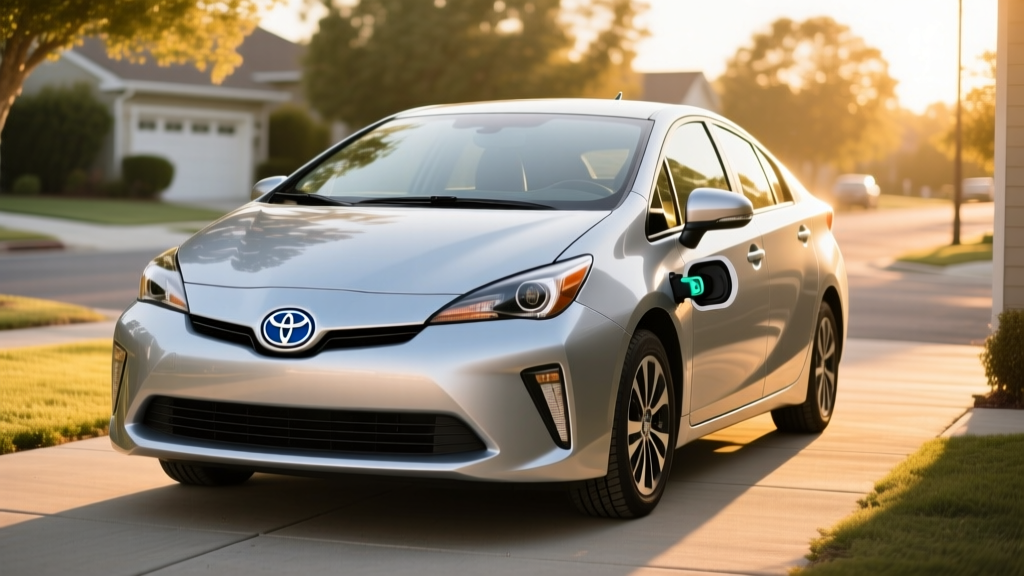
The fourth-generation Toyota Prius landed for the 2016 model year with a radical redesign, a new TNGA platform, and a significant efficiency jump over its predecessor. Nearly a decade later, the 2016 Prius hybrid MPG figures remain a benchmark for conventional hybrids — and a major reason this car dominates the used market for budget-conscious, efficiency-focused drivers.
This guide covers everything a 2026 buyer or current owner needs to know: EPA versus real-world fuel economy, the distinction between the standard Prius HEV and the Prius Prime PHEV, battery health expectations, replacement costs, and how this hybrid stacks up against modern EVs and PHEVs.
2016 Prius Hybrid MPG: EPA Ratings and Real-World Results
The 2016 Toyota Prius comes in several trims, and the EPA ratings vary slightly depending on wheel size and equipment. The most efficient variant — the Prius Two Eco trim with low-rolling-resistance tires and lighter weight — achieves class-leading numbers.
| Trim | City MPG | Highway MPG | Combined MPG |
|---|---|---|---|
| Two Eco | 58 | 53 | 56 |
| One / Two / Three / Four / Four Touring | 54 | 50 | 52 |
Source: fueleconomy.gov
HEV vs. PHEV: Understanding the 2016 Prius Lineup
A common source of confusion is the difference between the standard 2016 Prius and the 2016 Prius Prime (initially called the Prius Plug-in for earlier generations). They are fundamentally different powertrains.
| Attribute | 2016 Prius (HEV) | 2017 Prius Prime (PHEV)* |
|---|---|---|
| Powertrain Type | Conventional Hybrid | Plug-in Hybrid |
| Needs to Plug In? | No — self-charging via regen + engine | Yes — plug in for electric-only range |
| Battery Capacity | 0.75 kWh (NiMH) / 1.3 kWh (Li-ion, Eco) | 8.8 kWh (Li-ion) |
| Electric-Only Range | N/A (EV mode ~1 mile at low speed) | 25 miles (EPA) |
| Combined MPG / MPGe | 52–56 MPG | 54 MPG (gas) / 133 MPGe (electric+gas) |
| Total Range | ~600+ miles | ~640 miles (25 electric + 615 gas) |
| Charging Time (120V) | N/A | ~5.5 hours |
| Charging Time (240V) | N/A | ~2 hours |
| DC Fast Charging | N/A | Not supported |
*The plug-in variant transitioned to the "Prius Prime" nameplate for the 2017 model year. The 2016 model year was the last sold as "Prius Plug-in Hybrid" with lower electric range (11 miles EPA).
Key distinction: The standard 2016 Prius HEV never needs to be plugged in. It generates all its electrical energy through regenerative braking and the gasoline engine. The Prius Prime PHEV can be plugged in to access a meaningful electric-only driving range, then operates as a conventional hybrid once the battery is depleted.
Powertrain Specs: What's Under the Hood
The 2016 Prius uses Toyota's Hybrid Synergy Drive system, pairing a 1.8-liter Atkinson-cycle four-cylinder engine with two motor-generators and a planetary gearset that functions as a continuously variable transmission.
| Specification | Detail |
|---|---|
| Engine | 1.8L 4-cyl Atkinson-cycle (95 HP / 105 lb-ft) |
| Electric Motor | Permanent magnet AC synchronous (71 HP / 120 lb-ft) |
| Combined Net Horsepower | 121 HP |
| Transmission | eCVT (planetary gearset) |
| 0–60 mph | ~9.8 seconds |
| Drivetrain | Front-wheel drive |
| Curb Weight | 3,042–3,117 lbs (varies by trim) |
The 121 HP figure may sound modest, but the electric motor's instant torque (available from 0 RPM) makes the Prius feel more responsive in city driving than the number suggests. The Atkinson-cycle engine sacrifices peak power for thermal efficiency — it's optimized to convert fuel into motion with minimal waste, which is the core reason the 2016 Prius hybrid MPG numbers are so strong.
Battery Health, Warranty, and Replacement Cost
Hybrid battery longevity is the single biggest concern for used Prius buyers. Here's what the data shows.
Real-world battery lifespan: Data from fleet operators, taxi services, and owner surveys consistently shows that the 2016 Prius NiMH hybrid battery typically lasts 150,000–200,000+ miles before significant degradation. The fourth-generation Prius improved thermal management over earlier models, reducing the hot-spot degradation that plagued some 2004–2009 units.
Battery replacement costs in 2026:
- New OEM Toyota battery: $2,000–$2,500 installed at a dealership
- Refurbished/reconditioned battery: $800–$1,500 installed at an independent hybrid specialist
- Individual module replacement: $200–$500 (only failed modules replaced — viable option for NiMH packs)
For context, a Prius with 160,000 miles that needs a $1,200 refurbished battery has still saved thousands over a comparable gas-only vehicle in fuel costs alone. The battery replacement is not the financial catastrophe some fear.
Does the 2016 Prius Qualify for Any Tax Credits?
Federal tax credit (§30D): No. The 2016 Prius HEV does not qualify for the federal plug-in vehicle tax credit because it is a conventional hybrid — it has no plug and no meaningful electric-only range. The federal credit applies only to plug-in vehicles (BEVs and PHEVs) meeting battery capacity, sourcing, MSRP, and income requirements per current IRS rules.
The 2016 Prius Prime PHEV originally qualified for a federal credit (up to $4,502 based on battery capacity), but that credit applied only at the time of original purchase. Used vehicle purchases do not retroactively qualify for the new-vehicle credit.
Used clean vehicle credit (§25E): Under current IRS rules, a used PHEV or BEV purchased from a dealer for $25,000 or less may qualify for a credit of 30% of the sale price (up to $4,000), subject to income limits. A used 2017+ Prius Prime purchased within these parameters could potentially qualify. The standard Prius HEV does not qualify for this credit either.
State incentives: Some states offer rebates or HOV lane access for hybrids or PHEVs. These vary significantly by jurisdiction — check your state's energy office or DMV for current programs.
2016 Prius vs. Modern Alternatives: HEV, PHEV, or Full EV?
If you're considering a 2016 Prius in 2026, you're likely weighing it against newer hybrids, PHEVs, and affordable EVs. Here's a practical decision framework:
Choose the 2016 Prius HEV if:
- Your budget is under $15,000
- You have no home charging access
- You drive 30–60 miles/day in mixed city/highway
- You want minimal maintenance and proven reliability
- You take frequent long road trips (600+ mile range, 3-min refuel)
Choose a PHEV (e.g., Prius Prime) if:
- You have home Level 2 charging (or can install it)
- Your daily commute is under 25–40 miles (electric-only covers it)
- You still want gas flexibility for road trips
- You want to reduce fuel use by 60–80% vs. a gas car
- Budget allows $18,000–$30,000+ for a used/new PHEV
Choose a full EV if:
- You have reliable home charging
- Your daily driving is under 200 miles
- You want near-zero maintenance (no oil, filters, exhaust)
- You qualify for the §30D or §25E tax credit
- Local DC fast-charging infrastructure is adequate
Skip the 2016 Prius if:
- You need AWD (consider the 2019+ Prius AWD-e)
- You want modern ADAS (2016 has basic Toyota Safety Sense P, but lacks lane-centering, full-speed adaptive cruise updates)
- You want strong acceleration (9.8s 0–60 is leisurely)
- Infotainment/CarPlay/Android Auto is essential (not available on 2016)
Reliability and Long-Term Ownership Costs
The 2016 Prius benefits from one of the strongest reliability records in the automotive industry. According to Consumer Reports historical data and J.D. Power dependability studies, the fourth-generation Prius consistently ranks at or near the top for its segment.
Key reliability points:
- Hybrid system: The planetary eCVT has no belts, clutches, or torque converter to fail — it is one of the most durable transmissions ever engineered.
- Brakes: Regenerative braking significantly reduces pad and rotor wear. Many Prius owners report original brake pads lasting 80,000–100,000+ miles.
- Engine: The 2ZR-FXE 1.8L is under-stressed and Atkinson-cycle, leading to minimal internal wear. 300,000+ mile examples are common.
- Known issues: Some owners report head gasket concerns past 200,000 miles (primarily if coolant was not maintained), and the 12V auxiliary battery may need replacement every 4–6 years like any vehicle.
Estimated annual maintenance cost: $350–$500/year (oil changes, cabin air filter, tire rotations, brake fluid). This is significantly lower than most gas-only vehicles due to reduced brake wear and the simplicity of the hybrid drivetrain.
Pros and Cons of the 2016 Prius in 2026
Pros
- 52–56 MPG combined (EPA) — still best-in-class for non-plug-in vehicles
- Proven long-term reliability; 200K+ mile examples are common
- Low maintenance costs (eCVT, regen braking, simple engine)
- Affordable used pricing ($9,000–$15,000 depending on mileage/condition)
- 600+ mile total range — zero range anxiety
- Spacious hatchback cargo area (27.4 cu ft behind rear seats)
Cons
- Modest 121 HP — slow acceleration and highway merging
- 2016 infotainment lacks Apple CarPlay, Android Auto
- Toyota Safety Sense P is basic by 2026 ADAS standards
- Polarizing exterior styling (subjective but affects resale)
- Road noise and ride firmness noticeable on rough pavement
- No AWD option (introduced for 2019 model year)
Frequently Asked Questions
How many MPG does the 2016 Prius actually get in real driving?
Most owners report 50–56 MPG combined in mixed driving, closely matching or slightly exceeding the EPA estimate of 52 MPG (54 city/50 highway for most trims, 56 combined for the Two Eco). City-heavy driving favors the Prius because regenerative braking recaptures energy. Sustained 75+ mph highway driving drops real-world MPG to roughly 45–48. Cold weather (below 35°F) can reduce efficiency by 5–10%.
Is the 2016 Prius a plug-in hybrid?
No. The standard 2016 Toyota Prius is a conventional hybrid (HEV). It charges its battery exclusively through regenerative braking and the gasoline engine — you never plug it in. The plug-in variant was sold as the "Prius Plug-in" through 2015 and renamed "Prius Prime" starting with the 2017 model year.
How long does the 2016 Prius hybrid battery last?
Based on fleet data and owner reports, the NiMH hybrid battery in the 2016 Prius typically lasts 150,000–200,000+ miles. Toyota's warranty covers 8 years/100,000 miles (10 years/150,000 miles in CARB states). If replacement is needed, expect $800–$1,500 for a refurbished unit or $2,000–$2,500 for a new OEM battery.
Does the 2016 Prius qualify for any federal tax credit?
No. The 2016 Prius HEV is a conventional hybrid and does not qualify for the federal §30D new clean vehicle credit or the §25E used clean vehicle credit. These credits require a plug-in vehicle with a minimum battery capacity. Always verify current rules on IRS.gov.
Is the 2016 Prius still worth buying in 2026?
Yes — for the right buyer. If your priority is maximum fuel efficiency at a low purchase price, with no need for home charging infrastructure, the 2016 Prius remains one of the most rational used car purchases available. Its 52–56 MPG, low maintenance costs, and proven 200,000+ mile durability make it an outstanding value at $9,000–$15,000. If you need modern infotainment, advanced ADAS, or stronger acceleration, consider newer alternatives.
What's the difference between the Prius Two Eco and other trims?
The Two Eco trim uses lithium-ion battery cells (1.3 kWh) instead of NiMH (0.75 kWh), lighter-weight wheels, and low-rolling-resistance tires. This yields 58 city / 53 highway / 56 combined MPG versus 54/50/52 for other trims. The trade-off is slightly fewer standard features and a less common trim on the used market.