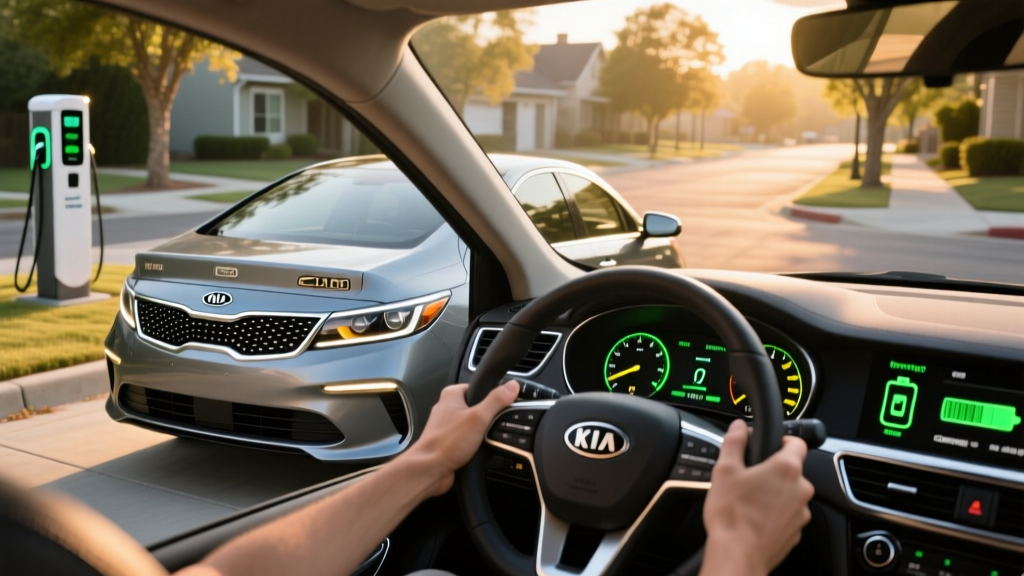
The 2016 Kia Optima Hybrid sedan occupies a specific niche in the used-car market: a midsize conventional hybrid (HEV) that prioritizes fuel efficiency and comfort without requiring any change in driving habits. No plug, no range anxiety, no charging infrastructure to worry about. For buyers in 2026 exploring the used hybrid market, this generation of Optima Hybrid offers a compelling value proposition — but only if you understand exactly what you're getting, what to watch for, and how it stacks up against modern alternatives.
This guide breaks down the 2016 Optima Hybrid's real-world efficiency, powertrain specs, battery longevity, ownership costs, and whether it still makes sense nearly a decade after it rolled off the assembly line.
2016 Kia Optima Hybrid Sedan: Quick Verdict
The 2016 Optima Hybrid is a conventional hybrid (HEV), not a plug-in hybrid. It cannot be plugged in and has no electric-only driving mode of any meaningful distance. Instead, it uses a small lithium-ion polymer battery paired with a 2.0-liter four-cylinder engine to recapture braking energy and assist acceleration, delivering meaningful fuel savings over the gas-only Optima without altering your refueling routine.
| Powertrain | 2.0L I4 + electric motor |
| Combined Horsepower | 199 hp |
| Battery | 1.4 kWh lithium-ion polymer |
| EPA MPG (City/Hwy/Combined) | 36 / 40 / 38 |
| Transmission | 6-speed automatic |
| 0-60 mph | ~8.8 seconds |
| Original MSRP (EX trim) | ~$26,795 |
| Hybrid Battery Warranty | 10 years / 100,000 miles (original owner) |
How Many MPG Does the 2016 Optima Hybrid Get?
The EPA rates the 2016 Kia Optima Hybrid at 36 MPG city, 40 MPG highway, and 38 MPG combined, according to fueleconomy.gov. These figures apply to the EX trim, which was the primary hybrid offering for this model year.
| Metric | City | Highway | Combined |
|---|---|---|---|
| EPA Rating | 36 MPG | 40 MPG | 38 MPG |
| Real-World Expectation | 37-40 MPG | 36-39 MPG | 36-39 MPG |
| Annual Fuel Cost (est.) | ~$1,400 (15,000 mi/yr at $3.50/gal avg) | ||
Real-World MPG vs. EPA Sticker
One of the defining characteristics of conventional hybrids is their tendency to exceed EPA city estimates in real-world stop-and-go driving. The regenerative braking system recaptures energy that a gas-only car wastes as heat at every stoplight, making urban driving the hybrid's sweet spot. Owners consistently report 37-40 MPG in city conditions.
Highway driving is a different story. At sustained speeds above 65 mph, the electric motor provides minimal assistance, and the 2.0-liter engine does most of the work while pushing a ~3,500 lb sedan. Expect 36-39 MPG on the highway — slightly below the EPA sticker in many cases, particularly with headwinds, hills, or a loaded trunk.
In cold weather (below 35°F), expect a 5-10% efficiency drop. The engine runs more frequently to provide cabin heat and maintain battery temperature, reducing the hybrid system's ability to shut the engine off at stops.
Powertrain and Driving Experience
The 2016 Optima Hybrid pairs a 2.0-liter GDI four-cylinder engine (producing 154 hp and 140 lb-ft of torque on its own) with a 38 kW electric motor integrated into the drivetrain. Combined system output is 199 horsepower.
Unlike many competitors that use a continuously variable transmission (CVT), Kia equipped this generation with a 6-speed automatic transmission. This was a deliberate choice: it delivers more natural shift feel and avoids the "rubber-band" drone that CVT-equipped hybrids (like the Toyota Camry Hybrid) produce under hard acceleration. The tradeoff is marginally less seamless electric-to-gas transitions — you can sometimes feel the engine engage, particularly from a stop.
The 1.4 kWh lithium-ion polymer battery is small by modern standards — for comparison, a current-generation PHEV might carry 13-20 kWh. But in a conventional hybrid, the battery doesn't need to be large. Its job is to buffer regenerative braking energy and provide brief torque-fill during acceleration, not to drive the car on electricity alone. The battery is located behind the rear seats, which reduces trunk space to approximately 13.4 cubic feet (down from 15.9 cu ft in the gas-only Optima).
What It Drives Like
The 2016 Optima Hybrid drives like a comfortable, slightly heavy midsize sedan. The 0-60 mph time of approximately 8.8 seconds is adequate for merging and passing but won't feel quick. Steering is light and isolated — this is a cruiser, not a sport sedan. Ride quality is a strong point, with composed damping over rough pavement and minimal road noise at highway speeds.
The hybrid system operates transparently in most conditions. The engine auto-stop function shuts the engine down at red lights and in heavy traffic, restarting seamlessly when you lift off the brake. An "EV" button on the center console allows you to force electric-only mode at very low speeds (under ~25 mph, for roughly one mile if the battery is sufficiently charged), but this is best used sparingly — the system manages energy more efficiently on its own.
HEV vs. PHEV vs. EV: Which Fits Your Situation?
The 2016 Optima Hybrid is a conventional HEV. Kia also offered a 2016 Optima PHEV (plug-in hybrid) variant in some markets, which is a fundamentally different vehicle. Understanding the distinction is critical before buying used.
| Factor | HEV (This Car) | PHEV | Full EV (BEV) |
|---|---|---|---|
| Plugs in? | No | Yes | Yes |
| Electric-only range | ~1 mi at low speed | 20-40 mi typical | 200-350+ mi |
| Home charging needed? | No | Recommended (Level 2) | Essential |
| Fuel cost per mile | ~$0.09 | $0.04-0.09 (depends on EV%) | $0.03-0.05 |
| Maintenance | Standard (oil, filters) | Standard + EV system | Minimal (no engine) |
| Best for | No home charging access | Home charging + short commute | Home charging + low running cost priority |
- You rent or live somewhere without access to a dedicated charging outlet
- Your commute is long and highway-heavy (the hybrid advantage is modest but consistent)
- You want lower fuel costs without changing any habits — just fill up at any gas station
- Your budget is in the $10,000-$16,000 used-car range
- You have access to Level 2 home charging and a commute under 30 miles (a PHEV can cover most trips on electricity alone)
- You want the lowest possible per-mile fuel cost (a BEV at $0.04/mi vs. the Optima Hybrid's ~$0.09/mi)
- You drive primarily in the city and want maximum regenerative benefit (BEVs recapture far more energy)
Battery Longevity, Warranty, and Replacement Cost
Battery durability is the number one concern for used hybrid buyers, and it should be. Here's what you need to know about the 2016 Optima Hybrid's battery system.
- Original warranty: 10 years / 100,000 miles (hybrid battery and hybrid-system components) for the original owner; 5 years / 60,000 miles for subsequent owners in most states
- California and CARB states: Hybrid battery covered for 10 years / 150,000 miles regardless of ownership transfer
- Coverage threshold: Kia warrants the battery against capacity loss below approximately 70% of original capacity
- What's covered: Battery pack, battery management system, hybrid motor, inverter, and related control modules
How Long Does the Battery Actually Last?
The 1.4 kWh lithium-ion polymer battery in the 2016 Optima Hybrid operates within a narrow state-of-charge window — typically between 40% and 80% — to minimize stress and extend cycle life. The battery management system (BMS) never allows a full charge or full discharge during normal operation. This conservative strategy is why hybrid batteries routinely outlast their warranty periods.
Based on fleet data and owner reports from vehicles now approaching 10 years old, the 2016 Optima Hybrid battery shows minimal degradation in most cases — typically 5-12% capacity loss over 100,000-150,000 miles. Because the battery is small and its role is limited (torque-fill and regen buffering, not primary propulsion), even a moderately degraded battery continues to deliver near-original fuel economy. You're unlikely to notice a meaningful MPG drop unless a cell fails outright.
Battery Replacement Cost
If the hybrid battery does fail outside of warranty coverage, here's what to expect:
- New OEM battery pack: $2,500-$3,800 (parts) + $500-$800 (labor) = $3,000-$4,600 total
- Remanufactured/refurbished pack: $1,500-$2,500 installed — a viable option for a vehicle in this price range
- Individual cell replacement: Some independent hybrid specialists can replace failed cells for $500-$1,200, though this is less common for Kia than for Toyota
For context, a used 2016 Optima Hybrid in 2026 typically sells for $10,000-$16,000 depending on mileage and condition. A full battery replacement represents a significant percentage of the vehicle's value — making pre-purchase battery diagnostics essential.
Pre-Purchase Battery Check
Before buying a used 2016 Optima Hybrid, take these steps:
- Request a hybrid battery health report from a Kia dealer or qualified hybrid technician. The OBD-II system stores State of Health (SoH) data that can be read with a scan tool.
- Check for stored diagnostic trouble codes (DTCs) related to the hybrid system — codes like P0A80 (replace hybrid battery) or P0A7F (hybrid battery pack deterioration) are red flags.
- Verify warranty transferability. If the car has under 100,000 miles and is in a CARB state, remaining hybrid battery warranty may transfer to you as the second owner.
- Look for the "Hybrid" badge on the trunk and confirm the VIN matches a hybrid build — title-washed or rebadged vehicles occasionally appear in the used market.
Reliability and Common Issues
The 2016 Optima Hybrid carries generally average to above-average reliability ratings for its class. The hybrid system itself is robust, but there are specific areas to monitor as these vehicles age:
- Hybrid system cooling fan: The battery pack has its own cooling fan, typically located near the rear seat. If it becomes clogged with dust or pet hair, battery temperatures rise and efficiency drops. Listen for unusual fan noise from the rear cabin area.
- 12V auxiliary battery: Like all hybrids, the Optima Hybrid has a standard 12V battery that powers electronics. This is separate from the hybrid traction battery and typically needs replacement every 3-5 years. A dead 12V battery will prevent the car from starting even if the hybrid battery is fully charged.
- Brake actuator: Regenerative braking reduces wear on the friction brakes significantly — many owners report 80,000+ miles on original brake pads. However, the electro-hydraulic brake actuator can develop issues in high-mileage examples. Symptoms include a spongy pedal feel or a warning light. Replacement runs $800-$1,400.
- Transmission: The 6-speed automatic is generally reliable, but some owners report rough shifts or hesitation at low speeds as the transmission fluid ages. A drain-and-fill at 60,000-mile intervals (not always listed in the maintenance schedule) is recommended.
The NHTSA gave the 2016 Optima a 5-star overall safety rating, and the IIHS named it a Top Safety Pick, which adds confidence for used buyers prioritizing crashworthiness.
Pricing and Tax Credit Eligibility
The 2016 Kia Optima Hybrid originally carried an MSRP of approximately $26,795 for the EX trim (the primary hybrid configuration). A fully loaded EX with the Technology Package pushed closer to $32,000.
In the 2026 used market, expect to pay:
| Mileage Range | Typical Asking Price | Condition Notes |
|---|---|---|
| 60,000-80,000 mi | $14,000-$16,000 | Excellent; likely still within powertrain warranty |
| 80,000-120,000 mi | $11,000-$14,000 | Good; check battery SoH; hybrid warranty may be expiring |
| 120,000-160,000 mi | $8,500-$11,000 | Fair; budget for potential battery replacement |
Does the 2016 Optima Hybrid Qualify for Any Tax Credit?
No federal tax credit applies to a used 2016 Optima Hybrid purchase in 2026. Here's why:
- The §30D new clean vehicle credit (up to $7,500) applies only to new vehicles with qualifying battery sourcing and critical mineral content. A 2016 model is not a new vehicle.
- The §25E used clean vehicle credit (up to $4,000 or 30% of sale price, whichever is less) applies to used EVs and PHEVs purchased from a dealer for $25,000 or less. However, a conventional hybrid (HEV) like the 2016 Optima Hybrid does not qualify — only plug-in vehicles with a minimum battery capacity of 7 kWh are eligible under this credit.
- Some state-level incentives for used hybrids may exist depending on your jurisdiction. Check your state's energy office or DMV website for current programs.
For the latest federal credit rules, refer to the IRS clean vehicle credits page.
Pros, Cons, and Ownership Costs
- 38 MPG combined with zero behavior change required
- No plug or charging infrastructure needed
- 6-speed automatic avoids CVT drone
- Strong safety ratings (5-star NHTSA, IIHS Top Safety Pick)
- Comfortable ride and quiet highway cruising
- Hybrid battery typically outlasts 150,000 miles
- Low used-car entry price ($10K-$16K in 2026)
- Trunk space reduced to 13.4 cu ft (battery intrusion)
- No electric-only driving capability (not a PHEV)
- Hybrid battery warranty may have expired on high-mile examples
- No federal tax credit eligibility (used HEV)
- Modest 199 hp — adequate but not quick
- Infotainment system is dated by 2026 standards
- Higher-mileage examples risk costly battery replacement
Estimated 5-Year Ownership Cost
For a 2016 Optima Hybrid purchased at ~$13,000 with 90,000 miles, driven 15,000 miles per year:
| Category | 5-Year Estimate |
|---|---|
| Fuel (38 MPG avg, $3.50/gal) | $6,900 |
| Insurance (avg) | $5,500-$7,000 |
| Maintenance (oil, brakes, tires, fluids) | $2,800-$3,500 |
| Potential battery replacement (if needed) | $0-$4,600 |
| Total (excluding purchase price) | $15,200-$22,000 |
Frequently Asked Questions
How many MPG does the 2016 Kia Optima Hybrid get in real-world driving?
Most owners report 36-39 MPG combined in mixed driving, closely matching the EPA rating of 38 MPG combined. City driving often yields 37-40 MPG thanks to regenerative braking, while sustained highway driving at 75+ mph may dip to 35-37 MPG. Cold weather and aggressive acceleration reduce these figures by 5-10%.
Can I plug in the 2016 Optima Hybrid to charge it?
No. The 2016 Optima Hybrid is a conventional hybrid (HEV), not a plug-in hybrid (PHEV). It has no charging port. The battery is charged entirely through regenerative braking and engine-driven generation. If you want a plug-in Kia from this era, look at the Optima PHEV (offered in select markets with approximately 27 miles of electric-only range and a 9.8 kWh battery).
Is the 2016 Optima Hybrid reliable at high mileage?
Yes, with proper maintenance. The hybrid system — battery, motor, and inverter — is generally robust past 150,000 miles. The most common age-related concerns are the 12V auxiliary battery, brake actuator, and transmission fluid condition. A pre-purchase hybrid battery health scan is strongly recommended for any example over 80,000 miles.
What does it cost to replace the hybrid battery?
A new OEM replacement battery costs approximately $3,000-$4,600 installed at a Kia dealer. Remanufactured packs are available for $1,500-$2,500 installed through independent hybrid specialists. Given the vehicle's used value of $10,000-$16,000, this is a significant expense — which is why verifying battery health before purchase is critical.
Does the 2016 Optima Hybrid qualify for any federal tax credit in 2026?
No. The §30D new vehicle credit does not apply to used vehicles, and the §25E used clean vehicle credit requires a plug-in vehicle with at least 7 kWh of battery capacity. The Optima Hybrid's 1.4 kWh battery and conventional HEV architecture make it ineligible for both credits. Some state or local utility rebates for fuel-efficient used vehicles may apply — check your jurisdiction.
How does the 2016 Optima Hybrid compare to a Toyota Camry Hybrid of the same year?
The 2016 Camry Hybrid LE achieves a higher EPA combined rating of 41 MPG (vs. 38 MPG for the Optima Hybrid) and uses a more refined e-CVT powertrain. However, the Optima Hybrid offers a more conventional driving feel with its 6-speed automatic, a more upscale interior, and typically lower used-car pricing. Both have strong reliability records. If maximum MPG is your priority, the Camry Hybrid wins; if you prefer a more engaging drive and don't mind 3 MPG less, the Optima is a strong alternative.
Should I buy a 2016 Optima Hybrid or a newer used full EV?
It depends entirely on your charging situation and budget. If you have reliable home Level 2 charging and can spend $18,000-$25,000, a used 2019-2021 EV (like a Chevy Bolt EV or Hyundai Kona Electric) will deliver far lower per-mile fuel costs (~$0.04/mi vs. $0.09/mi) and near-zero powertrain maintenance. If you lack home charging access, have a limited budget, or regularly drive 400+ mile trips where charging logistics matter, the 2016 Optima Hybrid at $10,000-$16,000 remains a practical, low-risk choice.