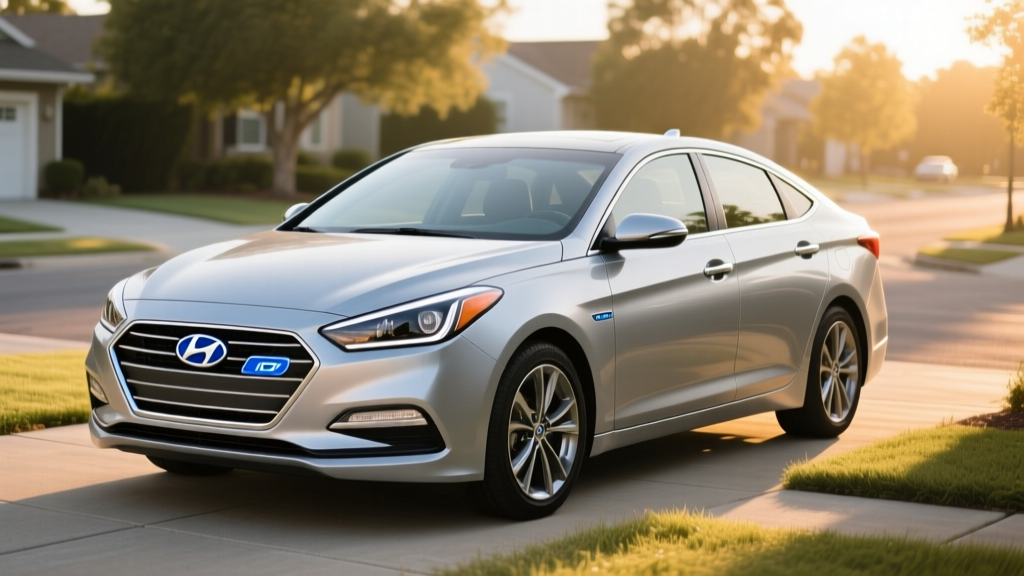
The 2016 Hyundai Sonata Plug-In Hybrid occupies a specific niche in the used-car market: a midsize sedan that can handle short commutes on electricity alone while retaining a gasoline engine for longer trips. With an EPA-rated 27 miles of electric-only range and 99 MPGe combined, it was one of the more practical PHEVs of its era. Now, as a used vehicle in 2026, it presents an affordable entry point into electrified driving — but buyers need to understand exactly what they're getting before signing any paperwork.
This guide covers every spec that matters, from battery capacity and charging times to real-world efficiency and long-term reliability. We'll also clarify how the Plug-In Hybrid differs from the conventional Sonata Hybrid, and whether either makes sense compared to a full battery-electric vehicle (BEV) today.
HEV vs. PHEV: Understanding the Two Sonata Hybrids
Hyundai sold two distinct hybrid variants of the Sonata in 2016, and confusing them is one of the most common mistakes used-car shoppers make. Here's the breakdown:
| Feature | 2016 Sonata Hybrid (HEV) | 2016 Sonata Plug-In Hybrid (PHEV) |
|---|---|---|
| Plug-in charging | No — charges via regenerative braking and engine | Yes — has a charge port for Level 1/Level 2 |
| Battery capacity | 1.62 kWh | 9.8 kWh |
| Electric-only range | None (electric-assist only) | 27 miles (EPA) |
| EPA combined MPG/MPGe | 40 MPG combined | 99 MPGe (electric) / 39 MPG (gas-only) |
| Combined horsepower | 193 hp | 202 hp |
| DC fast charging | N/A | No — Level 1/Level 2 only |
| Charge port | None | J1772 (Level 2) |
The conventional HEV is simpler: it never plugs in, has a small battery that assists the gasoline engine, and delivers strong city MPG through regenerative braking. The PHEV is a fundamentally different vehicle — it has a battery nearly six times larger, an electric motor powerful enough to drive the car solo at highway speeds, and a charge port that lets you replenish that battery from the grid. If you see a Sonata Hybrid without a charge port on the front fender, it's the HEV, not the PHEV.
Electric-Only Range, MPGe, and Fuel Economy
The headline figure for the 2016 Sonata Plug-In Hybrid is its 27 miles of EPA-rated electric-only range. That's enough to cover many daily commutes without burning a drop of gasoline, provided you charge at home or work.
EPA Electric-Only Range: 27 miles
Real-World Expectation: 20–25 miles in moderate weather; 15–19 miles in cold conditions (below 40°F) or at sustained highway speeds above 65 mph. Battery degradation in a 2016 model may reduce this further — expect 18–23 miles from a well-maintained example.
When the battery is depleted, the Sonata PHEV operates as a conventional hybrid, returning an EPA-rated 39 MPG combined (38 city / 40 highway). Here's the full efficiency breakdown:
| Mode | City | Highway | Combined |
|---|---|---|---|
| Electric (MPGe) | 101 MPGe | 95 MPGe | 99 MPGe |
| Gasoline-only (MPG) | 38 MPG | 40 MPG | 39 MPG |
Real-world MPG note: Like most hybrids, the Sonata PHEV tends to exceed its EPA city rating in stop-and-go traffic where regenerative braking is most effective. Owners frequently report 41–44 MPG in city driving once the battery is depleted. Highway driving at 75+ mph will drop efficiency closer to 35–37 MPG, as the gasoline engine works harder without regen assistance.
Total combined range — electric plus a full tank of gasoline — is approximately 550–590 miles, depending on driving conditions. The fuel tank holds 15.9 gallons.
Battery, Charging, and Powertrain Specs
| Specification | 2016 Sonata Plug-In Hybrid |
|---|---|
| Battery capacity | 9.8 kWh (lithium-polymer) |
| Usable battery capacity | ~7.6 kWh (approx. 78% usable buffer) |
| Electric motor output | 50 kW (67 hp) |
| Gasoline engine | 2.0L 4-cylinder, 154 hp |
| Combined system output | 202 hp |
| Transmission | 6-speed automatic |
| 0–60 mph | ~7.9 seconds |
| Level 1 charging (120V, 12A) | ~9 hours (0–100%) |
| Level 2 charging (240V, 16A) | ~2.5 hours (0–100%) |
| DC fast charging | Not supported |
| Charge connector | SAE J1772 |
| EPA electric range | 27 miles |
| EPA combined MPG (gas) | 39 MPG |
| EPA combined MPGe (electric) | 99 MPGe |
| Cargo volume | 13.3 cu ft (reduced by battery) |
A few things stand out in these specs. First, the 9.8 kWh battery was competitive for 2016 but modest by today's standards — the current-generation Toyota RAV4 Prime packs 18.1 kWh for 42 miles of range. Second, the Sonata PHEV does not support DC fast charging. This is typical for PHEVs of this era: the battery is small enough that Level 2 charging fills it in under three hours, making DCFC unnecessary for daily use. If you rely exclusively on public charging, though, the lack of fast charging means longer sessions.
The J1772 connector is the universal North American Level 2 standard. Every public Level 2 station in the U.S. is compatible, and adapters to NACS (Tesla) destination chargers are widely available for under $50.
Charging at Home: What to Expect
Most Sonata PHEV owners charge on a standard 120V household outlet (Level 1). At roughly 1.4 kW, a full charge takes about nine hours — perfectly adequate if the car sits overnight. If you install a 240V Level 2 home station (3.3–3.8 kW), you'll cut that to approximately 2.5 hours. Given the small battery, a dedicated Level 2 charger is a convenience upgrade, not a necessity.
Level 2 home installation typically costs $600–$1,500 including equipment and electrician labor, depending on panel proximity and local permit fees. For a PHEV with a 9.8 kWh battery, a basic 16-amp unit ($250–$400 for the charger itself) is sufficient.
Reliability, Battery Lifespan, and Warranty
The 2016 Sonata Plug-In Hybrid has generally solid reliability marks. The 2.0L naturally aspirated engine is well-proven, the 6-speed automatic avoids the complexity of a CVT, and Hyundai's hybrid system has fewer moving parts than some competitors. The most common complaints center on infotainment glitches and occasional 12V battery drain — neither of which is unique to the hybrid powertrain.
Original Hybrid Battery Warranty: 10 years / 100,000 miles (whichever comes first) for the lithium-polymer traction battery, covering defects and capacity loss below a manufacturer-defined threshold.
2026 Reality Check: A 2016 model is now 10 years old. If the original owner purchased in early 2016, the 10-year battery warranty has just expired or is expiring this year. Verify warranty transferability with a Hyundai dealer using the VIN — Hyundai's powertrain and hybrid battery warranties are typically tied to the original owner and do not transfer to second owners, who receive a reduced 5-year/60,000-mile warranty from the original in-service date.
Battery replacement cost: If the 9.8 kWh lithium-polymer pack fails outside warranty, expect a replacement cost of approximately $3,500–$5,500 including parts and labor at a dealership. Independent hybrid-battery specialists may offer refurbished packs for $2,000–$3,500. Before purchasing, request a battery health diagnostic — many dealers can read the State of Health (SoH) percentage from the battery management system.
According to fueleconomy.gov, the 2016 Sonata PHEV's combined annual fuel cost (assuming 15,000 miles/year and 55% highway driving) is approximately $1,100–$1,400 depending on local electricity and gasoline prices — a meaningful savings over the gasoline-only Sonata's ~$1,800 annual fuel cost.
Used Pricing and Tax Credit Eligibility
As of early 2026, the 2016 Hyundai Sonata Plug-In Hybrid trades in the used market between approximately $9,000 and $14,500, depending on mileage, condition, and trim (Limited was the sole PHEV trim). Well-maintained examples under 80,000 miles command the higher end of that range.
Does It Qualify for a Tax Credit?
Under current IRS §30D rules, the federal new-vehicle EV/PHEV tax credit of up to $7,500 does not apply to used vehicles purchased in 2026. However, the Used Clean Vehicle Credit (§25E) may apply:
- Credit amount: 30% of the sale price, up to a maximum of $4,000
- Vehicle price cap: Sale price must be $25,000 or less (the Sonata PHEV easily qualifies)
- Vehicle age requirement: Must be at least 2 model years old (2016 qualifies)
- Buyer income cap: AGI must not exceed $75,000 (single), $112,500 (head of household), or $150,000 (joint filers)
- Dealer requirement: Must be purchased from a licensed dealer (private-party sales do not qualify)
- Transfer at sale: The credit can be transferred to the dealer as a point-of-sale discount, reducing your out-of-pocket cost immediately
- Battery requirement: Vehicle must have a battery capacity of at least 7 kWh (the Sonata's 9.8 kWh qualifies)
- One-time use: Each buyer can claim this credit once every three years
At a $12,000 sale price, the 30% credit equals $3,600 — effectively bringing the net cost to $8,400 for eligible buyers. Always verify current rules at IRS.gov and consult a tax professional, as income limits and sourcing requirements can change.
Who Should Buy the Sonata PHEV vs. a Full EV or Gas Car
Choose the 2016 Sonata Plug-In Hybrid if:
- Your daily commute is under 25 miles round-trip and you can charge at home
- You want electric commuting but regularly take trips exceeding 200 miles
- You lack access to reliable public DC fast charging infrastructure
- Your budget is under $15,000 and you want electrified efficiency
- You want a conventional sedan with a large trunk (albeit reduced to 13.3 cu ft)
Choose a full BEV (e.g., used Chevrolet Bolt, Nissan Leaf) instead if:
- You can charge at home and your daily driving rarely exceeds 100 miles
- You want zero gasoline expenses and minimal maintenance (no oil changes, no engine)
- You have access to DC fast charging for road trips
Choose the conventional Sonata Hybrid (HEV) instead if:
- You cannot charge at home or at work
- You want hybrid efficiency (40+ MPG) without managing a plug-in routine
- You want lower upfront cost and less complexity
The Sonata PHEV's sweet spot is the driver with a short, predictable commute who still needs the flexibility of a gas engine for weekend trips. If you can plug in every night, you may go weeks without visiting a gas station. If you can't plug in regularly, you're carrying 300+ pounds of dead battery weight for nothing — buy the HEV instead.
Pros and Cons at a Glance
Pros
- 27-mile electric range covers most commutes
- 99 MPGe / 39 MPG combined — efficient in both modes
- Comfortable midsize sedan with good highway manners
- Qualifies for up to $4,000 used-vehicle tax credit
- J1772 connector — compatible with all public Level 2 stations
- Smooth electric-only driving at highway speeds
- Affordable used pricing ($9K–$14.5K)
Cons
- No DC fast charging capability
- Trunk reduced to 13.3 cu ft (battery intrusion)
- Original 10-year battery warranty has expired or is expiring
- Limited trim availability (only Limited trim offered as PHEV)
- Dated infotainment — no Apple CarPlay/Android Auto on 2016 model
- 9-hour Level 1 charge time is slow for a full replenishment
- Battery degradation may reduce electric range to 18–23 miles
Frequently Asked Questions
How many MPG does the 2016 Hyundai Sonata Plug-In Hybrid get?
On electric power, it achieves 99 MPGe combined (101 city / 95 highway). Once the battery is depleted, it operates as a conventional hybrid returning 39 MPG combined (38 city / 40 highway). Real-world city MPG often exceeds 40 thanks to regenerative braking.
How far can it go on electric only?
The EPA rates it at 27 miles of electric-only range. In real-world conditions, expect 20–25 miles in moderate weather and 15–19 miles in cold weather or at sustained highway speeds. Battery degradation in a 10-year-old vehicle may reduce this further.
Is the 2016 Sonata Plug-In Hybrid reliable?
Overall reliability is good. The 2.0L engine and 6-speed automatic are proven components, and Hyundai's hybrid system has a solid track record. The primary risk is the aging 9.8 kWh lithium-polymer battery, which is now at or beyond its original 10-year/100,000-mile warranty. A pre-purchase battery health check is strongly recommended.
What does a replacement battery cost?
A new OEM replacement battery costs approximately $3,500–$5,500 installed at a dealership. Refurbished or reconditioned packs from independent hybrid specialists may be available for $2,000–$3,500.
Does it qualify for any tax credit in 2026?
It does not qualify for the new-vehicle §30D credit. However, it may qualify for the Used Clean Vehicle Credit (§25E): 30% of the sale price up to $4,000, subject to buyer income caps ($75K single / $150K joint), a $25,000 maximum sale price, and purchase through a licensed dealer. Verify eligibility at IRS.gov.
Can I DC fast charge the Sonata PHEV?
No. The 2016 Sonata Plug-In Hybrid supports only Level 1 (120V) and Level 2 (240V, J1772 connector) charging. A full Level 2 charge takes approximately 2.5 hours; Level 1 takes about 9 hours.
Hybrid vs. PHEV vs. EV — which should I choose?
If you can charge at home and your daily driving is under 30 miles, the PHEV gives you electric commuting with gas-engine backup for long trips. If you can't charge at home, the conventional HEV delivers strong MPG without plug-in hassle. If you have home charging, rarely drive over 150 miles, and want zero gas costs, a full BEV is the better long-term choice. The Sonata PHEV is ideal for the "short commute, occasional road trip" driver who isn't ready to commit to full electric.
The 2016 Hyundai Sonata Plug-In Hybrid remains a practical, value-oriented used PHEV in 2026. Its 27-mile electric range and 39 MPG gas-only efficiency are still competitive, and the potential $4,000 used-vehicle tax credit makes it one of the most affordable ways to access plug-in driving. Just verify the battery health, understand the warranty status, and confirm it fits your daily driving pattern before committing.