Quick Verdict: A Proven Midsize Hybrid for Budget-Conscious Commuters
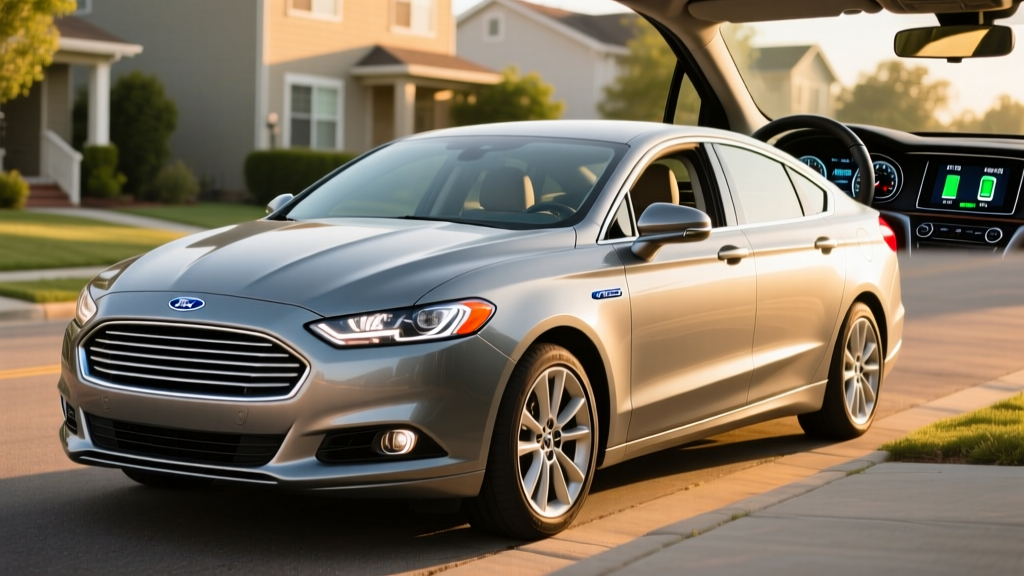
The 2016 Ford Fusion Hybrid SE occupies a specific niche in the 2026 used-car market: a midsize sedan that delivers genuine hybrid fuel savings without requiring a plug, a charging routine, or a steep purchase price. With an EPA-estimated 43 MPG combined, a proven 2.0-liter Atkinson-cycle powertrain, and a trunk full of cargo space (despite the hybrid battery packaging), this generation of Fusion Hybrid remains a rational choice for buyers who want electrified efficiency without committing to a plug-in hybrid (PHEV) or full battery-electric vehicle (BEV).
But a 10-year-old hybrid raises legitimate questions. How has the battery held up? What does replacement cost? And does the real-world fuel economy match the EPA sticker? This guide breaks down every number that matters.
HEV vs PHEV: What the 2016 Fusion Hybrid Actually Is
Before diving into specs, it's critical to understand what you're buying — because Ford sold two electrified Fusion variants in 2016, and they operate very differently.
| Attribute | Fusion Hybrid (HEV) | Fusion Energi (PHEV) |
|---|---|---|
| Plug-in charging required? | No — self-charging via regen & engine | Yes — plug in for electric-only miles |
| Battery capacity | 1.4 kWh (usable ~1.0 kWh) | 7.6 kWh (usable ~5.5 kWh) |
| Electric-only range | None (EV assist only, ~1-2 mi at low speed) | ~20 miles EPA electric-only |
| EPA combined MPG/MPGe | 43 MPG combined | 88 MPGe (electric) / 38 MPG (gas-only) |
| Total range | ~550+ miles | ~550 miles (EV + gas combined) |
| Federal tax credit (original) | None | ~$4,007 (expired for new purchases) |
The 2016 Ford Fusion Hybrid SE is the conventional hybrid (HEV). It does not plug in. The gasoline engine and regenerative braking recharge the small lithium-ion battery automatically. If you're looking for electric-only commuting range, you want the Fusion Energi (PHEV) instead — but that's a different vehicle with different trade-offs, which we'll cover below.
Fuel Economy: EPA Ratings and Real-World MPG
According to fueleconomy.gov, the 2016 Ford Fusion Hybrid achieves the following EPA estimates:
| Driving Cycle | MPG |
|---|---|
| City | 44 MPG |
| Highway | 41 MPG |
| Combined | 43 MPG |
Real-World MPG: What Owners Actually Report
Hybrid fuel economy is notoriously sensitive to driving style, and the Fusion Hybrid is no exception. The EPA's 43 MPG combined is achievable — and many owners exceed it in city-dominant driving. Here's what to expect:
- City / stop-and-go commuting: 44–48 MPG. The electric motor handles low-speed propulsion, and regenerative braking recaptures energy at every stop. Hybrids shine here.
- Mixed suburban driving: 40–44 MPG. Close to EPA combined.
- Sustained highway (70+ mph): 36–40 MPG. Aerodynamic drag dominates, the engine runs more often, and the hybrid system offers less advantage.
- Cold weather (below 30°F): Expect a 5–10% reduction. The engine runs more frequently to provide cabin heat and warm up the catalytic converter, reducing electric-motor utilization.
Owner-reported averages on Fuelly and similar platforms cluster around 40–42 MPG combined, which aligns closely with the EPA figure. Drivers who accelerate gently and anticipate stops regularly report mid-40s.
Powertrain Specs: Engine, Motor, and Combined Output
| Specification | Value |
|---|---|
| Engine | 2.0L Atkinson-cycle inline-4 |
| Engine horsepower | 141 HP @ 6,000 RPM |
| Electric motor | Permanent-magnet AC synchronous |
| Motor horsepower | 118 HP |
| Combined system output | 188 HP |
| Transmission | Electronically controlled CVT (eCVT) |
| Drivetrain | Front-wheel drive |
| Battery type | Lithium-ion (1.4 kWh gross) |
| 0–60 mph | ~7.8 seconds (Motor Trend tested) |
| Fuel tank | 13.5 gallons |
| Total range (estimated) | ~550–580 miles |
The 2.0L Atkinson-cycle engine sacrifices some peak power for thermal efficiency — it runs a late intake-valve closing cycle that extracts more energy from each combustion event. Paired with the electric motor through Ford's eCVT (which is a planetary gearset, not a belt-driven CVT), the powertrain delivers seamless transitions between electric-only, engine-only, and blended propulsion.
The 188 HP combined output is adequate for highway merging and passing. It's not sporty — this is an efficiency-first sedan — but it's never dangerously underpowered either. The eCVT avoids the "rubber-band" feel of traditional CVTs because the planetary gearset provides a direct mechanical connection between the engine and wheels.
Battery Longevity, Warranty, and Replacement Cost
Hybrid Battery Warranty (Original)
Ford warranted the 2016 Fusion Hybrid's lithium-ion traction battery for 8 years / 100,000 miles (whichever comes first) in most states, and 10 years / 150,000 miles in California Air Resources Board (CARB) states (CA, CT, ME, MD, MA, NJ, NY, OR, RI, VT, WA). By 2026, most 2016 models will have aged out of the standard 8-year warranty unless they were originally sold in a CARB state and remain under 150,000 miles.
Degradation Reality at 10 Years
The 2016 Fusion Hybrid uses a relatively small 1.4 kWh lithium-ion pack. Small hybrid batteries experience less stress than large BEV packs because:
- Shallow cycling: The battery management system (BMS) keeps the state of charge between roughly 40% and 60%, never fully charging or fully depleting the cells.
- Low C-rates: Charge and discharge rates are gentle compared to DC fast-charging a 75 kWh BEV pack.
- Air cooling: While less sophisticated than liquid thermal management, the Fusion's air-cooled pack has proven adequate for the low-stress duty cycle.
Based on owner reports and hybrid fleet data, 2016 Fusion Hybrid batteries at 100,000–150,000 miles typically retain 85–95% of original capacity. Because the battery is small and primarily assists the engine (rather than providing meaningful electric-only range), even 15–20% degradation is barely noticeable in daily driving — you may see 1–2 MPG less than when new.
Battery Replacement Cost
If the hybrid battery does fail outside warranty, here's what to budget:
- New OEM battery (Ford dealer): $2,500–$4,000 including parts and labor
- Remanufactured / refurbished battery: $1,500–$2,500 installed
- Used/salvage battery: $800–$1,500 (risky without cell-level testing)
The good news: widespread hybrid battery failure on this generation has not been a pattern. The 2013–2016 Fusion Hybrid battery is considered one of the more reliable packs in Ford's lineup. Independent hybrid specialists in most metro areas can now service these batteries at lower cost than a dealership.
2026 Used Pricing and Tax Credit Eligibility
As of early 2026, the 2016 Ford Fusion Hybrid SE trades on the used market in the following range:
| Condition / Mileage | Approximate Price |
|---|---|
| Excellent, under 70,000 mi | $13,000–$15,500 |
| Good, 70,000–110,000 mi | $10,000–$13,000 |
| Fair, 110,000–150,000 mi | $7,500–$10,000 |
| High mileage, 150,000+ mi | $5,500–$7,500 |
Federal Tax Credit Status
The 2016 Ford Fusion Hybrid (HEV) does not qualify for the federal §30D new clean vehicle credit and never did — conventional hybrids are not eligible. It also does not qualify for the Used Clean Vehicle Credit (§25E), because that credit requires the vehicle to be a qualified plug-in electric vehicle or fuel cell vehicle with a battery capacity of at least 7 kWh. The Fusion Hybrid's 1.4 kWh battery falls well short.
The Fusion Energi (PHEV) variant, with its 7.6 kWh battery, may qualify for the used-EV credit of up to $4,000 if purchased from a dealer for under $25,000 and the buyer meets IRS income requirements (AGI under $75,000 single / $150,000 married filing jointly). But that's the Energi, not the Hybrid SE covered here.
Some states offer their own incentives for used hybrid purchases — check your state's energy office or DMV for current programs.
Who Should Buy the 2016 Fusion Hybrid SE — And Who Shouldn't
Choose the 2016 Fusion Hybrid SE If:
- You want a comfortable midsize sedan with 40+ MPG and zero plug-in hassle
- Your commute is city-dominant or mixed (where the hybrid system excels)
- You lack access to home or workplace charging (making a PHEV or BEV impractical)
- You're budgeting under $15,000 and want proven reliability
- You need a full-size trunk (12.0 cu ft) for luggage or groceries
Look Elsewhere If:
- You want electric-only commuting — consider the Fusion Energi (PHEV), Toyota Prius Prime, or a used Chevrolet Volt
- You drive mostly highway miles — the hybrid advantage shrinks to ~36–40 MPG, and a modern turbo-diesel or efficient gas sedan narrows the gap
- You want the latest ADAS features — the 2016 Fusion lacks automatic emergency braking as standard and has no lane-centering assist
- You need all-wheel drive — the Fusion Hybrid is FWD only; consider the Toyota Camry Hybrid AWD or Ford Escape Hybrid instead
Hybrid vs PHEV vs EV: Which Powertrain Fits You?
| Factor | HEV (e.g., Fusion Hybrid) | PHEV (e.g., Fusion Energi) | BEV (e.g., Tesla Model 3) |
|---|---|---|---|
| Plug-in required? | No | Yes (for EV range) | Yes (always) |
| Home charging needed? | No | Recommended | Essential |
| Electric-only range | ~1 mi at low speed | 15–25 mi typical | 250–350+ mi |
| Fuel cost per mile | ~$0.08–0.10 | ~$0.04 (EV) / $0.10 (gas) | ~$0.03–0.05 |
| Maintenance cost | Low (no plug system) | Moderate (two systems) | Lowest (no engine) |
| Upfront cost (used, 2026) | $7K–$15K | $9K–$17K | $18K–$35K+ |
| Best for | No-charging-access buyers | Short-commute plug-in users | Home-charging, low-miles drivers |
The 2016 Fusion Hybrid SE makes the most sense as a transitional electrified vehicle: it cuts your fuel bill by roughly 35–40% compared to the gas-only Fusion (rated at 26 MPG combined) without requiring any infrastructure investment. If you can install a Level 2 charger at home and your commute is under 20 miles, a PHEV like the Fusion Energi or a used Chevrolet Volt delivers lower per-mile cost on most trips. If you're ready to go fully electric, a used 2020–2022 Tesla Model 3 or Chevrolet Bolt EV offers dramatically lower running costs — but at a higher entry price and the need for reliable charging access.
Reliability Notes and Common Issues
The 2016 Fusion Hybrid benefits from Ford's second-generation hybrid system, which debuted in the 2013 model year and had four years of refinement by 2016. Key reliability notes:
- Hybrid system: The eCVT planetary gearset, inverter, and electric motor have proven durable. Major hybrid-component failures are uncommon before 200,000 miles.
- 12V battery: Like all hybrids, the Fusion has a conventional 12V lead-acid battery that powers accessories and boots the hybrid system. Expect replacement every 4–5 years (~$150–$250).
- Brake wear: Regenerative braking significantly reduces friction-brake use. Original brake pads often last 80,000–120,000 miles.
- Coolant system: The hybrid system has its own coolant loop. Ford recommends coolant replacement at 100,000 miles — don't skip this.
- Known issues: Some owners report intermittent SYNC infotainment glitches (software updates help) and occasional power-steering assist warnings (check for open recalls via NHTSA).
Pros and Cons at a Glance
Pros
- 43 MPG combined EPA — real-world city driving can exceed 45 MPG
- No plug-in charging required — works with existing gas-station infrastructure
- Spacious midsize cabin with comfortable seating for five
- 12.0 cu ft trunk (only 2.0 cu ft less than gas Fusion)
- Proven hybrid powertrain with low failure rates
- Low used-car entry price ($7K–$15K in 2026)
- Regenerative braking extends brake life significantly
Cons
- Highway MPG drops to ~36–40 — less advantage on long road trips
- No electric-only driving range to speak of
- 2016-era infotainment (SYNC 2) feels dated; no Apple CarPlay/Android Auto on base units
- FWD only — no AWD option for snow-belt buyers
- No federal tax credit eligibility (new or used)
- Original hybrid battery warranty likely expired on most examples
- Discontinued after 2020 — long-term parts availability for body/interior trim may narrow
Frequently Asked Questions
How many MPG does the 2016 Ford Fusion Hybrid SE get?
The EPA rates it at 44 city / 41 highway / 43 combined. Real-world owners average 40–42 MPG combined, with city-dominant drivers regularly seeing 44–48 MPG. Highway-heavy driving at 70+ mph yields 36–40 MPG.
Does the 2016 Fusion Hybrid need to be plugged in?
No. The Fusion Hybrid is a conventional hybrid (HEV). It charges its own 1.4 kWh battery through regenerative braking and the gasoline engine. You fuel it like any other car at a gas station. Only the Fusion Energi (PHEV) variant requires plugging in.
How far can the 2016 Fusion Hybrid drive on electric power alone?
Effectively zero miles in any practical sense. The electric motor assists the engine at low speeds and can propel the car solo for roughly one mile at under 25 mph on a full charge, but the system is designed for blended operation, not electric-only driving. If you want electric-only range, look at the Fusion Energi (PHEV), which offers about 20 miles on battery alone.
Is the 2016 Fusion Hybrid reliable, and what does a battery replacement cost?
The 2016 Fusion Hybrid has a strong reliability record for its hybrid powertrain. The 1.4 kWh lithium-ion battery degrades slowly due to shallow cycling and typically retains 85–95% capacity at 100,000–150,000 miles. If replacement is needed, expect $1,500–$2,500 for a refurbished unit or $2,500–$4,000 for new OEM. The original 8-year/100,000-mile hybrid battery warranty has likely expired on most 2016 examples by 2026 (10-year/150,000-mile in CARB states may still apply).
Does the 2016 Ford Fusion Hybrid qualify for any tax credit?
No. The Fusion Hybrid (HEV) does not qualify for the federal §30D new vehicle credit or the §25E used clean vehicle credit, as it is not a plug-in vehicle and its battery is far below the 7 kWh minimum. The Fusion Energi (PHEV) may qualify for the used-EV credit of up to $4,000 if purchased under $25,000 from a dealer and the buyer meets IRS income caps. Check IRS.gov for current eligibility rules.
How does the Fusion Hybrid compare to a Toyota Camry Hybrid of the same year?
The 2016 Toyota Camry Hybrid (40 MPG combined EPA) trails the Fusion Hybrid by 3 MPG but has a stronger long-term parts ecosystem and a reputation for slightly better hybrid-system longevity. The Fusion offers a more refined ride, a quieter cabin, and a larger trunk. Both are strong used hybrid picks — the Fusion wins on efficiency, the Camry on brand reliability perception and resale.
What maintenance does the hybrid system require?
Beyond standard gas-car maintenance (oil changes every 7,500–10,000 miles, tire rotations, cabin air filter), the hybrid system adds two items: hybrid-system coolant replacement at 100,000 miles, and periodic inverter cooling system inspection. The eCVT has no transmission fluid to change on Ford's recommended schedule. Overall, maintenance costs are comparable to or slightly lower than the gas-only Fusion due to reduced brake wear.