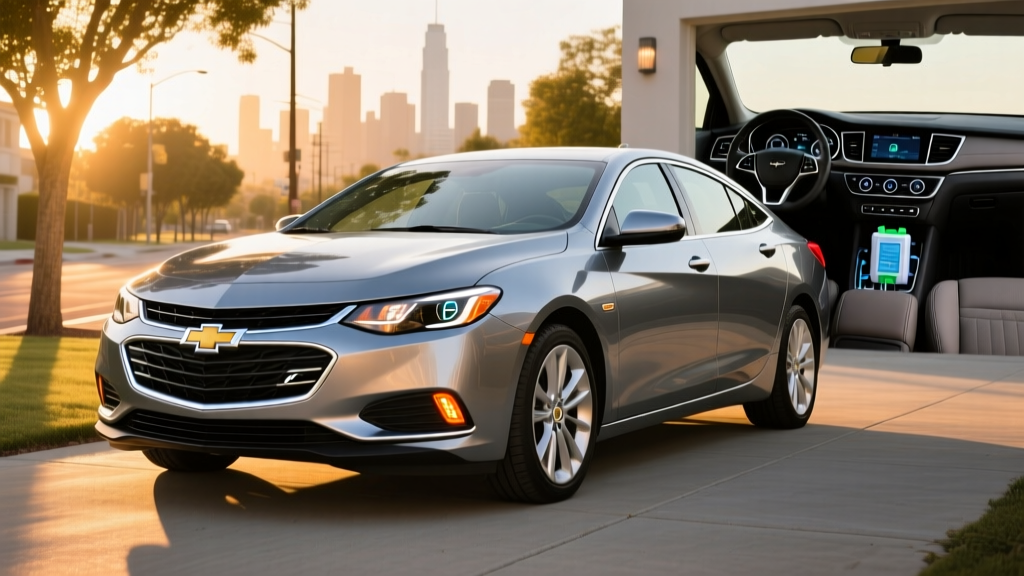
The 2016 Chevrolet Malibu Hybrid arrived as a fuel-sipping midsize sedan built for buyers who wanted Prius-rivaling efficiency without the Prius look. A decade later, it remains a compelling option on the used-hybrid market — especially as newer electrified vehicles command premium prices. If you're researching the 2016 Chevrolet Malibu Hybrid as a potential daily driver, this guide covers every number that matters: EPA and real-world MPG, battery longevity, replacement cost, and how it stacks up against modern hybrids, PHEVs, and full EVs.
HEV vs PHEV vs EV: Where the Malibu Hybrid Fits
Before diving into specs, it's critical to understand what the 2016 Malibu Hybrid is — and what it isn't. Chevrolet sold the ninth-generation Malibu in three powertrain flavors, and confusing them is a common mistake among used-car shoppers:
| Type | Powertrain | Plug-In Required? | Electric-Only Driving | 2016 Malibu Available? |
|---|---|---|---|---|
| HEV (Conventional Hybrid) | Gas engine + small electric motor; charges via regen braking | No — never plugs in | Very limited (low-speed assist only) | Yes — Malibu Hybrid |
| PHEV (Plug-In Hybrid) | Gas engine + larger motor & battery; can plug in to charge | Yes — for electric range | Typically 20–50 miles | No — not offered for Malibu |
| BEV (Battery Electric) | Electric motor only; no gas engine | Yes — always | Full range (200–400+ mi) | No — not offered for Malibu |
The 2016 Chevrolet Malibu Hybrid is a conventional HEV. It has no plug, no charging port, and no meaningful electric-only range. You fuel it like any gas car, and the hybrid system automatically recovers energy during braking and coasting to assist the gasoline engine. This distinction matters because some used listings mistakenly advertise it as a "plug-in" — it is not.
Fuel Economy: EPA Ratings and Real-World MPG
The headline number for the 2016 Malibu Hybrid is its EPA-estimated fuel economy, which was class-leading at launch. Here's the official breakdown from fueleconomy.gov:
| Driving Cycle | EPA Estimated MPG |
|---|---|
| City | 47 MPG |
| Highway | 46 MPG |
| Combined | 46 MPG |
Real-World MPG: What Owners Actually See
Conventional hybrids like the Malibu Hybrid tend to meet or exceed their EPA city estimates because stop-and-go traffic maximizes regenerative braking. Highway driving is where real-world figures may dip slightly, especially at sustained speeds above 70 mph or in cold weather.
- City/commute driving: Most owners report 44–50 MPG, with careful drivers occasionally exceeding the EPA 47 MPG city figure.
- Highway cruising (70–80 mph): Expect 38–43 MPG. Aerodynamic drag and the engine running more continuously reduce the hybrid advantage.
- Cold weather (below 32°F): Expect a 5–10% drop (roughly 40–43 MPG combined). The engine runs longer to warm the cabin and maintain battery temperature.
- Overall mixed driving: Real-world owner averages cluster around 42–46 MPG combined, closely tracking the EPA estimate.
For comparison, the gas-only 2016 Malibu with the 1.5L turbo four-cylinder rates at 27 city / 37 highway / 30 combined MPG. The hybrid nearly doubles the city figure and adds roughly 16 MPG on the combined cycle — a substantial gain that translates to real fuel savings.
Powertrain Specs: Engine, Motor, and Combined Output
| Specification | 2016 Chevrolet Malibu Hybrid |
|---|---|
| Engine | 1.8L inline-4 (Atkinson cycle) |
| Engine HP | 122 hp |
| Electric Motor | Two-motor drive unit (integrated into transaxle) |
| Combined System Output | 182 hp |
| Transmission | Continuously Variable (CVT — electrically variable) |
| Hybrid Battery | 1.5 kWh lithium-ion (80-cell) |
| 0–60 mph | ~7.5 seconds (est.) |
| Drivetrain | Front-wheel drive |
| Curb Weight | ~3,457 lbs |
| Fuel Tank | 13.0 gallons |
| Total Range (est.) | ~598 miles (at 46 MPG combined) |
The Malibu Hybrid's powertrain shares its two-motor Voltec-derived architecture with the contemporary Chevrolet Volt, though tuned for a conventional hybrid application. The 1.8L Atkinson-cycle engine prioritizes thermal efficiency over peak power, while the twin electric motors handle launch assist, regenerative braking, and seamless engine stop/start. The result is smooth, quiet acceleration from stops — one of the most refined hybrid drivetrains GM has produced.
Note the 1.5 kWh battery. This is a small hybrid-assist pack, not a traction battery designed for electric-only driving. It cannot be plugged in and cannot propel the car on electricity alone beyond brief low-speed creeping.
Battery Longevity, Warranty, and Replacement Cost
Battery lifespan is the single biggest concern for any used-hybrid buyer. Here's what you need to know about the 2016 Malibu Hybrid's pack:
Hybrid Battery Warranty (Original)
- Coverage: 8 years / 100,000 miles (whichever comes first)
- What's covered: Defects and capacity loss below a functional threshold
- Transferable: Yes — warranty follows the vehicle, not the original owner
- 2026 status: Most 2016 models have now exceeded the original 8-year warranty window
Real-World Battery Degradation
GM's lithium-ion hybrid packs from this era have proven durable. Unlike full EV batteries that cycle deeply every day, the Malibu Hybrid's 1.5 kWh pack operates in a narrow state-of-charge window (roughly 20–80% SoC), which dramatically reduces chemical stress. The battery management system never allows full charge or full discharge, preserving long-term health.
Based on owner reports and hybrid technician data:
- 100,000–150,000 miles: Most packs show minimal degradation; MPG remains within 1–2 MPG of new.
- 150,000–200,000 miles: Some capacity loss is normal, but complete failure is uncommon.
- Known failure mode: Individual cell imbalance rather than total pack death — a hybrid specialist can often recondition or replace individual modules.
Battery Replacement Cost
If the hybrid battery does fail outside warranty:
- New OEM replacement: $2,500–$4,000 (parts + labor at a dealership)
- Remanufactured/refurbished pack: $1,500–$2,500 from a hybrid specialist
- Individual module repair: $500–$1,200 if only specific cells have failed
For context, a high-voltage hybrid battery replacement is far less expensive than a full EV battery swap (which can exceed $10,000–$15,000). The Malibu Hybrid's small 1.5 kWh pack keeps replacement costs manageable.
Pricing in 2026: Used Market Values
The 2016 Malibu Hybrid was originally sold in a single, well-equipped trim with an MSRP of approximately $28,645 (including destination). It did not qualify for the federal §30D plug-in vehicle tax credit because it is a conventional HEV — a rule that remains unchanged in 2026. The IRS §30D credit applies only to plug-in electric vehicles (PHEVs and BEVs), not self-charging hybrids.
As of early 2026, used-market pricing for the 2016 Malibu Hybrid:
- 80,000–110,000 miles, good condition: $9,000–$12,000
- 110,000–150,000 miles, good condition: $7,000–$9,500
- 150,000+ miles or fair condition: $5,500–$7,500
At these prices, the Malibu Hybrid represents strong value — you're getting a 46-MPG midsize sedan for less than half the cost of a new compact hybrid. Factor in fuel savings versus a gas-only midsize sedan (roughly $600–$900/year at 15,000 miles driven and $3.40/gallon), and the payback on the hybrid premium is short.
Who Should Buy the 2016 Malibu Hybrid — and Who Shouldn't
Pros
- EPA 46 MPG combined — excellent for a midsize sedan
- Refined, quiet hybrid powertrain with smooth stop/start
- Spacious interior (15.8 cu-ft trunk, competitive rear legroom)
- Low battery replacement cost vs. EVs
- No charging infrastructure needed — just fill up with gas
- Strong value on the used market ($7K–$12K)
Cons
- No plug-in capability or electric-only range
- Original 8-year battery warranty has expired on most examples
- Only one trim was offered — limited option flexibility
- Hybrid-specific components may deter some independent mechanics
- Not eligible for any federal EV tax credit
- Aging infotainment system (2016-era Chevrolet MyLink)
Decision Framework: Is This the Right Electrified Vehicle for You?
Choose the 2016 Malibu Hybrid if: You want maximum MPG without changing your fueling habits, you don't have access to home or workplace charging, and you want a comfortable midsize sedan on a budget under $12,000.
Choose a PHEV (e.g., Toyota Prius Prime, Hyundai Tucson PHEV) if: You have reliable Level 2 charging access at home or work, your daily commute is under 30–40 miles (within electric-only range), and you want to drive mostly on electricity while keeping a gas engine for road trips.
Choose a full EV (e.g., Tesla Model 3, Chevrolet Equinox EV) if: You have consistent home charging, your daily driving is under 250 miles, you want to eliminate gasoline entirely, and you can budget $25,000+ for a used EV or $35,000+ new (potentially offset by the §30D federal tax credit of up to $7,500 for qualifying new EVs).
Reliability and Ownership Costs
The 2016 Malibu is the first year of the ninth generation, and first-model-year vehicles sometimes carry higher risk of early-production issues. That said, the hybrid powertrain itself — the two-motor Voltec drive unit and lithium-ion pack — is derived from the extensively validated Chevrolet Volt system and has a strong reliability record.
Key ownership considerations:
- Brakes: Hybrid regenerative braking significantly reduces pad wear. Many owners report 80,000+ miles on original brake pads.
- Transmission: The electrically variable transaxle has no traditional gears or torque converter, reducing mechanical wear points.
- 12V battery: Like all modern vehicles, the 12V auxiliary battery will need replacement every 4–6 years (~$150–$250). This is separate from the hybrid battery.
- Insurance: Typically comparable to the gas Malibu; hybrids don't carry the insurance premiums that some high-value EVs do.
- Maintenance: No hybrid-specific routine maintenance is required. Oil changes, tire rotations, and fluid top-offs follow standard intervals.
For a more detailed reliability picture, consult NHTSA safety and complaint data for the 2016 Malibu Hybrid. The model received a 5-Star Overall Safety Rating from NHTSA, which adds peace of mind for used buyers.
Frequently Asked Questions
How many MPG does the 2016 Chevrolet Malibu Hybrid get?
The EPA rates it at 47 city / 46 highway / 46 combined MPG. Real-world mixed driving typically yields 42–46 MPG combined, with city driving often matching or exceeding the 47 MPG estimate thanks to regenerative braking.
Does the 2016 Malibu Hybrid need to be plugged in?
No. The 2016 Malibu Hybrid is a conventional HEV (hybrid electric vehicle), not a plug-in hybrid. It charges its small 1.5 kWh battery entirely through regenerative braking and the gasoline engine. There is no charging port.
How far can it go on electric only?
It cannot. Unlike a PHEV, the Malibu Hybrid has no meaningful electric-only range. The electric motor assists the gas engine and handles brief low-speed maneuvers, but the gasoline engine is always the primary propulsion source.
Is the hybrid battery still under warranty in 2026?
The original warranty was 8 years / 100,000 miles. Since the 2016 model year is now a decade old, most examples have exceeded the warranty period — unless the vehicle has very low mileage and the warranty was extended by a certified pre-owned program. Verify warranty status with a GM dealer using the VIN before purchasing.
How much does it cost to replace the hybrid battery?
A new OEM replacement runs $2,500–$4,000 installed at a dealership. Remanufactured packs from hybrid specialists cost $1,500–$2,500. Individual cell-module repairs can be as low as $500–$1,200. Complete hybrid battery failure is uncommon on this platform.
Does the 2016 Malibu Hybrid qualify for any tax credit?
No. Federal §30D clean vehicle credits apply only to plug-in electric vehicles (PHEVs and BEVs) that meet battery capacity, MSRP, income, and critical-mineral sourcing requirements. Conventional hybrids like the Malibu Hybrid do not qualify. Some states or utilities may offer minor incentives for hybrids — check your local programs — but there is no federal credit available.
Is the 2016 Malibu Hybrid reliable?
The Voltec-derived hybrid system has a strong track record. The 1.8L Atkinson-cycle engine is low-stress, and the two-motor transaxle eliminates many traditional failure points. The main risk for a 10-year-old hybrid is battery degradation, though real-world reports suggest most packs remain functional well past 150,000 miles. Check NHTSA data for any open recalls or technical service bulletins before buying.
How does it compare to a Toyota Prius of the same era?
The 2016 Prius (fourth generation) rates at 52–56 MPG combined — roughly 6–10 MPG better than the Malibu Hybrid. However, the Malibu offers significantly more interior space, a quieter ride, and a more conventional sedan driving experience. If maximum MPG is your only priority, the Prius wins. If you want midsize comfort with strong efficiency, the Malibu Hybrid is the better fit.