Quick Verdict: The 2015 Camry Hybrid XLE in 2026
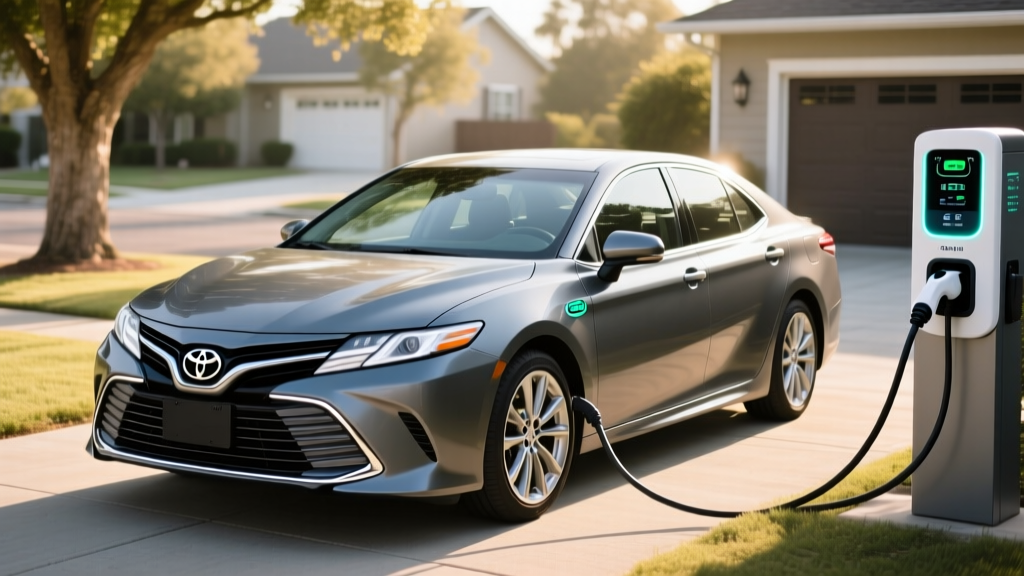
If you are shopping for a dependable, fuel-efficient midsize sedan on the used market, the 2015 Toyota Camry Hybrid XLE remains one of the most compelling choices. As a conventional hybrid electric vehicle (HEV), it requires no plug, no charging infrastructure, and no behavioral change from a standard gas car — it simply delivers consistently strong fuel economy through regenerative braking and electric-motor assist. The XLE trim adds leather-trimmed seats, dual-zone automatic climate control, and a premium audio system that elevate it above the base LE and sportier SE trims.
In 2026, a well-maintained 2015 Camry Hybrid XLE typically trades between $11,000 and $16,500 depending on mileage and condition. With EPA-rated efficiency of 40 MPG combined and Toyota's proven hybrid synergy drive, this sedan offers total cost of ownership that undercuts most competitors — gas or electrified — in its price bracket.
HEV vs PHEV: What Kind of Hybrid Is the Camry?
The 2015 Camry Hybrid is a conventional hybrid (HEV), not a plug-in hybrid (PHEV). This is the single most important distinction for buyers:
| Feature | HEV (2015 Camry Hybrid) | PHEV (e.g., Prius Prime) | BEV (e.g., Tesla Model 3) |
|---|---|---|---|
| Plug-in charging required? | No | Yes (for EV range) | Yes (always) |
| Electric-only driving | Brief, low-speed only (~1 mi) | 25–44 mi typical | 250–350+ mi |
| Battery size | 1.6 kWh (NiMH) | 8.8–13.6 kWh (Li-ion) | 50–100 kWh (Li-ion) |
| Gas engine? | Yes (primary power) | Yes (backup + hybrid) | No |
| Federal tax credit (§30D)? | No | Up to $7,500 (new only, subject to rules) | Up to $7,500 (subject to rules) |
| Fuel/energy source | Gasoline only | Gasoline + electricity | Electricity only |
The Camry Hybrid generates all its electricity internally — through the gasoline engine and regenerative braking. You never plug it in. This makes it ideal for drivers without access to home or workplace charging who still want significantly better fuel economy than a conventional gas car.
Fuel Economy: EPA Ratings vs Real-World MPG
| Driving Condition | EPA Rating | Real-World Expectation |
|---|---|---|
| City | 40 MPG | 38–44 MPG (hybrids often exceed EPA in city) |
| Highway | 38 MPG | 35–40 MPG (aerodynamic drag reduces electric assist benefit) |
| Combined | 40 MPG | 37–42 MPG depending on driving mix |
Source: EPA Fuel Economy — 2015 Toyota Camry Hybrid
One advantage of conventional hybrids that many buyers overlook: city driving often exceeds the EPA city estimate. The hybrid system thrives in stop-and-go traffic where regenerative braking recaptures energy constantly and the electric motor handles low-speed propulsion. On a 2015 Camry Hybrid XLE, expect 42–44 MPG in dense urban driving with moderate acceleration.
Highway driving tells a different story. Above 65 mph, aerodynamic drag dominates and the gasoline 2.5-liter four-cylinder does most of the work. Expect 35–38 MPG at sustained 75 mph highway speeds — slightly below the EPA highway rating. Cold weather further reduces efficiency by roughly 5–10% due to increased engine warm-up time and cabin heating demands.
Total driving range: With a 17.2-gallon fuel tank and 40 MPG combined, the 2015 Camry Hybrid XLE delivers approximately 688 miles of range per fill-up. Real-world range typically falls between 620 and 720 miles depending on driving conditions.
Powertrain Specs: Engine, Motor, and Combined Output
| Specification | Value |
|---|---|
| Gasoline engine | 2.5L inline-4 (2AR-FXE Atkinson cycle) |
| Engine horsepower | 156 HP @ 5,700 RPM |
| Engine torque | 156 lb-ft @ 4,500 RPM |
| Electric motor output | 105 kW (141 HP) |
| Net combined system horsepower | 200 HP |
| Transmission | eCVT (electronically controlled continuously variable) |
| Drivetrain | Front-wheel drive |
| 0–60 MPH | ~7.6 seconds |
| Hybrid battery | 244.8V Nickel-Metal Hydride (NiMH), 1.6 kWh |
| Curb weight | ~3,545 lbs |
The Hybrid Synergy Drive system seamlessly blends gasoline and electric power. The Atkinson-cycle 2.5L engine sacrifices some low-RPM torque for greater thermal efficiency, while the electric motor fills in the torque gap instantly from zero RPM. The result is smooth, responsive acceleration that feels quicker than the 200 HP figure suggests — particularly in city driving where the electric motor's instant torque shines.
The eCVT is not a belt-and-pulley CVT like those in some competitors. Toyota uses a planetary gearset that splits power between the engine and motor with no belts, no clutches, and no fixed gear ratios. This design is mechanically simpler and has proven extraordinarily durable over millions of miles of real-world use.
Hybrid Battery: Longevity, Warranty, and Replacement Cost
Original battery warranty: Toyota covered the 2015 Camry Hybrid battery for 8 years/100,000 miles (10 years/150,000 miles in California Air Resources Board states: CA, CT, ME, MA, NJ, NY, OR, RI, VT, WA). By 2026, original factory warranty coverage has expired for most vehicles unless they are exceptionally low-mileage examples in CARB states.
Is the 2015 Camry Hybrid reliable? Yes — it is among the most reliable hybrid vehicles ever produced. The 2AR-FXE engine and Hybrid Synergy Drive have been refined over multiple generations. Toyota's NiMH battery packs in this era routinely last 180,000 to 250,000+ miles before significant degradation. Many first-generation Prius taxis exceeded 300,000 miles on original hybrid batteries.
Hybrid battery replacement cost (2026 estimates):
| Option | Cost Range | Notes |
|---|---|---|
| New OEM Toyota battery | $3,500–$4,500 | Full warranty, dealership installation |
| Refurbished/remanufactured battery | $1,500–$2,500 | Replaced weak cells, 1–3 year warranty typical |
| Used salvage battery | $500–$1,200 | Risky — unknown remaining life, short warranty |
| Individual cell/module replacement | $300–$800 | Only viable if 1–2 modules are weak; specialist required |
The most common hybrid battery failure mode in 10-year-old Toyota hybrids is individual module imbalance rather than total pack failure. A hybrid specialist can test module voltages and replace only the weak modules for a fraction of a full pack replacement. If you are buying a 2015 Camry Hybrid XLE in 2026, request a hybrid battery health check (many dealers and independent shops can pull State of Health data via OBD-II).
Signs of hybrid battery degradation:
- Noticeable drop in fuel economy (3–5+ MPG below baseline)
- Engine running more frequently at low speeds or stops
- Reduced regenerative braking feel
- Hybrid system warning light on dashboard
- Rapid state-of-charge fluctuation on the energy monitor display
2015 Camry Hybrid XLE Pricing and Tax Credit Eligibility
Used market pricing (2026):
| Condition / Mileage | Typical Price Range |
|---|---|
| Excellent, under 80K miles | $14,500–$16,500 |
| Good, 80K–120K miles | $12,000–$14,500 |
| Fair, 120K–160K miles | $11,000–$12,500 |
| High mileage (160K+), needs battery | $8,500–$11,000 |
Does the 2015 Camry Hybrid XLE qualify for any tax credit? No. The federal §30D clean vehicle credit applies only to new qualifying plug-in electric vehicles (BEVs and PHEVs) — not to conventional hybrids (HEVs) and not to used-vehicle purchases of any type under the current credit structure. The separate §25E used clean vehicle credit (up to $4,000 or 30% of sale price, whichever is less) applies only to used BEVs and PHEVs, not HEVs. The 2015 Camry Hybrid is ineligible for federal tax credits.
Some states offer modest incentives for hybrid purchases or hybrid battery replacements — check your state's energy office or department of environmental quality for current programs. These vary widely and change frequently.
For current federal credit rules, consult the IRS clean vehicle credit page.
Who Should Choose the 2015 Camry Hybrid XLE?
Choose the 2015 Camry Hybrid XLE if:
- You lack access to home or workplace charging (apartment, street parking, no 240V outlet)
- You want 40 MPG without changing any habits — no plug, no apps, no range planning
- You prioritize low total cost of ownership and proven long-term reliability
- You drive 12,000–20,000 miles per year and want to minimize fuel spend
- You want a comfortable, well-equipped midsize sedan (XLE adds leather, premium audio, dual-zone climate)
Consider a PHEV (e.g., Prius Prime, RAV4 Prime) instead if:
- You have reliable home Level 2 charging and a commute under 40 miles
- You want to drive most days on electricity alone but need gas for road trips
- You are buying new and want to capture the §30D federal tax credit
Consider a full BEV (e.g., Tesla Model 3, Hyundai Ioniq 6) instead if:
- You have home charging access and want to eliminate gasoline entirely
- Your daily driving is under 200 miles and you rarely road-trip beyond DC fast-charger coverage
- You want the lowest per-mile energy cost (electricity is typically $0.03–$0.05/mile vs $0.10–$0.14/mile for gasoline at 40 MPG)
Ownership Economics: Annual Fuel Cost vs Gas Camry
At 15,000 miles per year and $3.40/gallon gasoline (2026 national average estimate):
| Vehicle | MPG Combined | Annual Fuel Cost | 5-Year Fuel Cost |
|---|---|---|---|
| 2015 Camry Hybrid XLE | 40 MPG | $1,275 | $6,375 |
| 2015 Camry 2.5L Gas (4-cyl) | 28 MPG | $1,821 | $9,107 |
| 2015 Camry 3.5L V6 Gas | 25 MPG | $2,040 | $10,200 |
The hybrid saves approximately $546 per year (or $2,732 over five years) in fuel costs compared to the four-cylinder gas Camry. At current used-car pricing, the hybrid's purchase premium over a gas-model equivalent is typically $1,500–$3,000, meaning the fuel savings alone pay back the premium within 3–5 years — and that's before factoring in lower brake wear (regenerative braking extends pad life significantly) and generally strong resale value.
Pros and Cons
Pros
- 40 MPG combined — exceptional for a midsize sedan, no plug required
- Proven reliability: Hybrid Synergy Drive and NiMH battery regularly exceed 200K miles
- XLE trim well-equipped: leather, dual-zone climate, premium audio, keyless entry
- Smooth, quiet ride with strong low-speed electric assist
- 688-mile total range — fewer fuel stops than any gas competitor
- Low brake wear thanks to regenerative braking
- Affordable used pricing: $11K–$16.5K in 2026
Cons
- No electric-only driving beyond very low-speed, short-distance creep
- No federal tax credit eligibility (HEV, not PHEV or BEV)
- Trunk space reduced by hybrid battery placement (13.1 cu ft vs 15.4 cu ft gas model)
- eCVT can drone under hard acceleration (common to all Toyota hybrids of this era)
- Hybrid battery replacement ($1,500–$4,500) is a future cost to budget for
- No DC fast charging or plug-in capability — this is by design for HEVs
- Infotainment system dated by 2026 standards (no Apple CarPlay/Android Auto from factory)
Frequently Asked Questions
How many MPG does the 2015 Toyota Camry Hybrid XLE get?
The EPA rates it at 40 MPG city, 38 MPG highway, and 40 MPG combined. In real-world driving, expect 38–44 MPG in city conditions and 35–40 MPG on the highway. Cold weather and aggressive driving reduce these figures by 5–10%.
Is the 2015 Camry Hybrid a plug-in hybrid?
No. The 2015 Camry Hybrid is a conventional hybrid (HEV). It charges its own battery through the gasoline engine and regenerative braking. You never plug it in. Toyota's plug-in hybrid in this era was the Prius Plug-in (later Prius Prime), not the Camry.
How far can the 2015 Camry Hybrid drive on electric only?
Effectively less than one mile, and only at very low speeds (under 25 mph) on a fully charged hybrid battery. The 1.6 kWh NiMH battery is designed for power assist and energy recapture, not sustained electric driving. This is normal for all conventional hybrids.
Is the 2015 Camry Hybrid reliable, and what does battery replacement cost?
Yes — it is one of the most reliable hybrid vehicles Toyota has produced. The hybrid battery (NiMH) typically lasts 180,000–250,000+ miles. If replacement is needed, expect $1,500–$2,500 for a refurbished pack or $3,500–$4,500 for a new OEM battery at a dealership. Individual module replacement by a hybrid specialist can cost as little as $300–$800.
Does the 2015 Camry Hybrid qualify for any federal tax credit?
No. The federal §30D clean vehicle credit and the §25E used clean vehicle credit apply only to plug-in electric vehicles (BEVs and PHEVs). Conventional hybrids (HEVs) like the Camry Hybrid are not eligible for any federal purchase credit. Some states may offer small incentives — check your state energy office.
How does the 2015 Camry Hybrid XLE compare to a modern 2026 hybrid?
Newer hybrids like the 2026 Toyota Camry Hybrid (52 MPG combined) and 2026 Honda Accord Hybrid (48 MPG combined) offer 10–15 MPG more thanks to improved battery chemistry, lighter materials, and more efficient engine cycles. However, the 2015 model's used pricing ($11K–$16.5K) versus $30K+ for a new hybrid means the 2015 model often wins on total cost of ownership when you factor in depreciation already absorbed by the first owner.
What should I check before buying a used 2015 Camry Hybrid XLE?
Request a hybrid battery health report (State of Health percentage via OBD-II scan). Check for hybrid system warning lights. Verify maintenance records — the gasoline engine still requires regular oil changes, coolant flushes, and inverter coolant service. Inspect brake pad thickness (regen braking extends life, but pads still wear). Confirm the 12V auxiliary battery age — like all cars, a dead 12V battery prevents the hybrid system from starting.