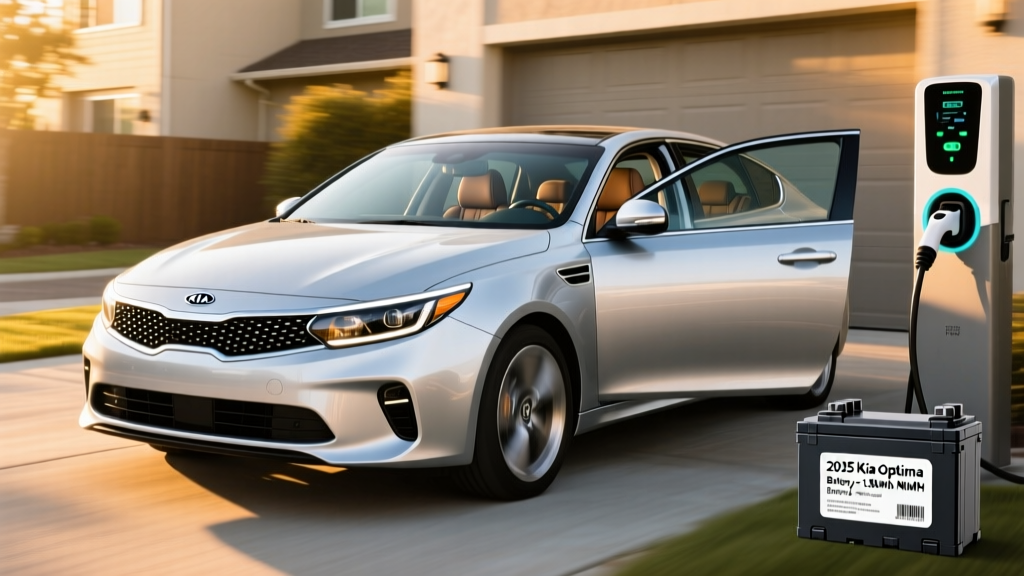
If you're shopping the used midsize sedan market in 2026 and fuel costs are eating into your budget, the 2015 Kia Optima Hybrid remains a compelling value play. It's a conventional hybrid (HEV) — meaning no plug, no range anxiety, and no dependence on charging infrastructure. With an EPA-rated 35 MPG combined and a proven powertrain shared with the Hyundai Sonata Hybrid, this generation of Optima Hybrid offers a practical bridge for drivers not yet ready to commit to a full battery-electric vehicle.
This guide breaks down everything a used-car buyer needs to know: real-world fuel economy, battery longevity and replacement costs, powertrain specs, and how the 2015 Optima Hybrid compares to going full EV or sticking with a gas-only midsize sedan.
2015 Optima Hybrid Fuel Economy: EPA Numbers and Real-World MPG
The EPA rates the 2015 Kia Optima Hybrid at the following fuel economy figures:
| Driving Cycle | EPA Rating | Real-World Expectation |
|---|---|---|
| City | 36 MPG | 35–38 MPG (hybrids excel in stop-and-go) |
| Highway | 35 MPG | 32–34 MPG (aerodynamic drag reduces hybrid advantage) |
| Combined | 35 MPG | 33–36 MPG depending on driving mix |
Like most conventional hybrids, the Optima Hybrid's regenerative braking system recovers energy during deceleration, giving it a slight edge in city driving. On the highway, the 2.4-liter engine operates more frequently without electric assist, narrowing the gap with efficient gas-only sedans. Expect roughly 33–36 MPG combined in mixed driving, based on owner-reported data on fueleconomy.gov.
For context, the gas-only 2015 Optima with the 2.4L engine rates at 27 MPG combined — so the hybrid delivers roughly a 30% fuel economy improvement with no change in driving habits.
Powertrain Specs: Engine, Motor, and Combined Output
| Engine | 2.4L 4-cylinder Atkinson-cycle (159 hp) |
| Electric Motor | 38 kW permanent-magnet synchronous (51 hp) |
| Combined System Output | 199 hp |
| Transmission | 6-speed automatic (no CVT) |
| Drivetrain | Front-wheel drive |
| Battery Pack | 1.4 kWh lithium-polymer |
| 0–60 mph | ~8.5 seconds |
| Curb Weight | ~3,630 lbs |
| EV-Only Mode | Yes, limited to ~1 mile at low speed |
The 2015 Optima Hybrid uses a parallel hybrid architecture. The electric motor sits between the engine and a conventional 6-speed automatic transmission — not a CVT like the Toyota Camry Hybrid. This gives it a more natural driving feel with distinct gear shifts, though it sacrifices a small amount of efficiency compared to the planetary gearset designs Toyota and Ford use.
The 1.4 kWh lithium-polymer battery is small by modern standards — it's a charge-depleting assist pack, not designed for meaningful electric-only driving. It captures energy under braking and deploys it during acceleration to reduce engine load.
HEV vs PHEV vs EV: Which Powertrain Fits Your Driving?
The 2015 Optima Hybrid is a conventional hybrid (HEV). It cannot be plugged in. The battery charges exclusively through regenerative braking and engine-driven generation. This is fundamentally different from a plug-in hybrid (PHEV) or a full battery-electric vehicle (BEV).
| Feature | HEV (e.g., 2015 Optima Hybrid) | PHEV (e.g., 2026 Tucson PHEV) | BEV (e.g., 2026 Ioniq 6) |
|---|---|---|---|
| Plug-in Charging | No | Yes | Yes |
| Electric-Only Range | ~1 mile (low speed) | 30–40 miles typical | 250–360 miles |
| Gas Engine | Yes (primary) | Yes (backup) | No |
| Fuel Cost per Mile | ~$0.10 (at $3.50/gal) | ~$0.04–0.10 (varies) | ~$0.03–0.05 (electric) |
| Home Charger Needed | No | Recommended (Level 2) | Essential (Level 2) |
| Tailpipe Emissions | Reduced | Minimal on short trips | Zero |
Choose the 2015 Optima Hybrid if: You want better fuel economy with zero lifestyle change — no plugs, no charging apps, no range planning. You drive 15,000+ miles per year in mixed city/highway conditions and want to reduce fuel spend without upfront investment in charging infrastructure.
Choose a PHEV if: You have home charging access, a commute under 35 miles, and want electric-only daily driving with gas-engine backup for road trips.
Choose a BEV if: You have reliable home Level 2 charging, want to eliminate gas entirely, and are comfortable with 2026 DC fast-charging infrastructure for longer trips.
Battery Health, Warranty, and Replacement Cost
Original Battery Warranty (When New)
Kia covered the 2015 Optima Hybrid's battery pack for 10 years / 100,000 miles (whichever comes first) for the original owner. For subsequent owners, coverage drops to 5 years / 60,000 miles. If you're buying a 2015 model in 2026, the original 10-year warranty has expired. Any remaining coverage depends on whether the vehicle was transferred within the first 5 years and has under 60,000 miles.
Battery degradation reality: The 1.4 kWh pack is small and operates within a narrow state-of-charge window (roughly 25–75% SoC), which significantly reduces stress on the cells. Hyundai-Kia's lithium-polymer chemistry has proven durable in this application. Most 2015 Optima Hybrids with 100,000–150,000 miles still retain 85–90% of their original battery capacity, based on owner reports and independent testing data.
Replacement cost: If the hybrid battery does fail out of warranty, expect to pay $2,000–$3,500 for a refurbished or new OEM replacement, including labor. Independent hybrid battery shops offer refurbished packs for $1,500–$2,200. This is a fraction of the cost of replacing a large BEV battery pack ($8,000–$20,000+), which is one reason conventional hybrids carry less long-term financial risk for used buyers.
Reliability, Safety Ratings, and Common Issues
The 2015 Optima Hybrid earned a 5-star overall safety rating from NHTSA and was an IIHS Top Safety Pick. The hybrid powertrain has a strong reliability record, with J.D. Power and Consumer Reports rating it average to above-average for the model year.
Known issues to check on a used 2015 Optima Hybrid:
- Hybrid system cooling fan: Can accumulate dust and debris, reducing battery cooling efficiency. Inspect and clean during purchase.
- Brake actuator recall: Some 2015 Optima Hybrids were subject to a recall for the hydraulic brake booster. Verify recall completion via NHTSA's VIN lookup.
- Transmission shudder: A small number of owners report mild shudder during low-speed electric-to-gas transitions. Usually resolved with a software update at a Kia dealer.
- 12V auxiliary battery: Like all hybrids, the 12V battery can fail independently of the hybrid pack. Budget $150–$250 for replacement if needed.
2015 Optima Hybrid Pricing in 2026 and Tax Credit Status
As of early 2026, used 2015 Kia Optima Hybrids trade between $8,000 and $13,000 depending on mileage, condition, and trim (LX or EX). The EX trim adds leather, heated seats, and an upgraded infotainment system.
Federal tax credit status: The 2015 Optima Hybrid is a conventional HEV, not a plug-in vehicle. It does not qualify for the IRS §30D Clean Vehicle Credit, which applies only to new plug-in hybrids and battery-electric vehicles meeting battery sourcing, MSRP cap, and buyer income requirements. It also does not qualify for the §25E used EV credit (limited to used PHEVs and BEVs with a battery of at least 7 kWh).
Some states previously offered hybrid purchase incentives, but most have sunset or shifted exclusively to plug-in vehicles. Check your state's current energy office or DMV for any remaining HEV rebates, though these are increasingly rare.
Pros
- 35 MPG combined — 30% better than the gas Optima
- No plug required — zero infrastructure dependency
- Conventional 6-speed automatic feels natural
- Proven Hyundai-Kia hybrid powertrain reliability
- Low used pricing ($8K–$13K) with strong value retention
- Small hybrid battery = lower replacement cost risk
Cons
- No meaningful electric-only driving range
- No federal tax credit eligibility (HEV)
- Highway MPG barely exceeds a modern turbo gas sedan
- 2015 infotainment is dated (no Apple CarPlay/Android Auto on base trim)
- Original 10-year battery warranty has expired for most examples
- Slower 0–60 vs. the turbocharged gas Optima SX
Who Should Buy the 2015 Optima Hybrid in 2026?
This car makes sense for a specific buyer profile:
Ideal buyer: You drive 12,000–20,000 miles per year in a mix of city and highway commuting. You don't have access to home charging (apartment, street parking, or landlord restrictions). You want to reduce fuel costs without the complexity, upfront cost, or charging dependency of a plug-in vehicle. You're buying on a budget under $15,000 and want something reliable with a known maintenance schedule.
Not the right fit: If you have home charging and a sub-30-mile commute, a used PHEV like the 2019–2021 Kia Niro PHEV or Toyota Prius Prime will save more on fuel through daily electric-only driving. If you want to eliminate gas entirely and have Level 2 charging access, a used 2019–2022 Chevrolet Bolt EV (eligible for the $4,000 used EV credit if priced under $25,000) offers far lower per-mile energy costs.
Frequently Asked Questions
How many MPG does the 2015 Optima Hybrid get?
The EPA rates it at 36 city / 35 highway / 35 combined MPG. In real-world mixed driving, expect 33–36 MPG. City driving often yields 35–38 MPG thanks to regenerative braking, while sustained highway driving at 70+ mph may drop to 32–34 MPG.
Can the 2015 Optima Hybrid drive on electric power only?
Technically yes, but only for about 1 mile at speeds under 25 mph. The 1.4 kWh battery is too small for meaningful electric-only range. This is a conventional hybrid — the gas engine does the majority of the work.
Is the 2015 Optima Hybrid reliable?
Yes. The Hyundai-Kia 2.4L hybrid powertrain has a strong long-term reliability record. The lithium-polymer battery operates in a narrow charge window that minimizes degradation. Most examples with 100K–150K miles show minimal battery capacity loss.
What does a hybrid battery replacement cost?
Expect $2,000–$3,500 for a new OEM battery or $1,500–$2,200 for a refurbished pack from an independent hybrid specialist. This is significantly less than a full EV battery replacement.
Does the 2015 Optima Hybrid qualify for any tax credit?
No. As a conventional hybrid (HEV), it is not eligible for the federal §30D new vehicle credit or the §25E used clean vehicle credit. These credits apply only to plug-in hybrids and battery-electric vehicles.
How does it compare to the 2015 Toyota Camry Hybrid?
The Camry Hybrid rates slightly higher at 40 MPG combined (vs. 35 for the Optima) and uses a proven eCVT. However, the Optima Hybrid offers a more conventional driving feel with its 6-speed automatic, more rear-seat legroom, and typically lower used pricing by $1,000–$2,000 at comparable mileage.
Should I buy the LX or EX trim?
The EX adds leather seating, heated front seats, a premium audio system, and rear ventilation. If budget allows, the EX is worth the premium for daily comfort. The hybrid powertrain and fuel economy are identical across trims.