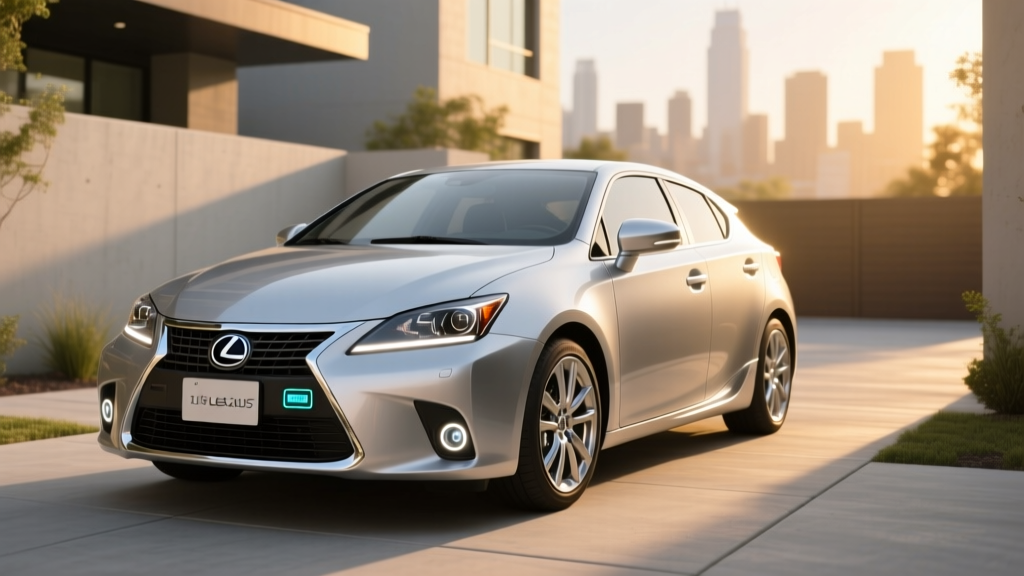
The 2015 Lexus CT 200h occupies a specific niche: a luxury-branded compact hatchback hybrid built on proven Toyota Hybrid Synergy Drive architecture. If you've been searching for a lexus hatchback hybrid 2015 model, you're likely looking at the used market — Lexus discontinued the CT 200h in the United States after the 2017 model year. That makes this a used-vehicle research guide, not a new-car review. We'll cover everything a prospective buyer needs: real-world MPG, the hybrid battery's expected lifespan, reliability data, and whether this car still makes sense against modern hybrids, PHEVs, and EVs in 2026.
HEV vs PHEV: What the CT 200h Actually Is
Before diving into specs, let's clarify a distinction that trips up many hybrid shoppers:
Conventional Hybrid (HEV) — CT 200h
- No plug required. The battery charges via regenerative braking and the gasoline engine.
- No electric-only driving range beyond brief low-speed creep (under ~1 mile at parking-lot speeds).
- Fuel economy benefit comes from the engine-motor synergy, not from grid electricity.
- No federal tax credit for used HEV purchases under current IRS §30D rules.
Plug-In Hybrid (PHEV) — e.g., Toyota Prius Prime
- Plugs into a wall outlet or Level 2 charger to fill a larger battery (typically 8–18 kWh usable).
- 25–44 miles of electric-only range before the gas engine engages.
- May qualify for tax credits when purchased new (subject to MSRP caps, income limits, and battery-sourcing rules under IRS §30D).
The 2015 Lexus CT 200h is a conventional hybrid (HEV). You will never plug it in. There is no electric-only commute mode beyond EV Mode's limited low-speed capability. If you need plug-in electric range, this is not the vehicle — consider a used Prius Prime or a newer PHEV instead.
Powertrain and Performance Specs
The CT 200h shares its powertrain with the third-generation Toyota Prius (2010–2015). That's not a knock — it's one of the most thoroughly validated hybrid drivetrains ever produced, with billions of real-world miles across the Toyota/Lexus fleet.
| Specification | 2015 Lexus CT 200h |
|---|---|
| Engine | 1.8L inline-4 Atkinson-cycle (98 hp) |
| Electric Motor | Permanent-magnet synchronous (80 hp / 153 lb-ft) |
| Combined System Output | 134 hp |
| Transmission | eCVT (planetary gearset, not a belt CVT) |
| Hybrid Battery | 1.3 kWh nickel-metal hydride (NiMH) |
| Drivetrain | Front-wheel drive |
| 0–60 mph | 9.8 seconds |
| Curb Weight | ~3,130 lbs |
| Cargo Volume | 14.3 cu ft (rear seats up) / 35.9 cu ft (folded) |
The 1.3 kWh NiMH battery is small by modern standards — a 2026 PHEV typically carries 13–18 kWh of lithium-ion capacity. But the CT 200h doesn't need a large pack. The hybrid system uses the battery as a buffer: capturing regenerative braking energy and deploying it for electric-motor assist during acceleration. The engine and motor work in concert through Toyota's planetary gearset, which seamlessly blends power sources without the shift shock of a conventional transmission.
Fuel Economy: EPA Ratings vs Real-World MPG
This is the CT 200h's primary selling point, and it holds up well even against 2026 compact hybrids.
| Driving Cycle | EPA Rating | Real-World Expectation |
|---|---|---|
| City | 43 MPG | 44–48 MPG (hybrids often exceed EPA city) |
| Highway | 40 MPG | 36–39 MPG (aerodynamics and weight at 70+ mph) |
| Combined | 42 MPG | 39–44 MPG depending on driving mix |
According to fueleconomy.gov, the 2015 CT 200h earns a 42 MPG combined rating. In practice, hybrid owners frequently report exceeding the EPA city estimate — regenerative braking recovers more energy in stop-and-go traffic than the test cycle captures. Highway driving tells the opposite story: at sustained 70–80 mph speeds, the engine does most of the work and aerodynamic drag dominates, pulling real-world highway MPG into the mid-to-upper 30s.
For context, a 2026 Toyota Prius LE achieves 57 MPG combined — a 36% improvement over a decade of hybrid evolution. But the CT 200h's 42 MPG combined still beats nearly every non-hybrid compact car on the used market, and the Lexus badge adds interior quality and dealer service experience that the Prius of the same era didn't match.
Hybrid Battery Lifespan, Warranty, and Replacement Cost
The top concern for any used-hybrid buyer is battery longevity. Here's what the data shows for the CT 200h's NiMH pack:
Original Battery Warranty
When new, Lexus covered the hybrid battery for 8 years / 100,000 miles (extended to 10 years / 150,000 miles in California Air Resources Board states: CA, CT, ME, MA, NJ, NY, OR, RI, VT, WA). For a 2015 model, the original factory warranty has expired in most cases by 2026 unless the vehicle has exceptionally low mileage and is registered in a CARB state.
Expected lifespan: Toyota/Lexus NiMH hybrid batteries routinely last 150,000–200,000+ miles before significant degradation. The CT 200h's battery is relatively small and conservatively managed — the hybrid system never fully charges or fully depletes it, keeping the NiMH cells in a longevity-friendly state-of-charge window (roughly 40–80% SoC). Failures before 120,000 miles are uncommon based on owner-reporting databases and NHTSA complaint records.
Replacement cost: If the battery does fail out of warranty, expect to pay $2,000–$3,500 for a refurbished or new OEM replacement pack at a Lexus dealer. Independent hybrid specialists often offer refurbished NiMH packs for $1,500–$2,500 installed. Some shops also replace individual failed modules rather than the entire pack, which can reduce cost to $500–$1,000 for a single bad cell.
Pre-purchase tip: Have a hybrid-qualified mechanic run a hybrid battery health check (many scan tools can read individual module voltages and internal resistance). Modules showing more than 0.2V variance under load are candidates for near-term service.
Reliability and Safety Record
The CT 200h benefits from one of the most reliable powertrains in the automotive industry. The 2ZR-FXE 1.8L Atkinson-cycle engine is understressed, the eCVT has no belts or clutches to wear, and the hybrid system has been proven across millions of Prius, Prius V, and Prius C vehicles.
Known issues specific to the 2015 CT 200h are minor:
- 12V auxiliary battery drain — if the car sits unused for weeks, the small 12V battery (separate from the hybrid traction battery) can die. A trickle charger solves this.
- Brake actuator recalls — some 2014–2015 Toyota/Lexus hybrids were recalled for brake booster assembly concerns. Verify recall completion at nhtsa.gov/recalls using the VIN.
- Interior rattles — some owners report dash and door panel creaks, typical of Lexus compact cars from this era. Not mechanical, but worth checking on a test drive.
The Insurance Institute for Highway Safety (IIHS) rated the CT 200h as Good in most crashworthiness tests, though it received a Marginal rating in the small overlap front test (a common weakness for compact cars of this generation). It lacks modern ADAS features — no automatic emergency braking, no lane-keeping assist. If active safety technology is a priority, you'll need to look at 2018+ models from Lexus or Toyota with Safety Sense.
Pricing and Tax Credit Eligibility
The 2015 Lexus CT 200h originally started at approximately $32,200 MSRP for the base trim, with the Premium and F Sport packages pushing prices to $36,000–$39,000. In the 2026 used market:
- Private-party / dealer used pricing: $12,000–$19,000 depending on mileage, condition, and trim. Examples under 80,000 miles command a premium.
- Federal tax credit: The CT 200h is a conventional hybrid (HEV), not a plug-in. It does not qualify for the federal §30D clean vehicle credit, which applies only to battery electric vehicles (BEVs) and plug-in hybrids (PHEVs) meeting battery-sourcing, MSRP, and buyer income requirements per IRS guidelines.
- Used EV credit (§25E): This credit (up to $4,000 or 30% of sale price for qualifying used BEVs and PHEVs under $25,000) also does not apply to conventional hybrids.
In short: there are no federal tax incentives for buying a used CT 200h. Some states may offer registration fee discounts or HOV lane access for hybrids, but these vary by jurisdiction — check your state's DMV or energy office for current programs.
Who Should Buy the CT 200h — And Who Shouldn't
Pros
- Proven, reliable Toyota hybrid powertrain with 200k+ mile longevity potential
- 42 MPG combined EPA; often exceeds 44 MPG in city driving
- Lexus dealer service network and premium interior vs contemporary Prius
- Hatchback practicality: 35.9 cu ft cargo with rear seats folded
- Low running costs: no plug, no range anxiety, 0W-20 oil changes, long-life brakes (regen reduces pad wear)
Cons
- Sluggish acceleration (9.8s 0–60) — noticeably slow for highway merging
- No modern ADAS (no AEB, no lane-keeping, no adaptive cruise)
- Dated infotainment: no Apple CarPlay/Android Auto, resistive touchscreen
- Firm ride quality, especially with 17-inch F Sport wheels
- No federal tax credit eligibility
Decision Framework: Is the CT 200h Right for You?
Choose the 2015 Lexus CT 200h if:
- You want a fuel-efficient used car under $18,000 with luxury branding and Toyota reliability.
- Your commute is city-heavy (where the hybrid system shines at 44+ MPG real-world).
- You don't have access to home or workplace charging (no plug needed).
- You value low maintenance costs and a proven powertrain over acceleration and tech.
Look elsewhere if:
- You want electric-only commuting — consider a used Prius Prime (PHEV) or Chevrolet Bolt (BEV).
- Modern safety tech matters — look at a 2019+ Toyota Corolla Hybrid or 2020+ Lexus UX 250h.
- You need quick acceleration for highway driving — the 134 hp output is genuinely slow by modern standards.
- You want to claim a federal tax credit — only BEVs and PHEVs qualify under current §30D and §25E rules.
Frequently Asked Questions
How many MPG does the 2015 Lexus CT 200h get?
The EPA rates the 2015 CT 200h at 43 MPG city, 40 MPG highway, and 42 MPG combined. In real-world driving, city-heavy commuters often see 44–48 MPG thanks to regenerative braking, while sustained highway driving at 70+ mph typically yields 36–39 MPG.
Does the 2015 Lexus CT 200h need to be plugged in?
No. The CT 200h is a conventional hybrid (HEV), not a plug-in hybrid (PHEV). The battery charges entirely through regenerative braking and the gasoline engine. You fuel it like any other car — there is no charging port and no electric-only driving range beyond very brief low-speed EV Mode operation.
Is the 2015 CT 200h hybrid battery reliable, and what does replacement cost?
Yes. The 1.3 kWh NiMH battery in the CT 200h shares architecture with the Prius and routinely lasts 150,000–200,000+ miles. If replacement is needed, expect $2,000–$3,500 for an OEM pack at a dealer, or $1,500–$2,500 from an independent hybrid specialist. Individual module replacement can cost as little as $500–$1,000.
Does the 2015 Lexus CT 200h qualify for any tax credit?
No. As a conventional hybrid (HEV), the CT 200h does not qualify for the federal §30D new clean vehicle credit or the §25E used clean vehicle credit. Both programs require a plug-in vehicle (BEV or PHEV) meeting specific battery-sourcing, MSRP, and income requirements. Check your state's energy office for any hybrid-specific incentives, as these vary by jurisdiction.
How does the CT 200h compare to a modern hybrid or EV in 2026?
A 2026 Toyota Prius LE delivers 57 MPG combined (36% better) with modern safety tech and infotainment, but starts at ~$29,000 new. A used 2015 CT 200h at $14,000–$18,000 offers lower upfront cost, Lexus luxury, and proven reliability — but sacrifices acceleration, safety features, and tech. For a plug-in alternative in this price range, look at a used 2017–2019 Prius Prime, which offers ~25 miles of electric-only range.
What should I check before buying a used 2015 CT 200h?
Prioritize: (1) a hybrid battery health scan showing module voltage variance under 0.2V, (2) verification that all NHTSA recalls — especially the brake actuator recall — have been completed, (3) a service history confirming regular oil changes with 0W-20 synthetic, and (4) a test drive listening for inverter whine or unusual brake actuator cycling. Also check the 12V auxiliary battery age — it should be replaced every 4–5 years.