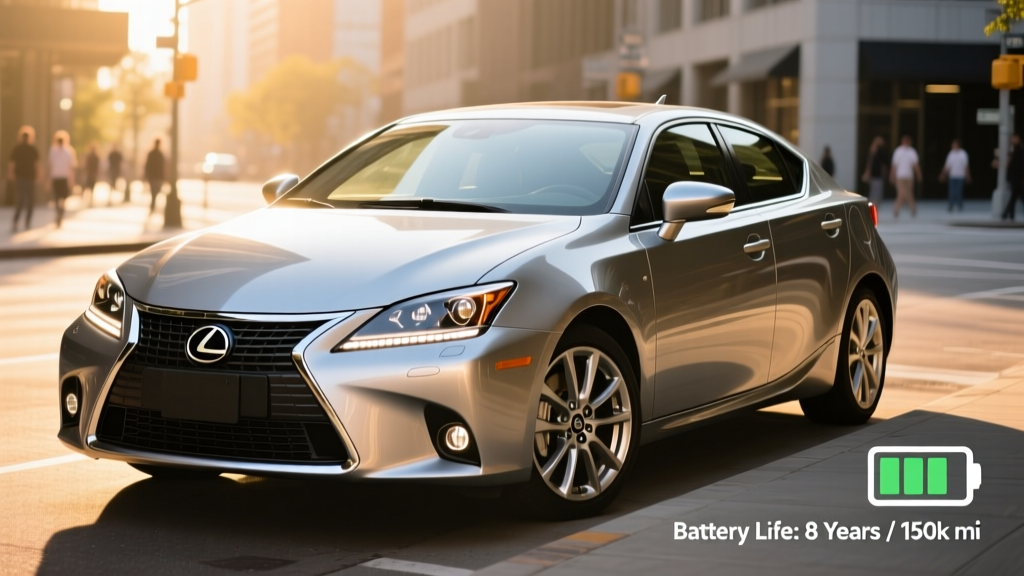
The 2015 Lexus CT 200h occupies a specific niche in the used electrified-car market: it's a premium compact hatchback hybrid that requires no plug, no range planning, and no lifestyle adjustment. For buyers in 2026 weighing a used hybrid against a newer EV or gas car, the CT 200h offers a compelling low-risk entry into electrified ownership — provided you understand exactly what it delivers and where it falls short.
This guide breaks down the 2015 Lexus CT 200h with the data precision you need: EPA fuel economy, real-world MPG, powertrain specs, hybrid battery longevity, replacement costs, and how it stacks up against modern alternatives.
HEV vs PHEV vs EV: Where the CT 200h Fits
Before examining specs, it's essential to classify the 2015 Lexus CT 200h correctly. It is a conventional hybrid electric vehicle (HEV) — not a plug-in hybrid (PHEV) and not a battery electric vehicle (BEV). You never plug it in. The car recovers energy through regenerative braking and the gasoline engine to keep its small nickel-metal hydride (NiMH) battery charged.
- HEV (this car): No plug. Small battery (~1.3 kWh). Gas engine + electric motor work together. You refuel only at gas stations. Example: 2015 Lexus CT 200h, Toyota Prius.
- PHEV: Plug-in capable. Larger battery (8–20+ kWh). 20–45 miles of electric-only driving, then operates as a hybrid. Example: Toyota RAV4 Prime, Jeep Wrangler 4xe.
- BEV: Plug-in only. No gas engine. 200–400+ miles of all-electric range. Example: Tesla Model 3, Hyundai Ioniq 5.
The CT 200h's hybrid system is about efficiency optimization, not electric-only propulsion. The electric motor assists the gas engine during acceleration and enables brief low-speed electric-only movement (typically under 1 mile at speeds below ~25 mph), but it is not designed for meaningful zero-emission commuting.
Fuel Economy: EPA Ratings vs Real-World MPG
The headline number for any hybrid buyer is fuel economy. The 2015 Lexus CT 200h carries an EPA rating of 42 MPG combined, broken down as follows:
| Cycle | EPA Rating | Real-World Expectation |
|---|---|---|
| City | 43 MPG | 42–46 MPG |
| Highway | 40 MPG | 36–40 MPG |
| Combined | 42 MPG | 39–43 MPG |
Why real-world often exceeds EPA in the city: Hybrids like the CT 200h thrive in stop-and-go traffic. Regenerative braking recovers kinetic energy that a gas car wastes as heat, and the electric motor handles low-speed propulsion where gas engines are least efficient. Owners who drive predominantly urban routes regularly report 44–46 MPG.
Why highway MPG drops: At sustained 70+ mph speeds, the aerodynamic drag of the CT 200h's hatchback shape and the limited electric-motor assist mean the 1.8L four-cylinder does most of the work. Expect 36–38 MPG on flat interstate driving at 75 mph, and slightly less in mountainous terrain or with a heavy cargo load.
Cold-weather impact: In sub-40°F conditions, expect a 5–10% fuel economy reduction (roughly 2–4 MPG) as the engine runs more frequently to maintain cabin heat and the battery operates less efficiently. This is normal for all hybrids and far less severe than the 20–30% range loss EVs experience in cold weather.
Powertrain Specifications and Driving Character
| Specification | 2015 Lexus CT 200h |
|---|---|
| Powertrain Type | Parallel Hybrid (HEV) |
| Gas Engine | 1.8L 4-cyl Atkinson-cycle, 98 hp |
| Electric Motor | 80 hp (60 kW) AC synchronous |
| Net Combined Output | 134 hp |
| Transmission | eCVT (planetary gearset) |
| 0–60 mph | ~9.8 seconds |
| Hybrid Battery | 1.3 kWh NiMH (201.6V) |
| Drivetrain | Front-wheel drive |
| Fuel Tank | 10.6 gallons |
| Total Range (est.) | ~445 miles |
The CT 200h shares its core hybrid powertrain with the third-generation Toyota Prius. The 1.8L Atkinson-cycle engine prioritizes thermal efficiency over peak power, while the electric motor fills in torque at low RPM where the gas engine is weakest. The result is adequate but not quick acceleration — the 9.8-second 0–60 time places it firmly in the "relaxed commuter" category.
The eCVT is not a traditional belt-driven CVT. Toyota's Hybrid Synergy Drive uses a planetary gearset that seamlessly blends engine and motor power. There are no fixed gear ratios and no rubber-band effect. Acceleration is linear and the system is remarkably smooth in everyday driving.
EV Mode: The CT 200h has a dashboard EV Mode button that forces electric-only operation, but it's limited to roughly 1 mile at speeds under 25 mph with a light throttle foot. It's useful for creeping through a parking garage or a quiet neighborhood — not for commuting.
Hybrid Battery Longevity, Warranty, and Replacement Cost
For any used hybrid buyer, the traction battery is the single biggest unknown. Here's what the data shows for the CT 200h's NiMH pack:
• 8 years / 100,000 miles (most states)
• 10 years / 150,000 miles (California and states adopting CARB emissions standards: CT, ME, MD, MA, NJ, NY, OR, RI, VT, WA)
Note for 2026 buyers: A 2015 model's original factory warranty has expired regardless of mileage. Battery coverage now depends on any remaining extended warranty or aftermarket protection plan.
Real-world battery lifespan: The CT 200h/Prius NiMH battery has proven to be one of the most durable hybrid batteries on the road. Fleet data and owner reports indicate most original packs last 150,000–200,000+ miles before significant degradation. Failures before 120,000 miles are uncommon under normal use. The battery rarely "dies" suddenly — instead, capacity gradually declines, resulting in slightly reduced MPG and more frequent engine cycling over time.
Battery replacement cost (2026 estimates):
- Toyota/Lexus OEM new pack: $2,500–$3,500 (parts) + $500–$1,000 (labor) = $3,000–$4,500 total
- Refurbished/remanufactured pack: $1,500–$2,500 installed
- Individual cell/module replacement: $500–$1,200 if only a few modules have degraded (a specialist hybrid shop can diagnose this)
What degrades a hybrid battery: Extreme heat is the primary enemy. Cars that spent their lives in Arizona, Texas, or the Middle East desert may show accelerated degradation. Frequent deep discharge cycles (rare in normal HEV use, since the system maintains a 40–80% state-of-charge window) and prolonged storage at very low or very high SoC also contribute. A 10-year-old CT 200h with 130,000 miles from a temperate climate is generally a safer battery bet than one with 90,000 miles from Phoenix.
Pricing, Value, and Tax Credit Eligibility in 2026
The 2015 Lexus CT 200h is no longer in production (Lexus discontinued it after the 2017 model year in the US). All purchases in 2026 are on the used market.
Used market pricing (2026 estimates):
- 80,000–110,000 miles, good condition: $11,000–$14,000
- 110,000–150,000 miles, good condition: $8,500–$11,500
- 150,000+ miles or fair condition: $6,000–$9,000
Tax credit eligibility: The 2015 Lexus CT 200h does not qualify for the federal §30D Clean Vehicle Credit. That credit applies only to new plug-in vehicles (BEVs and PHEVs meeting battery sourcing and MSRP caps). Conventional hybrids like the CT 200h have never qualified for the $7,500 new-vehicle credit.
However, buyers should check for the Used Clean Vehicle Credit (§25E) — but this too applies only to used plug-in vehicles (BEVs and PHEVs priced under $25,000), not conventional hybrids. The CT 200h is excluded.
State-level incentives: A handful of states offer rebates or HOV lane access for hybrids, but most have shifted incentives toward plug-in vehicles. Check your state's energy office or AFDC incentive database for current local programs.
Who Should Choose the 2015 CT 200h — And Who Shouldn't
- 42 MPG combined — genuine fuel savings with zero lifestyle change
- Lexus build quality and interior materials above Prius
- Proven, durable Toyota hybrid powertrain
- No plug required — ideal for apartment dwellers without charging access
- Low maintenance: no timing belt, regenerative braking extends pad life
- Hatchback cargo versatility (14.3 cu ft behind rear seats, 37.4 cu ft folded)
- Strong reliability reputation; low cost of ownership
- Slow acceleration (9.8s 0–60) — underpowered for highway merging
- Firm ride quality; road noise noticeable on rough pavement
- Rear seat is tight for adults on longer trips
- Infotainment is dated: small screen, no Apple CarPlay/Android Auto
- No EV-only commuting capability (not a PHEV)
- No federal tax credit eligibility
- Aging design — discontinued since 2017
CT 200h vs Alternatives: Hybrid, PHEV, or EV?
The right choice depends on your driving pattern, home charging access, and budget. Here's a decision framework:
Choose the 2015 Lexus CT 200h (HEV) if:
- You lack access to home or workplace charging (apartment, street parking)
- Your budget is $8,000–$14,000 for a reliable, efficient daily driver
- You drive 10,000–15,000 miles/year and want to minimize fuel costs without plug-in logistics
- You want Lexus reliability with minimal maintenance surprises
Choose a used PHEV (e.g., Toyota Prius Prime, Ford Fusion Energi) if:
- You can install a Level 2 charger at home and your commute is under 25 miles
- You want some electric-only daily driving but need gas flexibility for road trips
- You can find one within the $25,000 used-vehicle credit cap (for eligible models)
Choose a used BEV (e.g., Chevrolet Bolt, Nissan Leaf, Tesla Model 3) if:
- You have reliable home Level 2 charging
- Your daily driving is under 200 miles and you rarely road-trip to charging deserts
- You want zero tailpipe emissions and the lowest per-mile "fuel" cost
- You're willing to accept potentially higher insurance premiums and battery replacement risk at higher mileages
Cost comparison at 12,000 miles/year:
- CT 200h (42 MPG, $3.40/gal): ~$970/year in fuel
- Comparable gas compact (30 MPG, $3.40/gal): ~$1,360/year in fuel
- BEV (3.5 mi/kWh, $0.14/kWh home charging): ~$480/year in electricity
The CT 200h saves roughly $390/year vs a gas equivalent. A BEV saves ~$880/year but requires charging infrastructure and carries a higher upfront cost.
Pre-Purchase Inspection Checklist for a Used 2015 CT 200h
Before buying any 10-year-old hybrid, take these steps:
- Hybrid battery health check: Ask a Toyota/Lexus dealer or hybrid specialist to run a battery health diagnostic. This reports individual module voltages and internal resistance — a $100–$150 investment that can save thousands.
- Check for hybrid system warning lights: A "Check Hybrid System" message on the dash can indicate battery degradation, inverter issues, or a failing 12V auxiliary battery (a common and inexpensive fix, but verify).
- Review service records: Look for evidence of regular oil changes (the engine still needs them), brake fluid flushes, and inverter coolant changes (recommended at 100,000 miles).
- Test the regenerative braking: On a gentle downhill, lift off the accelerator. You should feel smooth deceleration as the motor recovers energy. Any grinding, pulsing, or dashboard warnings suggest brake or regen system issues.
- Verify 12V battery age: The CT 200h uses a conventional 12V lead-agcent or AGM battery for electronics. These typically last 3–5 years. A weak 12V battery can cause bizarre hybrid-system error codes that mimic traction battery failure.
- Check for open recalls: Search the VIN at NHTSA's recall database. The 2015 CT 200h had recalls related to airbag inflators and fuel system components on some build dates.
Frequently Asked Questions
How many MPG does the 2015 Lexus CT 200h get?
The EPA rates the 2015 CT 200h at 43 MPG city, 40 MPG highway, and 42 MPG combined. In real-world driving, city-heavy commuters often see 44–46 MPG, while sustained highway driving at 75 mph typically yields 36–38 MPG. Cold weather reduces these figures by roughly 5–10%.
Can I drive the 2015 Lexus CT 200h on electric power only?
Only in very limited circumstances. The EV Mode allows electric-only movement for approximately 1 mile at speeds under 25 mph with gentle throttle input. It is not designed for commuting or meaningful zero-emission driving. This is a conventional hybrid (HEV), not a plug-in hybrid (PHEV).
How long does the hybrid battery last and what does replacement cost?
The NiMH hybrid battery in the CT 200h typically lasts 150,000–200,000+ miles under normal driving conditions. Original factory warranty was 8 years/100,000 miles (10 years/150,000 miles in CARB states), but this has expired for all 2015 models. A full OEM battery replacement costs $3,000–$4,500 installed; refurbished packs run $1,500–$2,500.
Does the 2015 Lexus CT 200h qualify for any federal tax credit?
No. The federal §30D Clean Vehicle Credit and the §25E Used Clean Vehicle Credit both require plug-in capability (BEV or PHEV). The CT 200h is a conventional hybrid and has never qualified for federal purchase incentives. Some states may offer minimal hybrid incentives — check the AFDC database for your area.
Is the 2015 Lexus CT 200h reliable?
Yes. The CT 200h's Toyota-sourced hybrid powertrain is among the most proven and reliable in the industry. The planetary eCVT has no belts, clutches, or friction bands to wear. Regenerative braking significantly extends brake pad life (many owners report 80,000+ miles on original pads). The main long-term cost risk is hybrid battery replacement after 150,000+ miles, but this is a known, quantifiable expense.
Should I buy a 2015 CT 200h instead of a newer EV?
It depends on your charging situation and budget. If you cannot charge at home, drive more than 200 miles regularly, or want to stay under $14,000, the CT 200h is a practical, low-risk choice. If you have home Level 2 charging, a predictable commute, and a higher budget ($20,000+), a used BEV like the Chevrolet Bolt or Tesla Model 3 offers lower operating costs, stronger acceleration, and modern tech — at the trade-off of charging dependency and potentially higher insurance.