Quick Verdict: The 2015 Infiniti Q50 Hybrid a Decade Later
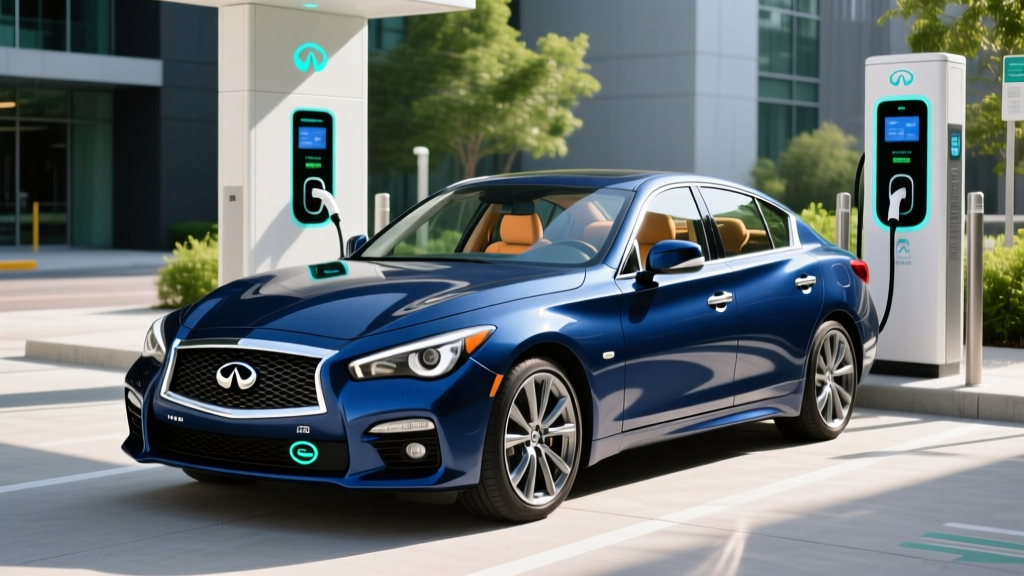
The 2015 Infiniti Q50 Hybrid pairs a 3.5-liter V6 with an electric motor in a conventional hybrid (HEV) configuration — meaning it never plugs in and recovers all its energy through regenerative braking and the engine. Originally positioned as a sport-luxury alternative to the Lexus GS 450h and BMW ActiveHybrid 3, the Q50 Hybrid delivered 360 combined horsepower with an EPA-estimated 29 MPG combined. For 2026 used-car shoppers, it occupies an interesting niche: a performance-oriented luxury sedan with modest fuel savings, now available at steep depreciation discounts.
But the real questions for a decade-old hybrid are different from those of a new one. How has the lithium-ion battery held up? What does replacement cost? And does a 2015-era hybrid still deliver meaningful savings over a modern turbocharged four-cylinder? This guide answers each of those with hard data.
HEV vs PHEV: Understanding What the Q50 Hybrid Is (and Isn't)
Conventional Hybrid (HEV): The 2015 Q50 Hybrid is a self-charging HEV. It has a small battery (1.4 kWh gross) that charges exclusively through regenerative braking and the gasoline engine. There is no plug, no electric-only range to speak of, and no eligibility for federal plug-in tax credits. The electric motor assists the engine during acceleration and enables brief low-speed electric-only creeping, but the gas engine is always the primary power source.
Plug-in Hybrid (PHEV): A PHEV like the current Toyota RAV4 Prime carries a much larger battery (18.1 kWh) that charges from a wall outlet or public charger, delivering 20–42 miles of electric-only driving before the gas engine takes over. The Q50 Hybrid does not offer this capability.
Full EV (BEV): A battery-electric vehicle has no gasoline engine at all. If daily driving under 40 miles with home charging access is your pattern, a modern BEV will cost far less per mile to operate than any HEV.
The distinction matters because used buyers sometimes see "hybrid" and assume plug-in capability or federal tax credit eligibility. The Q50 Hybrid qualifies for neither. Its value proposition is strictly about modestly improved fuel economy with sport-sedan performance in a luxury package.
Fuel Economy: EPA Numbers and Real-World MPG
| Driving Cycle | EPA Estimate | Real-World Expectation |
|---|---|---|
| City | 29 MPG | 28–31 MPG (hybrids often match or beat EPA city) |
| Highway | 31 MPG | 27–29 MPG (hybrid advantage shrinks at sustained speed) |
| Combined | 29 MPG | 26–29 MPG depending on driving mix |
The EPA's fueleconomy.gov listing rates the 2015 Q50 Hybrid at 29 MPG combined. The rear-wheel-drive variant achieves 29 city / 31 highway, while the AWD (Q50 Hybrid AWD) drops slightly to 27 city / 30 highway due to drivetrain losses.
In real-world driving, this hybrid system behaves like most single-motor HEVs from the mid-2010s: it excels in stop-and-go traffic where regenerative braking keeps the battery topped up and the engine can shut off at stops. Highway driving at 75+ MPH largely bypasses the hybrid advantage because the electric motor provides minimal assist at sustained cruising speeds. Expect real-world combined figures around 26–28 MPG for mixed driving with significant highway miles, and potentially 30+ MPG for predominantly urban commutes.
For context, a 2026 Toyota Camry Hybrid LE achieves 51 MPG combined — a reminder of how far hybrid efficiency has advanced in a decade. The Q50 Hybrid's fuel economy edge was modest even at launch; its appeal was always performance first, efficiency second.
Powertrain Specs: Engine, Motor, and Combined Output
| Specification | Detail |
|---|---|
| Gasoline Engine | 3.5L V6 (VQ35HR), 302 hp @ 6,800 rpm / 258 lb-ft torque |
| Electric Motor | 50 kW (67 hp), 214 lb-ft torque |
| Combined System Output | 360 hp |
| Transmission | 7-speed automatic with manual shift mode |
| Drivetrain | RWD standard; AWD available |
| Battery Type | Lithium-ion, 1.4 kWh gross capacity |
| 0–60 MPH | ~4.9 seconds (RWD) |
| EPA Combined MPG | 29 (RWD) / 27 (AWD combined estimate) |
| Fuel Tank | 20.0 gallons |
| Total Range | ~580 miles (RWD, combined) |
Infiniti's Direct Response Hybrid system was engineered for performance, not hypermiling. The VQ35HR V6 is a proven Nissan/Infiniti engine family, and the electric motor fills in torque at low RPM where the V6 is less responsive. The result is seamless acceleration and a 0–60 time that outpaces most V6 competitors of the era. The electric motor's torque fills in below 2,000 RPM, making the car feel quicker off the line than its 3,800-pound curb weight would suggest.
Because this is an HEV with a 1.4 kWh battery, there is no meaningful electric-only range. The motor can propel the car at very low speeds (parking lots, traffic creep) for short distances under a mile, but the engine fires up the moment moderate throttle is applied. There is no plug, no charging port, and no DC fast-charge capability.
Battery Longevity, Warranty, and Replacement Cost
Original Hybrid Battery Warranty: Infiniti covered the Q50 Hybrid's lithium-ion battery pack for 8 years / 100,000 miles (extended to 10 years / 150,000 miles in California and states adopting CARB emissions standards). For a 2015 model, original factory coverage has now expired in most states as of 2023, and even CARB-state coverage expired by 2025 at the latest.
This is the critical ownership question for any decade-old hybrid: will the battery need replacement, and what does it cost?
Degradation reality: The Q50 Hybrid's 1.4 kWh lithium-ion pack is small and operates within a narrow state-of-charge window (roughly 40–80% SoC), managed by the battery control module to minimize stress. This conservative buffer strategy means the battery rarely sees full charge or deep discharge — the two conditions that accelerate lithium-ion degradation. Most owner reports and hybrid battery health data from this era suggest the pack retains 70–85% of original capacity after 100,000–130,000 miles. Because the battery is so small to begin with, even 15–20% degradation is barely noticeable in daily driving — you might see 1–2 MPG less and slightly less aggressive electric assist.
Replacement cost: A new OEM hybrid battery pack from Infiniti runs approximately $2,500–$3,500 for the part, with labor adding $500–$800, putting total replacement at roughly $3,000–$4,300 at a dealership. Independent hybrid specialists can sometimes source refurbished packs for $1,500–$2,200 installed. Individual cell module replacement (only swapping degraded modules) is possible at some specialist shops for $800–$1,500, though this is less common for Infiniti than for Toyota/Lexus platforms where the aftermarket is more mature.
Failure rate context: Infiniti/Nissan hybrid systems from this generation have shown lower failure rates than early Ford and Hyundai hybrid packs but less long-term track record than Toyota's Hybrid Synergy Drive. The Q50 Hybrid was sold in relatively low volumes, so population data is limited. Most failures reported on owner forums occur between 110,000–150,000 miles. If you're buying a 2015 example with under 80,000 miles, the battery likely has substantial life remaining.
Used Pricing and Tax Credit Reality
As a used 2015 vehicle, the Q50 Hybrid is not eligible for the federal §30D new clean vehicle credit (up to $7,500 for qualifying new EVs/PHEVs) or the §25E used clean vehicle credit (up to $4,000 for used EVs/PHEVs priced under $25,000). Both credits require plug-in capability with minimum battery capacities that the Q50 Hybrid's 1.4 kWh pack does not meet. The IRS clean vehicle credit rules are explicit: only plug-in electric vehicles qualify.
Used market pricing (early 2026 estimates):
- 2015 Q50 Hybrid Premium (RWD), 80,000–100,000 miles: $11,000–$14,000
- 2015 Q50 Hybrid Premium (AWD), 80,000–100,000 miles: $12,000–$15,000
- Lower-mileage examples (under 60,000 miles): $15,000–$18,000
Original MSRP was approximately $44,000–$50,000 depending on trim and options. Depreciation has been steep — typical for luxury sedans and particularly for low-volume hybrid variants. This steep drop is a buyer's opportunity but also reflects the market's assessment of aging hybrid technology and the brand's resale trajectory.
Who Should Buy the 2015 Q50 Hybrid (and Who Shouldn't)
Pros
- 360 hp with smooth V6 + electric motor torque fill
- Quiet, well-insulated cabin with premium materials
- Modest fuel savings vs. non-hybrid Q50 (3.7L V6, ~22 MPG combined)
- Available AWD for four-season climates
- Steep depreciation means strong value at $12K–$15K
- Proven VQ35 engine family with wide parts availability
Cons
- 29 MPG combined is unremarkable vs. modern hybrids (Camry Hybrid: 51 MPG)
- Hybrid battery warranty has expired; replacement is $3,000–$4,300
- No plug-in capability, no EV mode, no tax credit eligibility
- Trunk space reduced by battery placement (~13.5 cu ft vs. 14.9 cu ft in gas Q50)
- Infiniti's infotainment (dual-screen) feels dated by 2026 standards
- Low production volume means fewer used examples to choose from
Choose the 2015 Q50 Hybrid if:
- You want a sport-luxury sedan with real acceleration (4.9s 0–60) and don't prioritize maximum fuel economy
- Your commute is mixed city/highway and you value a quiet, powerful V6 over a four-cylinder
- You find a well-maintained, sub-90,000-mile example with service records
- You accept the risk of a potential $3,000–$4,000 battery replacement in the next few years
Look elsewhere if:
- Maximum fuel economy is your priority — a used Toyota Camry Hybrid, Prius, or Honda Accord Hybrid delivers 40–55 MPG for similar or lower money
- You want plug-in electric driving — consider a used Chevrolet Volt, Toyota Prius Prime, or BMW 330e instead
- You need a current warranty — no 2015 hybrid carries remaining factory battery coverage
- You want modern ADAS features — the 2015 Q50 lacks automatic emergency braking, lane-keeping, and adaptive cruise as standard equipment
Hybrid vs PHEV vs EV: Which Powertrain Fits You?
The 2015 Q50 Hybrid sits at one end of the electrification spectrum. Here's how to decide which category fits your situation:
| Factor | HEV (like Q50 Hybrid) | PHEV | Full EV (BEV) |
|---|---|---|---|
| Plug-in Required? | No | Yes (for EV range) | Yes |
| Electric-Only Range | Negligible | 20–50 miles typical | 200–400+ miles |
| Home Charging Needed? | No | Recommended | Essential |
| Fuel Cost per Mile | ~$0.12–$0.15 | ~$0.04 (electric) / $0.12 (gas) | ~$0.03–$0.06 |
| Federal Tax Credit (new) | None | Up to $7,500 (§30D) | Up to $7,500 (§30D) |
| Maintenance Complexity | Engine + hybrid system | Engine + larger battery + charger | Simplest (no engine) |
| Best For | No home charging, want simplicity | Short commute + road trip flexibility | Home charging + low operating cost |
If you have access to Level 2 home charging and a commute under 40 miles, a used PHEV or BEV will deliver dramatically lower per-mile costs than even the best HEV. The Q50 Hybrid makes sense only if you specifically want its combination of V6 performance, luxury, and don't have reliable charging access — or if the steep depreciation makes it the best-value luxury sedan in your budget.
Frequently Asked Questions
How many MPG does the 2015 Infiniti Q50 Hybrid get?
The EPA rates it at 29 city / 31 highway / 29 combined for RWD models. AWD variants drop to approximately 27 city / 30 highway. Real-world combined driving typically yields 26–29 MPG depending on your city/highway mix and driving style. City-heavy commutes may see 30+ MPG thanks to regenerative braking; predominantly highway driving at 75+ MPH will drop to the mid-20s.
Can the 2015 Q50 Hybrid drive on electric power only?
Only at very low speeds (under ~25 MPH) for short distances (a few hundred yards). The 1.4 kWh battery is far too small to provide meaningful electric-only driving. This is a conventional hybrid — the gasoline V6 is always the primary power source, and the electric motor serves as an assist and regenerative energy recovery system.
Is the 2015 Q50 Hybrid reliable?
The VQ35HR V6 engine and 7-speed automatic transmission are proven, well-understood components with wide parts availability. The hybrid system itself has shown moderate reliability — not the bulletproof reputation of Toyota's hybrid synergy drive, but fewer widespread failures than some competitors. The main risk factor is the lithium-ion hybrid battery, which is now 10+ years old and outside warranty. Budget $3,000–$4,300 for a potential battery replacement if buying an example over 100,000 miles or with no battery health documentation.
What does a Q50 Hybrid battery replacement cost?
A new OEM replacement battery pack runs approximately $2,500–$3,500 for the part plus $500–$800 in labor at an Infiniti dealership, totaling $3,000–$4,300. Independent hybrid specialists may offer refurbished packs for $1,500–$2,200 installed. Individual cell module replacement is possible for $800–$1,500 at select shops. These are 2025–2026 pricing estimates and vary by region.
Does the 2015 Q50 Hybrid qualify for any tax credits?
No. As a conventional hybrid (HEV) with no plug-in capability and a 1.4 kWh battery, it does not qualify for the federal §30D new clean vehicle credit or the §25E used clean vehicle credit. Both require plug-in electric vehicles with minimum battery capacities. Some states historically offered hybrid purchase incentives, but these have largely expired or shifted exclusively to plug-in vehicles. Check your state's current energy office for any remaining programs, but do not expect credits for this vehicle.
How does the Q50 Hybrid compare to a non-hybrid Q50?
The 2015 Q50 3.7 (non-hybrid V6) produces 328 hp and achieves approximately 23 MPG combined. The Hybrid adds 32 hp, significantly more low-end torque from the electric motor, and gains roughly 6 MPG combined. The trade-offs are a slightly smaller trunk (battery packaging), higher original MSRP (roughly $5,000–$7,000 more), and the long-term battery replacement risk. On the used market, the Hybrid's steeper depreciation often makes it similarly priced to or even cheaper than equivalent non-hybrid examples.
Should I buy the 2015 Q50 Hybrid or a newer used hybrid?
If fuel economy is a priority, a 2018+ Toyota Camry Hybrid, Honda Accord Hybrid, or Toyota Prius will deliver 40–55 MPG combined with more modern safety tech and likely some remaining warranty. Choose the Q50 Hybrid specifically if you want a luxury sport sedan with V6 performance and accept the MPG and battery-age trade-offs. It fills a niche that modern economy hybrids don't — just don't expect it to compete on efficiency.
Sources: EPA fuel economy data via fueleconomy.gov; IRS clean vehicle credit rules via irs.gov; IIHS 2015 Q50 safety ratings.