Quick Verdict: A Practical Used Hybrid Hatchback
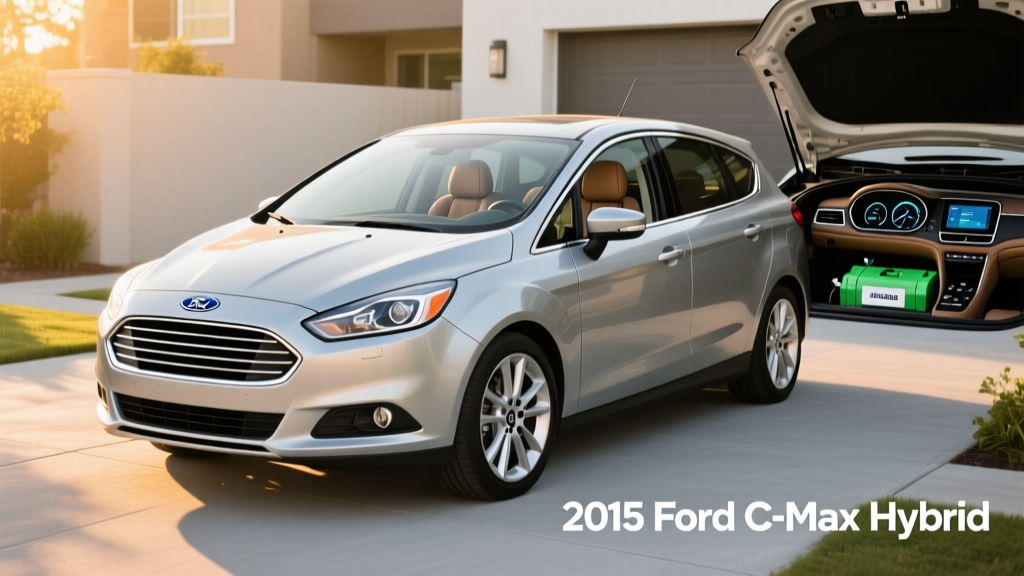
The 2015 Ford C-Max Hybrid is a compact multi-activity vehicle (Ford's term for a tall hatchback) that pairs a 2.0-liter Atkinson-cycle four-cylinder with an electric motor for an EPA-rated 42 MPG combined. Now available exclusively on the used market — Ford discontinued the C-Max after the 2018 model year — it remains a compelling choice for buyers who want hybrid efficiency without plugging in, need more cargo versatility than a sedan, and want to stay well under $15,000 in purchase price.
This guide covers the C-Max Hybrid (HEV). Ford also sold a C-Max Energi plug-in hybrid variant with a larger battery and electric-only driving capability. We'll distinguish the two clearly throughout, since confusing them is a common mistake among used shoppers.
HEV vs. PHEV: C-Max Hybrid vs. C-Max Energi
Before diving into specs, it's critical to understand what you're looking at on a used lot. The 2015 C-Max came in two electrified flavors:
| Attribute | C-Max Hybrid (HEV) | C-Max Energi (PHEV) |
|---|---|---|
| Plug-in required? | No — self-charging via regen & engine | Yes — plug in for electric-only miles |
| Battery size | 1.4 kWh (net usable) | 7.6 kWh (net usable) |
| Electric-only range | N/A (EV assist only, ~1 mi) | 20 miles EPA electric-only |
| EPA combined MPG / MPGe | 42 MPG combined | 95 MPGe (elec+gas) / 38 MPG (gas-only) |
| Total range | ~560 miles | ~550 miles (20 elec + 530 gas) |
| DC fast charging | No | No (Level 1/Level 2 AC only) |
| Federal tax credit (new) | None | Was eligible for ~$3,750 (expired) |
Key distinction: The C-Max Hybrid never needs to be plugged in. It recovers energy through regenerative braking and uses its gasoline engine to recharge the small battery as needed. The C-Max Energi, by contrast, has a charge port on the driver's front fender and benefits from overnight Level 2 charging to unlock its 20-mile electric-only range.
Fuel Economy: EPA Ratings vs. Real-World MPG
| Driving Cycle | EPA Rating | Real-World Expectation |
|---|---|---|
| City | 42 MPG | 43–47 MPG (hybrids excel in stop-and-go) |
| Highway | 38 MPG | 35–38 MPG (less regen benefit at steady speed) |
| Combined | 42 MPG | 39–43 MPG depending on driving mix |
Like most hybrids, the C-Max Hybrid actually tends to exceed its EPA city rating in real-world stop-and-go traffic. That's because the electric motor handles low-speed propulsion while regenerative braking recovers kinetic energy that a conventional car wastes as heat. On the highway, where the gasoline engine does most of the work and there's little braking to recapture, expect numbers closer to 35–38 MPG — especially at speeds above 70 mph or in cold weather.
According to fueleconomy.gov, the 2015 C-Max Hybrid is rated at 42 MPG combined. Owners who track their fuel consumption on Fuelly report averages clustering around 40–41 MPG, which aligns with our real-world expectations for a vehicle of this age with a slightly degraded battery.
Real-world fuel cost: At $3.25/gallon and 12,000 miles/year, the C-Max Hybrid costs roughly $930/year in fuel. A comparable non-hybrid compact (30 MPG combined) would cost ~$1,300/year — a savings of approximately $370 annually with the C-Max.
Powertrain and Performance Specs
| Specification | 2015 Ford C-Max Hybrid |
|---|---|
| Engine | 2.0L Atkinson-cycle I4 |
| Engine output | 141 hp @ 6,000 rpm / 129 lb-ft torque |
| Electric motor | Permanent-magnet AC synchronous (integrated into transmission) |
| Combined system output | 188 hp (net) |
| Transmission | Electronic continuously variable (eCVT / power-split) |
| 0–60 mph | ~8.1 seconds (tested) |
| Drivetrain | Front-wheel drive |
| Curb weight | ~3,607 lbs |
| Fuel tank | 13.5 gallons |
| Cargo volume | 24.5 cu ft (rear seats up) / 52.6 cu ft (folded) |
The power-split eCVT is not a traditional belt-and-pulley CVT — it's a planetary gearset that blends engine and motor power seamlessly. There are no rubber bands or sluggish feeling here; the C-Max Hybrid accelerates with reasonable urgency, and the 188 combined horsepower gives it a passing ability advantage over competitors like the 2015 Toyota Prius (134 hp combined).
Battery Health, Warranty, and Replacement Cost
Original battery warranty: Ford covered the C-Max Hybrid's lithium-ion traction battery for 8 years / 100,000 miles (10 years / 150,000 miles in CARB states like California, New York, and Massachusetts). For a 2015 model, the standard 8-year/100k warranty expired in 2023. CARB-state warranties expire in 2025.
This is the single most important consideration for any used-hybrid buyer: the original battery warranty has expired or is expiring on all 2015 C-Max examples. You are buying this car "as-is" on the battery unless the previous owner purchased an extended powertrain warranty or the battery was replaced under warranty before expiration.
How Long Do C-Max Hybrid Batteries Last?
The 1.4 kWh lithium-ion pack in the C-Max Hybrid is relatively small and is managed conservatively by Ford's battery management system (BMS). The BMS maintains a buffer — the battery never charges to 100% or discharges to 0% — which significantly extends cycle life. Based on owner reports and fleet data, C-Max Hybrid batteries commonly reach 150,000–200,000 miles before capacity loss becomes noticeable (reduced EV-assist, slightly lower MPG).
Battery Replacement Cost
If the traction battery does fail:
- OEM new battery (Ford dealer): $2,500–$3,500 for the battery pack, plus $500–$800 labor — total roughly $3,000–$4,300
- Refurbished/remanufactured battery: $1,500–$2,200 installed through independent hybrid specialists
- Individual cell/module replacement: Some hybrid repair shops can replace only the degraded modules for $800–$1,500, though this is less common on Ford's pack design than on Toyota's
Before purchasing, ask for a hybrid battery health report from a Ford dealer or qualified hybrid technician. This scan tool readout shows battery state of health (SoH) as a percentage and flags any cell imbalance.
Charging the C-Max Energi (PHEV Variant)
While this article focuses on the C-Max Hybrid, many used shoppers cross-shop the Energi. Here are the PHEV charging essentials:
| Charge Level | Power (kW) | Time (0–100%) | Notes |
|---|---|---|---|
| Level 1 (120V household) | ~1.4 kW | ~7 hours | Standard outlet; fine for overnight |
| Level 2 (240V home/public) | ~3.3 kW (onboard charger limit) | ~2.5 hours | Requires J1772 connector |
| DC Fast Charge | N/A | N/A | Not supported |
The Energi's 7.6 kWh battery (usable) gives it an EPA-rated 20 miles of electric-only range. Once that's depleted, the gasoline engine kicks in and the car operates as a conventional hybrid, returning about 38 MPG combined on gas alone. Total combined range (electric + gasoline) is approximately 550 miles.
Important: The Energi does not support DC fast charging. Maximum charge rate is 3.3 kW on Level 2, which is the limit of its onboard charger. This is perfectly adequate for overnight home charging but means you won't find meaningful benefit from public fast-charging stations.
Used Pricing and Tax Credit Eligibility
The 2015 C-Max Hybrid is available only on the used market. As of early 2026, typical pricing:
- C-Max Hybrid (HEV): $7,000–$11,000 depending on mileage, condition, and trim (S or SEL)
- C-Max Energi (PHEV): $8,500–$13,000 depending on mileage and battery condition
Does the Used C-Max Qualify for Any Tax Credit?
Under current IRS §25E rules (the used clean vehicle credit), you may be eligible for a tax credit of up to $4,000 (30% of the sale price, capped at $4,000) on a qualifying used EV or PHEV. Key requirements:
- Vehicle price cap: Sale price must be $25,000 or less (both C-Max variants qualify)
- Vehicle age: Must be at least 2 model years old (2015 qualifies)
- Buyer income limits (2026): AGI ≤ $75,000 single / $112,500 head of household / $150,000 joint
- Purchase from a dealer: Private-party sales do not qualify
- C-Max Hybrid (HEV): Does NOT qualify — conventional hybrids are excluded from §25E
- C-Max Energi (PHEV): May qualify — plug-in hybrids with ≥4 kWh battery are eligible under §25E if all requirements are met
- Transfer at point of sale: Eligible buyers can apply the credit as an immediate price reduction at the dealer
The C-Max Energi's 7.6 kWh battery exceeds the 4 kWh minimum, making it potentially eligible. Consult a tax professional and verify eligibility on IRS.gov before counting on this credit.
Reliability, Safety, and Common Issues
The C-Max Hybrid's powertrain is generally robust. The eCVT power-split device has no clutches or belts to wear, and the Atkinson-cycle engine runs under relatively low stress. Common issues reported by owners and tracked by NHTSA include:
- 12V battery drain: Like many hybrids, the C-Max can drain its 12V accessory battery if left sitting for extended periods. This is not the traction battery — it's the standard 12V that powers electronics. A jump-start or battery tender resolves this.
- Transmission shudder at low speed: Some owners report a subtle shudder during low-speed regenerative braking transitions. Usually resolved with software updates or, in higher-mileage examples, transmission fluid service.
- Door latch recalls: Ford issued recalls for door latch assemblies on 2013–2015 C-Max models. Verify recall completion on NHTSA's VIN lookup tool.
Pros
- 42 MPG combined; often exceeds EPA in city driving
- Spacious cargo area (24.5 / 52.6 cu ft) beats most compact sedans
- 188 hp combined — more power than contemporary Prius
- No plug-in required; seamless hybrid operation
- Affordable used pricing ($7k–$11k)
- Comfortable ride quality; quiet cabin at low speeds
Cons
- Original battery warranty has expired on all examples
- Highway MPG drops to 35–38 (less hybrid advantage)
- Discontinued after 2018 — parts availability narrowing for body panels
- Infotainment (SYNC with MyFord Touch) is dated and slow
- No DC fast charging (Energi PHEV variant)
- Heavier than competitors at 3,607 lbs affects tire wear
Who Should Buy the C-Max Hybrid vs. a Full EV or Gas Car?
Choose the C-Max Hybrid (HEV) if:
- You can't charge at home (apartment, street parking, no garage outlet)
- Your budget is under $12,000 and you want maximum MPG per dollar
- You frequently drive in stop-and-go city traffic where hybrids shine
- You need hatchback cargo space but don't want an SUV
- You take regular road trips and don't want to plan around charging
Choose the C-Max Energi (PHEV) if:
- You can install a Level 2 charger at home and your commute is under 20 miles
- You want some electric-only driving but also need gas-engine range flexibility
- You may qualify for the §25E used clean vehicle credit (up to $4,000)
Choose a full BEV (e.g., used Chevy Bolt EV, Nissan Leaf) if:
- You have reliable home or workplace Level 2 charging
- Your daily driving is under 150 miles and you rarely road-trip beyond charger coverage
- You want zero tailpipe emissions and minimal maintenance (no oil changes, no engine)
- You can spend $12,000–$18,000 on a used BEV
Stick with a conventional gas car if:
- Your budget is under $6,000
- You drive predominantly highway miles at high speeds (hybrid advantage diminishes)
- You want the simplest possible maintenance profile with no hybrid battery risk
Frequently Asked Questions
How many MPG does the 2015 Ford C-Max Hybrid get?
The EPA rates the 2015 C-Max Hybrid at 42 MPG city, 38 MPG highway, and 42 MPG combined. In real-world driving, expect 43–47 MPG in city traffic (where regenerative braking shines) and 35–38 MPG on the highway. Overall mixed driving typically returns 39–43 MPG.
How far can the C-Max Energi go on electric only?
The 2015 C-Max Energi (PHEV) delivers an EPA-rated 20 miles of electric-only range on a full charge. After the battery is depleted, the car operates as a standard hybrid at approximately 38 MPG combined. Total range (electric + gas) is roughly 550 miles.
Do I need to plug in the C-Max Hybrid?
No. The C-Max Hybrid (HEV) is a self-charging conventional hybrid. It charges its 1.4 kWh battery through regenerative braking and the gasoline engine. There is no plug or charge port. Only the C-Max Energi (PHEV) variant requires plugging in to access its electric-only range.
Is the 2015 C-Max Hybrid reliable?
The powertrain is generally reliable, with the eCVT and Atkinson-cycle engine proving durable well past 150,000 miles. The primary concern for a 2015 model in 2026 is traction battery health, since the original 8-year/100,000-mile battery warranty has expired. Get a hybrid battery health scan before purchasing. Common minor issues include 12V battery drain during extended parking and dated infotainment software.
What does a C-Max Hybrid battery replacement cost?
An OEM replacement traction battery through a Ford dealer costs approximately $3,000–$4,300 including labor. Refurbished or remanufactured batteries from independent hybrid specialists run $1,500–$2,200 installed. Most C-Max Hybrid batteries last 150,000–200,000 miles before significant degradation.
Does the C-Max Hybrid qualify for a tax credit?
The conventional C-Max Hybrid (HEV) does not qualify for any federal tax credit — used or new. The C-Max Energi (PHEV) may qualify for the IRS §25E used clean vehicle credit of up to $4,000 if purchased from a dealer for $25,000 or less, and if the buyer meets income limits ($75k single / $150k joint). The original $3,750 new-vehicle credit for the Energi expired long ago. Always verify current eligibility on IRS.gov.
How does the C-Max Hybrid compare to a 2015 Prius?
The C-Max Hybrid offers more horsepower (188 hp vs. 134 hp), more cargo space (24.5 cu ft vs. 21.6 cu ft), and a more car-like driving experience. The Prius wins on pure efficiency (50 MPG combined vs. 42 MPG) and has a longer track record for battery longevity. If MPG is your only metric, the Prius edges ahead. If you want power and space alongside strong hybrid efficiency, the C-Max is the better pick.