Why the 2015 Camry Hybrid Still Matters in 2026
If you've searched for camry hybrid mpg 2015, you're likely evaluating this sedan as a used hybrid purchase or benchmarking it against newer electrified options. The 2015 Toyota Camry Hybrid remains one of the most fuel-efficient midsize sedans ever sold in the US, and over a decade later, its real-world efficiency, bulletproof reliability, and low running costs keep it relevant — especially for buyers who want hybrid efficiency without plug-in complexity or EV charging logistics.
This guide covers the exact EPA MPG figures, what you'll actually see at the pump, the hybrid battery's expected lifespan and replacement cost, and how the 2015 Camry Hybrid stacks up against modern HEVs, PHEVs, and full EVs in today's market.
HEV vs PHEV: Where the 2015 Camry Hybrid Fits
Before we get to the numbers, a critical distinction. The 2015 Camry Hybrid is a conventional hybrid (HEV), not a plug-in hybrid (PHEV). This matters because it shapes everything about how you own and fuel the car.
| Feature | HEV (2015 Camry Hybrid) | PHEV (e.g., Prius Prime) | BEV (e.g., Tesla Model 3) |
|---|---|---|---|
| Plug-in charging required? | No — regenerative braking & engine charge the battery | Yes — plug in for electric-only miles | Yes — plug in for all driving |
| Electric-only range | ~1 mile at low speed | 25–44 miles (model-dependent) | 250–360+ miles |
| Primary fuel | Gasoline (assisted by electric motor) | Electricity + gasoline | Electricity only |
| Federal tax credit (§30D) | Not eligible | Up to $7,500 (if eligible) | Up to $7,500 (if eligible) |
| Home charger needed? | No | Recommended (Level 2) | Essential (Level 2) |
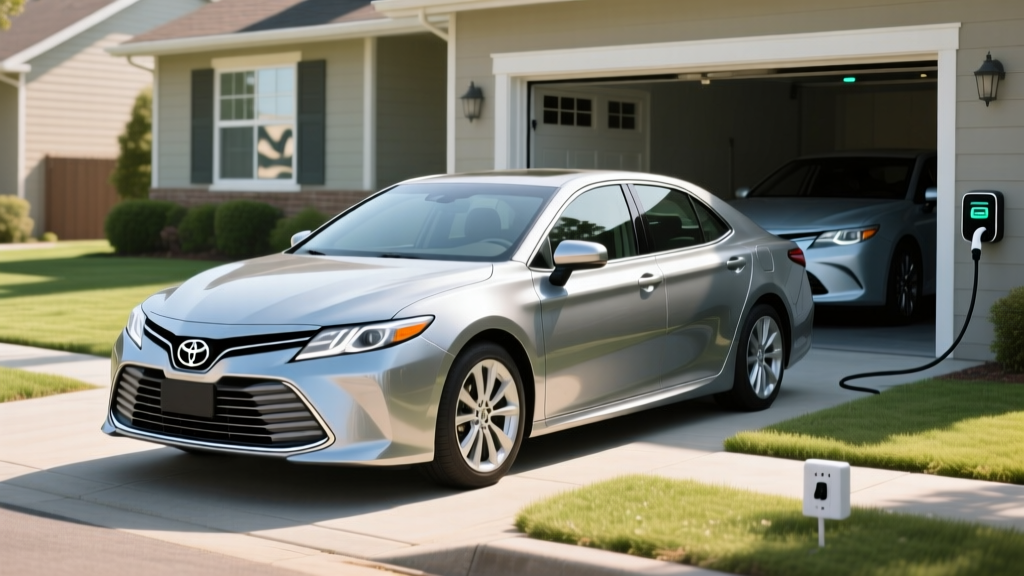
The 2015 Camry Hybrid charges its 1.6 kWh nickel-metal hydride (NiMH) battery pack entirely through regenerative braking and the gasoline engine. You never plug it in. You simply fill up at any gas station and drive — the hybrid system handles the rest.
2015 Camry Hybrid MPG: EPA Ratings and Real-World Results
The EPA rates the 2015 Toyota Camry Hybrid at 40 MPG combined, split between 40 MPG city and 38 MPG highway for the standard LE Hybrid trim. The sportier SE Hybrid trim, which added a firmer suspension and slightly wider tires, was rated marginally lower at 40/38/39 MPG (city/highway/combined). These figures were verified on fueleconomy.gov.
| Trim | City MPG | Highway MPG | Combined MPG | Fuel Tank (gal) | Total Range (mi) |
|---|---|---|---|---|---|
| LE Hybrid | 40 | 38 | 40 | 17.0 | ~680 |
| XLE Hybrid | 40 | 38 | 40 | 17.0 | ~680 |
| SE Hybrid | 40 | 38 | 39 | 17.0 | ~663 |
Real-World MPG: What Owners Actually Report
Hybrids like the Camry tend to match or exceed their EPA city ratings in real-world stop-and-go driving, because regenerative braking recaptures energy that gas-only cars waste as heat. However, highway mileage often falls slightly below the EPA estimate at sustained 75–80 mph speeds, where aerodynamic drag dominates and the electric motor assists less.
Based on aggregated owner data from Fuelly and EPA real-world testing patterns:
- City driving (stop-and-go, under 45 mph): 39–44 MPG — many owners report beating the EPA city figure
- Highway driving (70–80 mph sustained): 35–39 MPG — slightly below EPA highway estimate
- Mixed commuting (realistic daily average): 37–42 MPG
- Cold-weather penalty (below 30°F): Expect a 5–10% reduction, dropping to ~34–38 MPG combined, as the engine runs longer to heat the cabin and the battery operates less efficiently
Powertrain Specs: Engine, Motor, and Combined Output
| Specification | 2015 Camry Hybrid |
|---|---|
| Engine | 2.5L 4-cylinder Atkinson-cycle (156 hp, 156 lb-ft) |
| Electric Motor | Permanent-magnet AC synchronous (105 kW / 141 hp) |
| Net Combined Horsepower | 200 hp |
| Transmission | ECVT (electronically controlled continuously variable) |
| Hybrid Battery | 1.6 kWh NiMH (nickel-metal hydride) |
| 0–60 mph | ~7.6 seconds |
| Drivetrain | Front-wheel drive |
| Curb Weight | ~3,545 lbs |
The 2.5-liter Atkinson-cycle engine prioritizes thermal efficiency over peak power, while the electric motor fills in torque at low RPMs — the result is smooth, linear acceleration that feels quicker than the 200 hp figure suggests. The eCVT isn't a belt-driven CVT like those in some competitors; Toyota's planetary-gear power-split device is mechanically simple and has proven extremely durable over hundreds of thousands of miles.
Battery Lifespan, Reliability, and Replacement Cost
Hybrid battery longevity is the single most common concern for used hybrid buyers. The 2015 Camry Hybrid's NiMH battery pack is one of the most proven in the industry — Toyota has been refining this chemistry since the original 2001 Prius.
How Long Does the Battery Actually Last?
Based on fleet data, owner reports, and Toyota's track record:
- Typical lifespan: 150,000–200,000+ miles before significant degradation
- Degradation pattern: NiMH batteries lose capacity gradually, not suddenly. You'll notice a slow decline in electric-only assist and a small MPG drop (1–3 MPG) over time, not a catastrophic failure
- Failure rate: Very low. Independent mechanics report that Camry Hybrid batteries from this generation often last the life of the car with normal use
Battery Replacement Cost (2026)
If the battery does eventually need replacement:
- New OEM Toyota battery: $2,500–$3,500 installed at a dealership
- Refurbished/reconditioned battery: $1,200–$2,000 installed at an independent hybrid specialist
- Individual module replacement: Some specialists can replace only the failed cells within the pack for $500–$1,000, extending the pack's life at lower cost
Given that a 2015 Camry Hybrid in good condition trades for $10,000–$15,000 in 2026, a battery replacement is a meaningful but manageable expense — not a car-totaling event.
Reliability Ratings and Known Issues
The 2015 Camry Hybrid benefits from Toyota's reputation and a relatively simple powertrain with no turbo, no traditional automatic transmission to fail, and no plug-in charging hardware. Key reliability indicators:
- Consumer Reports: Historically rated the 2015 Camry Hybrid as "Above Average" or "Much Better Than Average" for predicted reliability
- NHTSA: The 2015 Camry earned a 5-Star Overall Safety Rating in government crash testing
- Common issues: Minimal. Some owners report brake actuator wear (the regenerative braking system's hydraulic pump) at high mileage ($800–$1,500 replacement), and standard wear items like suspension bushings and wheel bearings. The hybrid system itself is notably trouble-free
Does the 2015 Camry Hybrid Qualify for Any Tax Credit?
No. The 2015 Camry Hybrid is a conventional HEV and does not qualify for the federal §30D Clean Vehicle Credit. That credit — up to $7,500 — applies only to plug-in electric vehicles (BEVs and PHEVs) that meet battery-sourcing, MSRP, and buyer-income requirements per IRS rules.
As a used purchase in 2026, the 2015 Camry Hybrid also doesn't qualify for the §25E used clean vehicle credit (up to $4,000), which similarly requires a plug-in EV or PHEV. What you do get is a low purchase price, excellent fuel economy, and zero charging infrastructure requirements — savings that often offset the lack of a tax credit over time.
2015 Camry Hybrid vs Modern Alternatives: Which Should You Choose?
Choose the 2015 Camry Hybrid If:
- You want 40 MPG without plugging in anything
- Your budget is $10,000–$15,000
- You live in an apartment or lack home charging access
- You prioritize proven reliability over the latest tech
- You drive 12,000+ miles/year and want low fuel cost without range anxiety
Consider a Modern PHEV or EV Instead If:
- You want electric-only driving for short commutes (PHEV: 25–44 mi; EV: 250+ mi)
- You qualify for the $7,500 federal tax credit (new PHEV/EV) or $4,000 used EV credit
- You have access to home Level 2 charging
- You want the latest ADAS features (automatic emergency braking, lane centering)
- You want to minimize or eliminate gasoline use
Quick Cost Comparison (Annual Fuel, 15,000 mi/yr)
| Vehicle | MPG / MPGe | Annual Fuel Cost | Used Price (2026 est.) |
|---|---|---|---|
| 2015 Camry Hybrid (HEV) | 40 MPG combined | ~$1,240 | $10,000–$15,000 |
| 2025 Prius Prime (PHEV) | 52 MPG / 127 MPGe | ~$600–$950* | $33,000–$38,000 |
| 2025 Tesla Model 3 (BEV) | 132 MPGe | ~$550** | $38,000–$45,000 |
| 2015 Camry Gas (4-cyl) | 28 MPG combined | ~$1,770 | $9,000–$13,000 |
*PHEV cost assumes 50% electric / 50% gas driving with home charging. **EV cost assumes $0.14/kWh home charging average.
Ownership Economics: Total Cost Over 5 Years
Buying a used 2015 Camry Hybrid in 2026 makes strong financial sense for cost-conscious drivers. Here's a realistic 5-year ownership projection assuming 15,000 miles per year, $3.30/gallon gas, and average maintenance:
| Cost Category | 5-Year Total (est.) |
|---|---|
| Purchase price (avg, 120k miles) | $12,500 |
| Fuel (75,000 mi at 40 MPG) | $6,190 |
| Insurance (avg $1,100/yr) | $5,500 |
| Maintenance & repairs | $2,500–$3,500 |
| Tax credits | $0 |
| 5-Year Total | ~$26,690–$27,690 |
| Cost per mile | ~$0.36–$0.37/mi |
Compare that to a gas-only 2015 Camry at ~28 MPG: fuel alone jumps to ~$8,840 over 5 years — nearly $2,650 more. The hybrid premium pays for itself quickly through fuel savings.
Frequently Asked Questions
How many MPG does the 2015 Camry Hybrid get?
The EPA rates it at 40 MPG city, 38 MPG highway, and 40 MPG combined (LE/XLE trims). Real-world owners typically see 37–42 MPG in mixed driving, with city-heavy commuters often exceeding 40 MPG.
Does the 2015 Camry Hybrid need to be plugged in?
No. It is a conventional hybrid (HEV), not a plug-in. The battery charges through regenerative braking and the gasoline engine. You only ever put in gasoline.
How far can the 2015 Camry Hybrid drive on electric only?
Less than 1 mile, at very low speeds (under 25 mph), typically in parking lots or stop-and-go traffic. The electric motor primarily assists the gas engine to boost efficiency — it is not designed for meaningful electric-only driving. If you want 25+ miles of electric range, you need a PHEV like the Toyota Prius Prime or a full EV.
Is the hybrid battery reliable, and what does replacement cost?
Yes — Toyota's NiMH hybrid batteries are among the most reliable in the industry, typically lasting 150,000–200,000+ miles. Replacement costs $1,200–$3,500 depending on whether you choose refurbished or new OEM. The original warranty was 8 years/100,000 miles (10 years/150,000 miles in CARB states).
Is the 2015 Camry Hybrid a good buy in 2026?
For buyers seeking a reliable, efficient midsize sedan without plug-in requirements, it's one of the strongest used-car values available. With 40 MPG, a proven powertrain, low maintenance costs, and a $10,000–$15,000 price range, it's ideal for commuters, rideshare drivers, and budget-conscious families who lack home charging access.
Hybrid vs PHEV vs EV — which is right for me?
HEV (like this Camry): Best if you can't charge at home, drive long distances frequently, or want the lowest upfront cost with no lifestyle change. PHEV (like Prius Prime): Best if you can charge at home, commute under 40 miles round-trip, and want electric daily driving with gas flexibility for road trips. BEV (like Model 3 or Ioniq 6): Best if you have reliable home charging, want the lowest per-mile fuel cost, and are comfortable planning road trips around DC fast charging.